Within China Mysteries
Why Chinese Ghost Stories Still Haunt Places
Chinese ghost stories preserve fears, histories and moral lessons while revealing how societies remember unusual places.
On this page
- Ancient tales of spirits and encounters
- Historic sites shaped by ghost legends
- How stories preserve memory and meaning
Page outline Jump by section
Introduction
Chinese ghost stories are not simply tales of frightening spirits. They are a way of storing memories about people, places, injustice, family obligations and events that communities do not want forgotten. Across China, stories of ghosts have often grown around old roads, abandoned houses, battlefields, temples and historic landscapes, turning locations into archives of emotion and meaning. These traditions do not prove that supernatural beings exist; rather, they show how societies preserve the past through storytelling, ritual and repeated retelling.
The mechanism behind Chinese ghost traditions is especially interesting because the “ghost” often represents a memory that has not been settled. A restless spirit may stand for an unjust death, an abandoned obligation, a warning about moral behaviour or a connection between living families and their ancestors. From classical strange tales to famous “haunted” locations such as Fengdu’s Ghost City, ghost traditions reveal how China has repeatedly used the supernatural to explain human experiences that history alone does not fully capture.[OUP Academic]academic.oup.comOUP AcademicAncestor Worship | Oxford Bibliographies in Chinese Studies | Oxford AcademicFebruary 27, 2019…
Ancient tales of spirits and encounters
Ghosts as records of unfinished human stories
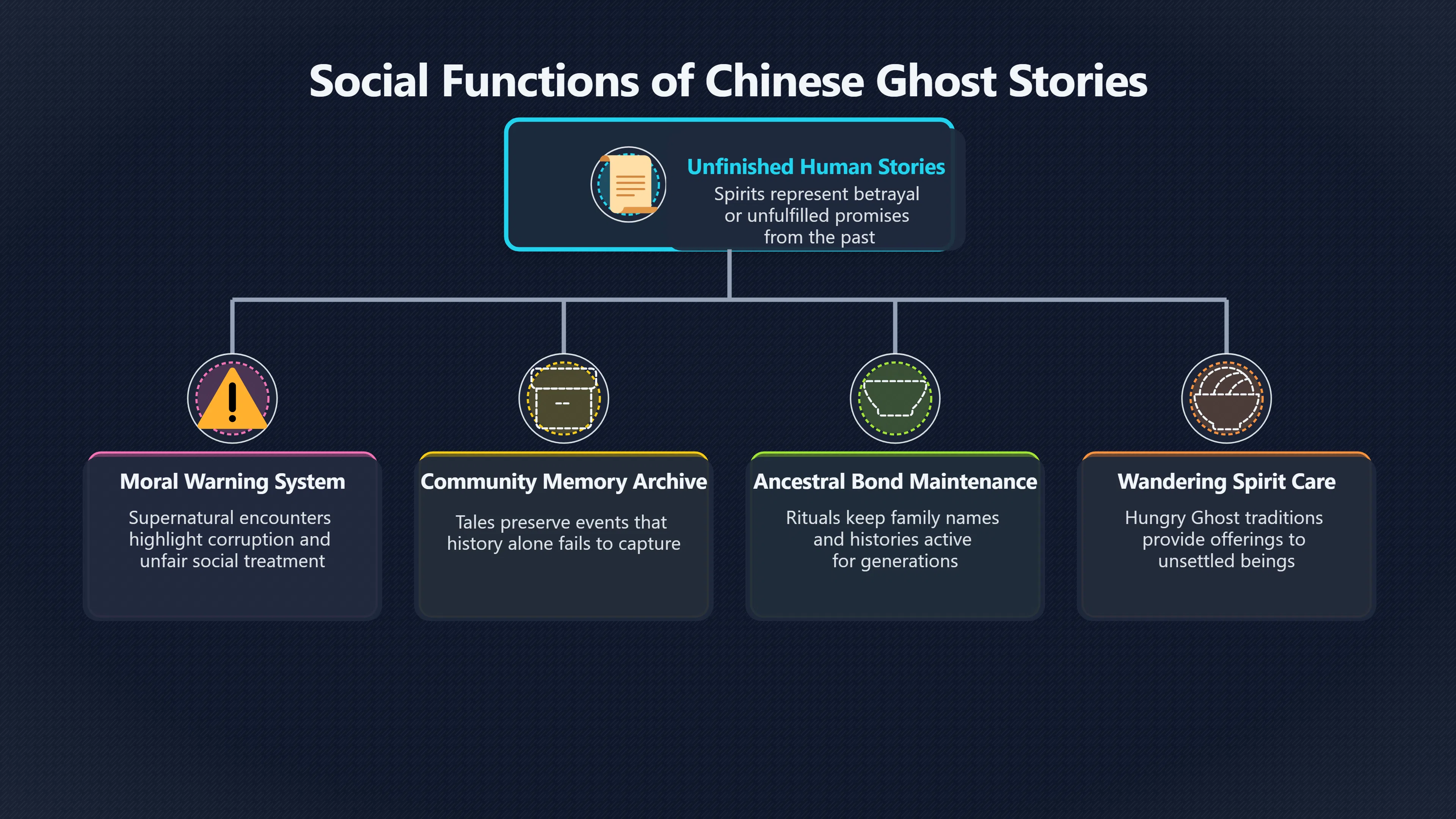
One of the strongest features of Chinese ghost literature is that spirits are rarely random monsters. They are often characters with a reason for appearing. A ghost may return because of betrayal, an unfulfilled promise, an improper burial, family neglect or a demand for justice. This gives ghost stories a social function: they transform forgotten people and unresolved events into narratives that communities can remember.
The tradition of recording unusual events, often known as “strange tales”, produced some of China’s best-known supernatural literature. The Qing dynasty writer Pu Songling collected nearly 500 stories in Strange Tales from a Chinese Studio, a work that became famous for combining ghosts, magical beings and strange encounters with observations about human society. Scholars have noted that these stories often use supernatural situations to explore social problems, emotions and moral questions rather than merely to frighten readers.[Wikipedia]WikipediaStrange Tales from a Chinese StudioStrange Tales from a Chinese Studio
A typical pattern appears again and again: the ghost enters ordinary life. A scholar meets a mysterious woman, a traveller encounters a spirit at a lonely location, or a family receives a warning from the dead. The strange event becomes a way to discuss ordinary concerns such as unfair treatment, desire, loyalty and corruption. In this sense, the ghost is not outside society; it is a dramatic voice from within it.[ScienceDirect]sciencedirect.comScienceDirect Becoming-Woman in Pu Songling’s Strange TalesBecoming-Woman in Pu Songling’s Strange Tales - ScienceDirectDecember 29, 2020…
Ancestors, wandering spirits and the problem of being forgotten
Chinese ideas about ghosts are closely connected with traditions of remembering the dead. Ancestor rituals have existed for centuries and involve honouring deceased relatives through offerings and ceremonies. Academic studies of Chinese ancestor worship describe it as a long-running cultural practice that crosses religious boundaries, including influences from Confucian traditions, Buddhism and Daoism.[OUP Academic]academic.oup.comOUP AcademicAncestor Worship | Oxford Bibliographies in Chinese Studies | Oxford AcademicFebruary 27, 2019…
This creates an important distinction between different kinds of spirits. Some dead people remain connected to families through respectful remembrance, while others become dangerous or unsettled figures because they lack proper recognition. The famous Hungry Ghost traditions reflect this concern: wandering spirits are treated as beings who require attention and offerings, reinforcing the idea that social bonds continue beyond death.[OUP Academic]academic.oup.comOUP AcademicAncestor Worship | Oxford Bibliographies in Chinese Studies | Oxford AcademicFebruary 27, 2019…
From a memory perspective, this is a powerful mechanism. Rituals do not only honour the dead; they keep relationships, names and histories active. A forgotten person risks becoming a “ghost” in the cultural sense — someone removed from collective memory. A remembered person remains part of the family story.
Historic sites shaped by ghost legends
Fengdu and the landscape of the afterlife
Few places demonstrate the link between geography and ghost memory better than Fengdu Ghost City. Located on Ming Mountain near the Yangtze River, Fengdu developed a reputation as a city associated with the underworld. Its temples, sculptures and religious imagery depict judgement after death, punishment and the journey of souls.[Wikipedia]WikipediaFengdu Ghost CityFengdu Ghost City
The origins of Fengdu’s ghost identity are tied to legends about two Han dynasty figures, Yin Changsheng and Wang Fangping, whose names were later associated in popular tradition with the “King of Hell”. Whether or not the story reflects historical events, the legend gave the landscape a lasting supernatural identity. Over centuries, buildings, rituals and stories reinforced one another until the mountain itself became a memory map of death and moral judgement.[China.org.cn]china.org.cnFengdu: the Chinese ghost cityFengdu: the Chinese ghost city
Fengdu illustrates how places become “haunted” without requiring evidence of paranormal activity. A location can accumulate layers of stories until visitors experience it through those meanings. The mountain, temples and statues act like a physical record of beliefs about what happens after death and how human behaviour is judged.

Ghost legends as local history in disguise
Many Chinese ghost locations function in a similar way. A bridge, ruined building or old battlefield may become associated with spirits because communities attach memories to places where something significant happened. The story may preserve a real historical anxiety even when the supernatural details cannot be verified.
This pattern appears worldwide, but Chinese traditions often connect ghost stories with moral order and social relationships. A haunting may be interpreted as a reminder that violence, injustice or neglect should not simply disappear from public memory. The spirit becomes a symbolic witness.
This is why ghost legends can survive even when belief changes. A modern visitor may not accept that a ghost literally occupies a location, but the story can still preserve information about how earlier generations understood suffering, duty and loss.
How stories preserve memory and meaning
The supernatural as a memory system
Chinese ghost traditions work through repetition. A story is told at a family gathering, appears in literature, becomes attached to a temple or enters local tourism. Each retelling may change details, but the central message survives.
This process resembles a cultural memory system. Stories select certain events and emotions as worth preserving. A forgotten death becomes a warning tale. A dangerous place becomes a moral landmark. A historical tragedy becomes a legend that can be carried across generations.
The important point is that memory does not require a story to be historically exact in every detail. Folklore scholars often study legends not only for whether they describe literal events, but for what communities choose to remember and why.

Between belief, folklore and evidence
Ghost traditions occupy an unusual position because they sit between personal experience, cultural practice and historical evidence. A reported encounter with a ghost may involve misperception, storytelling changes or later additions. At the same time, dismissing every ghost story as meaningless misses why these accounts matter.
For researchers of folklore and history, the valuable evidence is often not the existence of the spirit itself but the survival of the narrative. A ghost story can reveal fears about social disorder, attitudes towards death, ideas about justice and changing relationships between people and places.
Modern China has also seen changes in how these traditions are presented. Some ghost-related sites are now cultural attractions, while some rituals continue as expressions of family respect rather than literal fear of spirits. The tradition survives because it can adapt: a ghost can be a religious figure, a literary character, a tourist symbol or a reminder of historical memory.
Chinese ghost traditions therefore belong in the country’s wider record of strange and unexplained stories not because they provide proof of supernatural events, but because they show something equally fascinating: how human societies turn uncertainty, grief and forgotten histories into stories that refuse to disappear.
Amazon book picks
Further Reading
Books and field guides related to Why Chinese Ghost Stories Still Haunt Places. Use these as the next step if you want deeper reading beyond the article.
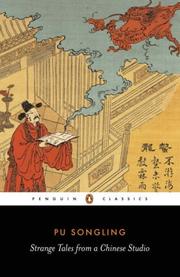
Strange tales from a Chinese studio
A foundational collection of Chinese supernatural tales and spirit encounters.
The encyclopedia of unsolved mysteries
First published 1987. Subjects: Curiosities and wonders.
The Book of the Damned
This is a reproduction of a book published before 1923. This book may have occasional imperfections such as missing or blurred pages, poo...
Chinese ghost stories
Provides comparative East Asian supernatural storytelling context.
eBay marketplace picks
Marketplace Samples
Live-tested eBay searches with available results related to this page.




Endnotes
1.
Source: academic.oup.com
Link:https://academic.oup.com/reference/62338/reference-article-abstract/554184903
Source snippet
OUP AcademicAncestor Worship | Oxford Bibliographies in Chinese Studies | Oxford AcademicFebruary 27, 2019...
Published: February 27, 2019
2.
Source: china.org.cn
Title: Fengdu: the Chinese ghost city
Link:https://www.china.org.cn/travel/2015-07/02/content_35962735.htm
3.
Source: Wikipedia
Title: Strange Tales from a Chinese Studio
Link:https://en.wikipedia.org/wiki/Strange_Tales_from_a_Chinese_Studio
4.
Source: sciencedirect.com
Title: ScienceDirect Becoming-Woman in Pu Songling’s Strange Tales
Link:https://www.sciencedirect.com/org/science/article/pii/S2352133323000341
Source snippet
Becoming-Woman in Pu Songling’s Strange Tales - ScienceDirectDecember 29, 2020...
Published: December 29, 2020
5.
Source: Wikipedia
Title: Fengdu Ghost City
Link:https://en.wikipedia.org/wiki/Fengdu_Ghost_City
6.
Source: china.org.cn
Link:https://www.china.org.cn/china/shandong/2011-01/05/content_21677306.htm
Source snippet
5, 2011 — GHOSTS OF THE QING DYNASTY LIVE ON By Wang Yanfang Image0 CommentsImagePrintImage E-mail China.org.cn, January 5, 2011 Image: G...
Published: January 5, 2011
7.
Source: china.org.cn
Link:https://www.china.org.cn/english/travel/66101.htm
Source snippet
As "Ghost Town" Fades, Artist Tries to Preserve TraditionJune 3, 2003 — Born during a thunderstorm 75 years ago, his name is as eccentric...
Published: June 3, 2003
8.
Source: loongwander.com
Title: Fengdu Ghost City
Link:https://www.loongwander.com/en-US/article/fengdu-ghost-city
Source snippet
Chongqing Tourist Attraction - LoongWanderAugust 20, 2025 — FENGDU GHOST CITY - CHONGQING TOURIST ATTRACTION 2025-08-20 3497 Fengdu Ghost...
Published: August 20, 2025
9.
Source: people.reed.edu
Link:https://people.reed.edu/~brashiek/scrolls/seriesA/common/fengdu.html
Source snippet
reed.eduFengdu, City of GhostsFENGDU - CITY OF GHOSTS Image On the north bank of the Yangzi 172 kilometers east of Chongqing, Fengdu lays...
Additional References
10.
Source: researchgate.net
Link:https://www.researchgate.net/publication/374312451_Clans_and_Spiritual_Space_A_Case_Study_of_Guandi_Temple_in_an_Ancient_Hakka_Town_in_South_China
Source snippet
(PDF) Clans and Spiritual Space: A Case Study of Guandi Temple in an Ancient Hakka Town in South ChinaChapter PDF Available CLANS AND SPI...
11.
Source: researchgate.net
Link:https://www.researchgate.net/publication/42386211_How_Do_We_Think_about_Death—-A_Cultural_Glance_of_Superstitious_Ideas_from_Chinese_and_Western_Ghost_Festivals
Source snippet
(PDF) How Do We Think about Death?----A Cultural Glance of Superstitious Ideas from Chinese and Western Ghost FestivalsArticle PDF Availa...
12.
Source: researchgate.net
Link:https://www.researchgate.net/publication/343081019_The_Face_of_the_Nonhuman_Human-Animal_Encounters_in_Pu_Songling%27s_Liaozhai_Zhiyi
Source snippet
(PDF) The Face of the Nonhuman: Human-Animal Encounters in Pu Songling’s Liaozhai ZhiyiArticle PDF Available THE FACE OF THE NONHUMAN: HU...
13.
Source: researchgate.net
Link:https://www.researchgate.net/publication/382744881%27Novelty%27_through_narrative_and_paratextual_voice_The_case_of_John_Minford%27s_translation_of%27The_laughing_girl%27
Source snippet
June 1, 2024 — Article PDF Available ‘NOVELTY’ THROUGH NARRATIVE AND PARATEXTUAL VOICE: THE CASE OF JOHN MINFORD’S TRANSLATION OF ‘THE LA...
Published: June 1, 2024
14.
Source: thevintagenews.com
Link:https://www.thevintagenews.com/2016/08/08/according-chinese-legend-fengdu-ghost-city-place-devil-lives/
Source snippet
August 8, 2016 — ACCORDING TO CHINESE LEGEND, THE FENGDU GHOST CITY IS A PLACE WHERE THE DEVIL LIVES * News * Abandoned Spaces Aug 8, 201...
Published: August 8, 2016
15.
Source: drpress.org
Link:https://drpress.org/ojs/index.php/ijeh/article/view/15739
Source snippet
rnational Journal of Education and HumanitiesJanuary 15, 2024 — ANALYSIS OF THE UGLY FEMALE IMAGES IN "STRANGE TALES FROM A CHINESE STUDI...
Published: January 15, 2024
16.
Source: ebsco.com
Link:https://www.ebsco.com/research-starters/religion-and-philosophy/ghost-festival-zhongyuan-festival
Source snippet
Ghost Festival (Zhongyuan Festival) | Religion and Philosophy | Research Starters | EBSCO ResearchFULL ARTICLE The Ghost Festival, or the...
17.
Source: doi.org
Link:https://doi.org/10.24043/001c.151310
Source snippet
(2025). In the Darkness of the Gods: A Visual Autoethnography of Mystery and Illumination in a South China Village Temple. Folk, Knowledg...
18.
Source: thevintagenews.com
Link:https://www.thevintagenews.com/2016/09/21/according-chinese-legend-fengdu-ghost-city-place-devil-lives-2/
Source snippet
September 21, 2016 — THE FENGDU GHOST CITY IS A PLACE WHERE THE DEVIL LIVES, ACCORDING TO CHINESE LEGEND * News * Abandoned Spaces Sep 21...
Published: September 21, 2016
19.
Source: journal.binus.ac.id
Link:https://journal.binus.ac.id/index.php/Humaniora/article/view/3338
Source snippet
Brief Analysis on The Mannerism of Strange Stories of A Chinese Studio by Pu Songling | Humaniora: Journal of Indonesia Culture and Socie...
Topic Tree