Germany's Weirdest Stories Without the Hype
Germany’s strange-history record is unusually rich because it sits at the meeting point of folklore, early print culture, religious vision, mountain weather, courtly ghost stories, psychical research and tourist humour.
Page outline Jump by section
Why Germany is such fertile ground for strange reports
Germany’s weird record is inseparable from its historical patchwork of courts, free cities, bishoprics, forests, borderlands and local identities. Before modern Germany existed as a nation state, stories travelled through church records, town chronicles, broadsheets, family legends and later through the collecting work of scholars such as Jacob and Wilhelm Grimm. The Grimm brothers’ annotated copies of Children’s and Household Tales were added to UNESCO’s Memory of the World list in 2005, a useful reminder that German folklore is not just “fairy-tale stuff” but a documented cultural inheritance with global reach.[Grimmwelt Kassel]grimmwelt.deOpen source on grimmwelt.de.
That matters for Forteana because many German anomalies survive in unusually specific forms: a date, a town, a witness group, a printed image, a museum inscription, a court rumour, a pilgrimage site or an investigator’s report. The stronger examples do not become interesting because they are obviously paranormal. They become interesting because they sit in the awkward middle ground between event, interpretation and memory.
The Nuremberg sky battle: a UFO before UFOs?
On 14 April 1561, residents of Nuremberg were said to have seen a frightening display in the morning sky: blood-red arcs, globes, crosses, rods, cylinders and a black spear-like form. The account was published soon afterwards by the local artist Hans Glaser as an illustrated broadsheet, with the language framing the spectacle as a divine warning rather than a scientific puzzle.[The Public Domain Review]publicdomainreview.orgcelestial phenomenon over nuremberg april 14th 1561celestial phenomenon over nuremberg april 14th 1561
Modern retellings often call the Nuremberg event an early UFO sighting, and it is easy to see why. The woodcut looks startlingly modern to readers raised on aerial craft, dogfights and alien-war imagery. Yet that may say as much about us as it does about 1561. The original text belongs to a culture of “wonders” in which unusual sky events were moral signs, warnings and newsworthy marvels. Public Domain Review notes that the event was interpreted religiously at the time and only much later became attractive to extraterrestrial speculation, especially after twentieth-century interest in flying saucers.[The Public Domain Review]publicdomainreview.orgcelestial phenomenon over nuremberg april 14th 1561celestial phenomenon over nuremberg april 14th 1561
The sceptical reading is not that “nothing happened”. It is that something seen in the sky may have been filtered through fear, theology and print culture. Parhelia, or sun dogs, are produced when sunlight passes through hexagonal ice crystals, often appearing as bright spots beside the sun; the Met Office also describes related halo effects caused by ice crystals and droplets.[Met Office]weather.metoffice.gov.ukMet Office Optical effects: nature's light showMet Office Optical effects: nature's light show That does not neatly explain every detail in Glaser’s image, but it does show why early modern “aerial battles” need not be aircraft. Germany’s most famous old sky mystery is therefore best understood as a meeting between atmospheric optics, religious interpretation and the appetite of early news media for extraordinary signs.

Hamelin: the vanished children behind the Pied Piper
The Pied Piper of Hamelin is one of Germany’s strangest cases because the fairy-tale version sits on top of a much older memory of loss. Hamelin Museum gives the core tradition in stark terms: in 1284, on 26 June, 130 children born in Hamelin were led away by a piper in colourful clothing and disappeared near Calvary. The museum also notes that the lost Gothic glass window of the town church, probably dating from around 1300, may be the oldest source linked to the legend.[Museum Hameln]museumhameln.deMuseum Hameln Dauerausstellung_engl_RF07 | museumhameln.deMuseum Hameln Dauerausstellung_engl_RF07 | museumhameln.de
The rats, the unpaid pest controller and the moral revenge plot appear to be later narrative growth. The older material is colder and more disturbing: children leave, a piper is involved, and the town remembers. That has encouraged many explanations, including migration, recruitment, disease, pilgrimage, accident and social trauma. None has solved the case. The point is not that a magical musician literally opened a mountain. The point is that Hamelin preserved a communal disappearance with unusual precision: date, number, route and grief.
For German Forteana, Hamelin is a model case of how folklore can preserve the outline of a historical wound while changing its meaning. A possible medieval tragedy becomes a cautionary tale about broken promises; then a children’s story; then a tourist identity; then a recurring symbol of seduction, loss and public failure. The strangeness survives because the tale is both over-familiar and unresolved.
The Brocken: when a ghost is your own shadow
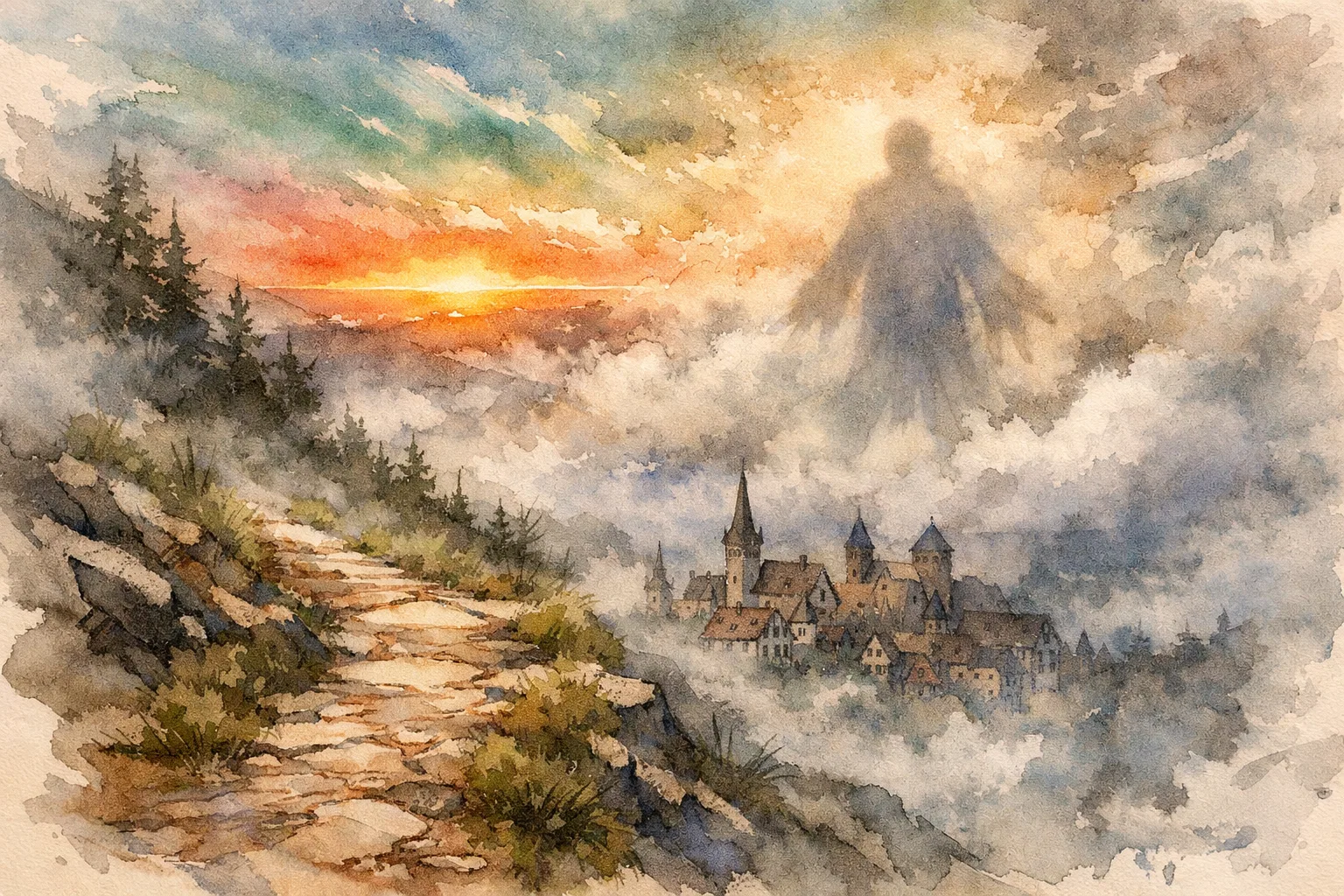
Some German mysteries are beautifully explicable without becoming less eerie. The Brocken, the highest peak of the Harz Mountains, gave its name to the Brocken spectre: a giant shadow cast onto mist or cloud when the sun is behind the observer. The Met Office describes it as an optical illusion in which the viewer’s shadow appears as a distant, enormous figure, magnified by the way light and water droplets affect depth perception.[Met Office]weather.metoffice.gov.ukMet Office Optical effects: nature's light showMet Office Optical effects: nature's light show
That explanation is tidy, but the experience is not. A walker on a foggy ridge suddenly sees a huge human shape ringed with light and apparently moving in the air. Before modern optics, such a sight could easily become a giant, spirit, warning or mountain presence. The Brocken already carried a heavy load of folklore: Harz tourism still presents Walpurgis Night as a regional festival of witches, devils, bonfires and spring customs, especially around 30 April.[Harzinfo]harzinfo.deOpen source on harzinfo.de.
The Brocken therefore matters because it shows one of the classic routes by which Fortean material forms. A real physical phenomenon produces a genuinely uncanny human experience. Folklore supplies the vocabulary. Literature and tourism preserve the mood. The ghost is “only” a shadow, but it is a shadow in exactly the right place to become a legend.
The White Lady: a court ghost with political weight
Germany’s White Lady traditions are not just generic haunted-castle stories. The Berlin version is tied to the Hohenzollern dynasty and the old Berlin Palace, where the figure was said to appear before deaths or disasters. Stadtmuseum Berlin describes the White Lady as a ghostly female figure attached to several European castles, with the Berlin Palace legend reaching deep into the city’s past.[Stadtmuseum Berlin]stadtmuseum.deBerlin Die Weiße Frau | Stadtmuseum BerlinBerlin Die Weiße Frau | Stadtmuseum Berlin
One strand connects her to Kunigunde of Orlamünde, whose tragic legend involves a fatal misunderstanding and the killing of her children. Stadtmuseum Berlin notes that the White Lady was said to have appeared among the Hohenzollerns as early as the fourteenth century, when the family still resided in Franconian Nuremberg.[Stadtmuseum Berlin]stadtmuseum.deBerlin Die Weiße Frau | Stadtmuseum BerlinBerlin Die Weiße Frau | Stadtmuseum Berlin The details shift across versions, but the function is stable: the ghost turns dynastic anxiety into a visible omen.
Sceptically, a “death-warning” ghost is easy to challenge. Great houses are full of illness, succession politics, servants, rumours and retrospective storytelling. Once a family ghost is expected to appear before misfortune, almost any odd sighting can be fitted to a death after the fact. Yet that is also why the White Lady is culturally important. She is not merely a spooky woman in a corridor; she is a mechanism by which aristocratic families turned uncertainty into tradition, and tradition into status.
Rosenheim: Germany’s modern poltergeist problem
The Rosenheim poltergeist case is one of Germany’s most discussed twentieth-century paranormal claims. In 1967, a lawyer’s office in Rosenheim, Bavaria, was reportedly troubled by electrical disturbances, swinging lights, unexplained telephone charges and moving objects. The case drew in Hans Bender, the prominent German parapsychologist, and became important enough that the journal Zeitschrift für Parapsychologie und Grenzgebiete der Psychologie devoted a 1968 issue to the Rosenheim case, including Bender’s article and a physical investigation by Friedbert Karger and Gerhard Zicha.[IGPP]igpp.deZeitschrift für Parapsychologie und Grenzgebiete der PsychologieZeitschrift für Parapsychologie und Grenzgebiete der Psychologie
Believers have treated Rosenheim as a rare case in which poltergeist claims met technical investigation. The reported focus on a young female employee also matched a recurring parapsychological theory that “poltergeist” outbreaks cluster around psychological stress. But the sceptical record is serious. Later criticism argued that naturalistic possibilities had not been adequately excluded, and accounts of possible trickery, nylon threads and mechanically produced meter readings have long shadowed the case.[Wikipedia]WikipediaRosenheim poltergeist claimRosenheim poltergeist claim
Rosenheim remains valuable not because it proves psychokinesis, but because it shows the modern version of an old pattern. Instead of a haunted castle, the setting is an office. Instead of a family curse, there are telephones, electricity meters and workplace tensions. Instead of a monk or court chronicler, there are psychologists, physicists, journalists and sceptics. The story moved German ghost tradition into the age of paperwork and appliances.

Visionary Germany: Marpingen, Heroldsbach and public belief
Germany’s visionary cases show how religious apparitions can become social events, not just private experiences. In July 1876, three eight-year-old girls in Marpingen, in the Saarland, claimed to have seen the Virgin Mary. Historian David Blackbourn’s study describes the episode as the “German Lourdes”, examining its miracles, pilgrimages, political background and repercussions in Bismarckian Germany.[Google Books]books.google.comBooks Marpingen: Apparitions of the Virgin Mary in Bismarckian GermanyBooks Marpingen: Apparitions of the Virgin Mary in Bismarckian Germany
The Marpingen case became more than a question of whether three children had seen what they said they saw. It drew in pilgrims, claims of cures, Catholic identity, state suspicion and the politics of the period. That makes it Fortean in the broader sense: a disputed anomaly that exposes the social machinery around belief. The interesting question is not simply “Was it real?” but “Why did this claim gather such force at that moment?”
The same pattern appeared after the Second World War at Heroldsbach, north of Nuremberg. A study of post-war West German miracles states that the Heroldsbach apparitions began in 1949 and drew an estimated 1.5 million pilgrims by the time the visions ended in 1952.[Zeithistorische Forschungen]zeithistorische-forschungen.deOpen source on zeithistorische-forschungen.de. Such numbers matter. Even when church authorities, historians or sceptics dispute visionary claims, pilgrimage itself becomes a historical fact: people travelled, prayed, argued, bought objects, wrote testimony and made the site meaningful.
Monsters with a wink: the Wolpertinger and the Tatzelwurm
Germany’s mystery animals range from comic taxidermy to older Alpine dragon-lore. The Wolpertinger, especially associated with Bavaria, is usually presented as a hybrid creature assembled from parts of familiar animals: hare, antlers, wings, fangs, tail and whatever else the joke requires. The German Hunting and Fishing Museum in Munich describes itself as a natural-history museum covering hunting and fishing across German-speaking regions, and the Wolpertinger has become closely associated with this kind of museum-and-inn display culture.[Deutsches Jagd- und Fischerei-Museum]jagd-fischerei-museum.deOpen source on jagd-fischerei-museum.de.
The Wolpertinger is important because it is a hoax that does not quite behave like a hoax. Nobody needs to believe in it for it to work. It is a performance of Bavarian humour, tourist teasing and mock-natural history. Stuffed specimens make the imaginary animal look official, while the absurd anatomy tells the reader not to be too solemn.
The Tatzelwurm is a darker creature. Alpine tradition describes it as a lizard-like or dragon-like beast, often with a cat-like head, a serpentine body and short legs, reported across the Bavarian, Austrian, Swiss and neighbouring Alpine regions.[Wikipedia]WikipediaOpen source on wikipedia.org. Unlike the Wolpertinger, the Tatzelwurm belongs more to fear of remote terrain: ravines, pastures, rocks, holes and sudden animal encounters. Plausible explanations range from misidentified reptiles and mammals to embroidered traveller tales, but its persistence shows how mountain landscapes generate their own bestiary.
Strange rain, blood rain and the science of bad omens
Germany does not need a famous “fish rain” case to belong in the Fortean tradition of anomalous falls. Early modern German culture was highly receptive to reports of strange rains, bloody skies and ominous falls because such phenomena fitted a broader European language of warning signs. Accounts of “blood rain” were historically treated as portents, especially in medieval and early modern Europe, before natural explanations such as dust, spores or other airborne material became more common.[Wikipedia]WikipediaBlood rainBlood rain
Modern Germany still gets “blood rain” headlines, but the explanation is usually mundane: Saharan dust mixed with rain can leave reddish deposits on cars, windows and pavements. Reports in 2024 described red-looking rain forecast for North Rhine-Westphalia because of Saharan dust crossing the region.[IamExpat in Germany]iamexpat.deIam Expat in Germany“Blood rain” forecast for North Rhine-WestphaliaIam Expat in Germany“Blood rain” forecast for North Rhine-Westphalia
This is a useful caution for the whole subject. A phenomenon can be real, rare-looking and culturally dramatic without being paranormal. Red rain is not fake because it has a natural cause; it is exactly the sort of real natural oddity that earlier witnesses could interpret as divine anger, plague warning or supernatural blood. Forteana often begins in the gap between experience and available explanation.
How to read German Forteana without flattening it
The strongest German cases reward a double vision. Read only as supernatural evidence, they become overclaimed. Read only as errors, they lose the human reasons they endured. The Nuremberg sky spectacle was a printed wonder before it was a UFO. Hamelin was a communal disappearance before it was a ratcatcher fairy tale. The Brocken spectre is an optical effect that still feels like an apparition. The White Lady is a ghost story that helped organise dynastic fear. Rosenheim is a disputed poltergeist case that reveals how modern technology can become haunted. Marpingen and Heroldsbach show how visions can become political and social events, whether or not one accepts the visions themselves.
That is why Germany’s strange-history record has such staying power. Its best stories are not random oddities scattered across a map. They are pressure points where weather, print, religion, folklore, psychology, tourism and scepticism all meet. The result is a national Fortean landscape that is less about proving monsters and miracles than about watching people encounter the uncanny, explain it with the tools they have, and pass it on because the story still feels unfinished.
Amazon book picks
Further Reading
Books and field guides related to Germany's Weirdest Stories Without the Hype. Use these as the next step if you want deeper reading beyond the article.

The vanishing hitchhiker
First published 1981. Subjects: History and criticism, Legends, Urban folklore, Légendes, Folklore urbain.
Mysteries
First published 1978. Subjects: Occultism, Parapsychology, Supernatural, Curiosities and wonders.
Fairy tales
First published 1800. Subjects: Allemagne, Tales, Fairy tales, Folklore, Contes.
The Complete Grimm's Fairy Tales
German folklore is central to the country's enduring strange traditions.
eBay marketplace picks
Marketplace Samples
Live-tested eBay searches with available results related to this page.
Endnotes
1.
Source: grimmwelt.de
Link:https://www.grimmwelt.de/en/journal/the-childrens-and-household-tales
2.
Source: harzinfo.de
Link:https://www.harzinfo.de/en/events-in-the-harz/walpurgis-in-the-harz
3.
Source: stadtmuseum.de
Title: Berlin Die Weiße Frau | Stadtmuseum Berlin
Link:https://www.stadtmuseum.de/artikel/die-weisse-frau
4.
Source: igpp.de
Title: Zeitschrift für Parapsychologie und Grenzgebiete der Psychologie
Link:https://igpp.de/information/zfp/
5.
Source: Wikipedia
Title: Rosenheim poltergeist claim
Link:https://en.wikipedia.org/wiki/Rosenheim_poltergeist_claim
6.
Source: books.google.com
Title: Books Marpingen: Apparitions of the Virgin Mary in Bismarckian Germany
Link:https://books.google.com/books/about/Marpingen.html?id=ytfYAAAAMAAJ
7.
Source: zeithistorische-forschungen.de
Link:https://zeithistorische-forschungen.de/1-2009/4628
8.
Source: Wikipedia
Link:https://en.wikipedia.org/wiki/Tatzelwurm
9.
Source: Wikipedia
Title: Blood rain
Link:https://en.wikipedia.org/wiki/Blood_rain
10.
Source: iamexpat.de
Title: Iam Expat in Germany“Blood rain” forecast for North Rhine-Westphalia
Link:https://www.iamexpat.de/lifestyle/lifestyle-news/blood-rain-forecast-north-rhine-westphalia
11.
Source: media.unesco.org
Title: germany grimm rev
Link:https://media.unesco.org/sites/default/files/webform/mow001/germany_grimm_rev.pdf
12.
Source: Wikipedia
Title: 1561 celestial phenomenon over Nuremberg
Link:https://en.wikipedia.org/wiki/1561_celestial_phenomenon_over_Nuremberg
13.
Source: Wikipedia
Title: Nürnberger Flugblatt von 1561
Link:https://de.wikipedia.org/wiki/N%C3%BCrnberger_Flugblatt_von_1561
14.
Source: Wikipedia
Link:https://en.wikipedia.org/wiki/Wolpertinger
15.
Source: Wikipedia
Title: Brocken spectre
Link:https://en.wikipedia.org/wiki/Brocken_spectre
16.
Source: Wikipedia
Title: Pied Piper of Hamelin
Link:https://en.wikipedia.org/wiki/Pied_Piper_of_Hamelin
17.
Source: Wikipedia
Title: Klopgeest van Rosenheim
Link:https://nl.wikipedia.org/wiki/Klopgeest_van_Rosenheim
18.
Source: Wikipedia
Title: Spuk von Rosenheim
Link:https://de.wikipedia.org/wiki/Spuk_von_Rosenheim
19.
Source: Wikipedia
Link:https://de.wikipedia.org/wiki/Brockengespenst
20.
Source: Wikipedia
Title: Walpurgis Night
Link:https://en.wikipedia.org/wiki/Walpurgis_Night
21.
Source: Wikipedia
Link:https://en.wikipedia.org/wiki/Elwetritsch
22.
Source: Wikipedia
Link:https://en.wikipedia.org/wiki/Storsj%C3%B6odjuret
23.
Source: Wikipedia
Title: List of named animals and plants in Germanic heroic legend
Link:https://en.wikipedia.org/wiki/List_of_named_animals_and_plants_in_Germanic_heroic_legend
24.
Source: Wikipedia
Link:https://de.wikipedia.org/wiki/Wolpertinger
25.
Source: Wikipedia
Title: Deutsches Jagd und Fischereimuseum
Link:https://de.wikipedia.org/wiki/Deutsches_Jagd-_und_Fischereimuseum
26.
Source: Wikipedia
Title: German Hunting and Fishing Museum
Link:https://en.wikipedia.org/wiki/German_Hunting_and_Fishing_Museum
27.
Source: Wikipedia
Title: White Lady
Link:https://en.wikipedia.org/wiki/White_Lady
28.
Source: Wikipedia
Title: Weiße Frau
Link:https://de.wikipedia.org/wiki/Wei%C3%9Fe_Frau
29.
Source: Wikipedia
Title: Rain of animals
Link:https://en.wikipedia.org/wiki/Rain_of_animals
30.
Source: Wikipedia
Title: German Fairy Tale Route
Link:https://en.wikipedia.org/wiki/German_Fairy_Tale_Route
31.
Source: Wikipedia
Title: Grimms’ Fairy Tales
Link:https://en.wikipedia.org/wiki/Grimms%27_Fairy_Tales
32.
Source: Wikipedia
Title: Marian apparition
Link:https://en.wikipedia.org/wiki/Marian_apparition
33.
Source: munich.travel
Link:https://www.munich.travel/en/pois/arts-culture/hunting-and-fishing-museum
34.
Source: grimmwelt.de
Link:https://www.grimmwelt.de/en/
35.
Source: hameln.de
Title: german fairy tale route
Link:https://www.hameln.de/en/discoverandexperiencehamelin/thetownandthecountryside/german-fairy-tale-route
36.
Source: germany.travel
Link:https://www.germany.travel/en/campaign/fairytale-route/home.html
37.
Source: iamexpat.de
Title: german folklore wolpertinger
Link:https://www.iamexpat.de/lifestyle/lifestyle-news/german-folklore-wolpertinger
38.
Source: publicdomainreview.org
Title: celestial phenomenon over nuremberg april 14th 1561
Link:https://publicdomainreview.org/collection/celestial-phenomenon-over-nuremberg-april-14th-1561/
39.
Source: weather.metoffice.gov.uk
Title: Met Office Optical effects: nature’s light show
Link:https://weather.metoffice.gov.uk/learn-about/weather/optical-effects
40.
Source: museumhameln.de
Title: Museum Hameln Dauerausstellung_engl_RF07 | museumhameln.de
Link:https://museumhameln.de/dauerausstellung_engl_rf07/
41.
Source: jagd-fischerei-museum.de
Link:https://www.jagd-fischerei-museum.de/
42.
Source: museen-in-bayern.de
Title: deutsches jagd und fischereimuseum
Link:https://museen-in-bayern.de/en/museums/museum-details/deutsches-jagd-und-fischereimuseum
43.
Source: creatures-of-myth.fandom.com
Link:https://creatures-of-myth.fandom.com/wiki/Wolpertinger
44.
Source: obscurban-legend.fandom.com
Title: Rosenheim Poltergeist
Link:https://obscurban-legend.fandom.com/wiki/Rosenheim_Poltergeist
45.
Source: cryptidz.fandom.com
Link:https://cryptidz.fandom.com/wiki/Tatzelwurm
46.
Source: cryptidarchives.fandom.com
Link:https://cryptidarchives.fandom.com/wiki/Tatzelwurm
47.
Source: pdsh.fandom.com
Link:https://pdsh.fandom.com/wiki/Wolpertinger
48.
Source: atlasobscura.com
Title: deutsches jagd und fischereimuseum
Link:https://www.atlasobscura.com/places/deutsches-jagd-und-fischereimuseum
49.
Source: publicdomainreview.org
Title: charles fort and the book of the damned
Link:https://publicdomainreview.org/essay/charles-fort-and-the-book-of-the-damned/
50.
Source: mgv-muenchen.de
Link:https://mgv-muenchen.de/tour/deutsches-jagd-und-fischereimuseum/
51.
Source: mgv-muenchen.de
Link:https://mgv-muenchen.de/en/tour/deutsches-jagd-und-fischereimuseum-the-german-hunting-and-fishingmuseum/
52.
Source: astonishinglegends.com
Link:https://astonishinglegends.com/astonishing-legends/2018/9/24/tatzelwurm
53.
Source: tripadvisor.com
Title: German Hunting and Fishing Museum
Link:https://www.tripadvisor.com/Attraction_Review-g187309-d241621-Reviews-German_Hunting_and_Fishing_Museum-Munich_Upper_Bavaria_Bavaria.html
54.
Source: wrldrels.org
Link:https://wrldrels.org/2021/03/15/marpingen/
55.
Source: routeyou.com
Title: Rosenheim Poltergeist
Link:https://www.routeyou.com/en-de/location/view/51397538
56.
Source: hiddenrealms.ch
Title: brocken spectre
Link:https://hiddenrealms.ch/brocken-spectre/
57.
Source: hive.blog
Link:https://hive.blog/alienarthive/%40soultret/wolpertinger
58.
Source: abookofcreatures.com
Link:https://abookofcreatures.com/2021/05/28/wolpertinger/
59.
Source: tripadvisor.de
Title: Deutsches Jagd- und Fischereimuseum
Link:https://www.tripadvisor.de/Attraction_Review-g187309-d241621-Reviews-German_Hunting_and_Fishing_Museum-Munich_Upper_Bavaria_Bavaria.html
60.
Source: zulheimymaamor.blogspot.com
Title: the rosenheim poltergeist
Link:https://zulheimymaamor.blogspot.com/2025/05/the-rosenheim-poltergeist.html
Additional References
61.
Source: loc.gov
Link:https://www.loc.gov/everyday-mysteries/browse-all-questions/item/can-it-rain-frogs-fish-and-other-objects/
62.
Source: neh.gov
Link:https://www.neh.gov/humanities/2015/marchapril/feature/how-the-grimm-brothers-saved-the-fairy-tale
63.
Source: youtube.com
Link:https://www.youtube.com/watch?v=rX0189Ky9G0
Source snippet
First UFO Sighting? The 1561 Sky Battle Over Nuremberg...
64.
Source: youtube.com
Title: The Case NO ONE Could Explain — Rosenheim Poltergeist
Link:https://www.youtube.com/watch?v=WiWF37rJ384
Source snippet
The Ancient Secret Hidden Inside The Pied Piper Fairy Tale...
65.
Source: youtube.com
Link:https://www.youtube.com/watch?v=_tecEqEzDv4
Source snippet
The Case NO ONE Could Explain — Rosenheim Poltergeist...
66.
Source: atlasobscura.com
Link:https://www.atlasobscura.com/things-to-do/munich-germany/taxidermy
67.
Source: atlasobscura.com
Link:https://www.atlasobscura.com/things-to-do/munich-germany/museums
68.
Source: discovergermany.com
Link:https://www.discovergermany.com/50-years-of-the-german-fairytale-route/
69.
Source: facebook.com
Link:https://www.facebook.com/groups/badtaxidermy/posts/10159583196423944/
70.
Source: childrenofwanderlust.com
Link:https://www.childrenofwanderlust.com/fairy-tale/
Topic Tree
Follow this branch
Related pages 192
- Afghan Forteana
- Antigua Uncanny
- Bosnian Mysteries
- Botswana Weird
- Brazil Strange
- +187 more in sidebar