Within New Zealand Weird
Are Taniwha Monsters, Warnings or Place Memory?
Taniwha traditions are richer than lake-monster tales, linking dangerous water, guardianship, ancestry and remembered landscapes.
On this page
- What taniwha are in Maori tradition
- Water, danger and landscape knowledge
- Famous place stories and modern retellings
Page outline Jump by section
Introduction
Taniwha are often described outside New Zealand as lake monsters or dragons, but that comparison misses what makes the traditions distinctive. In many Māori narratives, taniwha are deeply connected to particular rivers, harbours, springs, caves and stretches of coastline. They can be dangerous, protective, ancestral or all three at once. Rather than functioning simply as mythical beasts, they often preserve knowledge about hazardous places, reinforce responsibilities to land and water, and embed tribal history in the landscape itself. For anyone interested in New Zealand’s strange traditions, taniwha stories are best understood not as cryptid reports but as a remarkable blend of folklore, environmental memory and cultural identity.[Te Ara]teara.govt.nzTe AraStory: Taniwha22 Sept 2012 — Taniwha are supernatural creatures in Māori tradition, similar to serpents and dragons in other cultur…
What are taniwha in Māori tradition?
There is no single description of a taniwha. Different iwi (tribes) and hapū (sub-tribes) tell different stories, and a taniwha’s appearance, behaviour and purpose vary from place to place. Some are said to resemble giant reptiles, whales, sharks, floating logs or other powerful water beings. Others are invisible except through their effects on the landscape or on people.[Te Ara]teara.govt.nzTe AraStory: Taniwha22 Sept 2012 — Taniwha are supernatural creatures in Māori tradition, similar to serpents and dragons in other cultur…
What unites many traditions is their close relationship with particular places rather than their appearance. A taniwha belongs to a river bend, a harbour entrance, a spring or a cave. Its story helps explain why that place matters and why it deserves respect.
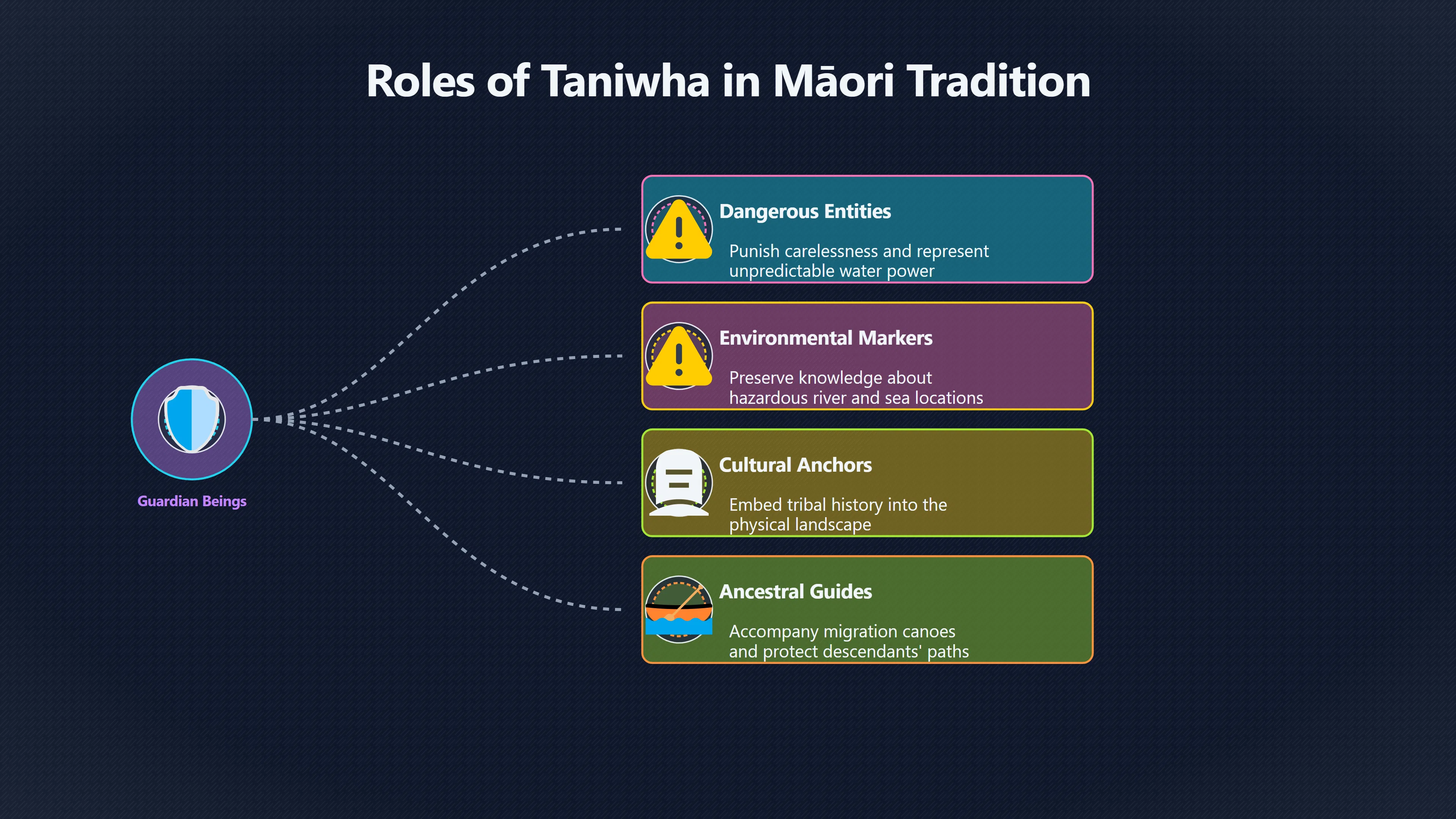
Many traditions distinguish between broadly two roles:
- Guardian taniwha, who protect particular communities, ancestral lines or important resources.
- Dangerous taniwha, who punish carelessness, attack trespassers or represent the unpredictable power of water.
These roles are not necessarily opposites. A guardian for one community may still be dangerous to outsiders or to anyone behaving without proper respect.[Te Ara]teara.govt.nzTe AraStory: Taniwha22 Sept 2012 — Taniwha are supernatural creatures in Māori tradition, similar to serpents and dragons in other cultur…
Why are taniwha linked to dangerous water?
One of the most striking features of taniwha traditions is how consistently they appear at places where rivers, lakes and seas present genuine hazards.
Deep pools, hidden currents, tidal races, dangerous surf, flood-prone valleys and unstable riverbanks often become associated with a taniwha. Rather than reducing these stories to simple superstition, many researchers argue that they also preserve accumulated environmental knowledge. A memorable story is far easier to pass between generations than a technical description of hydraulic hazards.[Earth Sciences New Zealand | NIWA]niwa.co.nzfacing natural hazards maori environmental knowledgeMany stories tell of the impacts from great waves caused by storms, inundation caused by…Read more…
For example, traditions may encourage people to avoid swimming in particular pools, to treat river crossings with caution or to recognise that apparently calm water can conceal deadly currents. In this sense, the taniwha functions less as an explanation for every accident than as a cultural warning attached permanently to a landscape.
This interpretation does not require deciding whether anyone literally believed a giant creature lived beneath the water. Oral traditions can work on several levels simultaneously: spiritual, historical, educational and practical.
Place memory written into the landscape
Perhaps the most important aspect of taniwha stories is that they transform geography into memory.
Instead of treating rivers and coastlines as anonymous features, Māori traditions often connect them with named beings, ancestors and historical events. Remembering the story also means remembering the place, the people associated with it and the behaviour expected there.
Environmental scientists and historians increasingly recognise that oral traditions can preserve information about floods, landslides, dangerous coastlines and other natural hazards across many generations. New Zealand’s research on Māori environmental knowledge notes that traditions involving taniwha frequently describe storms, flooding, destructive waves and places where lives were lost, suggesting that these narratives helped communities remember environmental risk long before written records existed.[Earth Sciences New Zealand | NIWA]niwa.co.nzfacing natural hazards maori environmental knowledgeMany stories tell of the impacts from great waves caused by storms, inundation caused by…Read more…
Because the stories are tied to named locations, they also reinforce identity. A river is not simply a river; it becomes part of an ancestral landscape with responsibilities attached to it.
Famous place traditions
Several well-known taniwha traditions illustrate how these stories are rooted in particular landscapes rather than generic monster tales.
Poutini and the West Coast
Among the best-known guardian taniwha is Poutini, associated with the South Island’s West Coast and with pounamu (greenstone). Rather than simply terrorising travellers, Poutini is remembered as the protector of the precious stone and is woven into traditions explaining how pounamu came to different river systems. The story links people, geology, trade and landscape into a single narrative.[LINZ]linz.govt.nzA Guardian TaniwhaPoutini was a taniwha, a giant water being. He was guardian for Kahue (Ngahue), the atua or deity of pounamu, greenston…
Harbour and river guardians
Many harbour entrances and river systems have their own guardian taniwha connected with particular iwi. These beings often accompany ancestral migration canoes in oral tradition before becoming permanent protectors of their descendants in Aotearoa. Their continuing presence symbolises the enduring relationship between community and place rather than an isolated supernatural encounter.[Te Ara]teara.govt.nzTe AraStory: Taniwha22 Sept 2012 — Taniwha are supernatural creatures in Māori tradition, similar to serpents and dragons in other cultur…
Sacred springs
Some springs and waterways are protected through traditions involving guardian taniwha. At Te Waikoropupū Springs, for example, stories surrounding the guardian Huriawa reinforce the springs’ exceptional spiritual importance alongside their extraordinary natural purity. The tradition encourages respect for the site as both a physical and cultural treasure.[Wikipedia]WikipediaTe Waikoropupū SpringsTe Waikoropupū Springs
Why modern debates still mention taniwha
Taniwha periodically appear in contemporary New Zealand news, especially during discussions about roads, prisons, dams or other developments affecting culturally significant landscapes.
Outside observers sometimes portray these disputes as arguments over whether a monster literally exists. That framing usually oversimplifies what is happening. For many Māori communities, referring to a taniwha expresses the cultural, historical and spiritual significance of a place. It signals that development proposals must consider relationships with the landscape that extend beyond engineering or economics alone.[Wikipedia]WikipediaOpen source on wikipedia.org.
The widely reported rerouting of part of State Highway 1 near Meremere in 2002 became one of the best-known examples. Public discussion often focused on the apparent supernatural element, but Māori commentators argued that the issue was fundamentally about protecting an ancestral landscape and respecting cultural values. The episode highlighted how easily traditional narratives can be misunderstood when interpreted only through a Western monster-story framework.[Wikipedia]WikipediaOpen source on wikipedia.org.

Monsters, metaphor or something else?
From a Fortean perspective, taniwha occupy an unusual position because they resist simple classification.
Unlike reports of unknown animals, there is generally no expectation that zoologists should discover a surviving species of taniwha. Nor are the stories primarily eyewitness accounts intended to prove the existence of a hidden creature. Instead, they belong to a living tradition in which history, ancestry, spirituality, morality and environmental observation overlap.
Sceptical readers may see taniwha primarily as symbolic narratives that encode practical knowledge about dangerous places. Others regard them as genuine spiritual guardians whose reality cannot be measured by scientific methods alone. Many Māori perspectives do not treat these interpretations as mutually exclusive, since stories can simultaneously communicate cultural truth, environmental knowledge and spiritual meaning.[Te Ara]teara.govt.nzTe AraStory: Taniwha22 Sept 2012 — Taniwha are supernatural creatures in Māori tradition, similar to serpents and dragons in other cultur…
Why taniwha matter in New Zealand’s strange-history tradition
Within New Zealand’s wider collection of unusual stories, taniwha stand apart because they demonstrate that not every remarkable tradition is best understood as an unexplained creature report.
Their enduring importance lies in the way they connect people with waterways, preserve memories of hazardous landscapes, reinforce tribal identity and encourage respectful relationships with the natural world. For readers exploring New Zealand’s Fortean heritage, taniwha therefore represent something richer than a local version of a lake monster. They are examples of how folklore can become a durable map of place, memory and survival, remaining meaningful long after the original events that inspired the stories have faded from living memory.[govt.nz]teara.govt.nzTe AraStory: Taniwha22 Sept 2012 — Taniwha are supernatural creatures in Māori tradition, similar to serpents and dragons in other cultur…
Amazon book picks
Further Reading
Books and field guides related to Are Taniwha Monsters, Warnings or Place Memory?. Use these as the next step if you want deeper reading beyond the article.

Maori myth and legend
Directly discusses Māori mythology including taniwha traditions.

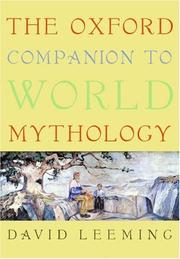
The Oxford companion to world mythology
Places taniwha within global mythic traditions.
Endnotes
1.
Source: niwa.co.nz
Title: facing natural hazards maori environmental knowledge
Link:https://niwa.co.nz/about-niwa/water-atmosphere/vol16-no2-june-2008/facing-natural-hazards-maori-environmental-knowledge
Source snippet
Many stories tell of the impacts from great waves caused by storms, inundation caused by...Read more...
2.
Source: Wikipedia
Link:https://en.wikipedia.org/wiki/Taniwha
3.
Source: linz.govt.nz
Link:https://www.linz.govt.nz/our-work/new-zealand-geographic-board/place-name-stories/maori-oral-history-atlas/poutini-guardian-taniwha
Source snippet
A Guardian TaniwhaPoutini was a taniwha, a giant water being. He was guardian for Kahue (Ngahue), the atua or deity of pounamu, greenston...
4.
Source: Wikipedia
Title: Te Waikoropupū Springs
Link:https://en.wikipedia.org/wiki/Te_Waikoropup%C5%AB_Springs
5.
Source: teara.govt.nz
Link:https://teara.govt.nz/en/taniwha
Source snippet
Te AraStory: Taniwha22 Sept 2012 — Taniwha are supernatural creatures in Māori tradition, similar to serpents and dragons in other cultur...
6.
Source: christchurchartgallery.org.nz
Link:https://christchurchartgallery.org.nz/bulletin/221/taniwha
Source snippet
Christchurch Art Gallery Te Puna o...16 Sept 2025 — Taniwha are guardians of waterfalls, warnings to intrepid travellers, tall tales aro...
Additional References
7.
Source: daniresh.com
Title: taniwha spirit guardians of the deep
Link:https://www.daniresh.com/post/taniwha-spirit-guardians-of-the-deep
Source snippet
Taniwha: Spirit Guardians of the Deep4 Jun 2025 — The Taniwha are often depicted as massive serpentine or dragon-like beings, but they ca...
8.
Source: facebook.com
Title: Taking taniwha seriously
Link:https://www.facebook.com/groups/aotearoanzhistory/posts/1426482832507408/
Source snippet
Taniwha are powerful water...Taniwha are guardian monsters that reside in bodies of water such as rivers or lakes and can appear as shar...
9.
Source: twinkl.it
Title: What is a Taniwha?
Link:https://www.twinkl.it/teaching-wiki/taniwha
Source snippet
Māori / New Zealand Legends - TwinklSome tribes view Taniwha as 'kaitiaki' or protectors of the people. They believe that Taniwha are for...
10.
Source: youtube.com
Title: Stories of New Zealand’s Extraordinary Landscape
Link:https://www.youtube.com/watch?v=fbCr7Hlp3rQ
Source snippet
Taniwha (Polynesian Sea Serpent) - Everything you need to know...
11.
Source: superprof.co.nz
Title: taniwha meaning
Link:https://www.superprof.co.nz/blog/taniwha-meaning/
Source snippet
in Māori Tradition24 Feb 2026 — What is a taniwha? Discover the taniwha, their role as guardians or warnings, and how taniwha traditions...
12.
Source: youtube.com
Title: Taniwha (Polynesian Sea Serpent)
Link:https://www.youtube.com/watch?v=EbD8Djrs65Y
Source snippet
"The Legend of the Taniwha" – A Maori Legend...
13.
Source: youtube.com
Title: “The Legend of the Taniwha” – A Maori Legend
Link:https://www.youtube.com/watch?v=uLArT6gd9eg
Source snippet
Wellington Harbour's taniwha - Roadside Stories...
14.
Source: youtube.com
Title: Wellington Harbour’s taniwha
Link:https://www.youtube.com/watch?v=VDCQGwqwrsM
Source snippet
The Taniwha of Wellington Harbour...
15.
Source: youtube.com
Title: The Taniwha of Wellington Harbour
Link:https://www.youtube.com/watch?v=8goyGO8P0eY
Topic Tree