Within Kiribati
Why Kiribati's Ghosts Haunt the Shore
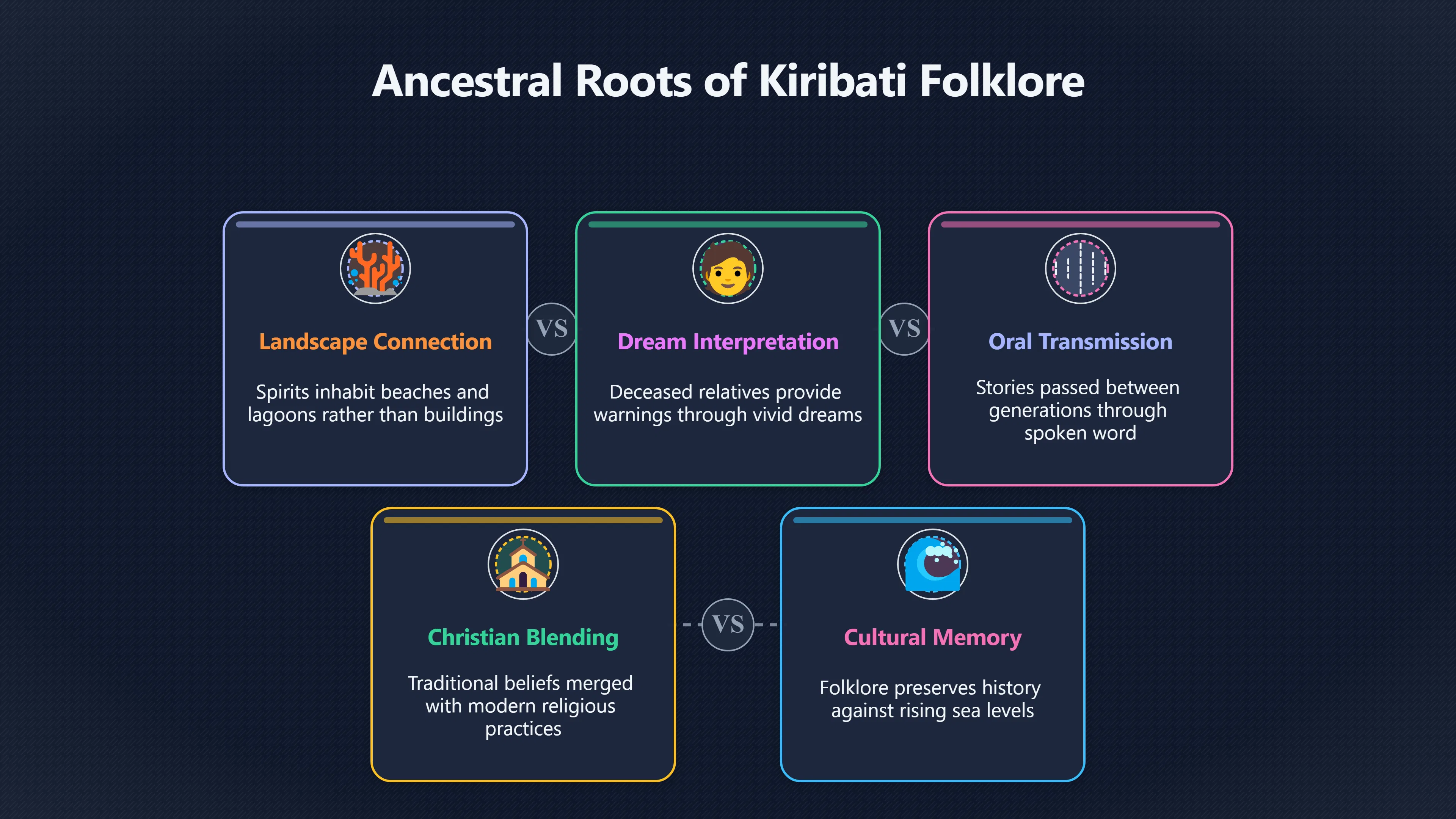
Many Kiribati ghost traditions are tied to beaches, lagoons and sacred places rather than haunted buildings.
On this page
- Ancestors, dreams and warnings
- Sacred places and respectful behaviour
- Why landscapes replace haunted houses
Page outline Jump by section
Introduction
Kiribati’s ghost traditions are strikingly different from the familiar image of haunted mansions or abandoned castles. Across these low coral atolls, stories of the dead are far more likely to be attached to beaches, lagoons, reefs and stretches of ancestral land than to buildings. In traditional belief, these places were not simply scenic landscapes but living parts of a community’s history, where the presence of ancestors could still influence the behaviour and fortunes of the living.[Kiribati Tourism]kiribatitourism.gov.kiKiribati TourismHistory – Page 1000 – Kiribati For TravellersMany people in Kiribati believe their ancestors to be spirits, some from Sam…
For anyone exploring the country’s strange folklore, the key idea is that these stories were rarely told simply to frighten people. Ghostly encounters, unsettling dreams and warnings from deceased relatives often carried practical or moral lessons. They reminded people to respect sacred places, observe social obligations and avoid unnecessary risks in an environment where poor decisions could easily become fatal. That cultural role makes Kiribati’s ghost traditions an important part of its distinctive Fortean landscape, even though there are relatively few dramatic paranormal case reports by modern standards.[ResearchGate]researchgate.netResearchGate(PDF) Gods, Spirits and Natural Hazards: Ontologies…Notwithstanding this, I-Kiribati mostly draw from Christian beliefs to…
Ancestors, dreams and warnings
Traditional I-Kiribati belief has long treated the boundary between the living and the dead as more permeable than modern Western ideas usually allow. Ancestors were not necessarily imagined as permanently absent. Instead, they could remain connected to families, particular islands and important places, appearing in dreams or through unusual experiences that were interpreted as guidance or caution rather than random supernatural events.[Kiribati Tourism]kiribatitourism.gov.kiKiribati TourismHistory – Page 1000 – Kiribati For TravellersMany people in Kiribati believe their ancestors to be spirits, some from Sam…
Dreams occupied an especially significant place within this worldview. Rather than being dismissed as meaningless, an unexpected dream involving a deceased relative could be interpreted as a warning about conflict, travel, illness or improper behaviour. Such experiences were often understood within family traditions instead of being presented as public evidence of ghosts.
From an evidence-based perspective, these accounts belong primarily to oral tradition rather than documented paranormal investigation. They are difficult to verify historically because they were usually passed between generations rather than recorded in newspapers or official archives. Even so, anthropological studies consistently note that beliefs about ancestors, spirits and continuing relationships with the dead remained intertwined with everyday life, even after Christianity became dominant across the islands. Rather than replacing older beliefs completely, Christian ideas often blended with traditional understandings of spirits and sacred places.[ResearchGate]researchgate.netResearchGate(PDF) Gods, Spirits and Natural Hazards: Ontologies…Notwithstanding this, I-Kiribati mostly draw from Christian beliefs to…
Believers may regard these dreams as genuine communication from ancestors. Sceptics instead point to grief, memory, coincidence and the psychological tendency to find meaning in emotionally powerful dreams. The stories themselves rarely attempt to prove either interpretation.
Why beaches and lagoons become haunted
Kiribati’s geography helps explain why its ghost stories are tied to landscapes rather than buildings. Most islands consist of narrow strips of coral surrounding lagoons, with relatively few ancient structures capable of acquiring the reputations associated with European haunted houses.
Instead, certain natural locations became spiritually charged because they were linked to ancestors, burials, legendary journeys or memorable historical events. A quiet beach after sunset, an isolated reef or a secluded lagoon could therefore become the setting for stories of ghostly figures, mysterious voices or unexplained presences.
One traditional example appears on Makin Atoll, where Nakaa Beach occupies an important place in island mythology. According to traditional belief, it marked the departure point for the spirits of the dead as they travelled towards the afterlife, with a guardian associated with the gateway between worlds. This is not presented as a historical paranormal event but as part of the islands’ sacred geography, illustrating how particular stretches of shoreline acquired spiritual importance.[Wikipedia]WikipediaNakaa BeachNakaa Beach
Modern retellings sometimes describe apparitions along beaches or lagoons, but these usually remain anecdotal and closely connected to older cultural beliefs rather than independent paranormal investigations.
Sacred places and respectful behaviour
Many ghost traditions functioned as social guidance. A place said to be inhabited by ancestral spirits was also a place where visitors were expected to behave respectfully.
These traditions encouraged people to:
- avoid disturbing sites connected with ancestors or burials;
- refrain from reckless behaviour around dangerous reefs or isolated shorelines;
- observe community customs when travelling through places regarded as spiritually important; and
- remember that actions affecting the community could have consequences extending beyond the individual.
From a practical perspective, such beliefs also reinforced safety. Coral atolls contain hidden channels, sharp reefs, strong currents and rapidly changing tides. Stories warning against wandering alone at night or showing disrespect in isolated locations may have helped reduce unnecessary risks while simultaneously strengthening cultural identity.
This practical dimension is common in folklore worldwide, but in Kiribati it is especially noticeable because the natural landscape itself carries the symbolic weight that castles, forests or ruined churches often carry elsewhere.
The famous ghost stories are surprisingly few
Readers expecting long catalogues of haunted locations may be surprised. Compared with many countries, Kiribati has remarkably few widely documented ghost legends available in published English-language sources.
One frequently repeated modern tale concerns a mysterious woman associated with a lagoon, presented in local storytelling circles as a traditional ghost narrative linked with ancestral belief and the spiritual significance of water. Like many oral traditions, versions differ, making it difficult to identify a single definitive account or establish its historical age.[Facebook]facebook.comMany people in Kiribati believe their ancestors to be spirits, some from Samoa, and some from the Gilberts. Known…Read more…
This scarcity of documented cases reflects history rather than an absence of belief. For much of Kiribati’s past, stories circulated orally within families and island communities instead of entering newspapers, folklore collections or psychical research archives. As a result, researchers often encounter broad descriptions of ancestral beliefs rather than detailed case histories with dates, witnesses and investigations.
Why landscapes replace haunted houses
Kiribati demonstrates that ghost traditions are shaped by environment as much as imagination.
In countries with centuries-old towns, abandoned buildings naturally become focal points for haunting legends. On low coral atolls, where storms, salt and changing coastlines continually reshape the land, the enduring landmarks are beaches, reefs, lagoons and sacred meeting places. These become the repositories of memory instead.
Climate change has added another layer to this relationship. Rising seas and coastal erosion threaten culturally important sites across Kiribati, meaning that places associated with ancestral traditions may themselves disappear beneath the ocean or require relocation. As these landscapes change, the stories attached to them become increasingly important records of cultural memory, whether one interprets them as folklore, history or spiritual tradition.[news.nationalgeographic.org]news.nationalgeographic.orgshoreline creeps closer to kiribatis sacred sitesShoreline Creeps Closer To Kiribati's Sacred Sites6 Jan 2016 — She will be telling the stories of the Kiribati people, their culture and…
For Fortean readers, this makes Kiribati unusual. Its ghost stories are less about proving apparitions and more about understanding how communities map memory, morality and ancestry onto the natural world. The beaches and lagoons are haunted not because there is compelling evidence of supernatural activity, but because generations of islanders regarded those places as where the past remained closest to the present.
Amazon book picks
Further Reading
Books and field guides related to Why Kiribati's Ghosts Haunt the Shore. Use these as the next step if you want deeper reading beyond the article.
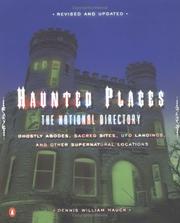
Haunted Places: The National Directory
Places Kiribati's unusual landscapes within the wider haunted-place tradition.

The Old Ways
First published 2012. Subjects: Voyages and travels, Walking, Description and travel, Natural history, Trails.

eBay marketplace picks
Marketplace Samples
Live-tested eBay searches with available results related to this page.
Endnotes
1.
Source: researchgate.net
Link:https://www.researchgate.net/publication/350607410_Gods_Spirits_and_Natural_Hazards_Ontologies_and_Epistemologies_of_Natural_Hazards_and_Climate_Change_in_Kiribati_and_Papua_New_Guinea
Source snippet
ResearchGate(PDF) Gods, Spirits and Natural Hazards: Ontologies...Notwithstanding this, I-Kiribati mostly draw from Christian beliefs to...
2.
Source: Wikipedia
Title: Nakaa Beach
Link:https://en.wikipedia.org/wiki/Nakaa_Beach
3.
Source: facebook.com
Link:https://www.facebook.com/groups/1675525435856585/posts/27419132494402526/
Source snippet
Many people in Kiribati believe their ancestors to be spirits, some from Samoa, and some from the Gilberts. Known...Read more...
4.
Source: news.nationalgeographic.org
Title: shoreline creeps closer to kiribatis sacred sites
Link:https://news.nationalgeographic.org/shoreline-creeps-closer-to-kiribatis-sacred-sites/
Source snippet
Shoreline Creeps Closer To Kiribati's Sacred Sites6 Jan 2016 — She will be telling the stories of the Kiribati people, their culture and...
5.
Source: kiribatitourism.gov.ki
Link:https://www.kiribatitourism.gov.ki/kiribati-pacific-ocean-location/history/1000/
Source snippet
Kiribati TourismHistory – Page 1000 – Kiribati For TravellersMany people in Kiribati believe their ancestors to be spirits, some from Sam...
Additional References
6.
Source: guampedia.com
Link:https://www.guampedia.com/pop-cultures-kiribati/
Source snippet
POP Cultures: KiribatiMany people in Kiribati believe their ancestors to be spirits, some from Samoa, and some from the Gilberts. POP Cul...
7.
Source: instagram.com
Link:https://www.instagram.com/p/DWjHlFcFuGr/
Source snippet
Stories speak of Nareau, a creator who shaped the world, spirits moving...Read more...
8.
Source: superstitionsmap.com
Link:https://superstitionsmap.com/%F0%9F%87%B0%F0%9F%87%AE-i-kiribati-superstitions/
Source snippet
folk omens, sea signs, dream readings, and ancestor-linked beliefs...Read more...
9.
Source: scribd.com
Link:https://www.scribd.com/document/2678596/kiribati-origins-and-culture
Source snippet
ed in a sacred tree called Te Kaintikuaba in Samoa.Read more...
10.
Source: oceanianfolktales.com
Title: te kaintikuaba the tree of life
Link:https://oceanianfolktales.com/te-kaintikuaba-the-tree-of-life/
Source snippet
Te Kaintikuaba -The Tree of Life | OceanianFolktales.com6 Nov 2025 — Learn about the myth of Te Kaintikuaba, the divine tree at the world...
11.
Source: youtube.com
Title: What Life Is Like in Kiribati: A Unique Culture in the Heart of the Pacific
Link:https://www.youtube.com/watch?v=XXQjYiZ1Qbw
Source snippet
Outer Island Experience | Butaritari Island | Kiribati...
12.
Source: youtube.com
Title: The Legend of King Kewe & Nei Aromaeao
Link:https://www.youtube.com/watch?v=umgxsX1lj3I
Source snippet
Nareau: The Micronesian Spider God Who Wove the Universe...
13.
Source: youtube.com
Title: Nareau: The Micronesian Spider God Who Wove the Universe
Link:https://www.youtube.com/watch?v=_UT2O9ITPOM
14.
Source: youtube.com
Title: Outer Island Experience | Butaritari Island | Kiribati
Link:https://www.youtube.com/watch?v=Nw78dLi5gno
15.
Source: youtube.com
Title: Tales from Kiribati Part 2
Link:https://www.youtube.com/watch?v=8SXKfL8hPis
Source snippet
The Legend of King Kewe & Nei Aromaeao...
Topic Tree