Within Weird Guatemala
Who Walks Guatemala's Roads at Night?
Guatemala's night legends turn roads, rivers and lonely streets into moral maps of danger, desire and grief.
On this page
- La Llorona, La Siguanaba and the warning woman motif
- El Cadejo, El Sombreron and danger on the road
- Why these legends still work as social folklore
Page outline Jump by section
Introduction
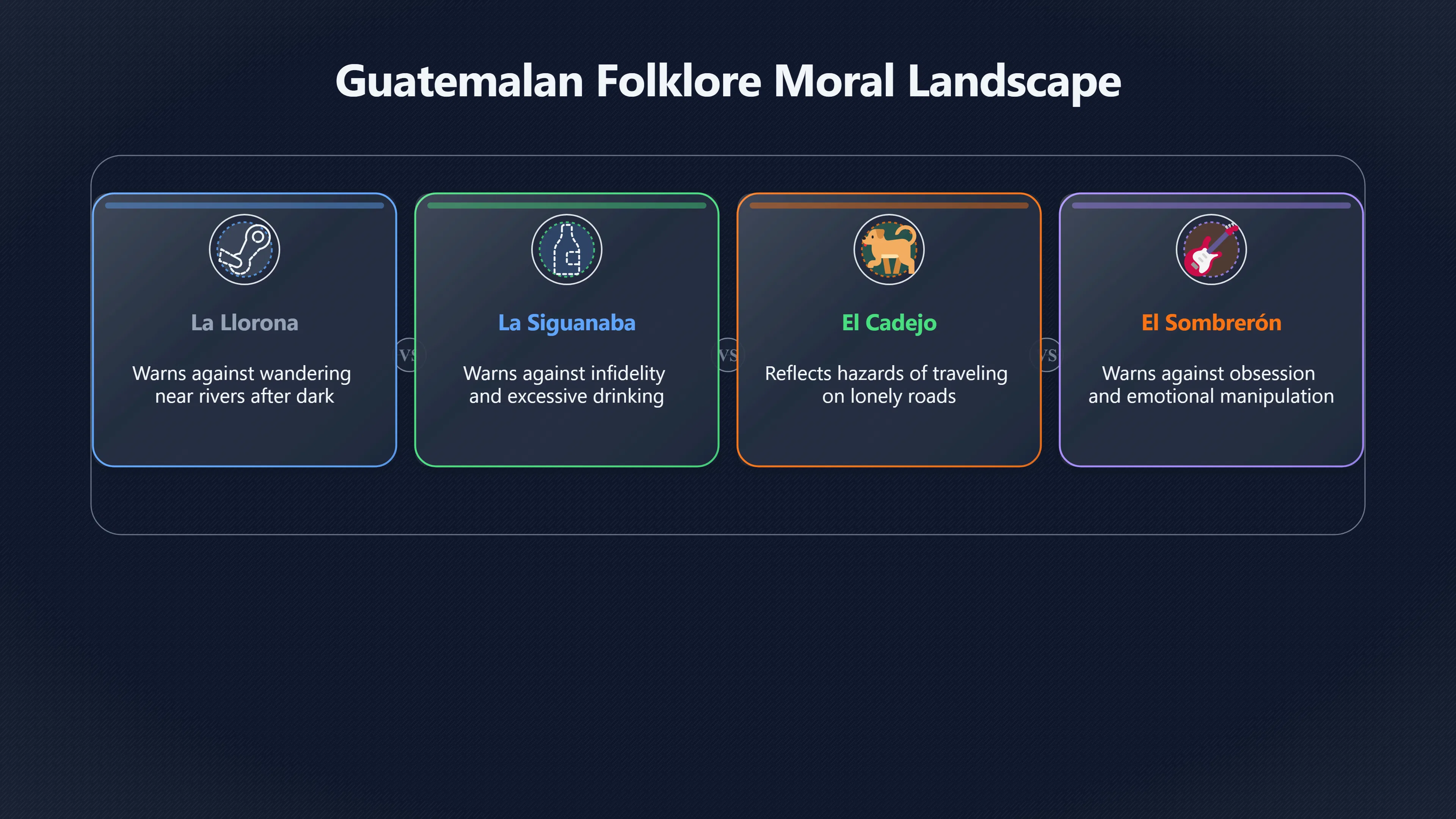
Guatemala’s best-known night legends are less about monsters than about behaviour. They turn lonely roads, riverbanks, crossroads and dark streets into moral landscapes where bad decisions seem to acquire supernatural consequences. Whether the listener believes in ghosts or not is almost beside the point. These stories explain why children should avoid rivers after dark, why travellers should treat deserted roads with caution, why excessive drinking invites danger, and why betrayal or obsession eventually catches up with those responsible.

Although individual tales vary from region to region, four figures dominate Guatemalan night folklore: La Llorona, La Siguanaba, El Cadejo and El Sombrerón. Their stories have been preserved through oral tradition, popular literature, local journalism and modern retellings, becoming some of the country’s most enduring examples of folklore functioning as social guidance rather than supernatural testimony.[Qué Pasa Magazine]quepasa.gtQué Pasa Magazine Legends of GuatemalaIncluding El Cadejo and La Llorona17 Oct 2018 — La Siguanaba is one of the most famous legends of Guatemala and the woman in the story is…
Who Walks Guatemala’s Roads at Night?
Night is rarely a neutral setting in Guatemalan folklore. Darkness represents uncertainty, distance from community and the weakening of ordinary social rules. Many legends begin with someone walking home alone, travelling between villages, crossing a bridge or following what appears to be a familiar voice.
Unlike horror stories designed purely to frighten, these narratives usually have a practical lesson. They teach listeners to avoid isolated places, respect family obligations, remain faithful to partners, moderate alcohol consumption or stay within the safety of home after dark. In rural communities where travel once meant poorly lit roads and genuine physical danger, such warnings had obvious real-world value.
The supernatural figures themselves are often recognisable from a distance but become terrifying only when approached too closely. That gradual shift—from ordinary to uncanny—is one reason these stories remain memorable across generations.[Wikipedia]WikipediaLeyendas de GuatemalaLeyendas de Guatemala
La Llorona, La Siguanaba and the Warning Woman Motif
La Llorona: grief beside the water
La Llorona, the Weeping Woman, appears throughout Latin America, but Guatemala has its own long-established versions, especially associated with old streets, rivers and the historic city of Antigua Guatemala. She is usually heard before she is seen, crying for her lost children while wandering near flowing water.
The precise backstory differs between communities. Some versions describe a woman who drowned her child and is condemned to search forever; others emphasise betrayal, forbidden love or divine punishment. Regardless of the details, the warning remains remarkably consistent.
The legend encourages several kinds of caution:
- children should not wander near rivers after dark;
- adults should respect family responsibilities;
- lonely night travel carries both natural and supernatural risks;
- appearances and sounds cannot always be trusted.
The haunting cry itself has become one of the most recognisable elements of Central American folklore, illustrating how sound can create fear even when nothing visible is present.[wikipedia.org]WikipediaLa LloronaLa Llorona
La Siguanaba: beauty as deception
If La Llorona embodies grief, La Siguanaba represents temptation. She commonly appears as an extraordinarily beautiful woman seen from behind, often with long flowing hair. Men who follow her into isolated places discover too late that her face is grotesque—commonly described as resembling a horse or, in some traditions, a skull.
The people most often targeted are not random victims. Oral tradition repeatedly portrays them as drunken men, unfaithful husbands or travellers whose own behaviour has already placed them at risk.
Rather than simply punishing curiosity, the legend acts as a warning against:
- infidelity;
- excessive drinking;
- travelling alone late at night;
- allowing desire to overcome judgement.
This moral structure explains why La Siguanaba has survived for centuries despite countless regional variations. The details change, but the lesson remains recognisable.[quepasa.gt]quepasa.gtleyendas guatemala tradicionleyendas guatemala tradicion
El Cadejo and El Sombrerón: dangers that follow travellers
El Cadejo and the uncertain protector
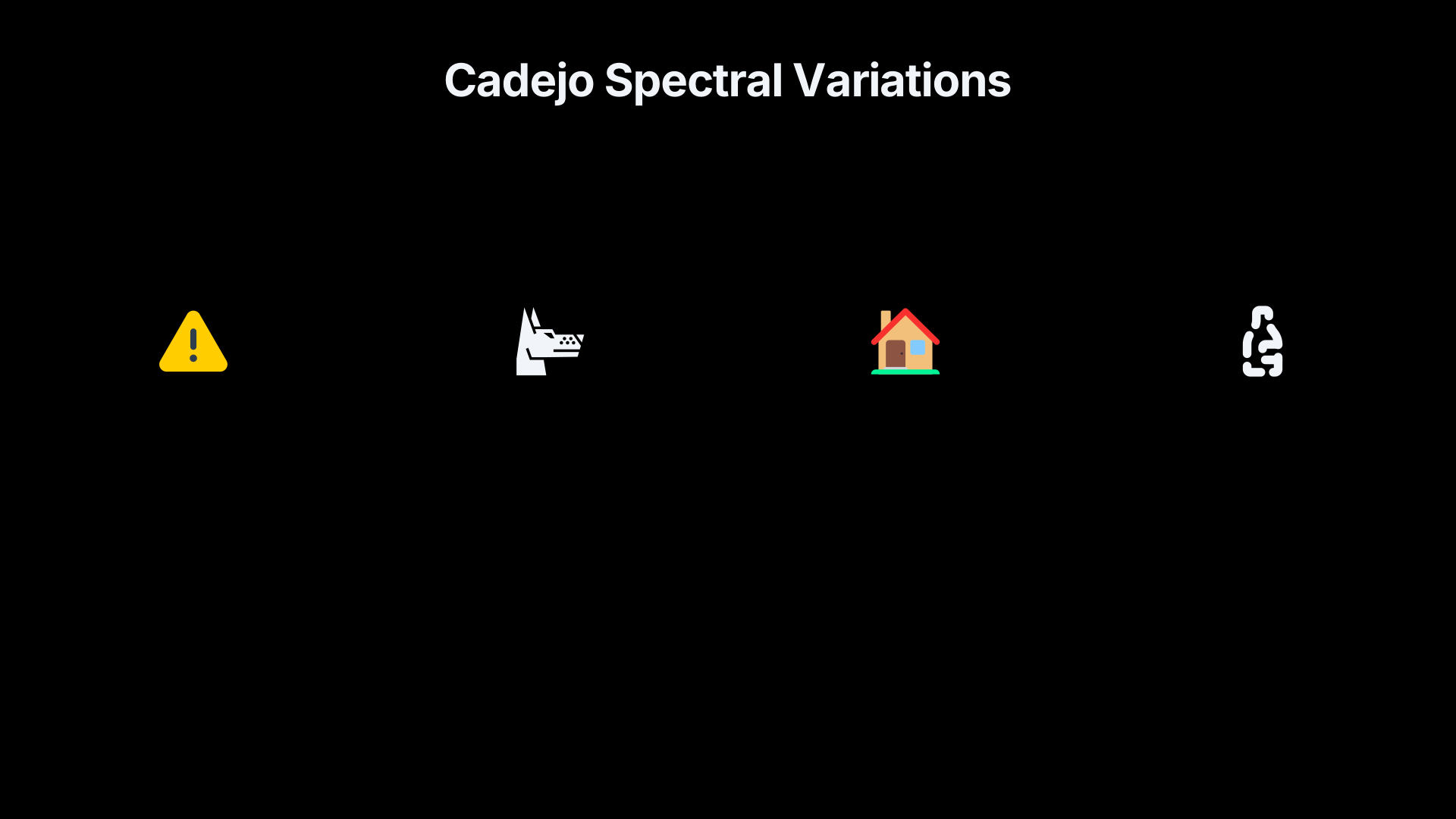
El Cadejo is among Guatemala’s most complex legendary figures because he is not always entirely malevolent. He usually appears as a spectral dog encountered on deserted roads after dark.
Many Guatemalan traditions distinguish between different forms of the Cadejo. The black Cadejo is often associated with fear, misfortune and moral danger, while stories of a white Cadejo portray it as a mysterious guardian that escorts vulnerable travellers safely home. Even the darker versions sometimes protect intoxicated people from robbers or accidents while simultaneously reminding them of the consequences of their excesses.
This ambiguity makes the Cadejo unusual. Rather than rewarding good behaviour outright, it accompanies people who have already made poor choices, suggesting that mercy and judgement may arrive together.
Because the legend centres on lonely roads, it also reflects the genuine hazards of travelling at night before modern transport and lighting became widespread.[Wikipedia]WikipediaOpen source on wikipedia.org.
El Sombrerón and dangerous fascination
El Sombrerón differs from the wandering ghosts by being more of an enchanting trickster. Usually described as a small man wearing an enormous hat and carrying a guitar, he serenades young women, braids their hair and gradually draws them away from ordinary life.
The danger is psychological rather than openly violent. His victims become distracted, sleepless, withdrawn and increasingly detached from family and community.
The warning embedded in the story concerns obsession and manipulation rather than physical attack. Families historically retold the legend as a reminder that charm, romance and flattering attention can conceal harmful intentions.
Like many Guatemalan legends, El Sombrerón blends humour, eeriness and morality. His exaggerated appearance makes him memorable, while his behaviour reflects very human anxieties about unwanted courtship and emotional control.[wikipedia.org]WikipediaEl SombrerónEl Sombrerón
Why these legends still work as social folklore
These stories continue to circulate because they solve several cultural problems at once.
First, they make practical advice memorable. “Don’t walk alone beside the river at night” becomes far easier to remember when linked to La Llorona than when expressed as a simple rule.
Second, they transform ordinary dangers into vivid narratives. Darkness, alcohol, loneliness, infidelity and unfamiliar roads are all genuine sources of risk. Folklore gives those risks a face and a personality.
Third, the legends remain flexible. Modern Guatemalans may encounter them through school lessons, literature, films, tourism, social media or family storytelling rather than purely through oral tradition. Yet each generation adapts the stories to contemporary settings while preserving their central warnings.
Finally, these legends demonstrate that Guatemalan Fortean tradition is rarely concerned with proving supernatural events. Their cultural importance lies in what they communicate about responsibility, community and survival. Whether listeners believe that the spirits literally walk the roads matters less than the fact that the stories still shape how many people imagine the landscape after sunset.[wikipedia.org]WikipediaLeyendas de GuatemalaLeyendas de Guatemala

Amazon book picks
Further Reading
Books and field guides related to Who Walks Guatemala's Roads at Night?. Use these as the next step if you want deeper reading beyond the article.
The Encyclopedia of Ghosts and Spirits
Useful background on ghost motifs such as La Llorona.
Latin American Folktales
Includes regional storytelling traditions relevant to Guatemala.
eBay marketplace picks
Marketplace Samples
Live-tested eBay searches with available results related to this page.
Endnotes
1.
Source: Wikipedia
Title: Leyendas de Guatemala
Link:https://es.wikipedia.org/wiki/Leyendas_de_Guatemala
2.
Source: Wikipedia
Title: La Llorona
Link:https://en.wikipedia.org/wiki/La_Llorona
3.
Source: Wikipedia
Link:https://en.wikipedia.org/wiki/Sihuanaba
Source snippet
SihuanabaThe Sihuanaba, Siguanaba, Cegua, Cigua, or Sihuehuet is a supernatural character from Central American folklore, though it ca...
4.
Source: Wikipedia
Link:https://en.wikipedia.org/wiki/Cadejo
5.
Source: Wikipedia
Link:https://es.wikipedia.org/wiki/Cadejo
6.
Source: Wikipedia
Title: El Sombrerón
Link:https://en.wikipedia.org/wiki/El_Sombrer%C3%B3n
7.
Source: Wikipedia
Link:https://en.wikipedia.org/wiki/Guatemala
Source snippet
GuatemalaIts capital and largest city, Guatemala City, is the second most populous city in Central America, and its metro area is the...
8.
Source: Wikipedia
Link:https://es.wikipedia.org/wiki/Guatemala
Source snippet
Guatemala - Wikipedia, la enciclopedia libreEs el país más poblado de Centroamérica y el décimo más poblado de América, con 18 312 373...
9.
Source: guatemala.com
Link:https://www.guatemala.com/
Source snippet
eportes y cultura; guía de lugares más visitados y un directorio completo...
10.
Source: youtube.com
Title: Siguanaba | Short Horror Film | Garf TV
Link:https://www.youtube.com/watch?v=q8s2IxVALDU
Source snippet
THE GHOST OF THE CHILERO'S RETURN | A PACT THAT LASTS...
11.
Source: quepasa.gt
Title: Qué Pasa Magazine Legends of Guatemala
Link:https://quepasa.gt/legends-guatemala-tradition/
Source snippet
Including El Cadejo and La Llorona17 Oct 2018 — La Siguanaba is one of the most famous legends of Guatemala and the woman in the story is...
12.
Source: thefoodieskitchen.com
Title: guatemalan folklore la llorona urban legend
Link:https://www.thefoodieskitchen.com/2012/10/29/guatemalan-folklore-la-llorona-urban-legend/
Source snippet
Guatemalan Folklore: La Llorona (Urban Legend)29 Oct 2012 — La Llorona, the weeping woman, is an urban legend that is well known througho...
13.
Source: quepasa.gt
Title: leyendas guatemala tradicion
Link:https://quepasa.gt/leyendas-guatemala-tradicion/?lang=es
14.
Source: teachingcentralamerica.org
Link:https://www.teachingcentralamerica.org/spooky
Source snippet
Spooky Central AmericaBased in Guatemala, the tale of el sombrerón represents a short boy, or even a goblin, who wears a large hat, dons...
15.
Source: es.scribd.com
Link:https://es.scribd.com/document/714307362/leyendas
Source snippet
El Sombrerón es un hombre pequeño vestido de negro que recorre Guatemala enmulando a jóvenes mujeres...
16.
Source: dictionary.cambridge.org
Link:https://dictionary.cambridge.org/es/diccionario/ingles-espanol/guatemalan
Source snippet
traducir al español - Cambridge DictionaryJun 10, 2026 — traducir Guatemalan: guatemalteco, guatemalteco, guatemalteca. Más información...
Additional References
17.
Source: reddit.com
Link:https://www.reddit.com/r/guatemala/comments/1c6dwqf/common_folk_lore_and_superstitions/
Source snippet
Common Folk Lore and Superstitions: r/guatemalaYou can definitely include La Llorona, El Sombrerón, El Cadejo, La Siguanaba, or La Tatua...
18.
Source: facebook.com
Link:https://www.facebook.com/61565427826515/posts/guatemala-la-leyenda-de-la-siguanabaguatemala-guatemala-guate-leyendasdeguatemal/122107942754514260/
Source snippet
GUATEMALA La LEYENDA de la SIGUANABA #guatemala...These legends represent the character and folklore of indigenous communities and, whil...
19.
Source: guatemala.gob.gt
Link:https://guatemala.gob.gt/
Source snippet
ierno de GuatemalaLa primera cosecha, balance de gestion primer año de gobierno, informe gubernamental, evaluación de gobierno, report...
20.
Source: csueastbay.edu
Link:https://www.csueastbay.edu/history/student-research-and-projects/images/leyendas-monstruosas-catalog.pdf
Source snippet
concept of La. Siguanaba is enacted culturally to keep men from having affairs or staying out late and getting into mischief.[19] Her fol...
21.
Source: scribd.com
Link:https://www.scribd.com/document/943899542/Characters-of-the-Legend-of-Guatemala
Source snippet
e, including La Llorona, a woman who killed her children...Read more...
22.
Source: abctales.com
Title: el sombreron based upon guatemalan folktale
Link:https://www.abctales.com/story/well-wisher/el-sombreron-based-upon-guatemalan-folktale
Source snippet
El Sombreron (Based upon a Guatemalan folktale)Jan 16, 2016 — Pedro told La Llorona about El Sombrero and how he had enchanted Susana and...
23.
Source: instagram.com
Link:https://www.instagram.com/reel/CzCt2HTAuYJ/?hl=en
Source snippet
cursed by the gods for her deceit. Condemned to eternal wandering...
24.
Source: scribd.com
Link:https://www.scribd.com/document/746347599/20-Legends-of-Guatemala
Source snippet
il appeared, the Siguanaba that deceives men by later...Read more...
25.
Source: scribd.com
Link:https://www.scribd.com/document/960940632/legends-of-the-community-docx
Source snippet
rona, The Big Hat Man, La Siguanaba, and El Sisimite.Read more...
26.
Source: australialatam.com
Title: guatemala country spotlight
Link:https://www.australialatam.com/country-spotlight/guatemala-country-spotlight
Source snippet
GuatemalaSep 25, 2025 — Guatemala es un país multiétnico y pluricultural ubicado en América Central. Es el más poblado y el tercero más g...
Topic Tree