Within Estonia Strange
Why Do Estonian Lakes Need Guardians?
Estonian water lore turns lakes, marshes and reservoirs into moral landscapes where drowning, respect and civic anxiety take human form.
On this page
- Water mothers, fathers and fairies
- Lake Ulemiste and Tallinn's flood warning
- What dangerous place legends are doing
Page outline Jump by section
Introduction
Estonian water folklore treats lakes, marshes and deep pools as places with personalities rather than empty scenery. Traditional stories describe waters that must be respected because they possess guardians, demand proper behaviour or punish arrogance and carelessness. These tales were never simply ghost stories. They helped explain drowning accidents, marked dangerous places in the landscape and reinforced the idea that humans shared the world with powerful natural forces. The best-known example is the legend of Lake Ülemiste beside Tallinn, where a supernatural guardian threatens to flood the capital if it is ever declared complete. Alongside that famous story are older beliefs in water mothers, water fathers and dangerous spirits that blur the line between moral lesson, environmental warning and supernatural tradition.[Wikipedia]WikipediaLegends of TallinnLegends of Tallinn
Why do Estonian lakes need guardians?
Unlike some European traditions that focus on a single ruler of all waters, Estonian folklore often imagines each significant body of water as having its own guardian or resident spirit. Lakes, rivers and springs become living places with their own rules. Crossing them, fishing in them or simply behaving disrespectfully near them could invite misfortune.
This reflects a wider Baltic Finnic view of nature in which forests, rocks, springs and waters possess protective spirits connected to particular places rather than universal deities. Such beliefs made the landscape feel inhabited and morally significant. A dangerous lake was dangerous not only because of cold water or hidden depths, but because someone—or something—was believed to dwell there.[Wikipedia]WikipediaEstonian folkloreEstonian folklore
Rather than presenting these beings as straightforward monsters, many traditions portray them as guardians maintaining balance. They reward respect and punish recklessness, creating stories that function simultaneously as religious belief, folklore and practical safety advice.
Water mothers, fathers and fairies
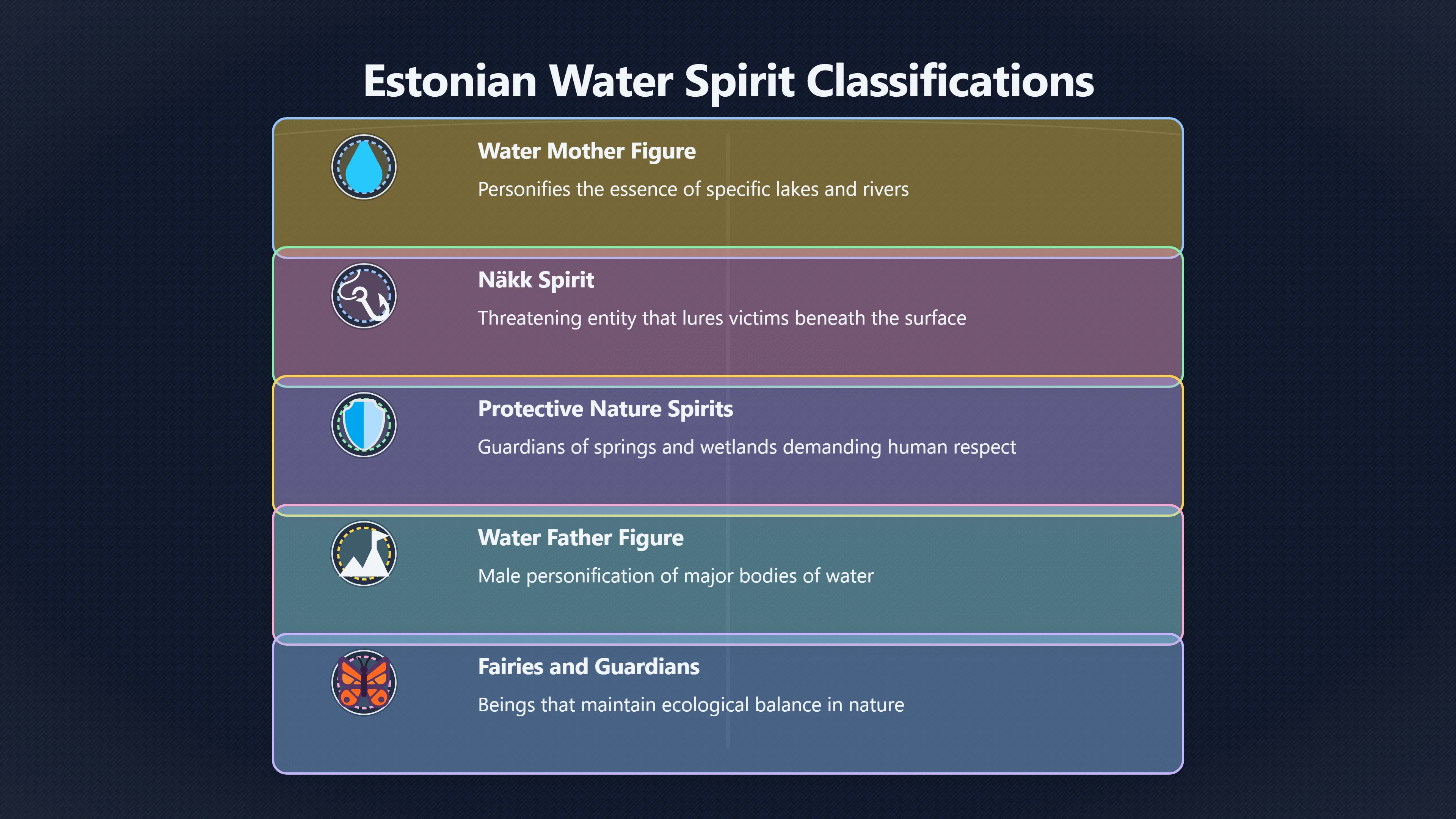
Estonian tradition includes several overlapping categories of water beings.
Water Mother and Water Father represent the personification of lakes and rivers. Rather than appearing in dramatic legends, they embody the idea that every important stretch of water has its own master or mistress. Closely related Baltic Finnic traditions preserve accounts in which every lake possesses its own “mother” or “father”, who may claim the lives of those who ignore proper behaviour or violate customary rituals. These traditions help illuminate the broader cultural background shared with Estonian folklore.[Folklore]folklore.eeAs the bodies of water were first and foremost dangerous for small children…Read more…
The Näkk, often translated as a water spirit, occupies a more threatening role. Related to Scandinavian and Finnish traditions, the Estonian näkk lurks near water, tempting or dragging victims beneath the surface. Different local traditions imagine the spirit differently: sometimes beautiful and seductive, sometimes frightening, and sometimes associated with the restless dead who suffered violent deaths. Rather than describing actual supernatural encounters, these stories often served as explanations for unexplained drownings or disappearances.[Wikipedia]WikipediaNixie (folkloreNixie (folklore
Protective nature spirits, sometimes grouped with fairies or guardian spirits, extend the same logic to springs, rivers and wetlands. Instead of being wholly evil, these beings defend their places and expect humans to behave appropriately. Such figures reinforce a recurring feature of Estonian folklore: nature is neither friendly nor hostile by default, but demands respect.[Wikipedia]WikipediaEstonian folkloreEstonian folklore
Lake Ülemiste and Tallinn’s flood warning
No Estonian water legend is better known than that of Lake Ülemiste.[Wikipedia]WikipediaLake ÜlemisteLake Ülemiste
According to tradition, the mysterious Old Man of Ülemiste lives within the lake outside Tallinn. Periodically he leaves the water and asks a deceptively simple question:
“Is Tallinn finished yet?”
The only safe answer is “No.” If anyone were to reply that the city was finally complete, the old man would release the waters of the lake and drown Tallinn beneath a catastrophic flood.[Wikipedia]WikipediaLegends of TallinnLegends of Tallinn
The story has several layers.
First, it connects the lake directly with the city’s survival. Lake Ülemiste is not merely scenery but the source of most of Tallinn’s drinking water, giving the legend an unusually tangible connection to civic life.[Wikipedia]WikipediaLake ÜlemisteLake Ülemiste
Second, the legend transforms endless construction into a virtue. Tallinn is never allowed to become “finished”; continuous growth symbolically protects the city from destruction. In modern retellings the tale has become a humorous explanation for why there always seems to be another building project underway.
Finally, the story expresses an ancient fear of water overwhelming human settlement. Before modern engineering, floods genuinely threatened communities. The supernatural guardian provides a memorable way of expressing a very real environmental risk.
What dangerous-place legends are doing
Many stories about haunted lakes are less interested in proving the supernatural than in changing human behaviour.
Several recurring functions appear throughout Estonian water lore.
- Explaining drownings. Before modern rescue services and scientific understanding, sudden disappearances beneath the water could be attributed to spirits claiming victims.
- Protecting children. Tales of dangerous water beings discouraged young people from swimming alone or playing too close to lakes, rivers and marshes.
- Marking hazardous places. Certain pools, bogs and lakes acquired reputations that encouraged caution around unstable ground, cold water or hidden currents.
- Encouraging respect. Water was treated as something that could not simply be exploited. Ritual courtesy and careful behaviour reinforced sustainable relationships with important natural resources.[Folklore]folklore.eeAs the bodies of water were first and foremost dangerous for small children…Read more…
From this perspective, the supernatural mechanism matters less than the practical outcome. The stories encode generations of environmental experience into memorable narratives.
Folklore, drowning and modern interpretation
Modern historians and folklorists generally interpret these traditions as products of oral culture rather than evidence for literal supernatural beings.
The remarkable consistency of water-spirit stories across Estonia and neighbouring Baltic Finnic cultures suggests that they evolved because communities repeatedly faced similar dangers. Cold lakes, deep bog pools and unpredictable weather created genuine risks, while oral storytelling offered a memorable way to communicate them across generations.[Folklore]folklore.eeAs the bodies of water were first and foremost dangerous for small children…Read more…
Believers have sometimes regarded the legends more literally, arguing that guardian spirits remain attached to particular lakes or springs. Others view them symbolically, seeing them as reminders that nature cannot be completely controlled.
Neither interpretation diminishes their cultural importance. Whether understood as religious memory, metaphor or environmental folklore, these stories continue to shape how many Estonians think about historic landscapes.
Why the stories still matter
Water spirits occupy a distinctive place within Estonia’s strange traditions because they connect folklore directly to the physical landscape. Unlike wandering ghosts or isolated monster tales, these legends remain anchored to recognisable lakes, marshes and reservoirs that people still visit today.
The legend of Lake Ülemiste continues to appear in tourism, public art and discussions of Tallinn’s identity, while older traditions about water mothers, water fathers and the näkk preserve an older worldview in which every lake demanded humility. Their lasting appeal lies not in proving the supernatural but in reminding listeners that water can sustain life, conceal danger and inspire stories powerful enough to survive long after the beliefs that created them have faded.
Amazon book picks
Further Reading
Books and field guides related to Why Do Estonian Lakes Need Guardians?. Use these as the next step if you want deeper reading beyond the article.
The lore of the land
Explains how lakes and landscapes attract supernatural traditions.

The Penguin Book of Dragons
Appeals to readers exploring supernatural beings across cultures.
Estonian Folk Tales
Includes traditional stories rooted in Estonian landscapes and waters.
eBay marketplace picks
Marketplace Samples
Live-tested eBay searches with available results related to this page.
Endnotes
1.
Source: Wikipedia
Title: Legends of Tallinn
Link:https://en.wikipedia.org/wiki/Legends_of_Tallinn
2.
Source: Wikipedia
Title: Estonian folklore
Link:https://en.wikipedia.org/wiki/Estonian_folklore
3.
Source: Wikipedia
Title: Estonian mythology
Link:https://en.wikipedia.org/wiki/Estonian_mythology
4.
Source: folklore.ee
Link:https://www.folklore.ee/folklore/vol12/spirits.htm
Source snippet
As the bodies of water were first and foremost dangerous for small children...Read more...
5.
Source: Wikipedia
Title: Nixie (folklore)
Link:https://en.wikipedia.org/wiki/Nixie_%28folklore%29
6.
Source: Wikipedia
Title: Lake Ülemiste
Link:https://en.wikipedia.org/wiki/Lake_%C3%9Clemiste
7.
Source: europeisnotdead.com
Link:https://europeisnotdead.com/estonia-the-old-man-from-the-lake-ulemiste/
Source snippet
Back to European legends...Read more...
Additional References
8.
Source: hiddentallinn.com
Link:https://hiddentallinn.com/old-man-lake-ulemiste/
Source snippet
The Old Man of Lake ÜlemisteThe little grey man is the keeper of Lake Ülemiste; a mythical figure who was unable to escape the rains that...
9.
Source: youtube.com
Title: They meet only once a year
Link:https://www.youtube.com/watch?v=srgwu6stH80
Source snippet
Estonian folklore mythology spirits Estonian Mythology ~ Kalevipoeg, Linda & Kalev 🇪🇪 The Jolly Reiver...
10.
Source: x.com
Link:https://x.com/chandrarsrikant/status/1795404442923143199
Source snippet
long nights. Legend has it that if one runs into him...Read more...
11.
Source: facebook.com
Link:https://www.facebook.com/Tallinnbyfoot/photos/tallinn-has-a-little-known-legend-of-the-%C3%BClemiste-elder-%C3%BClemiste-vanake-who-live/2003154683278980/
Source snippet
lives at Lake Ülemiste,Tallinn's main water source.Read more...
12.
Source: eesti.pl
Title: myths and legends in tallinn 1336
Link:https://www.eesti.pl/myths-and-legends-in-tallinn-1336.html
Source snippet
Myths and Legends in Tallinn11 Oct 2009 — The most well-known myth is probably the myth of the Old Man of Ülemiste Lake. An old man, call...
13.
Source: polvacomenius.weebly.com
Title: myths and legends about estonia
Link:https://polvacomenius.weebly.com/myths-and-legends-about-estonia.html
Source snippet
and legends about EstoniaThe little old man of Ülemiste lake is a creature from Estonian mythology who according to the legend lived near...
14.
Source: youtube.com
Link:https://www.youtube.com/watch?v=VEtTIHg8Glk
Source snippet
They meet only once a year - Hämarik and Koit, the cosmic lovers Dawn and Dusk of Estonian fairytale...
15.
Source: youtube.com
Title: Kodukäija and Külmking
Link:https://www.youtube.com/watch?v=UyfFak1_JQo
Source snippet
Koerakoonlased - The Dog-Snouted Monsters of Estonian Folk Tales...
16.
Source: youtube.com
Title: Estonian Mythology ~ Kalevipoeg, Linda & Kalev 🇪🇪
Link:https://www.youtube.com/watch?v=1wDl7tuaLZM
Source snippet
Kodukäija and Külmking - The Haunting Spirits of Ancestors from Estonian Folklore...
17.
Source: youtube.com
Link:https://www.youtube.com/watch?v=_x64Wn6PAoo
Source snippet
Estonian Mythology ~ Kalevipoeg, Linda & Kalev 🇪🇪...
Topic Tree