What Makes The Gambia So Strangely Memorable?
The Gambia’s strongest strange-history material is not a neat catalogue of UFO files or laboratory puzzles.
Page outline Jump by section
Introduction
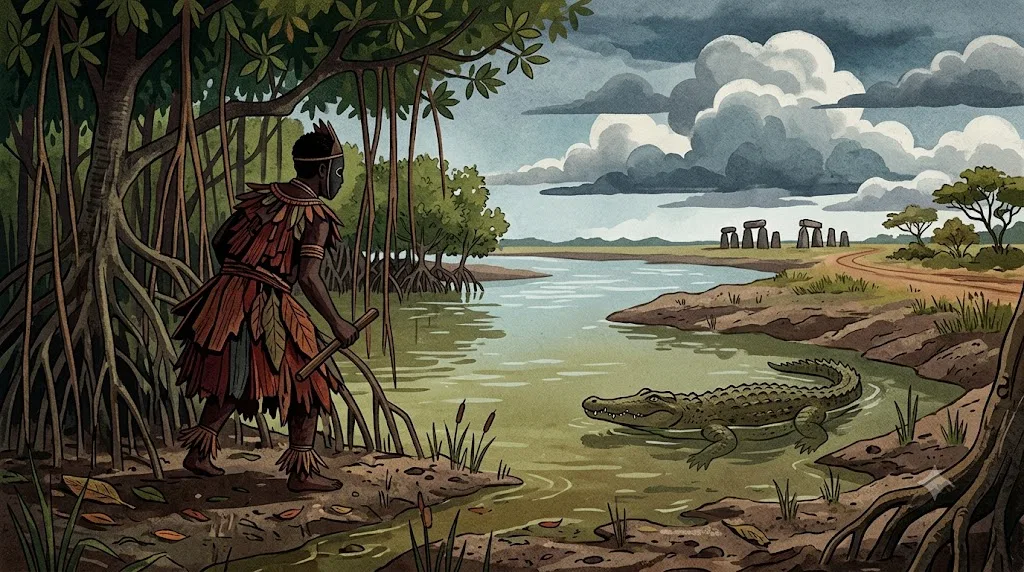
The best-known case is the Ninki Nanka, a feared water creature associated with the River Gambia and its swamps. Modern cryptozoologists have treated it as a possible “mystery animal”, but the better reading is broader: it is part monster, part warning, part river spirit, part tourist-era symbol, and part reminder that folklore can outlive every attempted explanation.[The Independent]independent.co.ukOpen source on independent.co.uk.
The Ninki Nanka: Gambia’s river dragon
The Ninki Nanka is the country’s headline Fortean creature. It is usually described as a reptilian or dragon-like being of the swamps and mangroves, but accounts vary sharply. In one modern travel account along the River Gambia, the creature is said to have, depending on the teller, the head of a crocodile and body of a donkey, a mixture of hippopotamus and giraffe, or simply the form of a large snake. The one recurring motif is not zoological detail but danger: seeing it is said to bring death, and mirrors are carried in some tellings to deflect its fatal gaze.[National Geographic]nationalgeographic.comOpen source on nationalgeographic.com.
That slipperiness is exactly what makes the Ninki Nanka important as Gambian Forteana. A mystery animal report normally asks, “What species was seen?” A legend like this also asks, “What kind of place produces such a creature?” The Gambia River is not a decorative backdrop; it is the country’s long artery, lined in places with mangroves, creeks, mudbanks, birds, snakes, crocodiles and hippos. National Geographic’s 2023 account of the Ninki Nanka Trail places the legend among real river hazards, noting that hippos, water cobras, black mambas and puff adders are part of the wider riverine world.[National Geographic]nationalgeographic.comOpen source on nationalgeographic.com.
The 2006 “dragon hunt”
The Ninki Nanka became internationally visible in July 2006 when a Centre for Fortean Zoology expedition went to The Gambia to look for it. The Independent described the expedition as a search for a legendary creature said locally to be a giant reptile up to about 30 feet long, dwelling in mangrove swamps, with some descriptions combining a crocodile body, giraffe neck, horse-like head and horns. The team’s leader, Richard Freeman, suggested one possible naturalistic line of inquiry: that behind the legend there might be an unusually large monitor lizard or another misidentified animal.[The Independent]independent.co.ukOpen source on independent.co.uk.
The same report also shows why the case remains weak as zoological evidence. A supposed “scale” given to the expedition reportedly turned out to be rotted film rather than biological material. Witness testimony was more intriguing than physical evidence, especially because reports repeatedly linked sighting the creature with later illness or death, but that consistency is folkloric rather than scientific proof.[The Independent]independent.co.ukOpen source on independent.co.uk.
A sceptical reading does not require dismissing everyone involved as foolish. River folklore often compresses different observations into one memorable form: crocodiles glimpsed in mud, hippos surfacing at dusk, snakes moving through reeds, disease following frightening encounters, and warnings about entering dangerous places. The Ninki Nanka may be less a hidden species than a cultural container for risk: the swamp as a living moral and physical boundary.
Sacred crocodiles and living “impossible” animals
The Gambia’s sacred crocodile pools are among its most distinctive strange-but-real sites. Kachikally Crocodile Pool in Bakau is the best known, but it is usually described as one of three sacred crocodile pools in the country, alongside Folonko in Kartong and Berending on the north bank. These places are not simply wildlife attractions. They are associated with fertility rites, prayer, blessing-seeking and local custodianship.[Wikipedia]WikipediaKachikally Museum and Crocodile PoolKachikally Museum and Crocodile Pool
Kachikally is especially striking because it brings a seemingly dangerous animal into an atmosphere of reverence and controlled intimacy. Visitors often encounter crocodiles at close range; the site’s public identity combines a museum, a sacred pool, family stewardship and tourism. The crocodiles are commonly described in older tourist material as Nile crocodiles, but modern crocodile research has complicated that assumption: West Africa contains the West African crocodile, Crocodylus suchus, a species long confused with the Nile crocodile. A 2025 conservation summary for West Africa notes that The Gambia is home to three crocodile species: West African slender-snouted crocodile, West African crocodile and West African dwarf crocodile.[biaza.org.uk]biaza.org.ukblog crocodiles of the world foundations conservation in west africablog crocodiles of the world foundations conservation in west africa
That biological correction matters for Fortean interpretation. One of the easiest traps in strange-animal stories is assuming that local tradition and zoology are enemies. At the crocodile pools, they overlap. The reptiles are real; the sacred meanings attached to them are also socially real; and the older mislabelling of crocodile species shows that even formal natural history can lag behind local familiarity with animals.
There is also a conservation angle. An IUCN Crocodile Specialist Group document from 2024 reported that communities in West and Central African survey contexts perceived crocodiles as sacred, linked with ancestors, fertility and water preservation, even while also recognising negative impacts. That is not proof that sacred belief “explains” conservation, but it shows how supernatural or ancestral associations can shape how dangerous animals are tolerated and protected.[IUCN CSG]iucncsg.orgIUCN CSGAgenda Item: SC. 2.2. Crocodile Specialist Group SteeringIUCN CSGAgenda Item: SC. 2.2. Crocodile Specialist Group Steering
Masked spirits, social order and the Kankurang
Not every uncanny Gambian tradition is about creatures in water. The Kankurang, practised in Manding cultural areas of The Gambia and Senegal, is a major initiatory rite in which a masked and costumed man embodies a protective spirit. A UNESCO-linked project description says the Kankurang is the protector of order and justice, an exorcist of evil spirits, and part of a ritual system through which boys learn community rules, medicinal plants and other knowledge.[UNESCO Japan]unesco.emb-japan.go.jpOpen source on go.jp.
For an outsider, a masked figure moving through a village may look like theatre. Within the tradition, the boundary is not so simple. The Kankurang is a social force, a spiritual office and a disciplined performance at once. It protects initiates, frightens or disciplines the community, and makes invisible authority visible. Recent reporting from Janjanbureh describes the Kankurang as feared and revered, a guardian of tradition and a vessel of spiritual protection, with different costume types made from bark, leaves or newer synthetic materials.[The World Of Interiors]worldofinteriors.comOpen source on worldofinteriors.com.
The modern twist is that the Kankurang is also changing. UNESCO’s safeguarding project noted threats from urbanisation, deforestation and standardisation, especially because the rite traditionally involves forest retreat. A 2025 cultural report similarly describes ecological pressure on the trees used for costumes and the emergence of newer costume forms made from recycled sacks.[UNESCO Japan]unesco.emb-japan.go.jpOpen source on go.jp.
This is Fortean in a quieter sense. The mystery is not whether a supernatural being can be photographed. It is how a community maintains a figure that is, by design, both human and more-than-human. The Kankurang’s power comes partly from controlled ambiguity: everyone knows there is a person under the costume, yet the ritual requires treating the figure as something else.
Sacred trees, jinn and places where landscape remembers
The Gambia’s official heritage material records a number of sacred sites where legends attach to trees, groves, stones and burial places. The National Centre for Arts and Culture describes Santangba near Brikama as a sacred tree site linked to ancestral migration from Mali; children are traditionally taken there for prayers before circumcision. It also describes Berewuleng, near Sanyang, as a grove centred on a large boulder where legend says a Muslim jinn with a long beard used a mosque and was seen going there with prayer beads; people still go to pray and leave money or food on the boulder.[NATIONAL CENTRE FOR ARTS & CALTURE]ncac.gmNATIONAL CENTRE FOR ARTS & CALTURESacred SitesNATIONAL CENTRE FOR ARTS & CALTURESacred Sites
These accounts are valuable because they show how “haunted place” traditions in The Gambia often do not fit a simple ghost-story model. The uncanny is embedded in social use: prayer, offerings, initiation, family custodianship and local guidance. A sacred site is not merely a backdrop for a spooky tale. It is a place where authority, memory and risk are managed.
The Great Tree at Latrikunda German in Serekunda offers a modern example. Anadolu Agency reported in 2025 that the huge kapok tree is believed by locals to be sacred, associated with ancestral spirits, wishes and small offerings. The same article also presents it as a daily public landmark: a place of shade, trade, photography and neighbourhood gathering.[Anadolu Ajansı]aa.com.trAnadolu AjansıKapok tree: Gambia's time-defying 'sanctuary' for spiritsAnadolu AjansıKapok tree: Gambia's time-defying 'sanctuary' for spirits
That double identity is important. A tree can be a market landmark and a spirit sanctuary at the same time. To a Fortean reader, the interesting question is not whether ancestral spirits can be proved to inhabit a trunk. It is why certain trees, rocks and groves become durable containers for collective memory. The answer usually lies in age, visibility, survival, ritual repetition and the feeling that some places have watched longer than any living person.
The stone circles: ancient certainty, modern uncertainty
The Stone Circles of Senegambia are not paranormal, but they belong in any serious account of Gambia’s strange-history record because they are genuinely impressive, ancient and still partly unresolved. UNESCO describes the World Heritage site as an extraordinary concentration of more than 1,000 monuments in a band about 100 km wide along roughly 350 km of the River Gambia. The four main groups are Sine Ngayène and Wanar in Senegal, and Wassu and Kerbatch in The Gambia; together they include 93 stone circles and many burial mounds. Excavated material suggests dates between the 3rd century BC and the 16th century AD.[UNESCO World Heritage Centre]whc.unesco.orgWorld Heritage Centre Stone Circles of SenegambiaWorld Heritage Centre Stone Circles of Senegambia
The mystery here is not a fantasy of vanished aliens or impossible technology. It is the more interesting human puzzle of organisation, labour and meaning. UNESCO states that the stone circles and associated burial mounds form a vast sacred landscape created over more than 1,500 years and reflect a prosperous, highly organised society.[UNESCO World Heritage Centre]whc.unesco.orgWorld Heritage Centre Stone Circles of SenegambiaWorld Heritage Centre Stone Circles of Senegambia
The Wassu quarry site sharpens the picture. UNESCO’s tentative-list description says the nearby laterite ridge preserves evidence of quarrying, partially dressed stones and broken fragments, and argues that the builders needed strong knowledge of local geology, technical ability and the social organisation to move blocks that could weigh up to seven tons.[UNESCO World Heritage Centre]whc.unesco.orgWorld Heritage Centre Wassu Stone Circles Quarry SiteWorld Heritage Centre Wassu Stone Circles Quarry Site
For readers drawn to ancient mysteries, the key point is that the real evidence is better than the fantasy. The stones do not need invented supernatural builders. Their strangeness lies in the scale and duration of the tradition, the lost details of the society that sustained it, and the way burial, landscape and labour were fused into a monument system that still commands attention.

What sceptics and believers are really arguing about
The strongest Gambian cases rarely divide cleanly into “true” and “false”. They ask different kinds of questions.
For the Ninki Nanka, believers may point to repeated testimony, the persistence of the fatal-gaze motif, and the possibility that a large or rare animal was glimpsed in difficult terrain. Sceptics point to the absence of reliable physical evidence, the changing descriptions, and plausible sources of misidentification such as crocodiles, hippos, snakes, monitor lizards and fear-amplified river encounters. The 2006 expedition is useful precisely because it produced colour, testimony and a failed physical lead rather than a captured monster.[The Independent]independent.co.ukOpen source on independent.co.uk.
For the crocodile pools, the argument is not whether crocodiles exist. They plainly do. The question is how to understand claims of sacredness, fertility and ancestral power around them. A narrow sceptic might call the beliefs symbolic. A more careful interpretation recognises that symbolism can alter behaviour: where animals are sacred, people may feed them, protect them, avoid killing them, or build visitor economies around them.[Kachikally]kachikally.comOpen source on kachikally.com.
For the Kankurang and sacred sites, the key issue is category. Outsiders may treat them as folklore, performance or heritage. Participants may treat them as spiritual authority, social regulation and inherited law. Both descriptions can be true in different registers. UNESCO’s safeguarding language itself reflects that overlap, describing the Kankurang as a protective spirit embodied by a masked man and as a ritual system under pressure from environmental and social change.[UNESCO Japan]unesco.emb-japan.go.jpOpen source on go.jp.
Why Gambia’s Forteana still has pull
The Gambia’s strange material lasts because it is attached to places people can still visit and landscapes people still use. The Ninki Nanka belongs to the river and its creeks. Kachikally belongs to a living crocodile pool in Bakau. The Kankurang belongs to initiation, community discipline and Janjanbureh’s cultural memory. Santangba, Berewuleng and the Great Tree attach uncanny presence to trees, stones and groves. Wassu and Kerbatch place ancient human organisation into the open landscape.[nationalgeographic.com]nationalgeographic.comOpen source on nationalgeographic.com.
That makes The Gambia a useful country case for strange-history writing because the best material is not just “weird things said to have happened”. It is a set of living negotiations between danger and reverence, ecology and belief, tourism and secrecy, archaeology and lost memory. The Ninki Nanka may never be found because there may be no single animal to find. Yet the story remains powerful because it gives a memorable shape to the river’s older truths: water feeds, hides, carries, kills and remembers.
Amazon book picks
Further Reading
Books and field guides related to What Makes The Gambia So Strangely Memorable?. Use these as the next step if you want deeper reading beyond the article.

The hero with a thousand faces
Helps interpret recurring mythic patterns behind Gambian legends.

Lonely Planet West Africa
Provides context for Gambian culture and regional traditions.

The Penguin Book of Dragons
Adds comparative context for dragon-like traditions such as the Ninki Nanka.
eBay marketplace picks
Marketplace Samples
Live-tested eBay searches with available results related to this page.
Endnotes
1.
Source: Wikipedia
Title: Kachikally Museum and Crocodile Pool
Link:https://en.wikipedia.org/wiki/Kachikally_Museum_and_Crocodile_Pool
2.
Source: biaza.org.uk
Title: blog crocodiles of the world foundations conservation in west africa
Link:https://biaza.org.uk/news/detail/blog-crocodiles-of-the-world-foundations-conservation-in-west-africa
3.
Source: iucncsg.org
Title: IUCN CSGAgenda Item: SC. 2.2. Crocodile Specialist Group Steering
Link:https://www.iucncsg.org/content_images/Darwin/SC27%202.2%20West%20and%20Central%20Africa.pdf
4.
Source: ncac.gm
Title: NATIONAL CENTRE FOR ARTS & CALTURESacred Sites
Link:https://ncac.gm/sacred-sites/
5.
Source: whc.unesco.org
Title: World Heritage Centre Stone Circles of Senegambia
Link:https://whc.unesco.org/en/list/1226/
6.
Source: whc.unesco.org
Title: World Heritage Centre Wassu Stone Circles Quarry Site
Link:https://whc.unesco.org/en/tentativelists/6063/
7.
Source: kachikally.com
Link:https://kachikally.com/
8.
Source: unesco.org
Title: document 927
Link:https://www.unesco.org/archives/multimedia/document-927
9.
Source: ich.unesco.org
Title: kankurang manding initiatory rite 00143
Link:https://ich.unesco.org/en/RL/kankurang-manding-initiatory-rite-00143
10.
Source: ich.unesco.org
Title: action plan for the safeguarding of the kankurang manding initiatory rite 00039
Link:https://ich.unesco.org/en/projects/action-plan-for-the-safeguarding-of-the-kankurang-manding-initiatory-rite-00039
11.
Source: ich.unesco.org
Title: gambia GM
Link:https://ich.unesco.org/en/state/gambia-GM?cp=GM&info=projects&topic=fr-etat
12.
Source: Wikipedia
Title: Ninki Nanka
Link:https://en.wikipedia.org/wiki/Ninki_Nanka
13.
Source: Wikipedia
Title: Belgian UFO wave
Link:https://en.wikipedia.org/wiki/Belgian_UFO_wave
14.
Source: Wikipedia
Title: Rain of animals
Link:https://en.wikipedia.org/wiki/Rain_of_animals
15.
Source: Wikipedia
Title: UFO sightings in Africa
Link:https://en.wikipedia.org/wiki/UFO_sightings_in_Africa
16.
Source: Wikipedia
Title: Meteorite fall
Link:https://en.wikipedia.org/wiki/Meteorite_fall
17.
Source: Wikipedia
Link:https://de.wikipedia.org/wiki/Kankurang
18.
Source: africa.com
Link:https://africa.com/museums-of-the-gambia
19.
Source: portals.iucn.org
Link:https://portals.iucn.org/library/sites/library/files/documents/1992-008.pdf
20.
Source: groups.io
Title: Cryptozoology in the Gambia
Link:https://groups.io/g/dgml/topic/cryptozoology_in_the_gambia/57100733
21.
Source: youtube.com
Title: The Ninki Nanka | West Africa’s Swamp Dragon
Link:https://www.youtube.com/watch?v=Wru7DkEfgVU
Source snippet
Touching a Live Crocodile at Gambia's Sacred Kachikally Pool...
22.
Source: independent.co.uk
Link:https://www.independent.co.uk/news/science/the-monster-detectives-on-the-trail-of-the-ninkinanka-6095664.html
23.
Source: nationalgeographic.com
Link:https://www.nationalgeographic.com/travel/article/exploring-gambias-new-ninki-nanka-trail
24.
Source: unesco.emb-japan.go.jp
Link:https://www.unesco.emb-japan.go.jp/htm/d_ich_kankurang.htm
25.
Source: worldofinteriors.com
Link:https://www.worldofinteriors.com/story/kankurang-guardian-spirit-gambia
26.
Source: aa.com.tr
Title: Anadolu AjansıKapok tree: Gambia’s time-defying ‘sanctuary’ for spirits
Link:https://www.aa.com.tr/en/africa/kapok-tree-gambias-time-defying-sanctuary-for-spirits/3511539
27.
Source: facebook.com
Link:https://www.facebook.com/groups/1948839472064649/posts/4059112947703947/
28.
Source: facebook.com
Link:https://www.facebook.com/groups/544175310009545/posts/1314931672933901/
29.
Source: cryptidarchives.fandom.com
Title: Ninki nanka
Link:https://cryptidarchives.fandom.com/wiki/Ninki_nanka
30.
Source: cryptidz.fandom.com
Title: Ninki Nanka
Link:https://cryptidz.fandom.com/wiki/Ninki_Nanka
31.
Source: tripadvisor.com
Title: Kachikally Crocodile Pool
Link:https://www.tripadvisor.com/Attraction_Review-g479198-d2462024-Reviews-Kachikally_Crocodile_Pool-Bakau_Banjul_Division.html
32.
Source: tripadvisor.com
Title: Kachikally Crocodile Pool
Link:https://www.tripadvisor.com/Attraction_Review-g479198-d2462024-Reviews-or30-Katchikally_Crocodile_Pool-Bakau_Banjul_Division.html
33.
Source: pulseofafrica.info
Link:https://pulseofafrica.info/travel/120
34.
Source: tripadvisor.co.uk
Title: KACHIKALL Y CROCODILE POOL
Link:https://www.tripadvisor.co.uk/Attraction_Review-g479198-d2462024-Reviews-Kachikally_Crocodile_Pool-Bakau_Banjul_Division.html
35.
Source: gambiajobetoursandtravel.com
Title: Kachikally Cocodrile Pool
Link:https://www.gambiajobetoursandtravel.com/20-top-destinations-in-gambia/kachikally-cocodrile-pool
36.
Source: kumakonda.com
Link:https://kumakonda.com/kankurang/
37.
Source: my-gambia.com
Link:https://www.my-gambia.com/mymagazine/kachikally-sacred-site-and-crocodile-pool/
Additional References
38.
Source: youtube.com
Title: Touching a Live Crocodile at Gambia’s Sacred Kachikally Pool
Link:https://www.youtube.com/watch?v=ufxGGyXKPeY
Source snippet
Experience the Gambia: The Crocodile Pool...
39.
Source: researchgate.net
Link:https://www.researchgate.net/publication/390332392_Diversity_distribution_and_conservation_of_crocodiles_Order_Crocodylia_in_Guinea-Bissau_West_Africa
40.
Source: instagram.com
Link:https://www.instagram.com/p/DVtCGQxggKk/?hl=en
41.
Source: facebook.com
Link:https://www.facebook.com/wilphotographer/videos/a-fireball-was-seen-and-caught-on-camera-early-hours-of-this-morning-with-witnes/1266399499010143/
42.
Source: accessgambia.com
Link:https://www.accessgambia.com/information/bakau-kachikally.html
43.
Source: facebook.com
Link:https://www.facebook.com/100091831598980/posts/according-to-reports-two-unidentified-metallic-objects-reportedly-fell-from-the-/664589856612062/
44.
Source: spyscape.com
Link:https://spyscape.com/article/alien-hoaxes-that-went-viral
45.
Source: amsmeteors.org
Link:https://www.amsmeteors.org/
46.
Source: my-gambia.com
Link:https://www.my-gambia.com/mymagazine/behind-the-lens-ninki-nanka/
47.
Source: facebook.com
Link:https://www.facebook.com/GambiaExperience/posts/did-you-know-the-kachikally-crocodile-pool-is-one-of-three-sacred-crocodile-pool/10157929586021836/
Topic Tree
Follow this branch
Related pages 192
- Afghan Forteana
- Antigua Uncanny
- Bosnian Mysteries
- Botswana Weird
- Brazil Strange
- +187 more in sidebar