Within Tunisia Uncanny
Why Chott el Djerid Looks Haunted
Chott el Djerid turns heat, salt, vanished water and former crocodile habitat into Tunisia's great natural weirdness stage.
On this page
- Mirages, heat and false horizons
- Lake Tritonis and mythic geography
- Saharan crocodiles and environmental change
Page outline Jump by section
Introduction
Chott el Djerid is one of the few places where ordinary physics can feel genuinely uncanny. This immense salt pan in southern Tunisia regularly produces shimmering lakes that vanish as you approach, floating islands, upside-down horizons and distant “cities” that dissolve into hot air. For centuries these optical tricks have encouraged stories about lost caravans, vanished lakes and strange creatures said to inhabit a landscape that is usually dry but occasionally becomes a shallow inland sea. Unlike many Fortean locations, however, the mystery here grows from well-understood natural processes that are extraordinary enough without needing supernatural explanations.
What makes Chott el Djerid especially fascinating is that its legends overlap with real environmental history. Geological evidence shows that the basin once held much larger bodies of water, while historical records indicate that crocodiles survived in parts of the Sahara until surprisingly recently. The result is a landscape where folklore, classical geography and changing climate continually reinforce one another.
Why the desert seems haunted
Chott el Djerid is the largest salt pan in the Sahara, stretching across southern Tunisia between Tozeur and Kebili. Most of the year its surface consists of salt crust, gypsum, clay and mud, but after unusually wet winters it can become covered by shallow water before rapidly evaporating again. UNESCO’s description emphasises that the basin was once occupied by a much larger permanent lake and warns that the apparently solid surface can conceal unstable mud capable of swallowing animals or vehicles.[UNESCO World Heritage Centre]whc.unesco.orgWorld Heritage Centre Chott El JeridUNESCO World Heritage CentreChott El Jerid - UNESCO World Heritage CentreMay 28, 2008…
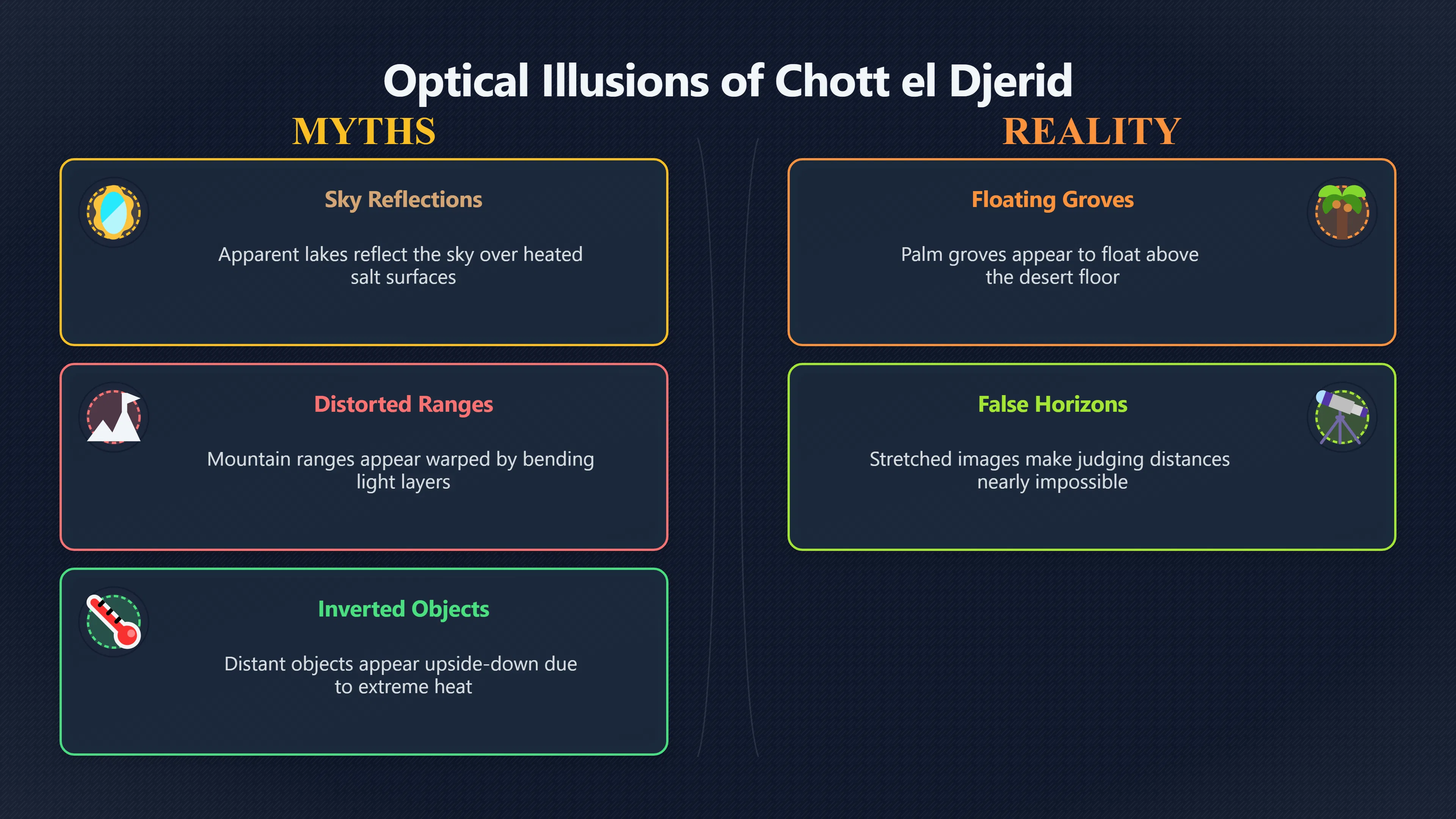
The combination of brilliant sunlight, extreme heat and an almost perfectly flat horizon makes the area one of North Africa’s classic mirage landscapes. The air immediately above the blazing salt surface becomes much hotter than the cooler air above it. Light bends through these layers, producing:
- Apparent lakes reflecting the sky.
- Floating islands or palm groves.
- Distorted mountain ranges.
- Inverted or stretched images of distant objects.
- False horizons that make judging distance almost impossible.
Travellers crossing the chott before modern roads often struggled to distinguish genuine water from optical illusions. Even today, photographs taken on hot afternoons can appear digitally manipulated despite showing entirely natural effects.
The strange appearance is amplified by the colours of the salt itself. Depending on moisture, algae, mineral concentration and the angle of the sun, the surface can shift between dazzling white, pink, pale green and violet, adding to the impression that the landscape is constantly changing.[UNESCO World Heritage Centre]whc.unesco.orgWorld Heritage Centre Chott El JeridUNESCO World Heritage CentreChott El Jerid - UNESCO World Heritage CentreMay 28, 2008…
Mirages, disappearing caravans and false lakes
The strongest Fortean reputation of Chott el Djerid comes not from monsters but from deception. Historical travellers repeatedly described seeing broad expanses of water that vanished as they approached, an experience so common across the Sahara that mirages became part of both local folklore and European travel writing.
The salt pan also had a more practical danger. Beneath apparently dry crusts lie saturated muds and brines. UNESCO’s documentation preserves traditions that camel caravans and even armies disappeared after leaving established routes because the surface could collapse beneath them. While such stories have undoubtedly grown in the telling, the underlying hazard is real enough that modern visitors are advised not to drive away from recognised crossings.[UNESCO World Heritage Centre]whc.unesco.orgWorld Heritage Centre Chott El JeridUNESCO World Heritage CentreChott El Jerid - UNESCO World Heritage CentreMay 28, 2008…
This mixture of genuine danger and optical illusion helps explain why supernatural interpretations flourished. A traveller might watch a glittering lake disappear, become disorientated, leave the safest path and encounter unstable ground. Natural causes and legendary storytelling became tightly intertwined.
Was this the legendary Lake Tritonis?
Since antiquity, scholars have debated whether Chott el Djerid or neighbouring chotts preserve memories of the mysterious Lake Tritonis described by ancient Greek writers.
Ancient authors placed Tritonis somewhere in North Africa and associated it with myths involving the goddess Athena and the hero Jason. Unfortunately, their geographical descriptions were inconsistent. Over the centuries, proposed locations have ranged from coastal lagoons to inland salt basins.
[Chott el Djerid]WikipediaChott el Djerid became an attractive candidate because:
- it occupies a huge natural depression;
- geological evidence confirms that much larger lakes existed here during wetter climatic periods;
- occasional flooding briefly recreates the appearance of a broad inland sea;
- mirages can make the flooded basin seem vastly larger than it really is.
Modern geology has complicated rather than settled the debate. Research shows that the basin has experienced repeated environmental changes through the Quaternary period, including phases with extensive lakes. There has also been debate over whether marine connections existed tens of thousands of years ago, although these prehistoric events long predate any classical traditions. The evidence therefore supports the idea that ancient observers may have encountered a dramatically wetter landscape, but it does not prove that Chott el Djerid was the Lake Tritonis of Greek legend.[Nature]nature.comMarine deposits 35,000–25,000 years old in the Chott el Djerid, southern Tunisia | NatureJanuary 7, 1982…
For Fortean readers, the important point is that mythology here grew around a landscape that genuinely changed over thousands of years rather than remaining permanently dry.
The mystery of the vanished crocodiles
Perhaps the most surprising “lost creature” associated with Chott el Djerid is not mythical at all.
Today it seems impossible to imagine crocodiles living on the edge of the Sahara, yet archaeological evidence, rock art and historical records demonstrate that the West African crocodile once occupied much of North Africa during wetter climatic periods. As deserts expanded, isolated populations survived in scattered springs, rivers and lakes.
Scientific reviews of Saharan crocodiles identify Chott el Djerid as one of the last refuges where crocodiles persisted before disappearing during the twentieth century. The Tunisian population appears to have become extinct sometime before the 1960s as increasing aridity and human pressures eliminated the remaining habitat.[PLOS]journals.plos.orgCrocodiles in the Sahara Desert: An Update of Distribution, Habitats and Population Status for Conservation Planning in Mauritania |…
That history helps explain why older stories from the region sometimes mention dangerous water creatures. While later retellings can sound like cryptozoological legends, the underlying animal was entirely real.
The crocodiles also illustrate how environmental memory can outlive the landscape itself. A place now famous for blinding salt and shimmering heat once contained enough permanent freshwater to support large reptiles.
Why the landscape encourages strange stories
Several independent factors combine to make Chott el Djerid unusually productive as a source of uncanny tales.
The environment is genuinely deceptive. Even experienced observers can misjudge distance, water and direction because of strong refraction over the heated surface.
The landscape changes dramatically. In unusually wet years the basin briefly resembles a shallow inland sea before evaporating over subsequent months, creating an almost magical transformation. Scientific monitoring after the exceptional floods of 1990 documented the birth and disappearance of one such temporary lake.[ScienceDirect]sciencedirect.comMarine-like potash evaporite formation on a continental playa: case study from Chott el Djerid, southern Tunisia - ScienceDi…
Real history resembles legend. Geological evidence confirms former lakes, while historical ecology confirms vanished crocodiles. Stories that sound fantastical often contain a kernel of environmental truth.
The terrain preserves little perspective. With almost no landmarks, travellers naturally fill visual uncertainty with imagination, making the chott a classic setting for tales of phantom cities, impossible lakes and mysterious disappearances.
What remains unexplained?
From a scientific perspective, very little about Chott el Djerid’s apparent “hauntings” requires paranormal explanations.
Mirages arise from well-understood atmospheric optics. Temporary lakes result from exceptional rainfall combined with an enclosed basin and rapid evaporation. Geological studies explain why traces of ancient water survive beneath today’s salt crust. The crocodiles belong to a documented chapter of Saharan environmental history rather than cryptozoology.[sciencedirect.com]sciencedirect.comMarine-like potash evaporite formation on a continental playa: case study from Chott el Djerid, southern Tunisia - ScienceDi…
Yet the landscape retains its power because human perception has limits. Even knowing the science does not prevent someone from seeing a gleaming lake that disappears before their eyes. Chott el Djerid remains one of Tunisia’s great natural theatres of illusion, where ordinary physics, deep environmental history and centuries of storytelling combine to produce one of North Africa’s most enduring Fortean landscapes.
Amazon book picks
Further Reading
Books and field guides related to Why Chott el Djerid Looks Haunted. Use these as the next step if you want deeper reading beyond the article.


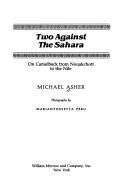
Two against the Sahara
First published 1988. Subjects: Description and travel, Travel, Sahara, description and travel, Voyages and travels, Journeys.
eBay marketplace picks
Marketplace Samples
Live-tested eBay searches with available results related to this page.
Endnotes
1.
Source: whc.unesco.org
Title: World Heritage Centre Chott El Jerid
Link:https://whc.unesco.org/en/tentativelists/5385/
Source snippet
UNESCO World Heritage CentreChott El Jerid - UNESCO World Heritage CentreMay 28, 2008...
Published: May 28, 2008
2.
Source: sciencedirect.com
Link:https://www.sciencedirect.com/science/article/pii/0037073894900434
Source snippet
Marine-like potash evaporite formation on a continental playa: case study from Chott el Djerid, southern Tunisia - ScienceDi...
3.
Source: nature.com
Link:https://www.nature.com/articles/295054a0
Source snippet
Marine deposits 35,000–25,000 years old in the Chott el Djerid, southern Tunisia | NatureJanuary 7, 1982...
Published: January 7, 1982
4.
Source: journals.plos.org
Link:https://journals.plos.org/plosone/article?id=10.1371%2Fjournal.pone.0014734
Source snippet
Crocodiles in the Sahara Desert: An Update of Distribution, Habitats and Population Status for Conservation Planning in Mauritania |...
5.
Source: sciencedirect.com
Title: Saharan lithium: Brine chemistry of chotts from eastern Algeria
Link:https://www.sciencedirect.com/science/article/abs/pii/S0883292720300482
Source snippet
April 1, 2020 — APPLIED GEOCHEMISTRY Volume 115, April 2020, 104566 SAHARAN LITHIUM: BRINE CHEMISTRY OF CHOTTS FROM EASTERN...
Published: April 1, 2020
6.
Source: whc.unesco.org
Link:https://whc.unesco.org/en/tentativelists/6095
Source snippet
Pan - UNESCO World Heritage CentreMarch 18, 2016 — ETOSHA PAN Namibia Date of Submission: 18/03/2016 Criteria: (vii)(viii)(x) Category: N...
Published: March 18, 2016
7.
Source: whc.unesco.org
Link:https://whc.unesco.org/fr/listesindicatives/5385/
Source snippet
El Jerid - UNESCO Centre du patrimoine mondialMay 28, 2008 — CHOTT EL JERID Tunisie Date de soumission: 28/05/2008 Critères: (vii)(viii)...
Published: May 28, 2008
8.
Source: youtube.com
Title: Tunisia Chott el Djerid
Link:https://www.youtube.com/watch?v=es3Ibyju4II
Source snippet
CHOTT EL DJERID, TUNISIA...
9.
Source: youtube.com
Title: CHOTT EL DJERID, TUNISIA
Link:https://www.youtube.com/watch?v=L1sKBevWKPY
Source snippet
Chott el Djerid: rust-washed salt lake - Sahara Desert, Tunisia...
10.
Source: youtube.com
Title: Chott el Djerid: rust-washed salt lake
Link:https://www.youtube.com/watch?v=0RmP0DIRbFE
Source snippet
On the Chott El Djerid salt lake causeway in Tunisia...
11.
Source: Wikipedia
Title: Chott el Djerid
Link:https://en.wikipedia.org/wiki/Chott_el_Djerid
Additional References
12.
Source: pmc.ncbi.nlm.nih.gov
Link:https://pmc.ncbi.nlm.nih.gov/articles/PMC3045445/
Source snippet
2011 Feb 25;6(2):e14734. doi: 10.1371/journal.pone.0014734 CROCODILES IN THE SAHARA DESERT: AN UPDATE OF DISTRIBUTION, HABITATS AND POPUL...
13.
Source: researchgate.net
Link:https://www.researchgate.net/publication/223016919_Marine-like_potash_evaporite_formation_on_a_continental_playa_case_study_from_Chott_el_Djerid_southern_Tunisia
14.
Source: science.nasa.gov
Title: Earth Observatory May 23,
Link:https://science.nasa.gov/earth/earth-observatory/in-a-desert-not-so-far-away-146767/
Source snippet
a Desert Not So Far Away - NASA ScienceMay 23, 2020 — Earth Observatory 3 min read IN A DESERT NOT SO FAR AWAY Image of the Day for May 2...
Published: May 23, 2020
15.
Source: youtube.com
Title: On the Chott El Djerid salt lake causeway in Tunisia
Link:https://www.youtube.com/watch?v=IJVBFNoOW-g
Source snippet
I Found a Pink Salt Lake in the Sahara Desert (Chott el Djerid, Tunisia) شط الجريد...
16.
Source: comptes-rendus.academie-sciences.fr
Link:https://comptes-rendus.academie-sciences.fr/geoscience/articles/en/10.5802/crgeos.132/
17.
Source: youtube.com
Link:https://www.youtube.com/watch?v=YLAht-JkMxM
Topic Tree