Within Equatorial Guinea
Why Bioko's Landscape Feels Haunted
Bioko's mountains, lakes, caves and standing stones form the strongest country-specific trail of sacred and uncanny tradition.
On this page
- Standing stones and ritual landmarks
- Pico Basile, lakes, caves and rivers
- What sacred geography can and cannot prove
Page outline Jump by section
Introduction
Bioko is the spiritual heart of Equatorial Guinea’s sacred landscape traditions. Long before the island became known for its volcanic scenery, rainforests and colonial history, the Bubi people understood its mountains, rivers, caves, lakes and standing stones as places where the visible and invisible worlds overlapped. Unlike famous “haunted” locations elsewhere, these places were not primarily associated with ghost stories designed to frighten outsiders. They formed part of a living religious geography that explained ancestry, health, fertility, misfortune and the relationship between people and the land.
For anyone exploring Equatorial Guinea’s Fortean heritage, this is one of the country’s richest and most distinctive traditions. Yet it also demands care. Most evidence comes from anthropology, oral history and archaeological research rather than sensational paranormal accounts. The mystery lies less in spectacular supernatural claims than in how an entire landscape became organised around sacred places whose meanings have survived centuries of colonial rule, Christianisation and social change.[Culture and History]cultureandhistory.revistas.csic.esThe start of the 20th century on Bioko Island (Equatorial Guinea) coincides with the expansion of Spanish colonisation.Read more…
Standing stones and ritual landmarks
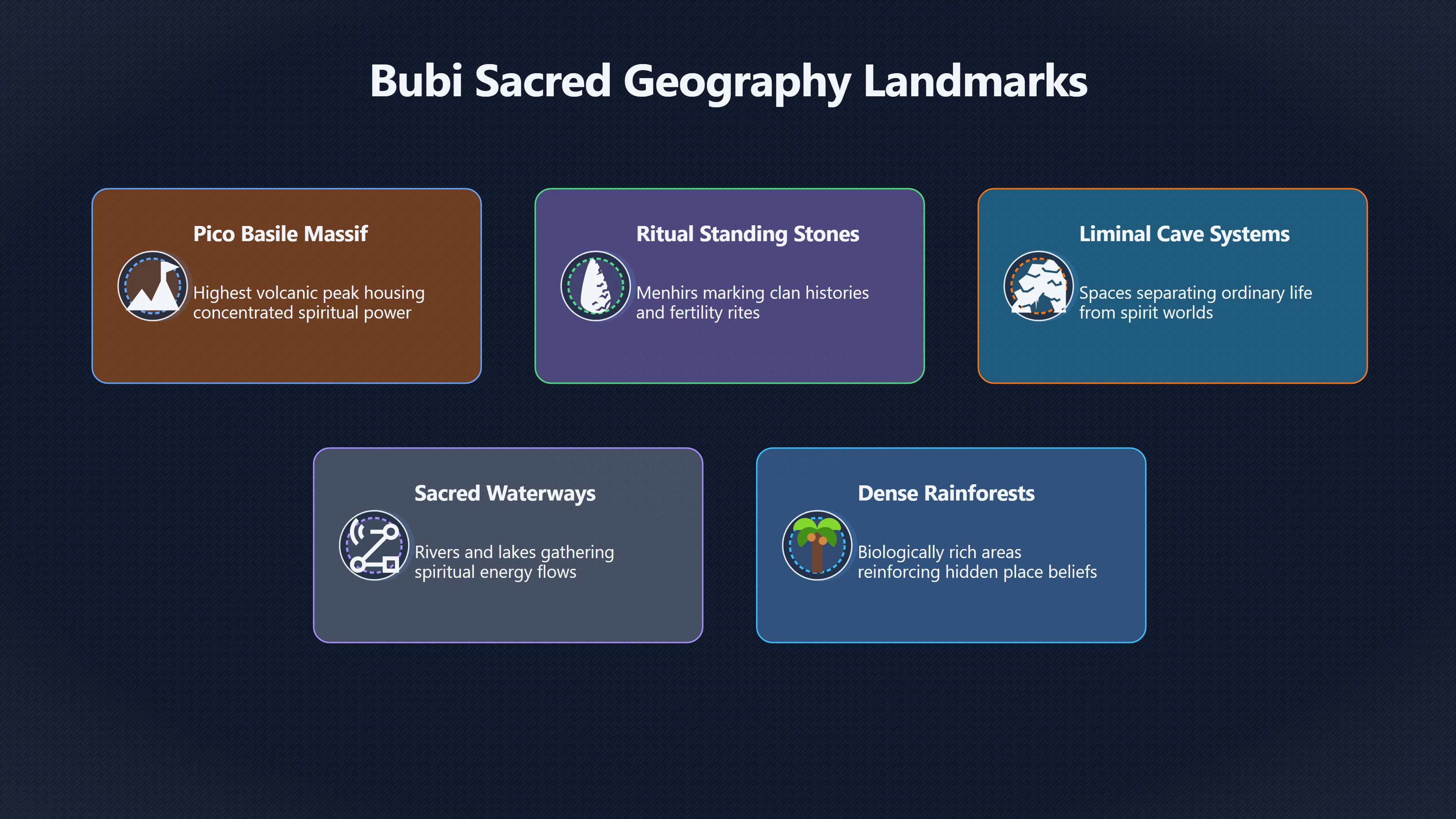
One of the most distinctive features of Bioko’s sacred geography is the presence of upright stones, or menhirs, found in different parts of the island. These are not generally regarded by archaeologists as mysterious prehistoric monuments in the style of Stonehenge. Instead, they are understood as ritual markers connected with Bubi religious life.
Colonial-era observers and later historians recorded that particular stones were linked to specific ceremonies, clan histories and sacred events. Some were associated with fertility, childbirth or the protection of children, while others marked places where offerings could be made or where spirits were believed to maintain a continuing presence. Rather than acting as isolated monuments, they formed part of a wider sacred landscape in which rocks, trees and waterways were interconnected.[101lasttribes.com]101lasttribes.com101 Last TribesBubi peopleA blending between the spirit world and the physical world on Bioko means nearly every distinctive landmark was…
The importance of these stones also illustrates a recurring theme in Fortean folklore: outsiders often mistake ritual objects for unexplained artefacts. Early European visitors sometimes described them simply as curious stones without understanding the local traditions attached to them. Modern archaeology instead places them within the religious life of the Bubi, where their significance depends on cultural memory rather than architectural mystery.[Culture and History]cultureandhistory.revistas.csic.esThe start of the 20th century on Bioko Island (Equatorial Guinea) coincides with the expansion of Spanish colonisation.Read more…
Pico Basile, lakes, caves and rivers
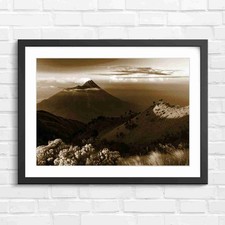
The most powerful point in Bioko’s sacred geography is the volcanic massif of Pico Basile, the island’s highest mountain. Rising over 3,000 metres above sea level, it dominates the landscape physically as well as spiritually.
Traditional Bubi belief regarded prominent mountains as places where supernatural power was especially concentrated. Rather than being remote wilderness, the highlands were understood as inhabited by spiritual forces connected with ancestors and the creator. Even after widespread conversion to Christianity during Spanish colonial rule, many traditional associations with the mountain survived in local memory alongside newer religious practices.[African Tribe Names Last Tribes]tribeguess.comThe peaks of Bioko were sacred. Christianity has largely replaced traditional practices.Read more…
The sacred geography extended well beyond the summit. Rivers were not merely watercourses but places where spiritual energy could gather. Lakes could become locations for ritual observance, while caves were often viewed as liminal spaces separating ordinary life from the spirit world. Because these locations were embedded in oral tradition rather than written scripture, their meanings sometimes varied between communities and family lineages.
Dense rainforest reinforced these beliefs. Much of southern Bioko remains exceptionally wet and biologically rich, with steep valleys, volcanic craters and cloud forest that can appear isolated even today. Such environments naturally encourage traditions in which hidden places possess unusual significance. Modern conservationists recognise many of these same areas as ecological treasures, demonstrating how sacred and environmental values often overlap.[Wikipedia]WikipediaPico Basilé National ParkPico Basilé National Park
Why the landscape itself became spiritually alive
Unlike belief systems that separate sacred buildings from ordinary countryside, traditional Bubi cosmology blurred the distinction between the spiritual and physical worlds.
Historical descriptions repeatedly note that distinctive natural features were believed to possess their own spiritual identities. Rivers, mountains and lakes were not simply symbolic; they were places where unseen beings might act upon human affairs. Illness, accidents or unexpected good fortune could all be interpreted through this relationship between landscape and spirit.
This does not mean every unusual rock or forest clearing carried equal importance. Sacred status was selective and developed through generations of ritual practice, inherited knowledge and communal memory. Particular locations gained authority because ceremonies were performed there, ancestors were associated with them or local tradition remembered significant events connected with the place.[101lasttribes.com]101lasttribes.com101 Last TribesBubi peopleA blending between the spirit world and the physical world on Bioko means nearly every distinctive landmark was…
For students of folklore, this makes Bioko especially interesting. Rather than isolated ghost legends, the island presents an integrated “spirit geography” in which supernatural belief is mapped across an entire volcanic landscape.
Colonial change and the survival of sacred places
Spanish colonial administration and Catholic missionary activity transformed Bubi society during the late nineteenth and twentieth centuries. Mission churches, new settlements and colonial administration weakened many traditional institutions, while Christian teaching discouraged older religious practices.
Yet sacred geography proved more resilient than many formal rituals. Anthropological studies show that traditional ideas continued to influence family life, marriage customs and local identity even after conversion to Christianity. In some cases, older beliefs merged with newer religious ideas instead of disappearing altogether.[Culture and History]cultureandhistory.revistas.csic.esThe start of the 20th century on Bioko Island (Equatorial Guinea) coincides with the expansion of Spanish colonisation.Read more…
This persistence helps explain why references to sacred mountains, ritual stones and spiritually significant landscapes still appear in modern discussions of Bubi heritage. Although relatively few people openly practise traditional religion today, the geography itself remains culturally meaningful.
What sacred geography can and cannot prove
For Fortean readers, Bioko offers an unusual kind of mystery. There are no well-documented hauntings, dramatic poltergeist cases or famous modern paranormal investigations attached to most of these locations. Instead, the evidence points to something historically deeper: an enduring system of sacred places whose meanings were transmitted through oral tradition.
Believers may regard these traditions as reflecting genuine spiritual realities embedded within the landscape. Sceptics usually interpret them as expressions of cultural identity, environmental knowledge and religious symbolism shaped over centuries. Archaeologists generally treat the standing stones and ritual sites as evidence of long-standing ceremonial practices rather than proof of supernatural forces.[csic.es]cultureandhistory.revistas.csic.esThe start of the 20th century on Bioko Island (Equatorial Guinea) coincides with the expansion of Spanish colonisation.Read more…
That balance of certainty and uncertainty is precisely what makes Bioko’s sacred geography such an important part of Equatorial Guinea’s strange heritage. The island’s mountains, caves, lakes and stones remain undeniably real, while the invisible meanings attached to them continue to exist in memory, tradition and belief rather than in measurable scientific evidence.
Amazon book picks
Further Reading
Books and field guides related to Why Bioko's Landscape Feels Haunted. Use these as the next step if you want deeper reading beyond the article.


The palm-wine drinkard and his dead palm-wine tapster in the...
First published 1952. Subjects: Fiction, Yoruba (African people), Folklore, Wine and wine making, Nigeria, fiction.
eBay marketplace picks
Marketplace Samples
Live-tested eBay searches with available results related to this page.
Endnotes
1.
Source: 101lasttribes.com
Link:https://www.101lasttribes.com/tribes/bubi.html
Source snippet
101 Last TribesBubi peopleA blending between the spirit world and the physical world on Bioko means nearly every distinctive landmark was...
2.
Source: Wikipedia
Title: Pico Basilé National Park
Link:https://en.wikipedia.org/wiki/Pico_Basil%C3%A9_National_Park
3.
Source: Wikipedia
Title: Cameroon line
Link:https://en.wikipedia.org/wiki/Cameroon_line
4.
Source: Wikipedia
Link:https://en.wikipedia.org/wiki/Bioko
5.
Source: Wikipedia
Title: Bubi people
Link:https://en.wikipedia.org/wiki/Bubi_people
Source snippet
Bubi peopleBubi people and the supernatural spirits shared the land. Sinister spirits were blamed for illness, accidents, and misfortune...
6.
Source: researchgate.net
Link:https://www.researchgate.net/publication/348609695_Between_Tradition_and_Evangelisation_Marriage_Ritualisation_on_Colonial_and_Contemporary_Bioko_Island
Source snippet
Marriage Ritualisation on Colonial and Contemporary Bioko IslandFinally, the text explains how the practices and values that the evangeli...
7.
Source: researchgate.net
Title: Research Gate(PDF) What is sacred in sacred natural sites?
Link:https://www.researchgate.net/publication/367485194_What_is_sacred_in_sacred_natural_sites_A_literature_review_from_a_conservation_lens
Source snippet
A literature...4 Mar 2026 — Sacred natural sites (SNS) are valuable biocultural hotspots and important areas for nature conservation. Th...
8.
Source: cultureandhistory.revistas.csic.es
Link:https://cultureandhistory.revistas.csic.es/index.php/cultureandhistory/article/download/189/615?inline=1
Source snippet
The start of the 20th century on Bioko Island (Equatorial Guinea) coincides with the expansion of Spanish colonisation.Read more...
9.
Source: thebubis.com
Title: The Bubis Bioko’s indigenous Bubi tribe
Link:https://www.thebubis.com/Overview.html
Source snippet
Bioko's indigenous Bubi tribe - The Bubis on Fernando PoA blending between the spirit world and the physical world on Bioko mean s nearly...
10.
Source: tribeguess.com
Link:https://www.tribeguess.com/learn/bubi
Source snippet
The peaks of Bioko were sacred. Christianity has largely replaced traditional practices.Read more...
Additional References
11.
Source: facebook.com
Title: the bubi people of bioko island equatorial guinea hold a rich cultural heritage
Link:https://www.facebook.com/eriatv/posts/the-bubi-people-of-bioko-island-equatorial-guinea-hold-a-rich-cultural-heritage-/1138175268328790/
Source snippet
The Bubi people of Bioko Island, Equatorial Guinea, hold a...31 May 2025 — What they have in common is that they use Iboga as a sacramen...
Published: May 2025
12.
Source: youtube.com
Link:https://www.youtube.com/watch?v=9R8X_GJwf_0
Source snippet
African Sacred Mountains & Caves: Hidden Portals to the DivineExplore sacred mountains and caves across Africa—hidden spiritual portals t...
13.
Source: youtube.com
Link:https://www.youtube.com/watch?v=_52RlDtIgDg
14.
Source: lastplaces.com
Title: We will try to talk to a priest and witness a traditional dance.Read more
Link:https://lastplaces.com/en/trips/ethnographic-trip-to-equatorial-guinea-november-2025/
Source snippet
Ethnographic trip to Equatorial Guinea ► Bantu tribes and...Although most Bubi are Catholic today, they still maintain some of their tra...
15.
Source: artofthemotherland.com
Title: spirits of the forest guardians of the island
Link:https://artofthemotherland.com/spirits-of-the-forest-guardians-of-the-island/
Source snippet
Spirits of the Forest, Guardians of the Island31 May 2025 — * Spiritual Beliefs and Sacred Sites: Bubi traditional religion involves a be...
Published: May 2025
16.
Source: instagram.com
Link:https://www.instagram.com/reel/Bo3o2q_jVVs/
Source snippet
ambia. It appears as a towering mass of palm fronds, and...Read more...
17.
Source: folktales.africa
Title: the healer of the sacred highlands
Link:https://folktales.africa/the-healer-of-the-sacred-highlands/
Source snippet
Africa.com15 Jun 2026 — Long ago, in the mist-covered highlands of Bioko Island, the Bubi people lived among fertile valleys, ru...
18.
Source: youtube.com
Title: The Bubi People: Guardians of Bioko’s Heritage.
Link:https://www.youtube.com/watch?v=_7aUJrJaVl8
Source snippet
"Friday Series: The Kingdom of the Bubi People; “Daily Rituals “[https://www.youtube.com/watch?v=t00uWpfvu5o..."](https://www.youtube.com/watch?v=t00uWpfvu5o...")...
19.
Source: youtube.com
Link:https://www.youtube.com/watch?v=WnDQTdqXS10
Source snippet
Protecting Biodiversity on Bioko Island...
20.
Source: youtube.com
Link:https://www.youtube.com/watch?v=t00uWpfvu5o
Source snippet
"Bioko Island: A Forgotten Gem in the Gulf of Guinea - travel documentary for Czech Television[https://www.youtube.com/watch?v=WnDQTdqXS10..."](https://www.youtube.com/watch?v=WnDQTdqXS10...")...
Topic Tree