Where Tunisia's Weird History Feels Real
Tunisia’s strange-history record is not best understood as a catalogue of monsters and flying saucers.
Page outline Jump by section
Introduction
That makes Tunisia unusually rewarding for grounded Forteana. The country offers genuine oddities without needing to pretend that every story is paranormal. A sudden lake near Gafsa can be discussed as geology, media sensation and local miracle-talk at once. Chott el Djerid can be a natural optical theatre, a classical mythic landscape and the former edge of a vanished crocodile range. Stambeli can be both a living ritual tradition and a window into how spirit beliefs carry social history. Tunisia’s weirdness is not a sideshow to its history; it is one of the ways that history has been remembered.
The lake near Gafsa that looked like a miracle
The most modern Tunisian “mystery” to travel widely online was the sudden appearance of a lake near Gafsa in 2014. International reports described water turning up in a dry, drought-stricken area roughly 25 kilometres from Gafsa, after shepherds or local residents noticed what quickly became known as “Gafsa Beach” or the “mysterious lake”. The story had all the ingredients of a perfect contemporary Fortean item: a startling before-and-after image, a desert setting, a dramatic local name, and an uneasy mix of relief and fear.[The Independent]independent.co.ukThe Independent Mystery as 'lake' appears in middle of Tunisian desertThe Independent Mystery as 'lake' appears in middle of Tunisian desert
The strangeness was not simply that water existed in Tunisia’s interior. It was that the lake appeared suddenly enough to feel like an event rather than a gradual seasonal feature. Early explanations included a rupture in rock above the water table, possibly releasing underground water, while other suggestions pointed to rainwater collecting in a natural hollow. Neither version required a supernatural cause, but both left room for uncertainty because the lake’s exact formation was not immediately settled in public reporting.[The Guardian]theguardian.commysterious lake tunisian desert turquoise green sludgemysterious lake tunisian desert turquoise green sludge
The story then changed tone. At first, photographs of blue water in a hot landscape made the place look like an impossible oasis. Within weeks, reports noted that the water had turned greenish and stagnant, raising fears about algae and contamination. The Gafsa region is associated with phosphate mining, and contemporary coverage warned that phosphate deposits can leave radioactive residues; later environmental research on southern Tunisia has also discussed naturally occurring radioactive isotopes and contamination concerns linked to phosphate-bearing formations and groundwater systems.[The Guardian]theguardian.commysterious lake tunisian desert turquoise green sludgemysterious lake tunisian desert turquoise green sludge
For Fortean readers, the lake matters because it shows how a real environmental event can behave like folklore almost immediately. Locals reportedly treated it variously as a blessing, curiosity, danger and tourist attraction. Sceptics did not need to “debunk” the lake itself: the water was real. The question was what kind of reality it represented — hydrological accident, geological release, polluted hazard, miracle-like coincidence, or all of these at once. That layered quality is what made the Gafsa lake a memorable Tunisian oddity rather than just a travel-news curiosity.

Chott el Djerid: mirages, lost lakes and crocodiles at the edge of belief
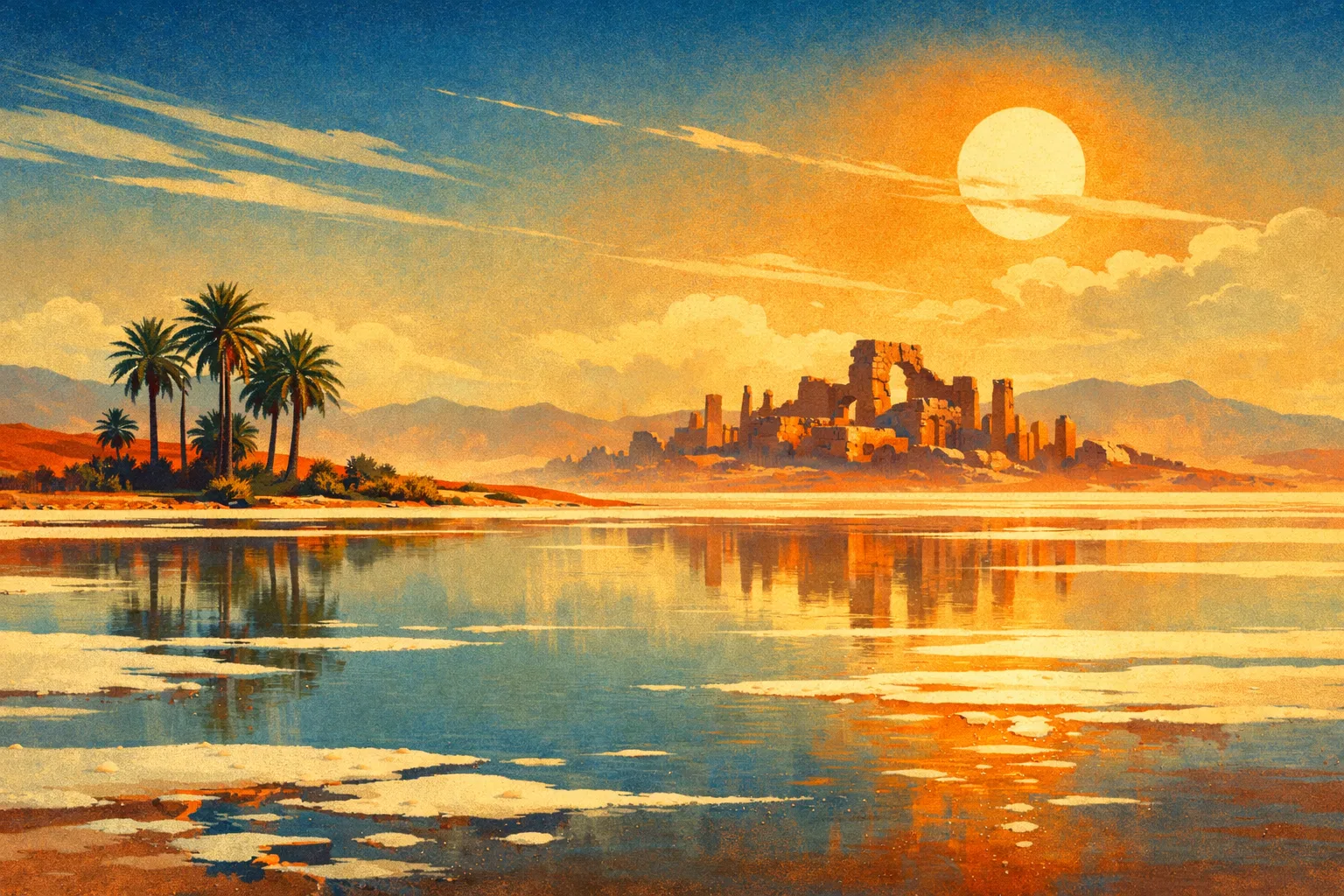
If Gafsa’s lake was a sudden mystery, Chott el Djerid is a long-running machine for producing strangeness. This enormous salt pan in southern Tunisia is listed by UNESCO on Tunisia’s tentative World Heritage list and stretches across the Tozeur and Kebili governorates; UNESCO gives its area as 586,187 hectares. Its surface, water cover and colours shift with season, rainfall and evaporation, making it one of the country’s great natural stages for ambiguous perception.[UNESCO World Heritage Centre]whc.unesco.orgOpen source on unesco.org.
The classic Chott el Djerid experience is the mirage. The Guggenheim Bilbao’s description of Bill Viola’s work filmed there is useful because it treats the site not as a fantasy backdrop but as an optical environment: in the midday heat, light bends and distorts so intensely that trees, dunes and buildings appear to float or shimmer. That is the sober explanation, yet the experience remains uncanny. A mirage is a real perception of a false arrangement; the witness is not necessarily lying or hallucinating.[Guggenheim Bilbao]guggenheim-bilbao.eusOpen source on guggenheim-bilbao.eus.
This is why the chott belongs in Tunisia’s Fortean record. It naturally produces the kind of testimony that strange-history writers recognise: “I saw water where there was none”; “the horizon moved”; “a shape floated above the ground”. In a less studied setting, such reports might become ghost lights, phantom lakes or lost cities. At Chott el Djerid, physics does much of the haunting.
The landscape also sits near older mythic geography. Classical writers described a North African Lake Tritonis connected with stories of Athena, Triton and the Argonauts, though its exact location remains debated rather than firmly identifiable with one modern site. Later retellings have often associated the idea of Tritonis with southern Tunisia and the chott landscape, helped by the fact that Chott el Djerid is itself an immense, changeable basin where water, salt and horizon can seem to rewrite the map.[Wikipedia]WikipediaLake TritonisLake Tritonis
Then there are the crocodiles. Modern readers may find “Saharan crocodiles” almost cryptozoological, but this is not a lake-monster rumour. A PLOS ONE review on Saharan crocodiles notes that crocodile populations became extinct in Chott el Djerid, Tunisia, between the beginning of the twentieth century and the 1960s, as part of a wider pattern of local extinction under aridity and human pressure.[PLOS]journals.plos.orgOpen source on plos.org.
That fact changes the emotional texture of the place. A modern visitor sees salt, heat and emptiness; the historical and zoological record says that crocodiles once survived in Saharan refuges, including the Tunisian chott system. In Fortean terms, this is the best kind of “monster” story: not an invented beast, but a real animal made unbelievable by environmental change.
Spirits in everyday Tunisia: jinn, Stambeli and the haunted hammam
Tunisia’s supernatural folklore is not confined to ruined buildings or tourist ghost stories. Belief in jinn remains part of social imagination, family storytelling and popular explanation, even among people who do not treat every tale literally. A 2024 essay in New Lines Magazine described the continuing force of jinn stories in Tunisian society despite long-running modernising and reformist pressures against such beliefs.[New Lines Magazine]newlinesmag.comNew Lines Magazine The Lasting Power of Jinn in Tunisian SocietyNew Lines Magazine The Lasting Power of Jinn in Tunisian Society
For an outside reader, the important point is not to flatten jinn into “ghosts” or “demons”. In Tunisian contexts, as elsewhere in the wider Arabic-speaking and Islamic world, jinn can function as explanations for uncanny places, sudden illness, possession-like states, bad luck, dreams, fear and moral warning. They give shape to experiences that might otherwise be described medically, psychologically, socially or spiritually, depending on the speaker.
The most substantial Tunisian spirit tradition for this page is Stambeli, a healing music and trance practice associated especially with Black Tunisians descended from enslaved sub-Saharan Africans. Richard C. Jankowsky’s ethnographic study, published by the University of Chicago Press, describes Stambeli as a tradition in which music calls on a pantheon of sub-Saharan spirits and North African Muslim saints to heal through ritualised trance.[University of Chicago Press]press.uchicago.eduOpen source on uchicago.edu.
That makes Stambeli a major piece of Tunisian Forteana, but it should not be treated as spooky entertainment. It is a cultural, musical and therapeutic system tied to histories of slavery, displacement, race, Islam, saint veneration and community memory. Reports of possession or trance within Stambeli are not merely claims that “spirits appeared”; they are structured ritual experiences, with musicians, songs, order, expectation and healing purpose. Journalism on the tradition has also stressed its precarious status today and its connection to Tunisia’s Black, Jewish and Amazigh cultural histories.[Equal Times]equaltimes.orgEqual Times Stambeli's last dance in TunisEqual Times Stambeli's last dance in Tunis
At the more urban-legend end of the spectrum sits the “hammam maiden” of the old medina of Tunis, reported by Al Jazeera in a regional Halloween folklore feature. The story centres on a young woman, a bathhouse and a warning to other women, making it less a “case” than a moralised haunting: the sort of tale that attaches fear to a specific public place and then teaches behaviour through unease.[Al Jazeera]aljazeera.comAl Jazeera Spooky Arab tales for Halloween: Tunisia's hammam maidenAl Jazeera Spooky Arab tales for Halloween: Tunisia's hammam maiden
These traditions show two different modes of Tunisian haunting. Stambeli is embodied, musical and communal; the hammam tale is cautionary, local and story-shaped. Both sit in the borderland between belief and social function. Whether or not a reader accepts spirits as literal beings, the stories still do work: they explain vulnerability, mark dangerous spaces, preserve memory and turn private anxiety into shared narrative.
Carthage and the Tophet: when archaeology becomes a horror story
No Tunisian ancient site has generated a darker argument than the Tophet of Carthage. The archaeological site of Carthage itself is recognised by UNESCO as a major ancient metropolis, founded by Phoenicians and central to Punic civilisation before becoming an important Roman site. Within that wider historical landscape, the Tophet has become one of the most contested places in Mediterranean archaeology.[UNESCO World Heritage Centre]whc.unesco.orgOpen source on unesco.org.
The claim is stark: ancient Carthaginians sacrificed infants and buried their cremated remains with offerings in a special sacred precinct. Greek and Roman writers accused Carthage of child sacrifice, but those sources were hostile and politically loaded, especially given Rome’s long conflict with Carthage. For centuries, the story therefore hovered between atrocity report, enemy propaganda and possible ritual fact.
Modern archaeology has not made the issue simple. A 2010 PLOS ONE paper by Jeffrey Schwartz and colleagues argued that skeletal remains from Punic Carthage did not support systematic infant sacrifice and were more consistent with a cemetery for children who died shortly before or after birth. That interpretation treated the Tophet less as a murder site than as a specialised burial ground for the very young.[PLOS]journals.plos.orgOpen source on plos.org.
Other scholars have pushed back. Oxford University’s 2014 summary of collaborative research argued that attempts to explain tophets merely as child cemeteries were misguided and that Carthaginian child sacrifice was supported by the combined evidence of burials, inscriptions and animal remains. The Guardian’s report on the same debate likewise presented the study as a challenge to the idea that the ancient accusations were only propaganda.[Oxford University]ox.ac.uk2014 01 23 ancient carthaginians really did sacrifice their children2014 01 23 ancient carthaginians really did sacrifice their children
For a Fortean page, the Tophet matters not because it is “paranormal”, but because it shows how an ancient horror story can remain unresolved in public imagination even when the evidence is physical. Bones, urns, inscriptions and hostile texts do not speak with one voice. Believers in the sacrifice interpretation see archaeology confirming a long-denied atrocity; sceptics of that interpretation see a grim but ordinary infant cemetery distorted by enemy literature and modern appetite for horror.
The careful position is that the Tophet is a real site, the infant remains are real, and the debate is real. What remains contested is the meaning of the depositions and the scale and nature of any sacrificial practice. It is one of Tunisia’s most powerful “strange history” cases because the uncertainty is not vague or flimsy; it is built into the difficult meeting point of archaeology, ancient propaganda, ritual practice and modern moral imagination.
Sky anomalies: thin files, bright clouds and better explanations
Tunisia does not have a widely documented, internationally famous UFO case on the scale of Roswell, Rendlesham Forest or the Belgian wave. That absence is itself useful. It means responsible coverage should not inflate scattered sightings into a national UFO mythology. The better approach is to separate three categories: archived reports, local witness stories, and ordinary sky phenomena that can look extraordinary.
One archival trace appears in a declassified CIA-hosted document relating to NICAP material, which lists a “Tunis-Tripoli” radar-visual UFO report dated 13 February 1953 involving a B-36 crew. The snippet is intriguing, especially because radar-visual reports carry more weight than anonymous lights-in-the-sky anecdotes, but it is still only a catalogue-style reference unless supported by full case documentation, witness statements, instrument records and later analysis.[CIA]cia.govOpen source on cia.gov.
More recent Tunisian sky strangeness often belongs to the age of viral images. A France 24 Observers video result, for example, framed unusual cloud formations over Tunisia with the question of whether locals read them as a message from aliens or from God. That is classic modern Forteana: not necessarily a mystery object, but a public moment in which an atmospheric display becomes a screen for cosmic, religious or humorous interpretation.[YouTube]youtube.comOpen source on youtube.com.
The sceptical toolkit here is straightforward. Tunisia’s skies can produce meteors, satellites, aircraft, military activity, lanterns, drones, bright planets, unusual cloud forms and mirage-like distortions near hot surfaces. None of those explanations should be forced onto a case without details, but they should be tried before reaching for extraterrestrial claims. The country’s better-attested uncanny sky material lies less in alien visitation than in how desert optics, heat and horizon effects prime people to distrust what their eyes are telling them.
Strange falls and missing monsters: what the evidence does not show
Some countries have famous Fortean “falls” of fish, frogs, blood-coloured rain or stones. Tunisia does not currently appear to have a strong, well-sourced national case of that type in the accessible record. That does not mean no odd fall was ever reported in a local newspaper or oral account; it means the evidence is not robust enough to treat such a case as central to Tunisia’s weird-history profile.
This matters because Forteana often rewards restraint. Animal rains are a recognised class of strange report worldwide, and the Library of Congress notes that witnesses often describe uniform falls of one kind of creature, with waterspouts and wind sorting by size and weight among the usual explanations. But without a specific Tunisian incident tied to a date, place and credible source, importing generic fish-rain lore would weaken rather than strengthen the page.[The Library of Congress]loc.govOpen source on loc.gov.
The same is true of lake monsters and phantom animals. Tunisia’s most interesting “monster” angle is not a Nessie-like creature but the historically documented disappearance of crocodiles from Saharan refuges. That is more valuable than a thin cryptid rumour because it shows how real ecology can become unbelievable with time. When a landscape changes, yesterday’s ordinary animal becomes tomorrow’s impossible story.
Why Tunisia’s weird record feels different
Tunisia’s Forteana is unusually tied to thresholds. Water appears where desert is expected. Salt flats imitate lakes. Heat turns the horizon theatrical. Crocodiles belong to a landscape that now seems too dry for them. A healing rite turns music into a meeting point with spirits. A bathhouse becomes a cautionary haunting. An ancient cemetery becomes a moral and archaeological battleground.
That pattern gives the country’s strange material its cultural pull. Tunisia is not simply “haunted” in the generic sense. Its uncanny stories often ask the same deeper question: what happens when a place refuses to stay in one category? Desert or lake, physics or vision, cemetery or sacrifice, illness or spirit, animal range or monster memory, weather or sign — the fascination lies in the border.
The strongest Tunisian cases also resist easy endings. The Gafsa lake can be explained without losing its eerie force. Chott el Djerid’s mirages are understood optical effects that still feel unreal when seen. Stambeli can be studied ethnographically without reducing it to mere performance. The Tophet debate can be argued from bones and inscriptions without becoming morally comfortable. That is the country’s distinctive contribution to grounded Forteana: not a pile of sensational claims, but a set of places and traditions where reality itself has always looked slightly unstable.
Amazon book picks
Further Reading
Books and field guides related to Where Tunisia's Weird History Feels Real. Use these as the next step if you want deeper reading beyond the article.

Carthage must be destroyed
Explores Tunisia's archaeological and historical background.
eBay marketplace picks
Marketplace Samples
Live-tested eBay searches with available results related to this page.


Endnotes
1.
Source: Wikipedia
Title: Lac de Gafsa
Link:https://en.wikipedia.org/wiki/Lac_de_Gafsa
2.
Source: whc.unesco.org
Link:https://whc.unesco.org/en/tentativelists/5385/
3.
Source: guggenheim-bilbao.eus
Link:https://www.guggenheim-bilbao.eus/en/exhibition/chott-el-djerid-a-portrait-in-light-and-heat
4.
Source: Wikipedia
Title: Lake Tritonis
Link:https://en.wikipedia.org/wiki/Lake_Tritonis
5.
Source: Wikipedia
Title: Chott el Djerid
Link:https://en.wikipedia.org/wiki/Chott_el_Djerid
6.
Source: journals.plos.org
Link:https://journals.plos.org/plosone/article?id=10.1371%2Fjournal.pone.0014734
7.
Source: whc.unesco.org
Link:https://whc.unesco.org/en/list/37/
8.
Source: journals.plos.org
Link:https://journals.plos.org/plosone/article?id=10.1371%2Fjournal.pone.0009177
9.
Source: cia.gov
Link:https://www.cia.gov/readingroom/document/cia-rdp81r00560r000100010001-0
10.
Source: youtube.com
Link:https://www.youtube.com/watch?v=kxHebgcHxYQ
11.
Source: youtube.com
Title: Did The Ancient Carthaginians Sacrifice Children?
Link:https://www.youtube.com/watch?v=lZsSB9riza8
12.
Source: Wikipedia
Title: Rain of animals
Link:https://en.wikipedia.org/wiki/Rain_of_animals
13.
Source: Wikipedia
Link:https://en.wikipedia.org/wiki/Stambali
14.
Source: Wikipedia
Link:https://en.wikipedia.org/wiki/Jinn
15.
Source: Wikipedia
Title: Carthage tophet
Link:https://en.wikipedia.org/wiki/Carthage_tophet
16.
Source: Wikipedia
Link:https://en.wikipedia.org/wiki/Carthage
17.
Source: Wikipedia
Title: Ancient Carthage
Link:https://en.wikipedia.org/wiki/Ancient_Carthage
18.
Source: Wikipedia
Link:https://en.wikipedia.org/wiki/Herodotus
19.
Source: Wikipedia
Title: Fata Morgana (mirage)
Link:https://en.wikipedia.org/wiki/Fata_Morgana_%28mirage%29
20.
Source: Wikipedia
Link:https://en.wikipedia.org/wiki/Crocodile
21.
Source: Wikipedia
Link:https://en.wikipedia.org/wiki/Tunisia
22.
Source: Wikipedia
Link:https://simple.wikipedia.org/wiki/Tunisia
23.
Source: Wikipedia
Title: Visions of Jesus and Mary
Link:https://en.wikipedia.org/wiki/Visions_of_Jesus_and_Mary
24.
Source: Wikipedia
Title: Our Lady of Zeitoun
Link:https://en.wikipedia.org/wiki/Our_Lady_of_Zeitoun
25.
Source: Wikipedia
Title: List of Intangible Cultural Heritage elements in Tunisia
Link:https://en.wikipedia.org/wiki/List_of_Intangible_Cultural_Heritage_elements_in_Tunisia
26.
Source: stambeli.com
Title: Black spirits, white saints
Link:https://stambeli.com/the-stambeli/
27.
Source: stambeli.com
Title: The book
Link:https://stambeli.com/the-book/
28.
Source: stambeli.com
Title: Home english
Link:https://stambeli.com/home-english/
29.
Source: youtube.com
Title: UF Os Are Really Jinn Appearances? With Imran Hussein
Link:https://www.youtube.com/watch?v=X8tOFhW-Fas
30.
Source: youtube.com
Title: CHOT T EL- DJERID
Link:https://www.youtube.com/watch?v=UjQOCfQ58vM
31.
Source: youtube.com
Link:https://www.youtube.com/shorts/fYVESlGwfHs
32.
Source: youtube.com
Title: UF Os Are Really Jinn Appearances?
Link:https://www.youtube.com/watch?v=TBcZwF7X0_c
33.
Source: youtube.com
Link:https://www.youtube.com/watch?v=lVj-CY7kE4Y
34.
Source: youtube.com
Link:https://www.youtube.com/watch?v=WdqgSWNJz0I
35.
Source: youtube.com
Title: Why is Herodotus called “The Father of History”?
Link:https://www.youtube.com/watch?v=A542ixwyBhc
36.
Source: youtube.com
Link:https://www.youtube.com/watch?v=hr4zzW-H-n4
37.
Source: youtube.com
Link:https://www.youtube.com/watch?v=p1BxkFZQiyQ
38.
Source: youtube.com
Link:https://www.youtube.com/watch?v=PrfdO4Hyyvc
39.
Source: youtube.com
Link:https://www.youtube.com/watch?v=Fw2wlVmOFOM
40.
Source: youtube.com
Link:https://www.youtube.com/watch?v=hmp3ZOkRGWc
41.
Source: ich.unesco.org
Title: tunisia TN
Link:https://ich.unesco.org/en/state/tunisia-TN?info=periodic-reporting
42.
Source: ich.unesco.org
Link:https://ich.unesco.org/en/Decisions/19.COM/7.b.13
43.
Source: digitalcollections.sit.edu
Link:https://digitalcollections.sit.edu/cgi/viewcontent.cgi?article=4081&context=isp_collection
44.
Source: tunisia.com
Link:https://www.tunisia.com/
45.
Source: youtube.com
Title: Stambeli, the spirits’ last dance
Link:https://www.youtube.com/watch?v=driWf1uNDiU
Source snippet
Child Sacrifice in Ancient Carthage...
46.
Source: youtube.com
Title: Child Sacrifice in Ancient Carthage
Link:https://www.youtube.com/watch?v=2QNgI8DVMzo
Source snippet
Lake Appeared in Desert in Minutes, No One Knows How...
47.
Source: youtube.com
Title: Lake Appeared in Desert in Minutes, No One Knows How
Link:https://www.youtube.com/watch?v=hr4AfHCy1rw
Source snippet
Ancient Child Sacrifice: From Canaanites to Carthage...
48.
Source: youtube.com
Title: Ancient Child Sacrifice: From Canaanites to Carthage
Link:https://www.youtube.com/watch?v=02BQyYu4cOo
49.
Source: independent.co.uk
Title: The Independent Mystery as ‘lake’ appears in middle of Tunisian desert
Link:https://www.independent.co.uk/travel/africa/mystery-as-lake-appears-in-middle-of-tunisian-desert-and-becomes-overnight-tourist-attraction-9642769.html
50.
Source: theguardian.com
Title: mysterious lake tunisian desert turquoise green sludge
Link:https://www.theguardian.com/world/2014/aug/01/mysterious-lake-tunisian-desert-turquoise-green-sludge
51.
Source: newlinesmag.com
Title: New Lines Magazine The Lasting Power of Jinn in Tunisian Society
Link:https://newlinesmag.com/essays/the-lasting-power-of-jinn-in-tunisian-society/
52.
Source: press.uchicago.edu
Link:https://press.uchicago.edu/ucp/books/book/chicago/S/bo9299440.html
53.
Source: equaltimes.org
Title: Equal Times Stambeli’s last dance in Tunis
Link:https://www.equaltimes.org/stambeli-s-last-dance-in-tunis
54.
Source: aljazeera.com
Title: Al Jazeera Spooky Arab tales for Halloween: Tunisia’s hammam maiden
Link:https://www.aljazeera.com/features/2023/10/31/spirittales-tunisias-hammam-maiden
55.
Source: ox.ac.uk
Title: 2014 01 23 ancient carthaginians really did sacrifice their children
Link:https://www.ox.ac.uk/news/2014-01-23-ancient-carthaginians-really-did-sacrifice-their-children
56.
Source: theguardian.com
Title: carthaginians sacrificed own children study
Link:https://www.theguardian.com/science/2014/jan/21/carthaginians-sacrificed-own-children-study
57.
Source: loc.gov
Link:https://www.loc.gov/everyday-mysteries/browse-all-questions/item/can-it-rain-frogs-fish-and-other-objects/
58.
Source: GOV.UK
Link:https://www.gov.uk/foreign-travel-advice/tunisia
59.
Source: theguardian.com
Title: last residents of tunisian ghost town set sights on europe
Link:https://www.theguardian.com/world/2023/oct/25/last-residents-of-tunisian-ghost-town-set-sights-on-europe
60.
Source: books.google.com
Link:https://books.google.com/books?id=TDXHtXRjZbQC&printsec=copyright
61.
Source: hinnavaatlus.ee
Title: university of chicago press stambeli music trance
Link:https://www.hinnavaatlus.ee/7455518/university-of-chicago-press-stambeli-music-trance/
62.
Source: aljazeera.com
Title: in tunisia a church procession blends faith nostalgia and migration
Link:https://www.aljazeera.com/features/2025/11/21/in-tunisia-a-church-procession-blends-faith-nostalgia-and-migration
63.
Source: penelope.uchicago.edu
Link:https://penelope.uchicago.edu/Thayer/E/Roman/Texts/Herodotus/home.html
64.
Source: mythus.fandom.com
Link:https://mythus.fandom.com/wiki/Jinn
65.
Source: atlasobscura.com
Title: chott el djerid
Link:https://www.atlasobscura.com/places/chott-el-djerid
66.
Source: omusa.org
Link:https://www.omusa.org/continents/tunisia/
67.
Source: argonauts-book.com
Title: Lake Tritonis
Link:https://www.argonauts-book.com/lake-tritonis.html
68.
Source: scholarworks.aub.edu.lb
Link:https://scholarworks.aub.edu.lb/bitstreams/03b85c9a-f712-4e14-aca9-d698273e0b9d/download
69.
Source: tunes.embaixadaportugal.mne.gov.pt
Title: mne.gov.pt General information
Link:https://tunes.embaixadaportugal.mne.gov.pt/en/about-tunisia/general-information
Additional References
70.
Source: reddit.com
Link:https://www.reddit.com/r/nonmurdermysteries/comments/f9go17/lac_de_gafsa_the_lake_that_mysteriously_appeared/
71.
Source: researchgate.net
Link:https://www.researchgate.net/publication/376891986_A_global_picture_of_unidentified_anomalous_phenomena_Towards_a_cross-cultural_understanding_of_a_potentially_universal_issue
72.
Source: academia.edu
Link:https://www.academia.edu/32521193/The_Tophet_and_Child_Sacrifice_in_the_Ancient_Mediterranean
73.
Source: academia.edu
Link:https://www.academia.edu/12347210/The_background_to_and_current_debate_on_the_issue_of_Carthaginian_child_sacrifice
74.
Source: researchgate.net
Link:https://www.researchgate.net/publication/380540277_Assessment_of_radiation_exposure_in_the_phosphate_mining_area_of_Gafsa_Southeastern_Tunisia
75.
Source: researchgate.net
Link:https://www.researchgate.net/publication/50250815_Crocodiles_in_the_Sahara_Desert_An_Update_of_Distribution_Habitats_and_Population_Status_for_Conservation_Planning_in_Mauritania
76.
Source: history.org.uk
Link:https://www.history.org.uk/podcasts/categories/439/podcast/707/ancient-carthage?srsltid=AfmBOopgr_mMtJ_9w0Fi1v7DU5JySQOi6uXdzX5JCTTXikfXXhe46vSB
77.
Source: facebook.com
Link:https://www.facebook.com/groups/thearchaeologynewsnetwork/posts/24954809194107290/
78.
Source: x.com
Link:https://x.com/histories_arch/status/2025145813639303373?lang=en
79.
Source: instagram.com
Link:https://www.instagram.com/p/DRLaLxOkgB_/
Topic Tree
Follow this branch
Related pages 192
- Afghan Forteana
- Antigua Uncanny
- Bosnian Mysteries
- Botswana Weird
- Brazil Strange
- +187 more in sidebar