Where Kenya's Weird Stories Meet Real Landscapes
Kenya’s strange-history record is not short of monsters, falling frogs, prophetic serpents, haunted craters and lions that became almost mythic.
Page outline Jump by section
Why Kenya’s weird record is tied to landscape
Kenya’s unusual reports cluster around places that already feel dramatic: the Rift Valley, Lake Victoria, volcanic craters, railway camps, highland forests and old colonial frontier zones. That does not make the stories supernatural. It does make them easier to remember. A crater with steaming geothermal vents, a lake wide enough to behave like an inland sea, or a railway camp being stalked by lions gives any rumour a stage.
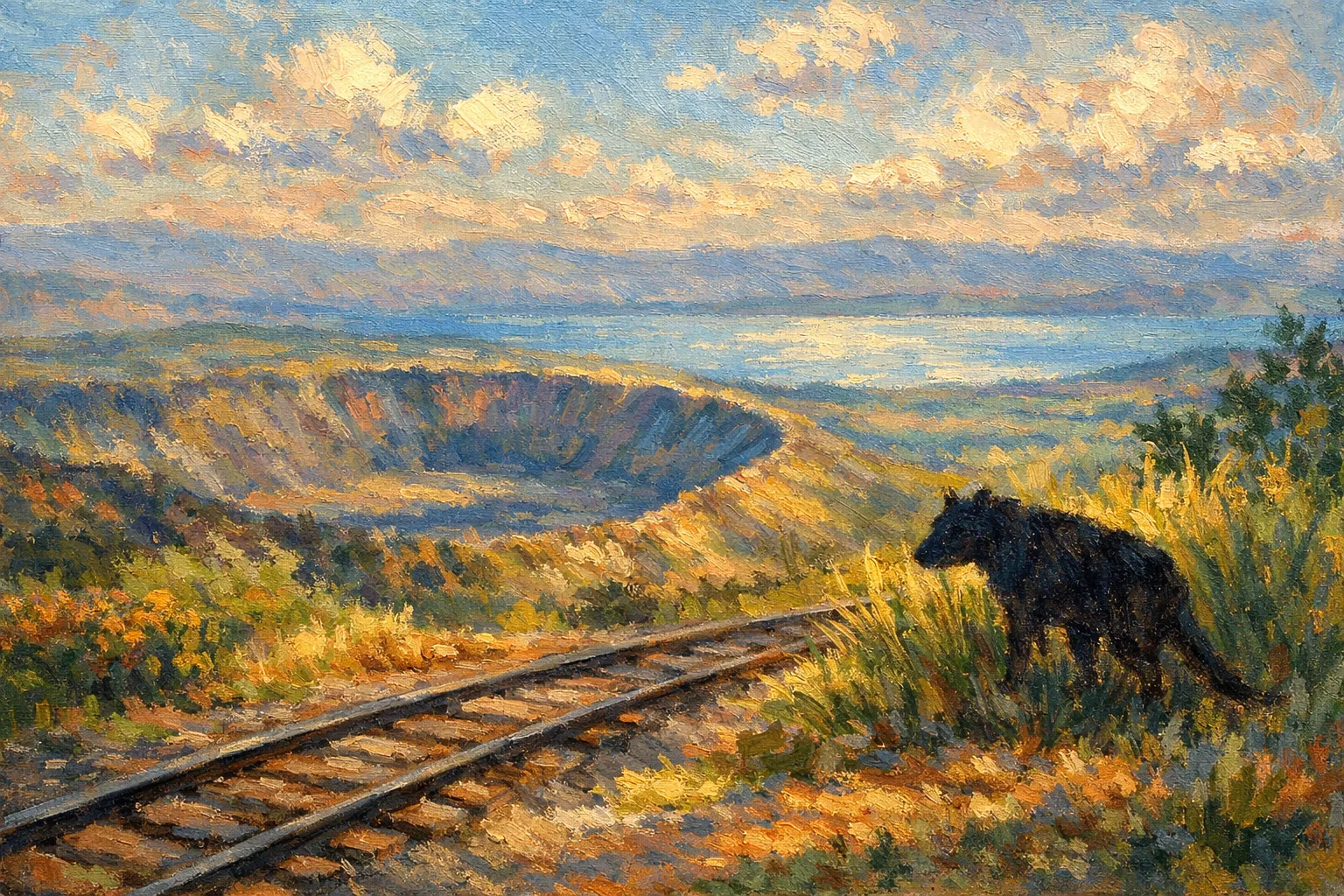
This is especially true of the Great Rift Valley. Menengai Crater, north of Nakuru, is a real volcanic caldera and a modern geothermal site; Kenya’s Geothermal Development Company describes the Menengai project as having begun in 2009 and estimates the field’s potential at 1,600 MW. That sober engineering context sits beside much older and more colourful stories of disappearances, devils and uncanny lights around the crater. The result is classic Forteana: a real landscape with real danger and geology, overlaid with reports that mix local warning tale, travel writing and ghost story.[GDC]gdc.co.keOpen source on gdc.co.ke.
Kenya’s western lake country gives a different kind of strangeness. Lake Victoria is shared by Kenya, Uganda and Tanzania, so its water legends often cross modern national borders. Reports of lake serpents, canoe spirits and prophetic beings are not cleanly “Kenyan” in a narrow administrative sense, but they belong naturally to Kenya’s Lake Victoria fringe. The most important point is not whether a lake monster exists, but how water, danger, fishing, politics and spiritual authority become tangled in stories that people pass on.
The Nandi Bear: Kenya’s best-known mystery animal
The Nandi Bear is probably Kenya’s most famous cryptozoological export: a supposed large, fierce, bear-like or hyena-like creature reported mainly from western Kenya and associated with the Nandi highlands. Early twentieth-century writers and naturalists treated it as a puzzle because descriptions seemed to point in several directions at once: sloping back, heavy forequarters, shaggy hair, nocturnal habits and a reputation for attacking people or livestock. The creature has also been linked with names such as Chemosit or Kerit, though those names are not always used consistently across communities and retellings.[Wikipedia]WikipediaNandi bearNandi bear
The appeal of the Nandi Bear lies in the gap between folklore and zoology. Colonial-era naturalists were fascinated by the possibility that local testimony pointed to an unknown animal. Later sceptics usually preferred more ordinary explanations: misidentified spotted hyenas, honey badgers, large baboons, exaggerated predator encounters, or a composite made from several animals and several traditions. That sceptical reading is strong because no body, breeding population, clear photograph or specimen has ever established the animal as a distinct species.
Yet the story should not be dismissed as merely silly. It shows how people describe danger through the categories available to them. A hyena glimpsed at night, a leopard attack, a large baboon moving strangely, or an oral account of a predator from another district can all become compressed into one memorable beast. The Nandi Bear also belongs to a wider East African pattern in which colonial natural history journals collected local reports of “unknown beasts” while often misunderstanding the cultural setting of the testimony.

Lake Victoria’s serpents and powers
Lake Victoria has produced lake-monster material of the kind found around many large bodies of water: long shapes seen from boats, stories of creatures attacking canoes, and water spirits with authority over fishing and danger. The name most often found in English-language cryptozoological writing is Lukwata, usually treated as a Lake Victoria serpent or monster in Baganda tradition, but reports and related beliefs reached communities around the wider lake, including western Kenya. C. W. Hobley wrote in 1913 that people on both sides of Lake Victoria told stories of such a creature, while later researchers have treated the material as folklore rather than zoological evidence.[Wikipedia]WikipediaOpen source on wikipedia.org.
For a Kenyan Fortean page, the Lake Victoria material matters because it links two strands that often get separated: monster stories and religious power. The lake is not just a backdrop for an alleged animal. It is a working environment where storms, drownings, whirlpools, sudden weather and fishing risk demand explanation. A story about a water serpent may encode fear of the lake itself as much as a claim about a flesh-and-blood creature.
This is also where the boundary between “monster” and “vision” blurs. The serpent god Mumbo, central to the Mumbo movement in south-west Kenya, was not simply a lake monster in the tourist sense. In scholarly accounts, Mumbo was a prophetic, millenarian figure associated with Lake Victoria, anti-colonial expectation and the promise that Europeans and their allied chiefs would be overthrown. Brett Shadle’s study describes Mumboism as a movement in south-west Kenya between 1912 and 1934 in which the serpent god promised to eject whites and chiefs and usher in prosperity.[Cambridge University Press & Assessment]cambridge.orgOpen source on cambridge.org.
The serpent god Mumbo and prophetic politics
Mumboism is one of the strongest examples of Kenyan Forteana because it was strange in form but historically serious in effect. The movement emerged in the colonial period around Onyango Dunde, who was said to have received a message from a serpent being associated with Lake Victoria. It attracted followers among Luo and Gusii communities and alarmed colonial authorities because its religious message was also political: European rule, mission Christianity, taxes and chiefs were cast as part of a world that would soon be overturned.[Wikipedia]WikipediaOpen source on wikipedia.org.
Calling Mumboism “weird” should not make it sound trivial. Millenarian movements often use visionary language to express real social pressure. In western Kenya, colonial taxation, labour demands, land pressure, mission influence and political subordination created conditions in which prophecy could become a form of resistance. The serpent in the lake was not a random fantasy pasted onto politics; it was a way of making invisible power speak in a world where the colonial state itself often seemed distant, arbitrary and overwhelming.
Sceptically, there is no reason to treat Mumbo as evidence for a literal supernatural serpent. Historically, however, the movement is excellent evidence for how strange claims can become socially powerful. The authorities’ response also shows that colonial governments did not need to believe a prophecy was literally true to fear its consequences. A rumour, vision or religious message could move people, and that was enough.
A related Kenyan case is Dini ya Msambwa, founded by Elijah Masinde among the Bukusu in western Kenya in the 1940s. It is better understood as an anti-colonial religious and political movement than as a paranormal curiosity, but it belongs beside Mumboism because prophecy, ancestral authority and resistance were again bound together. Recent scholarship on Masinde examines how colonial justice and psychiatry tried to recast a prophet as either criminal or mad, while Masinde used the courtroom to argue for his own moral and political vision.[ajess.kibu.ac.ke]ajess.kibu.ac.keA History of Dini Ya Musambwa in Bungoma County, KenyaA History of Dini Ya Musambwa in Bungoma County, Kenya
When fish and frogs reportedly fell from the sky
One of Kenya’s most delightfully Fortean newspaper oddities came from Nakuru, where reports in 2010 said fish and frogs had “rained” from the sky. The Daily Nation reported that Kenya Meteorological Department director Joseph Mukabana warned Kenyans to expect more such spectacles and explained the event in terms of strong winds lifting small animals from water surfaces before depositing them elsewhere with rain.[Nation Africa]nation.africaexperts warn of more fish and frogs rain 740078experts warn of more fish and frogs rain 740078
This is a good example of a strange report that does not need a paranormal explanation to remain interesting. “Animal rain” has been reported in many countries. The Library of Congress’s everyday-science explainer notes that many scientists consider waterspouts and tornadic updrafts plausible mechanisms for lifting small fish, frogs or other objects and dropping them when the system loses energy. That does not prove every reported animal fall happened exactly that way; eyewitness reports can be exaggerated, misremembered, or affected by animals already present on flooded ground. But it gives Kenya’s Nakuru story a plausible meteorological frame.[The Library of Congress]loc.govOpen source on loc.gov.
The Nakuru case also shows how modern Forteana is shaped by media. A rain of frogs makes a perfect headline: odd, harmlessly alarming and easy to retell. The scientific explanation may be less dramatic than the image of the sky dropping amphibians, but the very fact that experts publicly addressed it helped the story survive. It became not just “a weird thing someone said”, but a Kenyan example of a globally recognised weather oddity.
Menengai Crater: haunted place, dangerous place, geothermal place
Menengai Crater is often described in Kenyan media and travel writing as haunted. Stories include people vanishing, returning confused, seeing spirit beings, or witnessing impossible farming on the crater floor. The Daily Nation has reported the legend that the crater is home to demons and ghosts, and that some Kikuyu accounts call it a “place of devils”. Tourism sites repeat similar claims, sometimes with extra flourishes about spirits, sudden disorientation and eerie happenings.[Nation Africa]nation.africamysterious occurrences at haunted menengai crater 242750mysterious occurrences at haunted menengai crater 242750
The grounded reading starts with the place itself. A large volcanic caldera is not a gentle environment. Menengai’s steep slopes, rough lava, mist, isolation, changing light and geothermal associations all help create the conditions for eerie experience. People can get lost. Weather can close in. Sounds can carry strangely. A crater floor seen from above can make ordinary human activity look uncanny, especially through haze or at dusk.
That does not make the legends false in a cultural sense. They do real work. They warn people to treat the crater with respect, give a memorable identity to a dramatic landscape, and turn geology into story. Menengai is therefore not best read as “a haunted crater” or “just a volcano”, but as both a real volcanic site and a folklore engine. Its modern geothermal development adds a final twist: a place once framed through spirits and danger is also being drilled, measured and turned into infrastructure.[GDC]gdc.co.keOpen source on gdc.co.ke.

The Tsavo man-eaters: real lions, legendary afterlife
The Tsavo man-eaters are not paranormal, but they are essential to Kenya’s strange-history record because they show how a real animal crisis became a mythic horror story. In 1898, two male lions attacked railway workers building a bridge over the Tsavo River. Lieutenant-Colonel John Henry Patterson later claimed the lions killed 135 people, a figure that helped make the story famous. Modern research has sharply reduced that estimate: the Field Museum, where the lions are displayed, says later work by its scientists put the number at about 35.[Field Museum]fieldmuseum.orgField Museum Tsavo LionsField Museum Tsavo Lions
What makes the case Fortean is the way evidence and legend keep pulling against each other. The lions were real. Their skins and skulls survive. The attacks happened. But the public image of “prowling demons” grew through memoir, museum display, colonial adventure writing and later film. Scientific work has since examined diet, dental disease and ecological stress. Vanderbilt researchers studying dental microwear explored whether injury and prey shortage may have shaped the lions’ behaviour, while recent DNA analysis of hairs lodged in the lions’ teeth confirmed they had consumed humans as well as other prey.[Vanderbilt University]news.vanderbilt.eduOpen source on vanderbilt.edu.
The sceptical correction does not make the story less powerful. It makes it more interesting. A supernatural reading is unnecessary: drought, rinderpest, railway disruption, human encampments, injured predators and colonial record-keeping are enough. But once the lions entered popular culture as “the Ghost and the Darkness”, they became something more than animals. They became a Kenyan case study in how terror, empire and natural history can turn into legend.
Strange lights and UFO material: thinner than the monster lore
Compared with some countries, Kenya has a relatively thin well-documented UFO record in easily accessible sources. There are scattered references to unidentified objects near Nairobi, including a 1951 case noted in a 1969 UFO bibliography, but the public evidence is fragmentary and often filtered through later UFO catalogues rather than strong primary reporting.[governmentattic.org]governmentattic.orgAn Annotated Bibliography, Lynn E. Catoe, Prepared byAn Annotated Bibliography, Lynn E. Catoe, Prepared by
That thinness matters. A country-level Fortean page should not inflate weak UFO material just because “every country needs a flying saucer”. Kenya has plenty of stronger strange material without forcing the point. Where odd lights are reported, likely explanations include meteors, aircraft, satellites, military activity, atmospheric effects, balloons, drones and ordinary misidentification. In East Africa more broadly, the famous Ariel School case in Zimbabwe sometimes gets drawn into regional UFO discussions, but it is not a Kenyan case and should not be treated as one.[Wikipedia]WikipediaAriel School UFO incidentAriel School UFO incident
The better Kenyan angle is not a grand UFO tradition, but the way sky anomalies get absorbed into local rumour. A bright meteor, unusual aircraft light or re-entering space debris can be interpreted through religion, prophecy, technology or fear depending on the audience. That makes the social life of the report more interesting than the object itself.
How to read Kenya’s Forteana without flattening it
Kenya’s strange reports are best read in layers. The first layer is the claim: a beast in the Nandi hills, frogs in the rain, ghosts at Menengai, a serpent god in Lake Victoria, lions that seemed almost demonic. The second layer is evidence: newspapers, colonial journals, oral tradition, museum specimens, scholarly articles, meteorology, geology and later retellings. The third layer is meaning: why the story stuck.
Several patterns stand out.
Real environments produce real fear. Lakes drown people, craters disorient them, lions kill, storms do strange things, and night predators are easy to misread. Many “unexplained” stories begin with practical danger.
Colonial records are useful but distorted. Early reports of the Nandi Bear, lake monsters and prophetic movements often passed through colonial officials, missionaries or naturalists. Those writers preserved valuable testimony, but they also misunderstood, exoticised or politically reframed what they heard.
Folklore is not failed science. A lake serpent may not be a zoological animal, but it can still be a serious cultural form. It can express danger, authority, memory, social stress or resistance.
Debunking does not kill the story. The Tsavo lions become more, not less, compelling when their legend is compared with isotopes, teeth and museum specimens. The Nakuru animal rain is still wonderfully odd even if winds and waterspouts explain it.

Why Kenya’s weird stories still travel
Kenya’s Forteana has lasting pull because it is unusually varied. It includes one of Africa’s classic mystery animals, a globally famous man-eating lion case, a lake-serpent prophetic movement with real political consequences, a haunted volcanic crater, and a modern newspaper-friendly animal-rain oddity. The strongest stories are not isolated curiosities. They sit at the meeting point of land, animals, weather, colonial power, oral tradition and scientific explanation.
The most honest conclusion is also the most interesting one: Kenya’s strange record does not prove hidden monsters, supernatural craters or paranormal weather. It proves that mystery thrives where evidence is incomplete, landscapes are powerful, and stories answer needs that bare facts do not. In Kenya, the weird is not an escape from history. It is one of the ways history has been remembered.
Amazon book picks
Further Reading
Books and field guides related to Where Kenya's Weird Stories Meet Real Landscapes. Use these as the next step if you want deeper reading beyond the article.


Mysteries of the Unexplained
Covers many categories reflected across Kenya's strange history.
The Ghost and the Darkness
Provides context for Kenya's legendary wildlife narratives.
eBay marketplace picks
Marketplace Samples
Live-tested eBay searches with available results related to this page.




Endnotes
1.
Source: gdc.co.ke
Link:https://www.gdc.co.ke/menengai/
2.
Source: nation.africa
Title: mysterious occurrences at haunted menengai crater 242750
Link:https://nation.africa/kenya/counties/nakuru/mysterious-occurrences-at-haunted-menengai-crater-242750
3.
Source: Wikipedia
Title: Nandi bear
Link:https://en.wikipedia.org/wiki/Nandi_bear
4.
Source: Wikipedia
Title: Kalenjin folklore
Link:https://en.wikipedia.org/wiki/Kalenjin_folklore
5.
Source: Wikipedia
Link:https://en.wikipedia.org/wiki/Lukwata
6.
Source: cambridge.org
Link:https://www.cambridge.org/core/journals/africa/article/patronage-millennialism-and-the-serpent-god-mumbo-in-southwest-kenya-191234/1A6F6AD4E02D350DD542196EBB96548B
7.
Source: Wikipedia
Link:https://en.wikipedia.org/wiki/Mumboism
8.
Source: ajess.kibu.ac.ke
Title: A History of Dini Ya Musambwa in Bungoma County, Kenya
Link:https://ajess.kibu.ac.ke/a-history-of-dini-ya-musambwa-in-bungoma-county-kenya-1940-2017/
9.
Source: cambridge.org
Link:https://www.cambridge.org/core/journals/african-studies-review/article/prosecuting-a-prophet-justice-psychiatry-and-rebellion-in-colonial-kenya/2A28FE69036EF721F91431AADE61D8DD
10.
Source: nation.africa
Title: experts warn of more fish and frogs rain 740078
Link:https://nation.africa/kenya/news/experts-warn-of-more-fish-and-frogs-rain–740078
11.
Source: news.vanderbilt.edu
Link:https://news.vanderbilt.edu/2017/04/19/the-tale-teeth-tell-about-the-legendary-man-eating-lions-of-tsavo/
12.
Source: governmentattic.org
Title: An Annotated Bibliography, Lynn E. Catoe, Prepared by
Link:https://www.governmentattic.org/13docs/UFOsRelatedSubjBiblio_Catoe_1969.pdf
13.
Source: Wikipedia
Title: Ariel School UFO incident
Link:https://en.wikipedia.org/wiki/Ariel_School_UFO_incident
14.
Source: Wikipedia
Title: List of reported UFO sightings
Link:https://en.wikipedia.org/wiki/List_of_reported_UFO_sightings
15.
Source: Wikipedia
Title: Rain of animals
Link:https://en.wikipedia.org/wiki/Rain_of_animals
16.
Source: Wikipedia
Title: Tsavo Man Eaters
Link:https://en.wikipedia.org/wiki/Tsavo_Man-Eaters
17.
Source: Wikipedia
Title: Dini Ya Msambwa
Link:https://en.wikipedia.org/wiki/Dini_Ya_Msambwa
18.
Source: Wikipedia
Link:https://en.wikipedia.org/wiki/Poltergeist
19.
Source: nation.africa
Title: how frogs sleaze sabotaged sh4 8bn kibaki fish project 3022092
Link:https://nation.africa/kenya/news/how-frogs-sleaze-sabotaged-sh4-8bn-kibaki-fish-project-3022092
20.
Source: play.history.com
Link:https://play.history.com/shows/ancient-aliens/videos/unbelievable-mysteries-of-peru-revealed-compilation-ancient-aliens-the-unxplained-zone
21.
Source: youtube.com
Title: Two Lions Stopped an Empire | The True Story of the Tsavo Man-Eaters
Link:https://www.youtube.com/watch?v=EqxrqVrki1A
Source snippet
The Nandi Bear | The Fierce Beasts of Western Kenya...
22.
Source: youtube.com
Title: The Nandi Bear | The Fierce Beasts of Western Kenya
Link:https://www.youtube.com/watch?v=oFkNhw3W8uI
Source snippet
The Dingonek | The Bizarre Beast of Southern Kenya...
23.
Source: loc.gov
Link:https://www.loc.gov/everyday-mysteries/browse-all-questions/item/can-it-rain-frogs-fish-and-other-objects/
24.
Source: gdc.co.ke
Title: menengai caldera geothermal field eastern upflow
Link:https://www.gdc.co.ke/menengai-caldera-geothermal-field-eastern-upflow/
25.
Source: fieldmuseum.org
Title: Field Museum Tsavo Lions
Link:https://www.fieldmuseum.org/blog/tsavo-lions
26.
Source: cryptidz.fandom.com
Title: Lake Monsters
Link:https://cryptidz.fandom.com/wiki/Lake_Monsters
27.
Source: cryptidz.fandom.com
Title: Nandi Bear
Link:https://cryptidz.fandom.com/wiki/Nandi_Bear
28.
Source: cryptidarchives.fandom.com
Title: Nandi bear
Link:https://cryptidarchives.fandom.com/wiki/Nandi_bear
29.
Source: cryptidarchives.fandom.com
Link:https://cryptidarchives.fandom.com/wiki/Lukwata
30.
Source: libguides.fieldmuseum.org
Link:https://libguides.fieldmuseum.org/lions
31.
Source: kenyasafari.com
Title: Menengai Crater
Link:https://www.kenyasafari.com/menengai-crater.html
32.
Source: abookofcreatures.com
Link:https://abookofcreatures.com/2019/07/29/lukwata/
33.
Source: egyptunitedtours.com
Title: menengai crater
Link:https://egyptunitedtours.com/menengai-crater/
34.
Source: frontiersin.org
Link:https://www.frontiersin.org/journals/psychology/articles/10.3389/fpsyg.2025.1585437/pdf
35.
Source: altezzatravel.com
Title: lake victoria
Link:https://altezzatravel.com/articles/lake-victoria
36.
Source: paukwa.or.ke
Title: dini ya msambwa
Link:https://www.paukwa.or.ke/story-series/dinizetu/dini-ya-msambwa/
Additional References
37.
Source: youtube.com
Title: The Dingonek | The Bizarre Beast of Southern Kenya
Link:https://www.youtube.com/watch?v=2QW5I0xPwGA
Source snippet
We Drove Into Kenya's Haunted Forest And This Happened…...
38.
Source: researchgate.net
Link:https://www.researchgate.net/publication/384905339_A_Detailed_Phenomenology_of_Poltergeist_Events
39.
Source: academia.edu
Link:https://www.academia.edu/37934272/Historical_Profiles_in_Poltergeist_Research
40.
Source: buzzsprout.com
Link:https://www.buzzsprout.com/1180802/episodes/18538402-a-spirit-world-pretending-to-be-a-lake-the-serpent-spirits-of-lake-victoria-in-african-mythology
41.
Source: facebook.com
Link:https://www.facebook.com/TeamDOSOfficial/posts/20-unsolved-paranormal-cases-recorded/692784959551395/
42.
Source: spr.ac.uk
Link:https://www.spr.ac.uk/9-hauntings-and-poltergeists
43.
Source: israenet.org
Link:https://www.israenet.org/academicpapers
44.
Source: facebook.com
Link:https://www.facebook.com/RicWTSP/posts/can-fish-really-fall-from-the-sky-actually-yes-but-its-rare-of-course-the-fish-d/1041286680695506/
45.
Source: geotoys.com
Link:https://geotoys.com/blogs/geotoys-blog/cryptids-across-continents-global-legends-of-mystery-and-myth?srsltid=AfmBOoonnnrw-m2OW-3fMq6PhMthOa-7LIJQBL2jT6e0YmmTElG5hlc3
46.
Source: facebook.com
Link:https://www.facebook.com/WeatherWithHope/posts/did-you-know-animal-rainhave-you-ever-heard-of-animals-falling-out-of-the-sky-du/1597450238996425/
Topic Tree
Follow this branch
Related pages 192
- Afghan Forteana
- Antigua Uncanny
- Bosnian Mysteries
- Botswana Weird
- Brazil Strange
- +187 more in sidebar