Why Does Kazakhstan Feel So Uncanny?
Kazakhstan’s strange-history record is not a neat parade of monsters and ghosts.
Page outline Jump by section
Introduction
The strongest cases are rarely “unexplained” in a strict scientific sense. Baikonur lights usually have a spaceflight explanation; Barsa-Kelmes’ time anomalies have a documented hoax history; Lake Kok-Kol’s dragon is better treated as folklore wrapped round unusual water behaviour. Yet those explanations do not make the material dull. Kazakhstan’s weird record matters because it shows how real landscapes become uncanny when people live with distance, danger, memory and rumour.[esa.int]esa.intEuropean Space Agency ESAEuropean Space Agency ESA
Why Kazakhstan Is Fertile Ground for Strange Reports
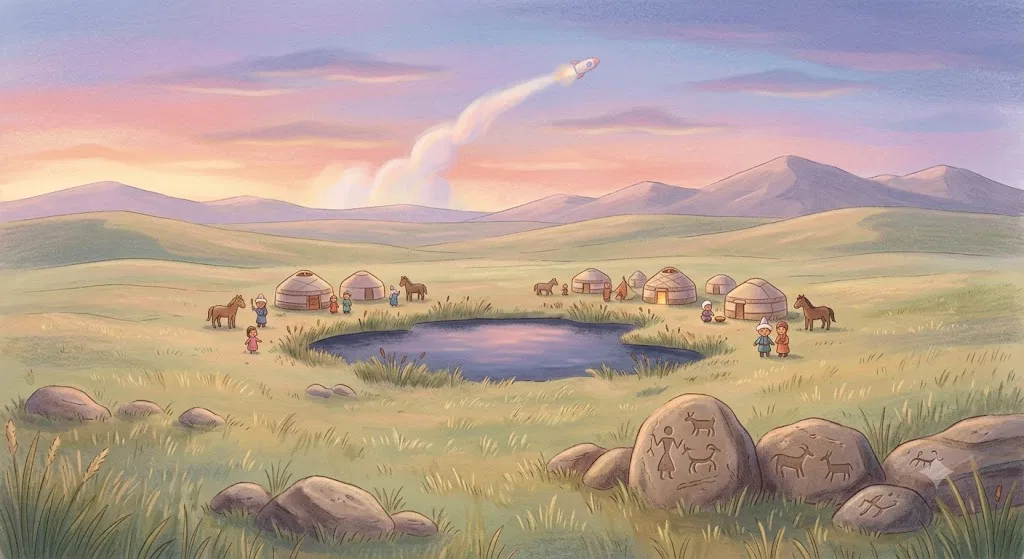
Kazakhstan is vast, sparsely populated in many regions, and environmentally extreme: steppe, desert, mountains, sealed Soviet sites, inland seas, meteorite scars and launch corridors all share the same national frame. That combination produces exactly the conditions in which unusual reports thrive. A light in the sky may be a rocket stage. A vanished island may become a legend about time. A dangerous lake may gain a guardian serpent. A nuclear crater may be remembered with a dread usually reserved for haunted places.
The country also has deep older layers of belief. Kazakh tradition includes pre-Islamic ideas about sky, land, ancestors and spirits, later mixed with Islamic practice and vocabulary. A Kazakh historical resource describes shamanism as a major pre-Islamic inheritance, associated with ancestor veneration and ritual contact with the other world; a recent academic study likewise frames Kazakh belief as a hybrid worldview shaped by religious syncretism rather than a simple replacement of old ideas by new ones.[«Қазақстан тарихы» порталы]e-history.kzOpen source on e-history.kz.
That matters for Forteana because a modern “weird” story in Kazakhstan often has two lives at once. It may be a tourist anecdote, a newspaper curiosity or a Soviet-era rumour, while also echoing much older ways of thinking about water, mountains, animals, ancestors and dangerous empty spaces. The point is not that old beliefs “explain” every modern claim. It is that they give modern claims a local grammar.
Lake Kok-Kol and the Dragon in the Water
One of Kazakhstan’s most appealing mystery-animal traditions centres on Lake Kok-Kol in Zhambyl Region, a small high mountain lake linked in popular accounts with a water spirit or monster called Aidakhar. Modern travel and local-interest sources describe stories of a large serpent-like being, sometimes said to be around 15 metres long, associated with sudden ripples, funnels, strange sounds and curative water. The Astana Times, writing about Zhambyl Region’s “enigmatic secrets”, presents the claim as legend and local testimony rather than verified zoology.[The Astana Times]astanatimes.comThe Astana Times Enigmatic Secrets of Zhambyl RegionThe Astana Times Enigmatic Secrets of Zhambyl Region
The monster story is unusually compact: a remote lake, an apparently odd water surface, reports of sounds, warnings about danger, and a named being. That is classic lake-monster material. It does not need a plesiosaur to work. The “creature” gives shape to things that are already unsettling: deep or unclear water, sudden turbulence, the fear of drowning, and the practical need to treat remote mountain lakes with respect.
The obvious sceptical reading is that Kok-Kol’s strangeness begins with hydrology, not biology. Reports of whirlpools, ripples, bubbles or noises can arise from underwater springs, gas release, wind effects, falling debris, temperature layers or local geology. Public travel accounts of Kok-Kol are not controlled measurements, and dramatic details — divers lost, animals dragged down, bottomless depths — are exactly the sort of material that grows in retelling. Still, the legend’s durability is important. Aidakhar turns a hazardous landscape feature into a story with rules: approach carefully, recognise the water’s power, and remember that the lake is not just scenery.[silkadv.com]silkadv.comLake Kok-kol in Zhambyl regionLake Kok-kol in Zhambyl region
Kazakhstan’s Kok-Kol tradition also shows why “lake monster” is sometimes the wrong category. This is not merely a hidden animal claim. In local framing, the being is a water spirit, and the lake’s supposed healing qualities are part of the same imaginative world. The Fortean interest lies in the overlap: cryptid language imported from Loch Ness-style comparison, older spirit belief, tourism storytelling, and genuine natural uncertainty in a hard-to-study setting.
Barsa-Kelmes: The Island That Would Not Let Rumours Go
Barsa-Kelmes, once an island in the Aral Sea, is one of Kazakhstan’s best examples of a story becoming stranger as the landscape itself changed. The name is commonly glossed as “the place of no return”, and the former island has been linked with tales of disappearances, time distortions, strange creatures and UFO-style rumours. The physical setting is already uncanny: the Aral Sea’s retreat turned islands into peninsulas, then into tracts of exposed seabed and desert. NASA’s long-running satellite record of the Aral Sea shows the wider environmental transformation: a massive irrigation-driven collapse in which the southern sea split, retreated and in places dried dramatically.[NASA Science]science.nasa.govScience World of Change: Shrinking Aral SeaScience World of Change: Shrinking Aral Sea
Barsa-Kelmes’ paranormal reputation, however, has a more mischievous modern history. The sceptical account published by Skeptoid traces the Soviet-era time-slip and UFO mythology to a chain of literary jokes, fan-club invention and media amplification rather than reliable witness evidence. In that version, the real “mystery” is how a localised joke and older island reputation travelled through popular science and strange-phenomena culture until the place acquired an aura of anomalous time.[skeptoid.com]skeptoid.comOpen source on skeptoid.com.
That debunking is not a reason to exclude Barsa-Kelmes from Kazakhstan’s strange record. It is precisely why it belongs there. Forteana is not only about unsolved events; it is also about hoaxes, rumours and the machinery by which a story becomes believable. Barsa-Kelmes had the ingredients: an ominous name, difficult access, environmental ruin, older tales, Soviet media habits, and a readership primed for cosmic mysteries. The result was a Central Asian “anomalous zone” whose evidence dissolves under inspection but whose cultural logic remains fascinating.
There is a grounded conservation story too. UNESCO lists Barsakelmes as a biosphere reserve in the Aral Sea basin, noting its importance for biodiversity in a region where bird migration routes converge. The wider “Cold Winter Deserts of Turan”, including Kazakh components, are also recognised by UNESCO as an arid Central Asian World Heritage property. The place of no return is therefore not just an internet mystery location; it is a real, fragile landscape where ecological catastrophe and myth-making have become entangled.[UNESCO]unesco.orgOpen source on unesco.org.
Baikonur Lights and the UFO Problem
Kazakhstan is one of the few countries where strange sky reports have to be read against a world-historical launch site. Baikonur Cosmodrome, in the Kazakh steppe, launched Sputnik 1 in 1957 and became central to Soviet and later Russian spaceflight. ESA describes Baikonur as the site of the first artificial satellite launch, while NASA continues to document Soyuz activity from the cosmodrome.[European Space Agency]esa.intEuropean Space Agency ESAEuropean Space Agency ESA
That makes Kazakhstan a natural factory for UFO-like appearances. Rockets and upper stages can produce glowing plumes, expanding clouds, spirals, bright moving points, delayed sonic effects and spectacular long-exposure trails. Seen without context, especially at dusk or night, these can look less like engineering and more like a visitation. The country’s sky folklore is therefore unusually modern: not only stars, omens and spirits, but launch windows, propellant, staging events and military secrecy.
The Baikonur context does not explain every light anyone has ever reported, but it changes the burden of interpretation. A strange glow over Kazakhstan is not automatically mysterious when a major spaceport operates there. At the same time, the secrecy around Soviet space and missile activity helped create the perfect emotional climate for speculation. Space.com notes that the Baikonur name itself was part of Cold War misdirection: the launch site was named after a mining town elsewhere to confuse outsiders.[Space]space.comThe Secret Backstory Behind Kazakhstan's Rocket LaunchThe Secret Backstory Behind Kazakhstan's Rocket Launch
There is also a more literal “fall from the sky” tradition around Baikonur: rocket debris. Research on rocket stages in the Kazakh steppe frames falling debris as a lived environmental and political issue, not just a spectacle. Scientific work on Baikonur-linked accidents and fuel contamination has examined ecological consequences, including the severe environmental impact of a Proton-M crash in 2013. In Fortean terms, this is where the sky stops being symbolic. Uncanny lights, thunderous launches and falling metal become part of everyday geography.[Society and Space]societyandspace.orgOpen source on societyandspace.org.
The Polygon and the Haunting of the Atomic Steppe
The Semipalatinsk Test Site, often called the Polygon, is not paranormal. Its horror is historical, technical and human. Yet it has the atmosphere of a modern haunted landscape: abandoned test infrastructure, invisible contamination, secrecy, illness, rumours and a crater lake made by a nuclear explosion. Between 1949 and 1989, Semipalatinsk was one of the Soviet Union’s main nuclear test sites; the Nuclear Threat Initiative records 456 tests there, including 116 atmospheric and 340 underground tests.[The Nuclear Threat Initiative]nti.orgsemipalatinsk test sitesemipalatinsk test site
The public-health legacy is substantial. A Lancet-linked overview describes four decades of testing and its continuing consequences for communities around the site. Journalism and documentary work have often treated the Polygon as a place where the Cold War became environmental memory: not ghosts in the old sense, but inherited damage, family stories, restricted zones and places that look empty while remaining charged with risk.[PMC]pmc.ncbi.nlm.nih.govOpen source on nih.gov.
The most Fortean object here is Lake Chagan, widely known as “Atomic Lake”. Kazakhstan’s National Nuclear Center describes the Chagan underground nuclear explosion of 15 January 1965 as a 140-kiloton test carried out as part of Soviet “peaceful nuclear explosion” ambitions. The blast created a crater that was later filled with river water.[nnc.kz]nnc.kzOpen source on nnc.kz.
Lake Chagan belongs to the weird-history record because it looks like folklore made by bureaucracy: a lake born in an instant, created by a weapon, promoted under the language of peaceful engineering, and later folded into dark tourism. It is not unexplained, but it is profoundly uncanny. A dragon lake asks whether something lives below the surface; Atomic Lake asks what kind of civilisation decides to make a lake with a bomb.
Zhamanshin: The Real Cosmic Scar
Kazakhstan’s most scientifically grounded “fall from the sky” is Zhamanshin crater in Aktobe Region. Unlike many Fortean impact claims, this is not a doubtful hole in the ground. It is a confirmed impact structure, usually described as about 14 kilometres across and around 900,000 years old, associated with impact glasses and tektite-like material. Geological studies have examined Zhamanshin glasses and the problem of how its impactites and tektites formed.[ScienceDirect]sciencedirect.comOpen source on sciencedirect.com.
Zhamanshin is interesting because it sits on the border between science and cosmic awe. Meteorite impacts once sounded like folklore: stones falling from heaven, fire in the sky, invisible forces. Modern planetary science has made them measurable, but not less strange. NASA’s discussion of the Tunguska event, although about Siberia rather than Kazakhstan, is a useful comparison: eyewitness fireballs, explosions, blast effects and missing fragments can generate long-running mystery even when the broad cause is accepted as an asteroid or comet airburst.[NASA]nasa.gov115 Years Ago: The Tunguska Asteroid Impact Event115 Years Ago: The Tunguska Asteroid Impact Event
Newer research has kept Zhamanshin lively. A 2026 preprint argues that high-resolution topographic analysis may indicate a larger multi-ring structure than standard estimates, with potentially greater environmental consequences than previously assumed. That claim should be treated as developing research rather than settled consensus, but it shows why Zhamanshin is more than a geological footnote: it is part of the live scientific question of how medium-to-large impacts affect climate, landscapes and biological history.[arXiv]arxiv.orgOpen source on arxiv.org.
For a Fortean reader, Zhamanshin is a useful corrective. Not every wonder needs witnesses, monsters or ghosts. Sometimes the strangest thing in a country’s record is a real scar from space, old enough to have no human memory and yet clear enough for modern science to read.
Spirits, Demons and the Steppe Imagination
Kazakhstan’s older supernatural landscape is populated less by castle ghosts than by beings of threshold, wilderness and danger. Folklore sources discuss hostile spirits, demonic women, witches, giants, dragons, ancestor presences and household or landscape guardians. An e-history overview of early Kazakh folklore notes that demonological tales often involve human struggle against hostile spirits and reflect both shamanistic and Islamic influences.[«Қазақстан тарихы» порталы]e-history.kzOpen source on e-history.kz.
One vivid example is the Jeztyrnaq, commonly described as a female demonic figure with brass or copper claws. Qalam Global presents her as one of the memorable demonic beings of Kazakh folklore: a dangerous figure met by a lone hunter in an empty, unfamiliar place. That setting is important. The fear is not simply of a monster; it is of being alone outside the human social world, where beauty, hospitality and danger may be hard to tell apart.[Qalam]qalam.globalOpen source on qalam.global.
Other figures, such as Albasty and Zhalmauyz Kempir, belong to a wider Turkic mythological field. A 2025 article on female demonic figures in Turkic mythology describes such beings as more than simple villains: they can function as mediators between worlds, initiators of heroic trials and embodiments of chthonic forces. For mainstream readers, the useful point is that Kazakh “monsters” often carry social meaning. They mark childbirth danger, travel danger, oath-breaking, greed, isolation, disrespect for sacred places or the need for courage.[tsj.enu.kz]tsj.enu.kzOpen source on enu.kz.
Modern horror, fantasy and film continue to draw on these figures. Reports on Kazakh horror cinema describe productions using evil spirits and figures from Kazakh tales and legends, showing that this material is not frozen in the past. It is being reworked for contemporary audiences who may no longer literally fear the old beings but still recognise their dramatic power.[The Astana Times]astanatimes.comqarakoz features evil spirits from kazakh folk talesqarakoz features evil spirits from kazakh folk tales
How to Read Kazakhstan’s Weird Record Without Flattening It
Kazakhstan’s Forteana is easy to misread in two opposite ways. The first mistake is credulity: treating every lake ripple, rocket plume or Soviet rumour as evidence of monsters, aliens or time portals. The second mistake is over-correction: explaining away the claim and assuming nothing remains. The more rewarding approach is to ask what kind of strangeness each case represents.
Lake Kok-Kol is best read as a water-spirit and lake-monster tradition attached to a genuinely remote and physically unusual place. Barsa-Kelmes is a case study in how hoax, ominous naming, environmental disaster and Soviet media culture can manufacture an anomalous zone. Baikonur lights show how advanced technology can create ancient-looking sky wonders. The Polygon demonstrates that the modern world can create haunted landscapes without needing ghosts. Zhamanshin reminds us that cosmic catastrophe is not folklore at all, but geology.
What ties these examples together is Kazakhstan’s scale. Distances are large, landscapes are dramatic, and many important places have been difficult to access, politically restricted or environmentally transformed. In such conditions, stories do not merely decorate geography. They help people make sense of risk, absence and awe.
Why These Stories Still Have Pull
Kazakhstan’s strange material lasts because it is not random. It gathers around places that already feel charged: a mountain lake with unexplained movements, an island stranded by a dying sea, a cosmodrome built under secrecy, a nuclear test zone, a meteorite crater, a steppe haunted by older spirit lore. Each case offers a different answer to the same readerly question: what happens when an immense landscape resists ordinary explanation?
The most honest conclusion is also the most interesting. Kazakhstan does not need imported paranormal glamour. Its country-level Forteana is strongest when kept close to its own ground: water spirits rather than generic lake monsters, launch plumes rather than vague UFOs, ecological disappearance rather than fantasy portals, nuclear engineering rather than gothic haunting, and folklore that still knows the steppe can be beautiful, useful and dangerous at the same time.
Amazon book picks
Further Reading
Books and field guides related to Why Does Kazakhstan Feel So Uncanny?. Use these as the next step if you want deeper reading beyond the article.

UFOs : Generals, Pilots, and Government Officials Go on the R...
Provides balanced investigation of unusual aerial sightings relevant to several Kazakhstan pages.

The world of Lore
Introduces legendary creatures and uncanny traditions that match the site's themes.
Mysteries of the Unexplained
Covers UFOs, strange places, anomalies and unexplained reports similar to Kazakhstan's cases.
eBay marketplace picks
Marketplace Samples
Live-tested eBay searches with available results related to this page.
Endnotes
1.
Source: esa.int
Title: European Space Agency ESA
Link:https://www.esa.int/Science_Exploration/Human_and_Robotic_Exploration/Mission_Odissea_-F._De_Winne-_english/Baikonur_from_the_steppes_of_Kazakhstan_to_space
2.
Source: skeptoid.com
Link:https://skeptoid.com/episodes/783
3.
Source: e-history.kz
Link:https://e-history.kz/en/e-resources/show/13453
4.
Source: silkadv.com
Title: Lake Kok-kol in Zhambyl region
Link:https://silkadv.com/en/content/lake-kok-kol-zhambyl-region
5.
Source: science.nasa.gov
Title: Science World of Change: Shrinking Aral Sea
Link:https://science.nasa.gov/earth/earth-observatory/world-of-change/aral-sea/
6.
Source: unesco.org
Link:https://www.unesco.org/en/mab/barsakelmes
7.
Source: whc.unesco.org
Link:https://whc.unesco.org/en/list/1693/
8.
Source: nasa.gov
Title: flags fly baikonur cosmodrome launch pad
Link:https://www.nasa.gov/image-article/flags-fly-baikonur-cosmodrome-launch-pad/
9.
Source: space.com
Title: The Secret Backstory Behind Kazakhstan’s Rocket Launch
Link:https://www.space.com/40785-history-baikonur-kazakhstan-launch.html
10.
Source: sciencedirect.com
Link:https://www.sciencedirect.com/science/article/abs/pii/S0269749120364009
11.
Source: pmc.ncbi.nlm.nih.gov
Link:https://pmc.ncbi.nlm.nih.gov/articles/PMC6734094/
12.
Source: nnc.kz
Link:https://www.nnc.kz/en/news/show/261
13.
Source: sciencedirect.com
Link:https://www.sciencedirect.com/science/article/pii/0012821X86901743
14.
Source: nasa.gov
Title: 115 Years Ago: The Tunguska Asteroid Impact Event
Link:https://www.nasa.gov/history/115-years-ago-the-tunguska-asteroid-impact-event/
15.
Source: arxiv.org
Link:https://arxiv.org/abs/2604.04884
16.
Source: e-history.kz
Link:https://e-history.kz/en/news/show/339422
17.
Source: qalam.global
Link:https://qalam.global/en/microrubrics/myth-en/jeztyrnaq-en
18.
Source: qalam.global
Link:https://qalam.global/en/articles/jeztyrnaq-en
19.
Source: tsj.enu.kz
Link:https://tsj.enu.kz/index.php/new/article/view/618
20.
Source: nasa.gov
Title: Image of the Day
Link:https://www.nasa.gov/image-of-the-day/page/70/?id=355383
21.
Source: nasa.gov
Title: Image of the Day
Link:https://www.nasa.gov/image-of-the-day/page/78/?id=373255
22.
Source: nasa.gov
Title: expedition 42 launches international space station
Link:https://www.nasa.gov/image-article/expedition-42-launches-international-space-station/
23.
Source: nasa.gov
Link:https://www.nasa.gov/blogs/spacestation/2019/08/page/2/
24.
Source: nasa.gov
Title: soyuz rocket rolled out by train launch pad 3
Link:https://www.nasa.gov/image-article/soyuz-rocket-rolled-out-by-train-launch-pad-3/
25.
Source: nasa.gov
Title: crescent moon kazakhstan
Link:https://www.nasa.gov/image-article/crescent-moon-kazakhstan/
26.
Source: nasa.gov
Link:https://www.nasa.gov/blogs/spacestation/2018/11/page/2/
27.
Source: nasa.gov
Title: expedition 64 backup crew members arriving baikonur kazakhstan
Link:https://www.nasa.gov/image-article/expedition-64-backup-crew-members-arriving-baikonur-kazakhstan/
28.
Source: nasa.gov
Title: Image of the Day
Link:https://www.nasa.gov/image-of-the-day/page/80/?id=374871
29.
Source: science.nasa.gov
Title: lake balkhash kazakhstan 969
Link:https://science.nasa.gov/earth/earth-observatory/lake-balkhash-kazakhstan-969/
30.
Source: dark-tourism.com
Link:https://www.dark-tourism.com/index.php/519-sts-polygon-soviet-nuclear-test-site-kazakhstan
31.
Source: whc.unesco.org
Link:https://whc.unesco.org/en/list/1103/
32.
Source: unesdoc.unesco.org
Link:https://unesdoc.unesco.org/ark%3A/48223/pf0000235413
33.
Source: whc.unesco.org
Link:https://whc.unesco.org/document/205774
34.
Source: silkadv.com
Link:https://silkadv.com/en/content/history-island-barsa-kelmes
35.
Source: islands.com
Link:https://www.islands.com/1828235/spooky-eerie-nature-park-reserve-populated-unusual-creatures-barsakelmes-central-asia-area-51/
36.
Source: esa.int
Link:https://www.esa.int/ESA_Multimedia/Images/2025/04/Earth_from_Space_The_shrinking_Aral_Sea
37.
Source: qalam.global
Title: WITC H
Link:https://qalam.global/en/articles/women-in-kazakh-mythology-en-3
38.
Source: meteorite.com
Link:https://www.meteorite.com/irghizites-crater-glass-tektites/
39.
Source: astanatimes.com
Title: The Astana Times Enigmatic Secrets of Zhambyl Region
Link:https://astanatimes.com/2023/06/enigmatic-secrets-of-zhambyl-region-loch-ness-monster-twin/
40.
Source: societyandspace.org
Link:https://www.societyandspace.org/articles/when-things-fall-from-the-sky-understanding-rocket-stages-on-the-kazakh-steppe-as-imperial-debris
41.
Source: nti.org
Title: semipalatinsk test site
Link:https://www.nti.org/education-center/facilities/semipalatinsk-test-site/
42.
Source: astanatimes.com
Title: qarakoz features evil spirits from kazakh folk tales
Link:https://astanatimes.com/2018/11/qarakoz-features-evil-spirits-from-kazakh-folk-tales/
43.
Source: facebook.com
Link:https://www.facebook.com/CADIproject/photos/cold-winter-deserts-of-turan-are-nominated-as-unesco-world-heritage-site-after-m/4941489452612108/
44.
Source: Wikipedia
Title: Baikonur Cosmodrome
Link:https://en.wikipedia.org/wiki/Baikonur_Cosmodrome
45.
Source: Wikipedia
Title: Tunguska event
Link:https://en.wikipedia.org/wiki/Tunguska_event
46.
Source: Wikipedia
Title: Zhamanshin crater
Link:https://en.wikipedia.org/wiki/Zhamanshin_crater
47.
Source: Wikipedia
Title: Aral Sea
Link:https://en.wikipedia.org/wiki/Aral_Sea
48.
Source: youtube.com
Link:https://www.youtube.com/watch?v=VfibOZQl4Fc
49.
Source: astanatimes.com
Title: kazakh fairy tales heroes villains and timeless legends
Link:https://astanatimes.com/2025/03/kazakh-fairy-tales-heroes-villains-and-timeless-legends/
50.
Source: astanatimes.com
Title: kazakhstan was launchpad for first human in space what comes next
Link:https://astanatimes.com/2026/04/kazakhstan-was-launchpad-for-first-human-in-space-what-comes-next/
51.
Source: astanatimes.com
Link:https://astanatimes.com/2023/09/altyn-emel-national-park-barsakelmes-nature-reserve-inscribed-on-unesco-world-heritage-list/
52.
Source: cryptidz.fandom.com
Link:https://cryptidz.fandom.com/wiki/Aidakhar
53.
Source: obscurban-legend.fandom.com
Link:https://obscurban-legend.fandom.com/wiki/Aidakhar
54.
Source: worldheritageexplorer.org
Title: cold winter deserts of turan
Link:https://www.worldheritageexplorer.org/sites/cold_winter_deserts_of_turan.html
55.
Source: passc.net
Link:https://www.passc.net/EarthImpactDatabase/New%20website_05-2018/Zhamanshin.html
56.
Source: en.wikivoyage.org
Title: Cold Winter Deserts of Turan
Link:https://en.wikivoyage.org/wiki/Cold_Winter_Deserts_of_Turan
57.
Source: jcasc.com
Link:https://jcasc.com/index.php/jcasc/article/view/1609
58.
Source: c2c.wii.gov.in
Title: cold winter deserts of turan
Link:https://c2c.wii.gov.in/cold-winter-deserts-of-turan
59.
Source: armagh.space
Title: Tunguska Event
Link:https://armagh.space/weather/history/tunguska-event
60.
Source: arabnews.pk
Link:https://www.arabnews.pk/node/2642966/world
Additional References
61.
Source: youtube.com
Title: We visited the strangest places in Kazakhstan. Mangystau, Ustyurt, Torgai
Link:https://www.youtube.com/watch?v=J1_RZo43WO4
Source snippet
2 A mysterious place haunts scientists - Amazing Kazakhstan from aviasales.kz...
62.
Source: youtube.com
Title: These rocks don’t look real | 4K Documentary
Link:https://www.youtube.com/watch?v=1Tz58u3eSZg
Source snippet
5 WHAT DOES THE RIVER HIDE? Disappearances in the Charyn Canyon...
63.
Source: researchgate.net
Link:https://www.researchgate.net/publication/330593575_Rocket_Wastelands_in_Kazakhstan_Scientific_Authoritarianism_and_the_Baikonur_Cosmodrome
64.
Source: instagram.com
Link:https://www.instagram.com/reel/DWxsr-6EvPN/
65.
Source: facebook.com
Link:https://www.facebook.com/empoweringfactspage/posts/a-strange-glowing-shape-in-the-sky-over-kazakhstan-quickly-caught-attention-with/122291956010067485/
66.
Source: reddit.com
Link:https://www.reddit.com/r/Kazakhstan/comments/1oprnfj/any_kazakh_mythological_creatures/
67.
Source: tselinny.org
Link:https://www.tselinny.org/en/event/barsakelmes
68.
Source: advantour.com
Link:https://www.advantour.com/kazakhstan/nature/barsa-kelmes.htm
69.
Source: protectedplanet.net
Link:https://www.protectedplanet.net/1673
70.
Source: livetheworld.com
Link:https://www.livetheworld.com//post/barsakelmes-a-scary-island-of-no-return-fqpm
Topic Tree
Follow this branch
Related pages 192
- Afghan Forteana
- Antigua Uncanny
- Bosnian Mysteries
- Botswana Weird
- Brazil Strange
- +187 more in sidebar