Within Iceland Forteana
Why Icelandic Ghosts Refuse to Fade
Iceland's ghost record runs from physical saga revenants to modern apparition reports studied through surveys and interviews.
On this page
- Draugr revenants in saga tradition
- Modern encounters with the dead
- Sceptical and believer readings of apparitions
Page outline Jump by section
Introduction
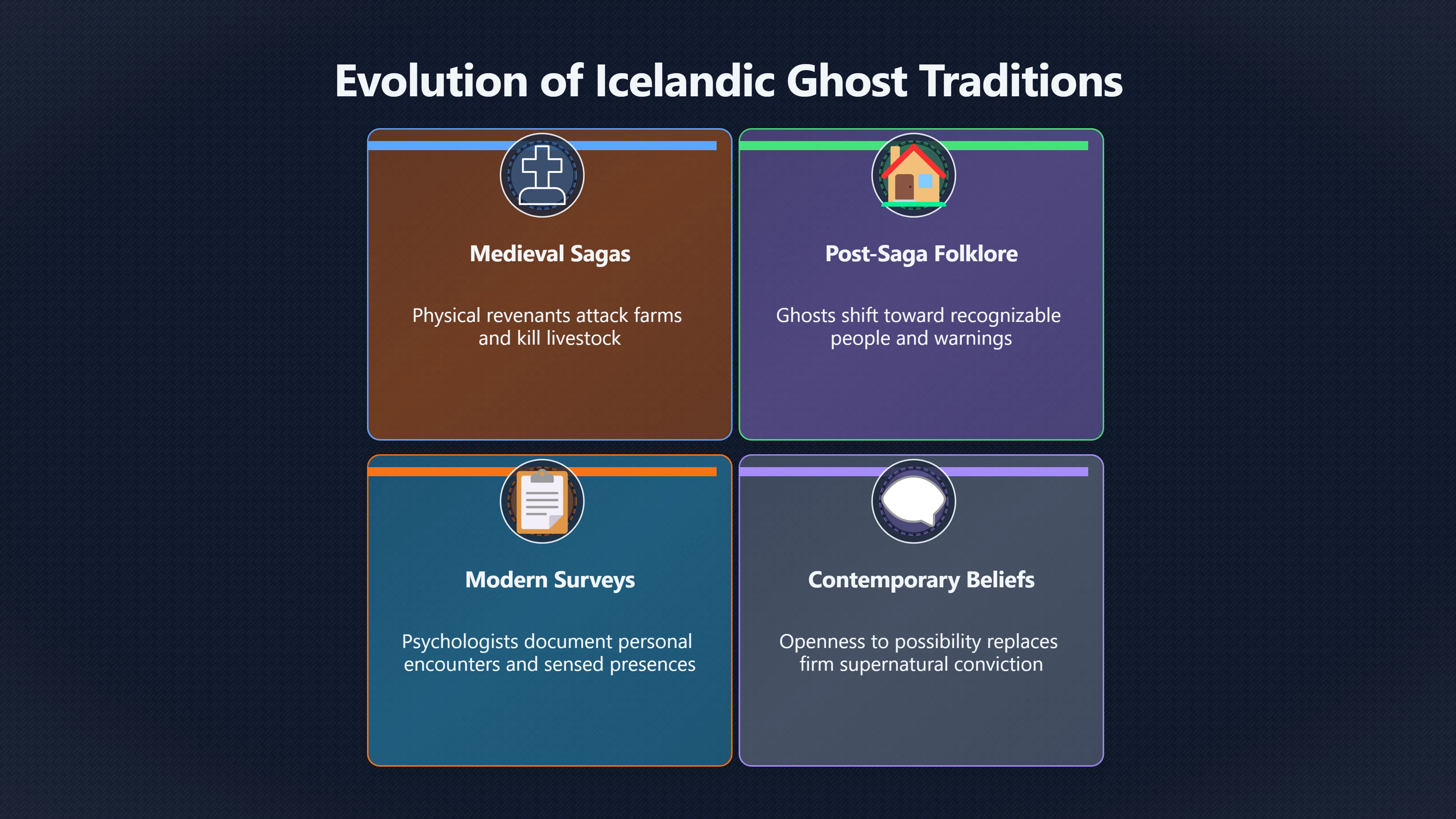
Iceland’s ghost tradition is unusual because it stretches in an almost unbroken line from medieval saga literature to modern interview-based surveys. The country’s most famous supernatural figures are not ethereal Victorian-style spirits but stubborn, physical revenants: dead people who return to trouble farms, attack travellers, spread illness or refuse to stay buried. Alongside these dramatic stories runs a quieter tradition of apparitions, deathbed visions and the feeling that deceased relatives are still present. Together they form one of Europe’s best-documented continuities between historical literature, oral folklore and modern testimony.
That continuity does not prove ghosts exist. Instead, it offers a remarkable record of how one society has described encounters with the dead across nearly a thousand years. Medieval authors, nineteenth-century folklore collectors, psychologists and folklorists have all examined the phenomenon from different angles, producing a body of evidence that is as interesting culturally as it is paranormally.[ResearchGate]researchgate.netResearch Gate(PDF) Contact with the Dead in Iceland Past and PresentResearchGate(PDF) Contact with the Dead in Iceland Past and PresentMay 28, 2024 — 25 May 2024 — This article focuses on the figures conce…
Why Icelandic ghosts are different
Many European ghost traditions centre on transparent apparitions, haunted houses or restless souls seeking justice. Icelandic stories certainly include such figures, but their best-known ghosts are far more physical.
The medieval sagas describe revenants who retain bodies, strength and personality after death. They may break out of burial mounds, kill livestock, attack neighbours or spread fear across an entire district. Rather than fading like mist, they must often be physically restrained, moved, burned or otherwise prevented from returning. These stories belong to a wider Norse tradition but reached particularly vivid expression in Icelandic literature.[Wikipedia]WikipediaEyrbyggja sagaEyrbyggja saga
The difference matters because it reflects changing ideas about death. In the oldest narratives, the dead are dangerous members of society who refuse to leave it. In later folklore, ghosts increasingly become apparitions, warnings or family visitors, much closer to modern accounts of seeing or sensing deceased relatives.
Draugr revenants in saga tradition
The saga literature contains some of the most famous revenant narratives in medieval Europe.
A recurring pattern appears throughout these stories:
- A difficult or violent individual dies.
- Strange events begin around the grave or farm.
- The corpse is discovered to be unnaturally preserved or active.
- Extraordinary measures become necessary to stop the haunting.
Perhaps the best-known example comes from Eyrbyggja Saga, where the dead landowner Thorolf Halt-Foot becomes a terrifying revenant after burial. His appearances are associated with physical attacks, panic among local people and repeated attempts to contain him. The saga eventually requires reburial and burning before the threat finally ends. Modern historians treat the account as literature rather than eyewitness history, but it preserves ideas about death, pollution, community order and the dangers posed by unresolved conflict.[Wikipedia]WikipediaEyrbyggja sagaEyrbyggja saga
Other saga episodes describe haunted farmhouses, undead visitors gathering around household fires and communities forced to confront multiple revenants at once. These tales often occur around the conversion period from paganism to Christianity, allowing medieval authors to contrast older beliefs with newer Christian ideas about burial and the afterlife. Scholars therefore read them not simply as ghost stories but as narratives exploring social change, religion and communal anxiety.[dokumen.pub]dokumen.pubhe conversion or pre-conversion period they were typically associated with…
From medieval monsters to household ghosts
As Icelandic folklore developed after the saga age, ghost traditions gradually shifted.
Instead of overwhelmingly violent revenants, later collections increasingly describe recognisable people returning after death. A deceased neighbour might appear to announce unfinished business, warn relatives of danger or simply be seen walking a familiar route. Farm communities passed these accounts through oral tradition well into the nineteenth century.
The older revenant never disappeared completely, however. Folklore collections still include stories of troublesome dead refusing burial or haunting particular farms. Rather than replacing one tradition with another, Iceland preserved several overlapping ideas about the dead, ranging from monstrous corpses to comforting family apparitions. This layering helps explain why modern Icelandic ghost beliefs can appear surprisingly varied.
Modern encounters with the dead
The most distinctive modern evidence comes not from dramatic hauntings but from surveys asking ordinary Icelanders about personal experience.
Psychologist Erlendur Haraldsson conducted pioneering national research into reports of encounters with deceased people, following up many claims through interviews rather than treating them simply as anecdotes. His work documented experiences including:
- seeing a deceased relative;
- hearing a familiar voice after death;
- sensing a strong presence;
- vivid deathbed or crisis apparitions;
- dreams that experiencers regarded as meaningful contact.
Haraldsson argued that Iceland produced an unusually high proportion of such reports compared with several other countries, although he did not claim this demonstrated survival after death. Instead, he treated the experiences as psychological and cultural phenomena worthy of systematic investigation rather than ridicule. Critics noted the familiar limitations of interview studies and self-reported experiences, while supporters praised the attempt to document experiences carefully instead of dismissing them outright.[wikipedia.org]WikipediaErlendur HaraldssonErlendur Haraldsson
What recent surveys actually found
More recent work by folklorist Terry Gunnell has extended this research by comparing nationwide surveys conducted in 1974, 2006–2007 and 2023.
Rather than asking only whether respondents “believe in ghosts”, these studies explored experiences, possibilities and attitudes towards contact with the dead. The results suggest that although Iceland has modernised rapidly, reports of perceived encounters with deceased people remain surprisingly common and attitudes have changed less dramatically than many observers might expect.
One important conclusion is that certainty is relatively rare. Many respondents instead occupy a middle ground, regarding contact with the dead as possible without insisting it is definitely real. This echoes broader Icelandic attitudes towards supernatural traditions, where openness to possibility often replaces firm belief or outright rejection. Gunnell argues that the survey findings make more sense when viewed against centuries of Icelandic storytelling, where experiences of the dead have long existed alongside everyday life rather than standing apart from it.[ResearchGate]researchgate.netResearch Gate(PDF) Contact with the Dead in Iceland Past and PresentResearchGate(PDF) Contact with the Dead in Iceland Past and PresentMay 28, 2024 — 25 May 2024 — This article focuses on the figures conce…

How believers and sceptics read the same stories
The same experiences receive very different interpretations depending on the framework used.
Believers commonly argue that repeated reports across centuries suggest genuine contact with the dead. They point to similarities between independent accounts, the emotional impact on witnesses and experiences occurring outside explicitly religious settings.
Psychologists and sceptics offer several alternative explanations:
- grief can produce vivid sensed-presence experiences that feel entirely real;
- dreams may later be remembered as supernatural communications;
- sleep paralysis and hypnagogic hallucinations can create convincing apparitions;
- expectation shaped by local folklore influences how unusual experiences are interpreted;
- memorable ghost stories naturally survive longer than ordinary experiences.
Neither approach completely eliminates the other. A bereaved person who feels a deceased spouse sitting beside them may experience something psychologically understandable while also interpreting it spiritually. Iceland’s surveys document that experience without being able to determine its ultimate cause.[researchgate.net]researchgate.netResearch Gate(PDF) Contact with the Dead in Iceland Past and PresentResearchGate(PDF) Contact with the Dead in Iceland Past and PresentMay 28, 2024 — 25 May 2024 — This article focuses on the figures conce…
Why the tradition refuses to disappear
Icelandic ghost traditions have endured because they connect literature, landscape and lived experience in unusual ways.
The sagas ensure that revenants occupy a prestigious place in national literature rather than existing only as local folklore. Rural oral traditions carried many ghost narratives into the modern era, while twentieth-century researchers chose to investigate reported experiences systematically instead of treating them solely as superstition. This combination means Iceland possesses an unusually continuous record, from medieval narrative through nineteenth-century folklore collections to contemporary survey data.
For readers interested in Iceland’s wider strange-history landscape, these ghost traditions also intersect naturally with other enduring themes: beliefs about hidden people, prophetic dreams, spiritual experiences and the ways dramatic landscapes encourage stories that blur the boundary between memory, belief and unexplained experience. Rather than presenting proof of the supernatural, Iceland’s ghost record demonstrates how one culture has preserved, debated and continually reinterpreted encounters with the dead across nearly a millennium.
Amazon book picks
Further Reading
Books and field guides related to Why Icelandic Ghosts Refuse to Fade. Use these as the next step if you want deeper reading beyond the article.


The Penguin Book of Dragons
Explores medieval supernatural beliefs related to revenants.

eBay marketplace picks
Marketplace Samples
Live-tested eBay searches with available results related to this page.
Endnotes
1.
Source: researchgate.net
Title: Research Gate(PDF) Contact with the Dead in Iceland Past and Present
Link:https://www.researchgate.net/publication/380944217_Contact_with_the_Dead_in_Iceland_Past_and_Present_The_Findings_of_a_New_Survey_of_Folk_Belief_and_Experiences_of_the_Supernatural_in_Iceland
Source snippet
ResearchGate(PDF) Contact with the Dead in Iceland Past and PresentMay 28, 2024 — 25 May 2024 — This article focuses on the figures conce...
Published: May 28, 2024
2.
Source: dokumen.pub
Link:https://dokumen.pub/supernatural-encounters-in-old-norse-literature-and-tradition-2503575315-9782503575315.html
Source snippet
he conversion or pre-conversion period they were typically associated with...
3.
Source: Wikipedia
Title: Eyrbyggja saga
Link:https://en.wikipedia.org/wiki/Eyrbyggja_saga
4.
Source: Wikipedia
Title: Erlendur Haraldsson
Link:https://en.wikipedia.org/wiki/Erlendur_Haraldsson
5.
Source: psi-encyclopedia.spr.ac.uk
Title: Psi Encyclopedia Erlendur Haraldsson
Link:https://psi-encyclopedia.spr.ac.uk/articles/erlendur-haraldsson/
Source snippet
Haraldsson - Psi EncyclopediaNational surveys in Iceland led him to examine apparitions, after-death communications and spiritual healing...
Additional References
6.
Source: academia.edu
Link:https://www.academia.edu/30028669/Modern_Legends_in_Iceland
Source snippet
(PDF) Modern Legends in IcelandThis paper explores modern legends and folk beliefs in Iceland, focusing particularly on the concept of ál...
7.
Source: scispace.com
Link:https://scispace.com/pdf/belief-in-ghosts-in-post-war-england-2o1n5nd5g0.pdf
Source snippet
BELIEF IN GHOSTS IN POST-WAR ENGLANDThis project examined, by qualitative investigation, the actual content and mechanics of ghost belief...
8.
Source: amazon.com
Link:https://www.amazon.com/stores/author/B001HPSDFQ/about?tag=searcht-20
9.
Source: espiritualidades.com.br
Link:https://www.espiritualidades.com.br/Artigos/H_autores/HARALDSSON_Erlendur_tit_Survey_of_Claimed_Encounters_with_the_dead.htm
Source snippet
rceived the presence of a deceased person.” A multinational Gallup survey...Read more...
10.
Source: escholarship.org
Title: qt16m8m9c6 noSplash 399370aafe84a608f07cbc6c9790affc
Link:https://escholarship.org/content/qt16m8m9c6/qt16m8m9c6_noSplash_399370aafe84a608f07cbc6c9790affc.pdf
Source snippet
An Open Secret of Icelandic Otherworldly Communicationby C Robinson · 2017 · Cited by 1 — A monograph came of his survey into Icelanders'...
11.
Source: youtube.com
Title: DRAUGR: The Undead Horror of Norse Mythology – Full Documentary
Link:https://www.youtube.com/watch?v=QLQHm-H10wo
Source snippet
The Viking Saga That Terrified Warriors: Grettir, Glamr, and the Rise of the Draugr | Norse Legends...
12.
Source: carlossalvarado.wordpress.com
Title: erlendur haraldsson 1931 2020
Link:https://carlossalvarado.wordpress.com/2020/11/24/erlendur-haraldsson-1931-2020/
Source snippet
He studied philosophy at the University of Edinburgh (1955-1956) and the University of Freiburg (1956-1958).Read more...
13.
Source: youtube.com
Title: Death, Mounds & Memory in Icelandic Saga Literature
Link:https://www.youtube.com/watch?v=ofLCD-bruGk
Source snippet
DRAUGR: The Undead Horror of Norse Mythology – Full Documentary...
14.
Source: youtube.com
Link:https://www.youtube.com/watch?v=u08OpqVTbjU
15.
Source: youtube.com
Title: The Draugr of Norse Mythology
Link:https://www.youtube.com/watch?v=Ki6xsapKOFk
Source snippet
Death, Mounds & Memory in Icelandic Saga Literature...
Topic Tree