Within Cameroon Mysteries
The Water Spirits Behind Cameroon's Legends
Stories of Mami Wata, jengu and other water beings show how communities interpret dangerous and mysterious waters.
On this page
- Mami Wata traditions and meanings
- Jengu beliefs near rivers and coastlines
- Folklore, danger and cultural memory
Page outline Jump by section
Introduction
Cameroon’s water-spirit traditions reveal how rivers, lakes and the Atlantic coast have long been understood as places where the visible and invisible worlds meet. Stories of Mami Wata and jengu (also called miengu in some coastal traditions) are not simply tales of mermaids or mysterious beings. They are cultural systems for thinking about wealth, healing, danger, ancestry, social rules and the unpredictable power of water.[staff.washington.edu]staff.washington.eduMami WataApril 25, 2008 — by M Wata · 2008 — Mami Wata: Arts for Water Spirits in Africa and Its Diasporas” explores the visual cultures and histo…
For communities living around Cameroon’s waterways, these spirits have often represented both opportunity and risk. A river can provide food, trade routes and livelihood, but it can also bring drowning, storms, illness or sudden loss. Water-spirit traditions grew in this space between dependence and uncertainty, turning dangerous landscapes into places with memory, personality and spiritual meaning.[Wikipedia]WikipediaOpen source on wikipedia.org.
The Water Spirits Behind Cameroon’s Legends
Mami Wata traditions and meanings
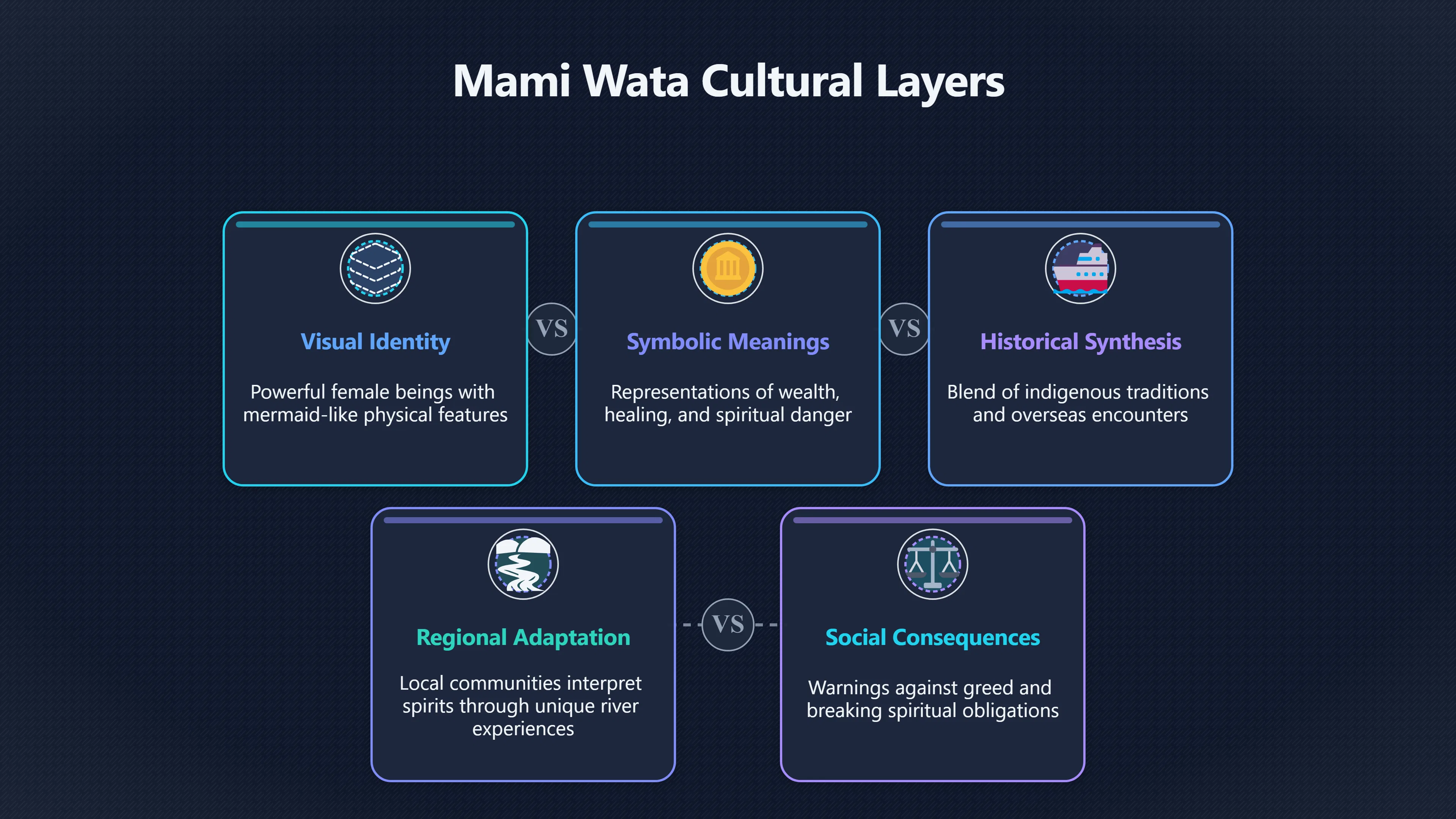
Mami Wata is one of Africa’s most widely recognised water-spirit traditions, appearing in different forms across Central, West and other parts of Africa. The figure is often represented as a powerful female water being, sometimes with mermaid-like features, and is associated with beauty, wealth, healing, temptation and danger. Scholars have noted that modern images of Mami Wata developed through a mixture of African water traditions and influences from overseas encounters, including European mermaid imagery.[staff.washington.edu]staff.washington.eduMami WataApril 25, 2008 — by M Wata · 2008 — Mami Wata: Arts for Water Spirits in Africa and Its Diasporas” explores the visual cultures and histo…
In Cameroon, Mami Wata stories belong to a wider landscape of beliefs about water beings rather than a single fixed legend. Different communities have interpreted the figure through local experiences of rivers, estuaries and the sea. In some accounts, encounters with water spirits are linked with prosperity or special gifts; in others, they warn against greed, disrespect or breaking social and spiritual obligations. The same spirit can therefore represent attraction and danger at the same time.[staff.washington.edu]staff.washington.eduMami WataApril 25, 2008 — by M Wata · 2008 — Mami Wata: Arts for Water Spirits in Africa and Its Diasporas” explores the visual cultures and histo…
The importance of Mami Wata in Cameroon’s folklore also reflects the country’s position within larger coastal and trading networks. Ideas about powerful water beings travelled between communities, adapting to local languages and traditions. Rather than being a single imported story, Mami Wata became part of a changing African conversation about the mysteries of water, commerce, personal ambition and the unseen forces believed to shape human fortunes.[staff.washington.edu]staff.washington.eduMami WataApril 25, 2008 — by M Wata · 2008 — Mami Wata: Arts for Water Spirits in Africa and Its Diasporas” explores the visual cultures and histo…
Jengu beliefs near rivers and coastlines
Among several Sawa coastal peoples of Cameroon, jengu are among the most important water spirits. These beings are traditionally associated with rivers, the sea and the spiritual life of communities including the Duala and Bakweri. Descriptions vary between groups, but jengu are commonly portrayed as beautiful water beings who can act as intermediaries between humans and the spirit world.[Wikipedia]WikipediaOpen source on wikipedia.org.
Jengu traditions are especially connected with ideas of protection, healing and communication. In traditional belief systems, the spirits may bring good fortune to those who respect them and may serve as a link between everyday life and ancestral forces. This makes them different from the simple “monster in the water” idea often attached to folklore from outside the region. Jengu are not merely creatures of fear; they are part of a moral and spiritual relationship between people and their environment.[Wikipedia]WikipediaOpen source on wikipedia.org.
A particularly striking example is the role of jengu traditions within the cultural life of the Sawa people and the Ngondo festival associated with the Duala. The festival includes rituals connected with the river and ancestral communication, including the famous water-diving ceremony in which a traditional participant is believed to enter contact with the spiritual world beneath the waters. To outsiders, such ceremonies may appear mysterious, but within their cultural setting they express continuity between ancestors, community leadership and the natural landscape.[Wikipedia]WikipediaOpen source on wikipedia.org.
These traditions also show why water spirits should not be separated from everyday life. For fishing communities and river traders, water is not an abstract symbol. It is a workplace, a source of food and a route connecting settlements. Spirits such as jengu provide a language for discussing respect for waterways and the consequences of disturbing relationships between humans and nature.[Wikipedia]WikipediaOpen source on wikipedia.org.
Folklore, danger and cultural memory
Water-spirit stories endure because they preserve memories about real experiences. Rivers and seas are powerful environments where accidents, disappearances and sudden changes in weather can occur. Before modern scientific explanations were widely available, spiritual traditions offered ways to interpret events that seemed beyond ordinary understanding. Even today, folklore can continue to influence how communities describe places that feel dangerous, sacred or unusual.
This does not mean that water-spirit traditions should be treated as failed attempts at science. Folklore and science often answer different questions. Science may explain how a flood, current or ecological change happens, while folklore explores what those events mean for a community. The continued presence of water spirits in Cameroon reflects the human need to attach memory and values to landscapes.
The strange-history appeal of these traditions comes from this overlap between belief, environment and experience. A mysterious figure beneath the water, a message from ancestral realms or a warning about disrespecting a river may not be verifiable as a physical event, but such stories reveal how communities have negotiated uncertainty for generations. They record fears, hopes and relationships with places that remain important.
Cameroon’s water spirits therefore belong to a broader tradition of “living mysteries”: stories that are not evidence of proven supernatural events, but are historically significant because they show how people understand the unknown. Mami Wata and jengu remain powerful symbols because they sit exactly where folklore has always been strongest — at the boundary between what people can see and what they believe lies beneath the surface.[staff.washington.edu]staff.washington.eduMami WataApril 25, 2008 — by M Wata · 2008 — Mami Wata: Arts for Water Spirits in Africa and Its Diasporas” explores the visual cultures and histo…

eBay marketplace picks
Marketplace Samples
Live-tested eBay searches with available results related to this page.
Endnotes
1.
Source: staff.washington.edu
Title: Mami Wata
Link:https://staff.washington.edu/ellingsn/Drewal-Mami_Wata-AfAr.2008.41.2.pdf
Source snippet
April 25, 2008 — by M Wata · 2008 — Mami Wata: Arts for Water Spirits in Africa and Its Diasporas” explores the visual cultures and histo...
Published: April 25, 2008
2.
Source: Wikipedia
Link:https://en.wikipedia.org/wiki/Jengu
3.
Source: omc.obta.al.uw.edu.pl
Link:https://www.omc.obta.al.uw.edu.pl/myth-survey/item/164
Source snippet
myth23 Jun 2017 — A Jengu is a water spirit which is believed to appear to people in different forms – sometimes as a beautiful black gir...
4.
Source: Wikipedia
Title: Mami Wata
Link:https://en.wikipedia.org/wiki/Mami_Wata
Source snippet
Mami WataMami Wata or similar is a mermaid, water spirit, and/or goddess in the folklore of parts of Western Africa, Central Africa, E...
5.
Source: academic.oup.com
Link:https://academic.oup.com/edited-volume/61663/chapter-abstract/553397327?login=false
Source snippet
Wata | Oxford Research Encyclopedia of African History | Oxford AcademicJune 18, 2024 — Oxford Research Encyclopedia of African History (...
Published: June 18, 2024
6.
Source: academic.oup.com
Title: Login Handler.ashx
Link:https://academic.oup.com/HTTPHandlers/Sigma/LoginHandler.ashx?error=login_required&state=a72b11e8-6d1c-495c-93a9-87387900cd7dredirecturl%3Dhttpszazjzjacademiczwoupzwcomzjeditedzyvolumezj61663zjchapterzj553397327
Source snippet
Wata | Oxford Research Encyclopedia of African History | Oxford AcademicJune 18, 2024 — * Society and Culture * Browse content in Society...
Published: June 18, 2024
7.
Source: the-demonic-paradise.fandom.com
Link:https://the-demonic-paradise.fandom.com/wiki/Jengu
Source snippet
The Demonic Paradise Wiki - FandomJengu (plural miengu) are water spirits in the traditional beliefs of the Sawa ethnic groups of Cameroo...
8.
Source: warriorsofmyth.fandom.com
Link:https://warriorsofmyth.fandom.com/wiki/Jengu
Source snippet
Warriors Of Myth Wiki | FandomJENGU Sign In to Save Save Edit * History * Purge * Talk (0) iframe | Disclaimer: While it is the intenti...
9.
Source: noobs-guide-to-necromancy.fandom.com
Link:https://noobs-guide-to-necromancy.fandom.com/wiki/Jengu
Source snippet
miengu) is a water spir...
10.
Source: swordsandsceptres.co.uk
Title: Mami Wata
Link:https://www.swordsandsceptres.co.uk/mythical-legendary-women-28/mami-wata
Source snippet
She is beautiful, but deadly, can offer you wealth, but also destruction, can heal, but...Read more...
11.
Source: youtube.com
Title: Mami Wata
Link:https://www.youtube.com/watch?v=_uI1zYTTFoY
Source snippet
The Mermaid Goddess of African FolkloreMami Wata, the "mother of water," is the enigmatic mermaid goddess revered throughout Africa and i...
12.
Source: monstropedia.org
Link:https://www.monstropedia.org/index.php?title=Jengu
Source snippet
JENGU From Monstropedia Jump to navigationJump to search A jengu (plural miengu) is a water spirit and deity in the tradition...
Additional References
13.
Source: researchgate.net
Link:https://www.researchgate.net/publication/249561869_Mami_Wata_Arts_for_Water_Spirits_in_Africa_and_Its_Diaspora
Source snippet
Mami Wata: Arts for Water Spirits in Africa and Its DiasporaIn the diaspora, she is known by many names -Mami Wata, Mama dlo, Imanja, Yem...
14.
Source: tripclimate.com
Link:https://tripclimate.com/guide/ngondo-festival
Source snippet
Ngondo Festival in Cameroon — Travel Guide | TripClimateImage: Ngondo Festival Photo: Shared Interest · CC BY 2.0 Festivals Seek Traditio...
15.
Source: zasb.unibas.ch
Link:https://zasb.unibas.ch/en/research/publications/new-publications/publication-tales-from-the-congo-river-catching-mami-wata/
Source snippet
unibas.chPublication: "Tales from the Congo River: Catching Mami Wata" | Centre for African Studies | University of BaselNovember 9, 2021...
Published: November 9, 2021
16.
Source: kevin-garwood.medium.com
Link:https://kevin-garwood.medium.com/cultural-confluences-the-evolution-of-mami-wata-from-water-spirit-to-global-icon-a50098f205a0
Source snippet
Evolution of Mami Wata from Water Spirit to Global IconMami Wata is a supernatural being who experienced at least two phases of evolution...
17.
Source: researchgate.net
Link:https://www.researchgate.net/publication/263758845_WatramamaMami_Wata_Three_Centuries_of_Creolization_of_a_Water_Spirit_in_West_Africa_Suriname_and_Europe
Source snippet
December 1, 2003 — Article PDF Available WATRAMAMA/MAMI WATA: THREE CENTURIES OF CREOLIZATION OF A WATER SPIRIT IN WEST AFRICA, SURINAME...
Published: December 1, 2003
18.
Source: mythologicalafricans.medium.com
Title: ngondo of the sawa protecting and celebrating ethnic identity edb1be3f6cfe
Link:https://mythologicalafricans.medium.com/ngondo-of-the-sawa-protecting-and-celebrating-ethnic-identity-edb1be3f6cfe
Source snippet
of the Sawa: Protecting and Celebrating Ethnic IdentityThe main goal of the ceremony, however, is for the Sawa people to commune with Mie...
19.
Source: stopblablacam.com
Title: In Cameroon, people still believe in the existence of “Mami Wata”
Link:https://www.stopblablacam.com/culture-and-society/2906-796-in-cameroon-people-still-believe-in-the-existence-of-mami-wata
Source snippet
June 29, 2017 — Image: In Cameroon, people still believe in the existence of “Mami Wata” IN CAMEROON, PEOPLE STILL BELIEVE IN THE EXISTEN...
Published: June 29, 2017
20.
Source: fareastmalls.com.sg
Link:https://www.fareastmalls.com.sg/en/clarke-quay-central
Source snippet
Clarke Quay Central | HomeClarke Quay Central is a shopping mall that offers a variety of exciting retail and F&B outlets across five lev...
21.
Source: ronelthemythmaker.com
Link:https://www.ronelthemythmaker.com/jengu-the-mermaid-from-africa-folklore-atozchallenge/
Source snippet
Jengu: The Mermaid from Africa #folklore #AtoZChallengeApr 12, 2021 — The jengu are linked to Mami Wata, an important African water spirit...
22.
Source: academia.edu
Link:https://www.academia.edu/129543629/Water_Spirits_and_Sacred_Rituals_The_Role_of_African_Traditional_Juju_in_Protecting_Blue_Ecosystems_in_Cross_River_State
Source snippet
nities has led to a number of traditional laws and taboos aimed at protecting water...
Topic Tree