Within Laos Mysteries
The Spirits Said To Roam Laos's Landscapes
Stories of phi spirits reveal how forests, rivers and places become linked with memory, warnings and unseen forces in Lao culture.
On this page
- Phi spirits in Lao traditions
- Ghost stories as warnings
- Sacred places and local memory
Page outline Jump by section
Introduction
The spirits said to roam Laos’s landscapes are not simply “ghost stories” in the Western sense. In Lao traditions, forests, rivers, mountains, villages and old buildings can be places where unseen beings, ancestral presences and memories of past events are believed to remain active. These accounts are part of a wider way of understanding the relationship between people and their surroundings, where unusual experiences may be interpreted through ideas about spirits, respect, danger and moral behaviour.[countrystudies.us]countrystudies.usOpen source on countrystudies.us.
For a Fortean reader, Lao spirit traditions are compelling because they sit at the boundary between folklore, personal experience and cultural history. A frightening encounter in a forest, a warning about a particular waterfall, or a story about a dangerous spirit may not provide proof of a supernatural event, but it can reveal how communities preserve memories, explain misfortune and mark certain landscapes as special.[Big Brother Mouse]bigbrothermouse.comBig Brother Mouse Phiiphong: Two Lao ghost stories (Published in LaosBig Brother Mouse Phiiphong: Two Lao ghost stories (Published in Laos
Phi spirits in Lao traditions
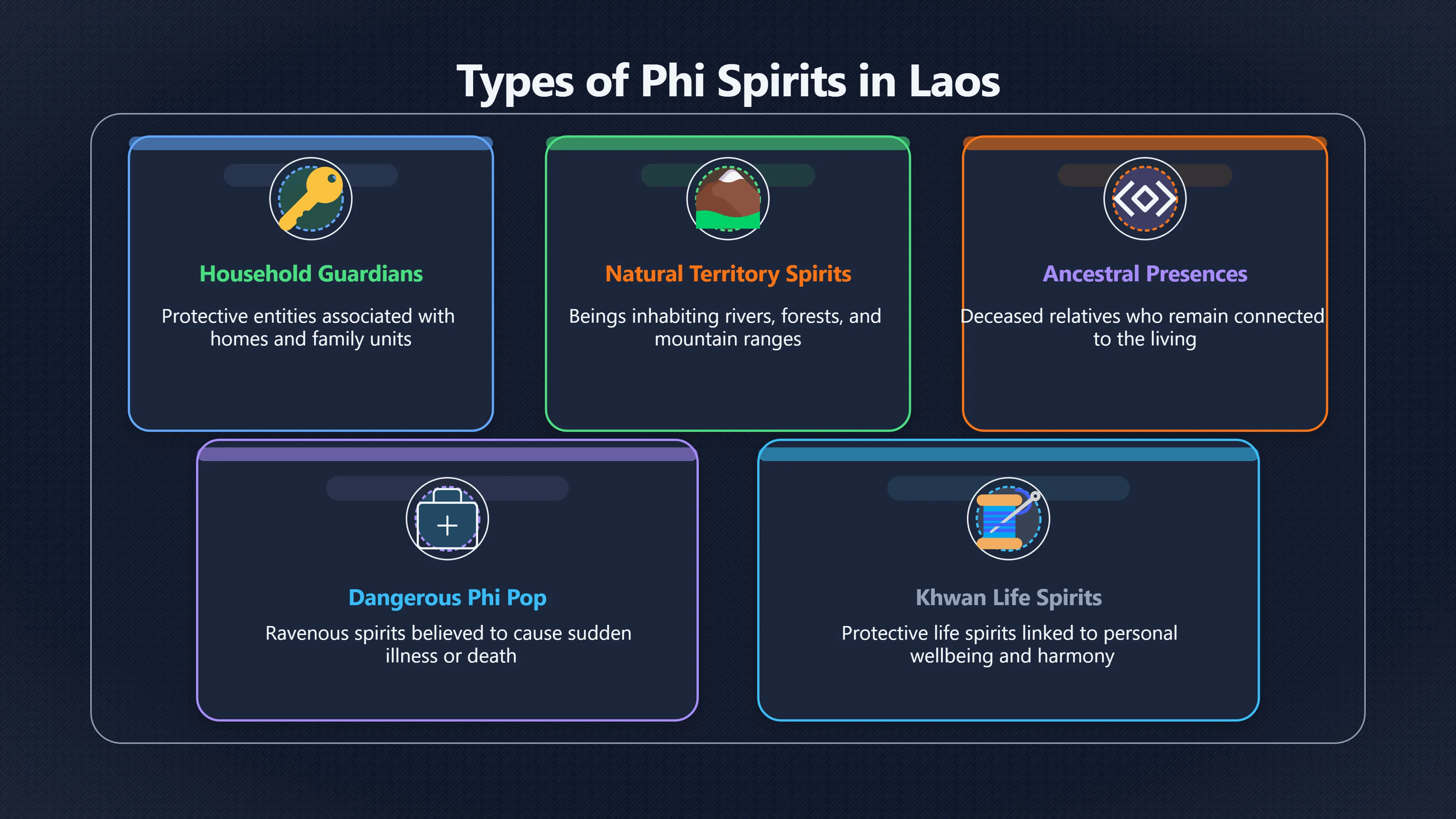
The Lao word often translated as “spirit” or “ghost” is phi, a broad category covering many different kinds of unseen beings. These are not all frightening apparitions. Some phi are associated with households, ancestors, temples, rivers, forests or particular territories, and their relationship with humans can range from protective to dangerous.[countrystudies.us]countrystudies.usOpen source on countrystudies.us.
Traditional Lao beliefs developed alongside Buddhism rather than simply being replaced by it. In many communities, ideas about spirits, karma, ancestors and Buddhist rituals overlap. Anthropologists studying Lao religious life describe a landscape where the dead, local guardians and other spiritual beings remain connected to the living through ceremonies, offerings and shared places.[Max Planck Institute]eth.mpg.deOpen source on mpg.de.
One important idea is that a person’s wellbeing is linked to spiritual balance. Many Lao traditions describe khwan, often understood as protective life spirits connected with a person. When these spirits are disturbed or leave the body, illness or misfortune may follow; rituals such as the baci ceremony are performed to restore harmony.[countrystudies.us]countrystudies.usOpen source on countrystudies.us.
From a modern scientific viewpoint, these explanations are cultural interpretations rather than measurable evidence of spirits. Yet they remain historically important because they show how people have long connected health, identity and place.
The feared spirits of illness and misfortune
Not every phi is a guardian. Some spirits are remembered as dangerous forces linked with sudden illness, death or unexplained events. Among the most feared are stories of phi pop, described in ethnographic studies as ravenous spirits believed to cause harm through human hosts. In southern Laos, researchers have examined how communities respond to these beliefs through spirit mediums, healing practices and ideas of social balance.[J-STAGE]jstage.jst.go.jpOpen source on go.jp.
Stories about such beings often function less like simple horror tales and more like warnings. They explain why certain behaviour is considered risky, why relationships within a community matter, and why invisible dangers may exist alongside everyday life.
Ghost stories as warnings
Many Lao ghost traditions work as landscape-based warnings. A forest is not merely a collection of trees; a river is not merely water; a cave is not merely rock. Places can carry histories, obligations and memories. A story about a dangerous location may preserve local knowledge about where people should be cautious, especially at night or during unusual circumstances.[countrystudies.us]countrystudies.usOpen source on countrystudies.us.
Traditional tales collected and retold in Laos often place spirits in ordinary settings: rice fields, paths, villages and waterways. One example is the story tradition surrounding Phiiphong, a spirit encountered in a rural landscape at night. Such stories were passed down orally and became part of popular Lao storytelling, using frightening encounters to entertain while also teaching lessons about cleverness, cooperation and survival.[Big Brother Mouse]bigbrothermouse.comBig Brother Mouse Phiiphong: Two Lao ghost stories (Published in LaosBig Brother Mouse Phiiphong: Two Lao ghost stories (Published in Laos
The strange power of these tales comes from their familiarity. A haunted castle or abandoned mansion may be distant from everyday life, but a haunted river bend or forest path is part of the world people actually travel through. The supernatural becomes a way of making ordinary landscapes emotionally charged.

Forests, caves and dangerous places
Forested areas have a particularly strong place in Lao imagination. Across mainland Southeast Asia, forests have often been viewed as spaces where humans enter territory that is less controlled and less predictable. In Lao belief systems, wild spirits may inhabit natural environments, requiring respect rather than simple fear.[countrystudies.us]countrystudies.usOpen source on countrystudies.us.
This does not mean every forest story should be treated as a report of an encounter with an unknown creature. Many are moral or cultural narratives. A tale about a spirit protecting a mountain, for example, may express ideas about respecting nature, avoiding arrogance or remembering ancestral connections.
Tourism authorities in places such as Sayaboury have also highlighted how waterfalls, mountains and caves are surrounded by legends in local memory. These stories often mix historical places, religious traditions and folklore, showing how a landscape can become famous partly because of the meanings attached to it.[Tourism Sayaboury]tourismsayaboury.orgTourism Sayaboury Phi Tha Khon Festival – Sayaboury TourismTourism Sayaboury Phi Tha Khon Festival – Sayaboury Tourism
Sacred places and local memory
Some of Laos’s most powerful spirit landscapes are not “haunted” in the frightening sense but sacred in the sense that they are believed to hold relationships between humans, ancestors and unseen forces. Temples, rivers and areas of natural beauty may become places where stories accumulate over generations.[Wikipedia]WikipediaLao peopleLao people
A useful example is the continuing relationship between Lao communities and the dead. Buddhist festivals connected with deceased relatives and spirits involve offerings, food and rituals intended to maintain links between the living and those who have passed away. Anthropologist Patrice Ladwig’s research describes these ceremonies as moments when relationships between humans and ghosts are actively renewed rather than simply remembered.[Max Planck Institute]eth.mpg.deOpen source on mpg.de.
This creates an unusual feature of Lao “haunted” landscapes: the dead are not always imagined as distant or threatening. Some spirits are family members, guardians or beings deserving care. The boundary between ghost story and ancestor tradition can therefore be much less clear than in many modern horror traditions.
The landscape remembers
For outsiders, the most intriguing aspect of Lao spirit traditions is the way geography becomes a record of belief. A mountain may carry a legend about its origin. A river may be associated with protective beings. A village may preserve stories of spirits that explain past troubles. These traditions turn physical places into cultural archives.[ResearchGate]researchgate.netResearchGate(PDF) Ontology, materiality and spectral traces: Methodological thoughts on studying Lao Buddhist festivals for ghosts and an…
This does not make every story historically verifiable. There is rarely physical evidence that confirms the existence of spirits themselves. Instead, the evidence lies in the persistence of traditions, rituals, oral storytelling and the continued importance of particular places.
Why Laos’s spirit landscapes remain part of strange-history culture
Lao spirit traditions matter to the wider history of unusual reports because they show how people interpret experiences that are difficult to explain. A strange sound in a forest, an illness without an obvious cause, or an unsettling place at night can become part of a shared story system.
Sceptical explanations may focus on psychology, environmental factors, memory and social transmission. Believers may see the same events as encounters with genuine spiritual realities. Between these positions lies the historical fact that spirit stories have shaped how generations of Lao people understand their surroundings.[countrystudies.us]countrystudies.usOpen source on countrystudies.us.
The enduring mystery of Laos’s haunted landscapes is therefore not only whether spirits exist. It is why certain places become powerful enough to attract stories at all. The answer lies in the meeting point between landscape and imagination: forests that inspire caution, rivers that carry sacred meaning, and communities that preserve invisible histories alongside visible ones.
Amazon book picks
Further Reading
Books and field guides related to The Spirits Said To Roam Laos's Landscapes. Use these as the next step if you want deeper reading beyond the article.


Ghosts : A Natural History
Directly explores ghost beliefs and cultural interpretations.
The Anthropology of Religion
Provides context for spirit traditions beyond simple ghost stories.

eBay marketplace picks
Marketplace Samples
Live-tested eBay searches with available results related to this page.

Endnotes
1.
Source: countrystudies.us
Link:https://countrystudies.us/laos/59.htm
2.
Source: Wikipedia
Title: Religion in Laos
Link:https://en.wikipedia.org/wiki/Religion_in_Laos
3.
Source: researchgate.net
Link:https://www.researchgate.net/publication/273599451_Ontology_materiality_and_spectral_traces_Methodological_thoughts_on_studying_Lao_Buddhist_festivals_for_ghosts_and_ancestral_spirits
Source snippet
ResearchGate(PDF) Ontology, materiality and spectral traces: Methodological thoughts on studying Lao Buddhist festivals for ghosts and an...
4.
Source: Wikipedia
Title: Lao people
Link:https://en.wikipedia.org/wiki/Lao_people
5.
Source: jstage.jst.go.jp
Link:https://www.jstage.jst.go.jp/article/seas/13/1/13_109/_article/-char/en
6.
Source: researchgate.net
Link:https://www.researchgate.net/publication/287206696_The_Cultural_and_Natural_Heritage_of_Caves_in_the_Lao_PDR_Prospects_and_Challenges_Related_to_Their_Use_Management_and_Conservation
Source snippet
The King of Luang Prabang is reported to have travelled regularly to Tham Ting to perform ceremonies for...
7.
Source: researchgate.net
Link:https://www.researchgate.net/publication/264488048_Visitors_from_hell_Transformative_hospitality_to_ghosts_in_a_Lao_Buddhist_festival
Source snippet
June 1, 2012 — Article PDF Available VISITORS FROM HELL: TRANSFORMATIVE HOSPITALITY TO GHOSTS IN A LAO BUDDHIST FESTIVAL * June 2012 * Jo...
Published: June 1, 2012
8.
Source: researchgate.net
Title: (PDF) Where Do the Ravenous Spirits (Phi Pop) Go?
Link:https://www.researchgate.net/publication/386370201_Where_Do_the_Ravenous_Spirits_Phi_Pop_Go_Nakasang_Village_in_Southern_Laos_as_a_Place_of_Cultural_Healing
Source snippet
Nakasang Village in Southern Laos as a Place of Cultural HealingArticle PDF Available WHERE DO THE RAVENOUS SPIRITS (PHI POP) GO? NAKASAN...
9.
Source: researchgate.net
Link:https://www.researchgate.net/publication/293087190_Spirits_of_the_place_Buddhism_and_Lao_religious_culture
Source snippet
Spirits of the place: Buddhism and Lao religious cultureSpirits of the Place is a rare and timely contribution to our understanding of re...
10.
Source: researchgate.net
Link:https://www.researchgate.net/publication/386359886_The_Geographies_of_Lao_Spirit_Mediumship_in_Mainland_Southeast_Asia
Source snippet
Nakasang Village in Southern Laos as a Place of Cultural Healing Article Full-text available * Apr 2024 * Ian G. Baird Spirits are ubiqu...
11.
Source: folklore.earth
Link:https://www.folklore.earth/culture/lao-loum/
Source snippet
Their spiritual life reflects a blend of Theravada Buddhism, indigenous animist traditions...
12.
Source: bigbrothermouse.com
Title: Big Brother Mouse Phiiphong: Two Lao ghost stories (Published in Laos)
Link:https://www.bigbrothermouse.com/books/phiipong-book.html
13.
Source: eth.mpg.de
Link:https://www.eth.mpg.de/cms/en/media/lao_buddhist_festivals_for_deceased
14.
Source: tourismsayaboury.org
Title: Tourism Sayaboury Phi Tha Khon Festival – Sayaboury Tourism
Link:https://www.tourismsayaboury.org/destinations/phithakhon/
15.
Source: rai.onlinelibrary.wiley.com
Link:https://rai.onlinelibrary.wiley.com/doi/abs/10.1111/j.1467-9655.2012.01765.x
Source snippet
LADWIG - 2012 - Journal of the Royal Anthropological Institute - Wiley Online Library...
16.
Source: jstage.jst.go.jp
Title: This article argues that this is not an attempt to ga
Link:https://www.jstage.jst.go.jp/browse/seas/13/1/_contents/-char/en
Source snippet
Asian StudiesApril 25, 2024 — To legitimize these modifications and maintain the rituals’ efficacy, people have appropriated rhetoric and...
Published: April 25, 2024
17.
Source: academic.oup.com
Link:https://academic.oup.com/hawaii-scholarship-online/book/20793
Source snippet
of the Place: Buddhism and Lao Religious Culture | Hawai'i Scholarship Online | Oxford AcademicJuly 29, 2009 — SPIRITS OF THE PLACE: BUDD...
Published: July 29, 2009
18.
Source: jstage.jst.go.jp
Title: jst.go.jp Where Do the Ravenous Spirits (Phi Pop) Go?
Link:https://www.jstage.jst.go.jp/article/seas/13/1/13_109/_pdf
Source snippet
IG Baird · 2024 · Cited by 12 — Indeed, the belief in ravenous spirits has become a convenient way of ridding undesirables...
19.
Source: jstage.jst.go.jp
Link:https://www.jstage.jst.go.jp/article/sea/2011/40/2011_54/_article/-char/ja/
Source snippet
the villagers and analyze the diverse meanings of phi belief, especially focusin...
20.
Source: tourismsayaboury.org
Link:https://www.tourismsayaboury.org/destinations/khop_district/
Additional References
21.
Source: luangprabangculture.com
Link:https://www.luangprabangculture.com/spirits.html
Source snippet
SpiritsAnother important spirit site found in all Lao towns is the City Pillar or Lak Meuang. This is a sacred post which marks the locat...
22.
Source: cambridge.org
Link:https://www.cambridge.org/core/journals/modern-asian-studies/article/belt-and-road-initiative-and-spirit-mediums-the-lower-sesan-2-dam-and-sacred-space-in-northeastern-cambodia/B521BDC5326C61425E4AA537EB18E0DF
Source snippet
Cambridge CoreJune 9, 2025 — SPIRIT MEDIUMS IN THE LAO TRADITION Ethnic Lao people have complex belief systems associated with spirits, m...
Published: June 9, 2025
23.
Source: cir.nii.ac.jp
Link:https://cir.nii.ac.jp/crid/1390001205773413504?lang=en
Source snippet
Benevolent Spirits and Evil Spirits: An Anthropological Study on Guardian Spirits in Northeastern Thailand | CiNii ResearchI attempt to i...
24.
Source: cir.nii.ac.jp
Link:https://cir.nii.ac.jp/crid/1360589290748113792
Source snippet
nii.ac.jpOntology, materiality and spectral traces: Methodological thoughts on studying Lao Buddhist festivals for ghosts and ancestral s...
25.
Source: buddhism.lib.ntu.edu.tw
Link:https://buddhism.lib.ntu.edu.tw/en/search/search_detail.jsp?seq=540828
Source snippet
from Hell: Transformative Hospitality to Ghosts in a Lao Buddhist FestivalAuthor Ladwig, Patrice (著) Source Journal of the Royal Anthropo...
26.
Source: factsanddetails.com
Link:https://factsanddetails.com/southeast-asia/Laos/sub5_3a/entry-2949.html
Source snippet
ANIMISM, SPIRITS, FUNERALS AND SUPERSTITIONS IN LAOS | Facts and DetailsANIMISM, SPIRITS, FUNERALS AND SUPERSTITIONS IN LAOS ANIMISM AND...
27.
Source: laoslife.info
Link:https://www.laoslife.info/spirit-worship-in-laos/
28.
Source: gutenberg.org
Link:https://www.gutenberg.org/cache/epub/35564/pg35564-images.html
Source snippet
The Project Gutenberg eBook of Laos Folk-Lore of Farther India, by Katherine Neville FleesonMarch 12, 2011 — THE PROJECT GUTENBERG EBOOK...
Published: March 12, 2011
29.
Source: researchportalplus.anu.edu.au
Link:https://researchportalplus.anu.edu.au/en/publications/lua-people-traditions-beliefs-and-sacred-natural-sites-in-norther/
Source snippet
People: Traditions, beliefs and sacred natural sites in Northern Thailand - The Australian National UniversityLUA PEOPLE: TRADITIONS, BEL...
30.
Source: mythfolklore.blogspot.com
Link:https://mythfolklore.blogspot.com/2014/06/myth-folklore-book-laos-folk-lore.html
Source snippet
Mythology and Folklore UN-Textbook: Myth-Folklore Book: Laos Folk-LoreMYTHOLOGY AND FOLKLORE UN-TEXTBOOK Content for a course in Myth & F...
Topic Tree