Within Weird Guatemala
How Did Maya History Become Doomsday Hype?
The 2012 Maya doomsday scare shows how ancient Guatemala-linked history can be repackaged into global prophecy panic.
On this page
- What the 2012 claims said
- Why scholars and science communicators pushed back
- What the panic reveals about modern Forteana
Page outline Jump by section
Introduction
In the years leading up to 21 December 2012, a worldwide belief took hold that the ancient Maya had predicted the end of the world. Because much of the Classic Maya civilisation flourished in what is now Guatemala, the country became closely associated with a prophecy that Maya scholars repeatedly said did not exist. The resulting panic is one of the clearest modern examples of how genuine archaeology, popular culture, New Age spirituality and internet rumours can combine into a global Fortean phenomenon. Rather than revealing an ancient apocalypse, the episode showed how easily fragments of real history can be reshaped into a compelling modern myth.[UT Austin News]news.utexas.eduUT Austin News Maya Scholar Debunks World-Ending Myth21, 2012, was a meaningful date to the ancient Mayans, according to art historian David Stuart. But his research indicates it wasn't the…

What the 2012 claims actually said
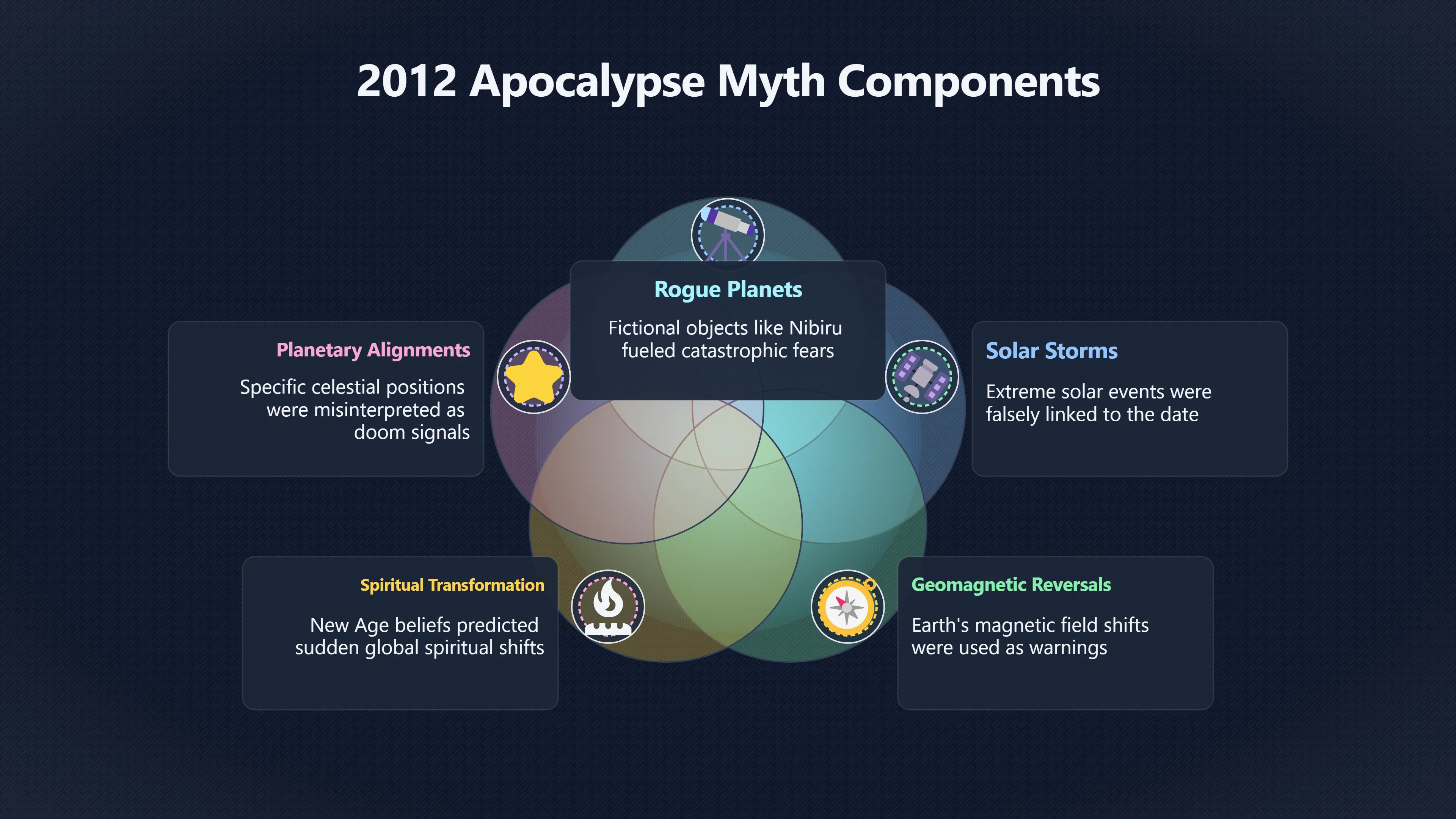
The central claim was that the Maya Long Count calendar ended on 21 December 2012 and that this supposedly marked the destruction of the Earth. Popular books, documentaries, websites and the 2009 disaster film 2012 linked the date to a bewildering variety of predicted catastrophes, including rogue planets, catastrophic solar storms, planetary alignments, geomagnetic reversals and sudden spiritual transformation.
These ideas rarely agreed with one another. Instead, they borrowed authority from the reputation of the ancient Maya while adding modern fears that had no basis in surviving Maya texts. The Long Count calendar did indeed reach the end of its thirteenth b’ak’tun—a major chronological cycle—but that is very different from a calendar ending altogether. It is closer to an odometer rolling over than to history stopping.[wikipedia.org]Wikipedia2012 phenomenon2012 phenomenon
For Guatemala, the association was unavoidable. The country contains some of the most celebrated Maya archaeological sites, including Tikal, and international media frequently used Guatemalan imagery when discussing the supposed prophecy. Tourism increased around Maya heritage sites as visitors sought to witness the alleged turning point, even though local archaeologists and Maya specialists consistently rejected the apocalyptic interpretation.[Wikipedia]Wikipedia2012 phenomenon2012 phenomenon
Why scholars and science communicators pushed back
The scholarly response was remarkably consistent. Experts on Maya writing, archaeology and history explained that no known ancient inscription predicts the destruction of the world in 2012.
Art historian and Maya epigrapher David Stuart noted that the end of the thirteenth b’ak’tun represented an important calendrical milestone but not an apocalypse. Ancient Maya inscriptions regularly refer to dates far beyond 2012, demonstrating that the civilisation expected time to continue rather than cease.[UT Austin News]news.utexas.eduUT Austin News Maya Scholar Debunks World-Ending Myth21, 2012, was a meaningful date to the ancient Mayans, according to art historian David Stuart. But his research indicates it wasn't the…
Other Maya specialists made similar points:
- The Long Count measures extremely long spans of time and naturally progresses into new cycles.
- Surviving inscriptions commemorate anniversaries and future dates rather than predicting global catastrophe.
- The widespread claim that the Maya “predicted the end of the world” originated in modern popular culture rather than ancient Maya tradition.[UT Austin News]news.utexas.eduUT Austin News Maya Scholar Debunks World-Ending Myth21, 2012, was a meaningful date to the ancient Mayans, according to art historian David Stuart. But his research indicates it wasn't the…
Science communicators also dismantled the accompanying astronomical claims. There was no hidden planet approaching Earth, no exceptional planetary alignment capable of causing disaster, and no unusual solar event expected for December 2012. Many of the scientific explanations promoted online relied on misunderstandings of astronomy or entirely fictional objects such as the mythical planet Nibiru.[Wikipedia]Wikipedia2012 phenomenon2012 phenomenon
Why Guatemala became linked to the panic
The irony is that the panic had relatively little to do with living Maya communities in Guatemala.
The modern prophecy emerged largely through a mixture of speculative books, New Age beliefs and entertainment media outside Guatemala, yet it borrowed prestige from genuine Maya achievements in mathematics, astronomy and calendar-making. Ancient knowledge became a backdrop against which modern anxieties about environmental collapse, technology and global catastrophe were projected.
Researchers studying the phenomenon in Guatemala have argued that the international fascination often reduced Maya culture to a mysterious source of hidden wisdom while overlooking the realities of contemporary Indigenous communities. The commercialisation of the 2012 date also turned archaeological heritage into a global commodity, with tourism campaigns, documentaries and merchandise frequently blurring the line between historical interpretation and sensational storytelling.[Academia]academia.eduAcademia"Pirates of Our Spirituality" The 2012 Apocalypse and…The idea behind this is that a long cyclical count in the sacred Maya ca…
What the panic reveals about modern Forteana
The 2012 phenomenon occupies an unusual place in Fortean culture because it was built around authentic historical material that was repeatedly misinterpreted.
Several recurring patterns stand out:
- Ancient authority gave modern rumours credibility. Real Maya inscriptions and calendars were used to legitimise ideas that the inscriptions themselves never expressed.
- Different fears merged into one narrative. Astronomical speculation, environmental anxiety, spiritual transformation and conspiracy theories became attached to the same date despite having different origins.
- Media repetition amplified certainty. Films, television specials, websites and social media often presented speculation alongside genuine archaeology, making it difficult for audiences to distinguish evidence from invention.
- Debunking never spread as quickly as the myth. Academic explanations were detailed but generally less dramatic than claims of impending catastrophe.[utexas.edu]news.utexas.eduUT Austin News Maya Scholar Debunks World-Ending Myth21, 2012, was a meaningful date to the ancient Mayans, according to art historian David Stuart. But his research indicates it wasn't the…
This pattern has become a textbook example of how misinformation can develop around genuine historical subjects without requiring forged documents or fabricated archaeological discoveries.
Why the story still matters
The world did not end on 21 December 2012, but the episode remains culturally significant because it demonstrates how modern societies create myths from fragments of the past.
For Guatemala, the scare is part of the country’s strange-history landscape not because it validates ancient prophecy, but because it shows how Maya civilisation became entangled with a worldwide belief that its own experts overwhelmingly rejected. It also serves as a reminder that archaeological discoveries often become more mysterious in popular retellings than they ever were in the original evidence.
As a piece of modern Forteana, the Maya doomsday panic is therefore less a story about failed prophecy than about the enduring appeal of apocalypse, the authority people grant to ancient cultures, and the remarkable ability of modern media to transform a calendrical milestone into one of the best-known global scares of the twenty-first century.[utexas.edu]news.utexas.eduUT Austin News Maya Scholar Debunks World-Ending Myth21, 2012, was a meaningful date to the ancient Mayans, according to art historian David Stuart. But his research indicates it wasn't the…

eBay marketplace picks
Marketplace Samples
Live-tested eBay searches with available results related to this page.


Endnotes
1.
Source: Wikipedia
Title: 2012 phenomenon
Link:https://en.wikipedia.org/wiki/2012_phenomenon
2.
Source: pmc.ncbi.nlm.nih.gov
Title: PMCCorrelating the Ancient Maya and Modern European
Link:https://pmc.ncbi.nlm.nih.gov/articles/PMC3623374/
Source snippet
by DJ Kennett · 2013 · Cited by 41 — This strongly supports the Goodman-Martínez-Thompson (GMT) correlation and the hypothesis that cl...
3.
Source: academia.edu
Link:https://www.academia.edu/9007847/_Pirates_of_Our_Spirituality_The_2012_Apocalypse_and_the_Value_of_Heritage_in_Guatemala
Source snippet
Academia"Pirates of Our Spirituality" The 2012 Apocalypse and...The idea behind this is that a long cyclical count in the sacred Maya ca...
4.
Source: news.utexas.edu
Title: UT Austin News Maya Scholar Debunks World-Ending Myth
Link:https://news.utexas.edu/2012/12/17/maya-scholar-debunks-world-ending-myth/
Source snippet
21, 2012, was a meaningful date to the ancient Mayans, according to art historian David Stuart. But his research indicates it wasn't the...
Additional References
5.
Source: youtube.com
Link:https://www.youtube.com/watch?v=wEPPuf6I0Ic
Source snippet
World Will Not End On 12.21.12... Really, NASA Says | VideoDelving deep into Mayan history, NASA scientist reveals that, much like an odo...
6.
Source: facebook.com
Link:https://www.facebook.com/nasdaily/posts/remember-when-people-thought-the-world-would-end-in-2012that-idea-came-from-the-/1489561205874880/
Source snippet
Some people believed that meant the end of the world. But the world did not end. The Maya civilization had...Read more...
7.
Source: youtube.com
Link:https://www.youtube.com/watch?v=YRqnB2c8UR8
Source snippet
This selection of videos features expert commentary from space agencies, anthropologists, and prominent science communicators addressing...
8.
Source: facebook.com
Link:https://www.facebook.com/GeoEnglishdotTV/posts/scientist-believes-mayan-calendar-was-incorrectly-read-doomsday-scheduled-for-th/3505709672817765/
Source snippet
lypse is this upcoming Sunday, Fathers Day.Read more...
9.
Source: youtube.com
Link:https://www.youtube.com/watch?v=gi_l6nC5CmQ
Source snippet
End of World in 2012? Mayan "Doomsday" Calendar Explained by Neil DeGrasse Tyson...
10.
Source: youtube.com
Title: Science Casts: Why the World Didn’t End Yesterday
Link:https://www.youtube.com/watch?v=QY_Gc1bF8ds
Source snippet
UK Professor Dispels Myths of Dec. 21, 2012 Doomsday Theory...
11.
Source: youtube.com
Link:https://www.youtube.com/watch?v=8BWzsuFnpDU
Source snippet
Mayan Apocalypse: Uncovering the Myth...
12.
Source: youtube.com
Link:https://www.youtube.com/watch?v=dFYiqOfRvDw
Source snippet
2012 and the End of the World: A Maya or a Modern Prophesy?Stories abound in popular culture about the end of the world citing prophesies...
13.
Source: youtube.com
Title: Mayan Apocalypse: Uncovering the Myth
Link:https://www.youtube.com/watch?v=tQdKj9jlyBU
Source snippet
ScienceCasts: Why the World Didn't End Yesterday...
Topic Tree