Within Myanmar Uncanny
Why Myanmar's Nat Spirits Still Matter
Myanmar's nat tradition turns violent death, local memory and sacred places into one of the country's strongest strange-history pillars.
On this page
- Who the 37 nats are and why the list is complicated
- Mount Popa as a living spirit landscape
- How shrines, offerings and stories preserve public memory
Page outline Jump by section
Introduction
Myanmar’s nat tradition is one of the country’s most distinctive contributions to the world’s strange folklore. Rather than treating ghosts as marginal supernatural curiosities, Burmese tradition places powerful spirits within an everyday religious landscape that overlaps with Buddhism, family life and local history. Nowhere is that connection between story and place stronger than Mount Popa, the extinct volcano long regarded as the spiritual home of many of Myanmar’s most important nats. The mountain is less a “haunted mountain” in the Gothic sense than a living sacred landscape where legends of violent death, miraculous encounters and protective spirits are mapped onto real shrines, pilgrimage routes and dramatic volcanic scenery. For anyone interested in Myanmar’s Fortean heritage, Mount Popa shows how folklore can become part of geography rather than remaining simply a collection of ghost stories.[wikipedia.org]WikipediaMount PopaMount Popa

Why the 37 nats are more complicated than they first appear
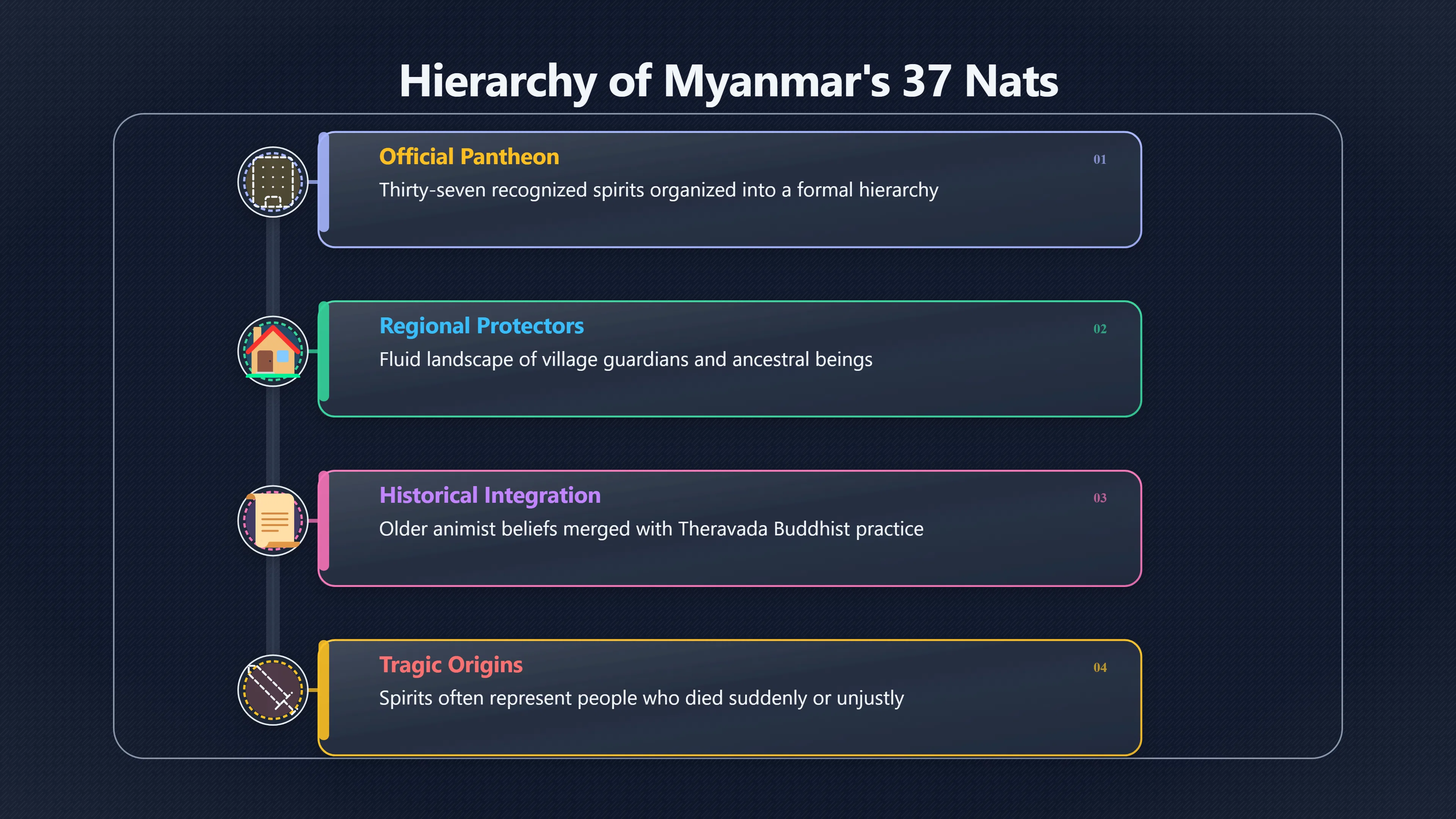
Many introductions to Burmese folklore describe the “37 nats” as though they were a fixed pantheon comparable to the Greek gods. The reality is more complicated.
The official list of thirty-seven spirits emerged through historical attempts to organise a much older and far more diverse body of local spirit traditions. According to long-standing historical accounts, King Anawrahta’s promotion of Theravada Buddhism in the eleventh century did not eliminate older spirit worship. Instead, influential local spirits were incorporated into a recognised hierarchy alongside Buddhist practice. Later scholars have noted that this official catalogue simplified what had always been a fluid landscape of regional guardian spirits, village protectors and ancestral beings.[uclmyanmar.org]uclmyanmar.orgthe lord of the great mountainHe changed the number of spirits from 36 to 37 by adding to the list Thagya (Sakra in Pali), the king of th…
Many of the best-known nats share a striking characteristic: they are remembered as people whose deaths were sudden, unjust or violent. Executed servants, betrayed warriors, wronged women and loyal retainers frequently appear in nat traditions. Their continuing power reflects an idea found across many cultures—that those who die tragically leave unfinished relationships with the living.
This makes nat stories unusually valuable as cultural history. Whether or not one accepts the existence of spirits, the tales preserve memories of political conflict, royal authority, family loyalty and social injustice. The supernatural framework became a way of remembering difficult human stories across generations.
Why Mount Popa became Myanmar’s spirit mountain
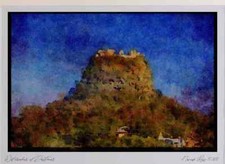
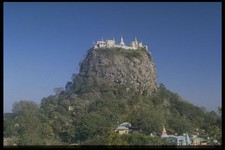
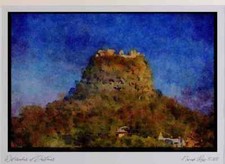
Mount Popa dominates the dry plains south-east of Bagan, rising more than 1,500 metres above sea level. Beside the main volcano stands the spectacular volcanic plug known as Taung Kalat, topped by monasteries and shrines reached by hundreds of steps. The striking landscape almost seems designed for mythology, and for centuries pilgrims have regarded it as the foremost centre of nat worship.[wikipedia.org]WikipediaMount PopaMount Popa
The geography itself contributes to the mountain’s uncanny reputation.
Unlike many haunted locations whose significance depends solely on stories, Mount Popa combines several features that reinforce one another:
- a dramatic isolated volcanic peak visible across the plains;
- monasteries sharing space with nat shrines;
- statues representing the official nat pantheon;
- regular pilgrimages and seasonal festivals;
- generations of local legends tied to particular places on the mountain.
This layering means visitors encounter not simply a historical monument but an active sacred landscape where folklore continues to shape behaviour.
Even modern visitors are commonly advised to follow traditional etiquette, including climbing barefoot, avoiding bringing meat to certain shrines and respecting local customs regarding clothing colours. Such practices are not evidence for supernatural forces, but they illustrate that the mountain remains spiritually significant rather than functioning solely as a tourist attraction.[exotravel.com]exotravel.comExo TravelWalk Amongst Myanmar's Revered Nats (Spirits) on Mount…December 31, 2010 — Its shrine is dedicated to the worship of the 37…
The spirits most closely associated with Popa
Although statues of all thirty-seven official nats appear at the shrine complex, tradition identifies only a handful as true residents of Mount Popa itself.
Among the most important are:
- Mahagiri and his sister, whose legends connect the mountain with earlier spirit traditions and themes of royal injustice.
- Byatta, a legendary royal servant whose romance with a supernatural woman ended in execution.
- Me Wunna (Popa Medaw), the flower-eating spirit who became the “Mother of Popa” after dying from grief.
- The Shwe Hpyin brothers, whose later stories became linked both to Mount Popa and to the famous Taungbyone spirit festival elsewhere in Myanmar.[Wikipedia]WikipediaMount PopaMount Popa
The result is not a single ghost legend but an interconnected family saga stretching across Myanmar’s sacred geography.
How Popa’s stories turn landscape into memory
Perhaps the most remarkable feature of Mount Popa is the way individual legends become attached to physical locations.
The tale of Popa Medaw, for example, is inseparable from the mountain itself. According to tradition, she was a supernatural woman who lived among the flowers growing on the volcanic slopes. Her relationship with Byatta ended after the king ordered his execution, and her death from grief transformed her into one of Myanmar’s most important female spirits. Her title—Mother of Popa—ties her identity permanently to the mountain.[Wikipedia]WikipediaPopa MedawPopa Medaw
Whether read as myth or religious narrative, the story explains why the mountain is seen not merely as scenery but as inhabited territory with its own spiritual history.
This is characteristic of nat belief more generally. Spirits are rarely imagined as floating abstractions. Instead they belong to particular hills, trees, villages, rivers or households. Mount Popa therefore functions almost as a map of remembered relationships between people, tragedy and place.
Modern conservation projects have even noted that nat shrines often reinforce people’s attachment to the surrounding landscape. Researchers studying Mount Popa National Park have argued that traditional spirit beliefs can encourage respect for forests and sacred sites because harming the landscape may also be understood as offending the spirits associated with it.[The Revealer]therevealer.orgThe RevealerReviving Burmese Nat Shrines to Protect Myanmar's Mount…8 May 2024 — A nat, also called deva, is a spirit, and traditional…
Are the haunting stories meant to be taken literally?
Outside Myanmar, Mount Popa is often marketed as a “haunted mountain”. That description captures only part of the picture.
For believers, the nats are neither horror-film ghosts nor fictional characters. They are powerful beings capable of protection, punishment and communication through ritual specialists. Offerings, ceremonies and festivals remain living practices rather than historical re-enactments.[The Revealer]therevealer.orgThe RevealerReviving Burmese Nat Shrines to Protect Myanmar's Mount…8 May 2024 — A nat, also called deva, is a spirit, and traditional…
Historians and anthropologists generally approach the same traditions differently. They see the stories as evidence of:
- the survival of older animist beliefs within Buddhist society;
- the preservation of historical memory through legend;
- the importance of sacred geography in Burmese identity;
- changing relationships between local communities and state religion.
Neither perspective requires dismissing the other. A scholar may analyse how legends evolved over centuries, while worshippers continue to treat the same spirits as active presences.
For Fortean readers, this distinction matters. Mount Popa is significant not because it produces well-documented paranormal investigations or modern ghost-hunting claims, but because it represents one of the world’s clearest examples of a landscape where supernatural belief has remained socially meaningful for hundreds of years.
How shrines and offerings keep the stories alive
Mount Popa demonstrates that folklore survives most effectively when it is woven into everyday ritual.
Shrines displaying colourful nat figures allow visitors to recognise individual spirits rather than treating them as anonymous ghosts. Offerings of flowers, fruit, coconuts and incense continually renew relationships between people and the spirits associated with particular places. Annual festivals attract pilgrims who already know the stories, while newcomers encounter them through guides, family traditions and religious ceremonies.[exotravel.com]exotravel.comExo TravelWalk Amongst Myanmar's Revered Nats (Spirits) on Mount…December 31, 2010 — Its shrine is dedicated to the worship of the 37…
This continual retelling prevents the legends from becoming museum pieces. Every pilgrimage, offering and festival links the present to stories of betrayal, loyalty, grief and justice that may be centuries old.
From a Fortean perspective, that is what makes Mount Popa exceptional. Its mystery does not depend on a single unexplained event or famous haunting. Instead, it shows how an entire landscape can become “haunted” through collective memory, with shrines, rituals and stories preserving a supernatural geography that remains meaningful in contemporary Myanmar.
Amazon book picks
Further Reading
Books and field guides related to Why Myanmar's Nat Spirits Still Matter. Use these as the next step if you want deeper reading beyond the article.

The Spirit Catches You and You Fall Down
First published 1997. Subjects: Asian Americans, Attitude, Attitude of Health Personnel, Child, Communication.
The Glass Palace
First published 2000. Subjects: Fiction, History, Historical fiction, Love stories, Domestic fiction.
From the land of green ghosts
First published 2002. Subjects: Padaung (Burmese people), Guerrillas, Biography, History, Nationalitätenpolitik.

Rivers of flavor
First published 2012. Subjects: Food, Social life and customs, Burmese Cooking, Cooking (Spices), Cooking, burmese.
eBay marketplace picks
Marketplace Samples
Live-tested eBay searches with available results related to this page.
Endnotes
1.
Source: Wikipedia
Title: Mount Popa
Link:https://en.wikipedia.org/wiki/Mount_Popa
2.
Source: uclmyanmar.org
Link:https://www.uclmyanmar.org/wp-content/uploads/2016/02/381075.pdf
Source snippet
the lord of the great mountainHe changed the number of spirits from 36 to 37 by adding to the list Thagya (Sakra in Pali), the king of th...
3.
Source: Wikipedia
Title: Popa Medaw
Link:https://en.wikipedia.org/wiki/Popa_Medaw
4.
Source: Wikipedia
Title: Shwe Hpyin Nyidaw
Link:https://en.wikipedia.org/wiki/Shwe_Hpyin_Nyidaw
5.
Source: youtube.com
Title: NAT PWE: a spiritual ceremony in Myanmar/Burma
Link:https://www.youtube.com/watch?v=ExXBrVJaN8M
Source snippet
Myanmar | Nat Pwe | Taungbyone Min Nyi Naung...
6.
Source: youtube.com
Title: Myanmar | Nat Pwe | Taungbyone Min Nyi Naung
Link:https://www.youtube.com/watch?v=aGpFrHO0p7s
Source snippet
Myanmar's SURREAL Volcano Temple...
7.
Source: therevealer.org
Link:https://therevealer.org/reviving-burmese-nat-shrines-to-protect-myanmars-mount-popa-national-park/
Source snippet
The RevealerReviving Burmese Nat Shrines to Protect Myanmar's Mount...8 May 2024 — A nat, also called deva, is a spirit, and traditional...
Published: May 2024
8.
Source: insideasiatours.com
Link:https://www.insideasiatours.com/blog/destination-profile-mount-popa
Source snippet
Destination profile: Mount PopaPerched at the top of Pedestal Hill is a cluster of temples and monasteries relating to both Buddhism and...
9.
Source: exotravel.com
Link:https://www.exotravel.com/blog/en/mount-popa-and-salay-myanmar/
Source snippet
Exo TravelWalk Amongst Myanmar's Revered Nats (Spirits) on Mount...December 31, 2010 — Its shrine is dedicated to the worship of the 37...
Published: December 31, 2010
Additional References
10.
Source: gunungbagging.com
Link:https://www.gunungbagging.com/popa/
Source snippet
PopaThe plug is home to Myanmar's most important Nat shrine, dedicated to 37 traditional spirits (Nats), with origins in pre-Buddhist ani...
11.
Source: facebook.com
Link:https://www.facebook.com/groups/921899805200688/posts/1603115123745816/
12.
Source: onthematyoga.com
Title: mt popa20b8dabd
Link:https://www.onthematyoga.com/mt-popa20b8dabd
Source snippet
Mt. Popa30 Apr 2016 — Mount Popa is described as the Mount Olympus of Burma with “a temple” built upon the top. Or at least that's what I...
13.
Source: dontworryjusttravel.com
Title: Spirit up!
Link:https://www.dontworryjusttravel.com/asiapacific/burmamyanmar/mount-popa/
Source snippet
Mount Popa and its stories are waiting for you.7 Aug 2012 — Mount Popa is a temple on top of a mountain dedicated to the 37 nats in Burma...
14.
Source: youtube.com
Title: Popa Taung Kalat, Myanmar [Amazing Places 4K]
Link:https://www.youtube.com/watch?v=opAPwEN6bIQ
Source snippet
NAT PWE: a spiritual ceremony in Myanmar/Burma...
15.
Source: scarletscribs.wordpress.com
Title: the mystical popa
Link:https://scarletscribs.wordpress.com/2026/01/22/the-mystical-popa/
Source snippet
Superstition has it that one should not wear black, red, green...Read more...
16.
Source: youtube.com
Title: Mount Popa Tour
Link:https://www.youtube.com/watch?v=SeA_OY-_s68
Source snippet
Popa Taung Kalat, Myanmar [Amazing Places 4K]...
17.
Source: youtube.com
Title: Myanmar’s SURREAL Volcano Temple
Link:https://www.youtube.com/watch?v=gy0jLX2s7Yo
Topic Tree