Within Strange Georgia
Was Abkhazia's Wild Woman Ever a Monster?
The Zana case shows how a wild-woman legend moved from cryptozoology into a disturbing human story after DNA research.
On this page
- The Almasty claim and why Zana attracted cryptozoologists
- What the DNA evidence changed
- Race, disability, captivity and the ethics of monster stories
Page outline Jump by section
Introduction
Few stories in the Caucasus have travelled as far through the world of cryptozoology as the tale of Zana, the so-called “wild woman” of Abkhazia. For decades she was presented as possible evidence that a surviving population of prehistoric humans still lived in the mountains, making her one of the most famous alleged “Almasty” cases. Yet modern DNA research transformed the story into something far more disturbing and, arguably, more important. Instead of revealing a hidden species, it pointed towards the life of an African woman who appears to have been enslaved, isolated, misunderstood and eventually turned into a monster by folklore, racial prejudice and sensational retellings. The case remains one of the clearest examples of how Fortean legends can change dramatically when historical and scientific evidence catches up with them.[Wiley Online Library]advanced.onlinelibrary.wiley.comOnline Library The genomic origin of Zana of AbkhaziaIn contrast to the speculations that she might…Read more…

Was Abkhazia’s Wild Woman Ever a Monster?
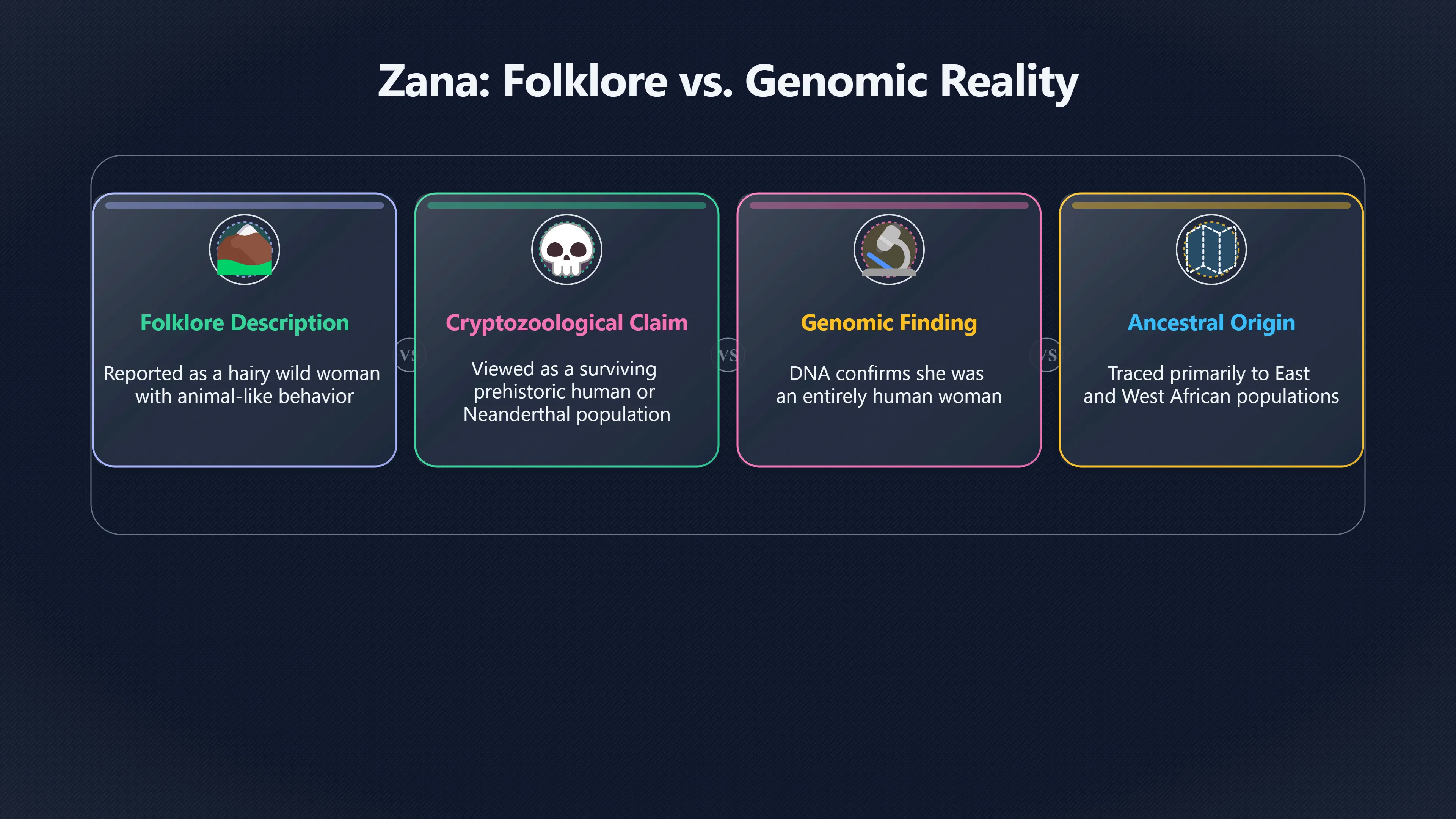
The traditional story places Zana in nineteenth-century Abkhazia, then part of the Russian Empire. According to local accounts collected many decades later, hunters captured an unusually strong woman living in the forests and brought her to the village of Tkhina. She reportedly resisted violently at first before eventually being kept on the estate of a local nobleman.
Descriptions of Zana quickly acquired legendary qualities. Witnesses, often recounting stories passed down through generations rather than first-hand observation, described her as exceptionally powerful, dark-skinned, heavily hairy, unable to speak and comfortable living outdoors. She was said to swim in cold rivers throughout the year and to possess extraordinary physical strength. Such features matched regional traditions about wild forest beings known locally as the Abkhaz equivalent of the Almasty, a legendary wild person found in folklore across much of the Caucasus and Central Asia.[Wikipedia]WikipediaZana of TkhinaZana of Tkhina
The story gained a second life during the Soviet period. Researchers interested in “relict hominids”—the idea that Neanderthals or other ancient human relatives might still survive—treated Zana as potentially genuine evidence. Boris Porshnev and later cryptozoologists argued that she represented a surviving primitive human rather than an ordinary woman. The case became a cornerstone of Soviet and later international cryptozoology, appearing repeatedly in books about Bigfoot, Yeti and other alleged wild people.[Wikipedia]WikipediaZana of TkhinaZana of Tkhina
One reason the story proved unusually persuasive was that it involved named descendants rather than anonymous folklore. Several of Zana’s children were known to local villagers, and her son Khwit became particularly significant because his remains survived long enough to be examined scientifically.
The Almasty claim and why Zana attracted cryptozoologists
Unlike fleeting monster sightings, the Zana story appeared to offer physical evidence. Researchers could point to graves, descendants and skeletal remains rather than relying solely on eyewitness testimony.
Supporters of the Almasty interpretation focused on reported characteristics including:
- unusual physical strength;
- claims that her body was covered in thick reddish hair;
- her inability to speak normally;
- accounts of animal-like behaviour;
- stories that she had been captured in remote mountain forests.
To cryptozoologists searching for a surviving non-human primate or Neanderthal population, these details seemed to fit an existing theory. Rather than questioning the reliability of oral traditions collected many decades after the events, some investigators treated the folklore as historical observation.
The case also reflected wider Cold War-era enthusiasm for searching the Caucasus and Central Asia for “wild men”. Newspapers and popular books often blurred the line between folklore, anthropology and speculative zoology, allowing Zana to become one of the best-known alleged examples worldwide.[Wikipedia]WikipediaZana of TkhinaZana of Tkhina

What the DNA evidence changed
Scientific investigation gradually dismantled the cryptozoological interpretation.
Researchers first studied the remains believed to belong to Zana’s son Khwit. Early DNA work suggested African maternal ancestry, contradicting claims that he descended from a non-human species. Some speculative interpretations nevertheless continued, with suggestions that Zana represented an isolated ancient African population unrelated to recent human history. Those ideas received considerable publicity despite limited evidence.[Channel 4]channel4.comChannel 4Was Russian 'Bigfoot' actually an African slave?1 Nov 2013 — But the big surprise in Sykes' results was that Zana's DNA is not C…
The decisive breakthrough came with whole-genome sequencing published in 2021. Researchers successfully identified skeletal remains believed to be Zana herself and confirmed genetically that the woman buried in the cemetery was Khwit’s mother.
The genomic evidence showed:
- Zana was entirely human.
- Her ancestry traced primarily to East African populations, with some West African ancestry.
- Khwit was the child of Zana and a local Caucasian father.
- There was no evidence whatsoever that she represented a surviving Neanderthal, an unknown human species or any non-human primate.[Wiley Online Library]advanced.onlinelibrary.wiley.comOnline Library The genomic origin of Zana of AbkhaziaIn contrast to the speculations that she might…Read more…
The researchers concluded explicitly that genome-wide evidence put an end to claims that Zana had been anything other than a human woman.[Wiley Online Library]advanced.onlinelibrary.wiley.comOnline Library The genomic origin of Zana of AbkhaziaIn contrast to the speculations that she might…Read more…
Exactly how she or her ancestors arrived in Abkhazia remains uncertain. One plausible explanation links her history to the movement of enslaved Africans through Ottoman trade networks into the Black Sea region between the sixteenth and nineteenth centuries. Another possibility is that she belonged to the small historical Afro-Abkhaz community, although the available evidence cannot identify her precise personal history.[PMC]pmc.ncbi.nlm.nih.govPMCThe genomic origin of Zana of AbkhaziaWe speculate that…Read more…
Race, disability, captivity and the ethics of monster stories
The scientific solution did not merely replace one biological explanation with another. It changed the moral centre of the story.
Modern scholars increasingly argue that Zana’s life illustrates how racial difference, disability and social exclusion can become transformed into legends of monsters. Contemporary accounts describe a woman who never integrated into village society, lived under conditions resembling captivity and bore several children under circumstances that remain deeply troubling and poorly documented.[PMC]pmc.ncbi.nlm.nih.govPMCThe genomic origin of Zana of AbkhaziaWe speculate that…Read more…
Researchers have also suggested that congenital generalised hypertrichosis—a rare condition causing excessive body hair—might explain some descriptions of her appearance. Other reported behavioural differences may reflect developmental disability, trauma, language barriers or the effects of prolonged isolation rather than evidence of anything non-human. None of these possibilities can be confirmed with certainty, but all are considerably more consistent with the evidence than earlier cryptozoological claims.[PMC]pmc.ncbi.nlm.nih.govPMCThe genomic origin of Zana of AbkhaziaWe speculate that…Read more…
The case therefore raises uncomfortable questions about the way supposedly “wild” people have been described throughout history. A person who was visibly different, unable to communicate in the local language or traumatised by enslavement could easily become the subject of extraordinary stories, especially in isolated rural communities where folklore already included traditions about forest beings.
Why the story still matters in Georgia’s strange-history record
Within the wider strange history of Georgia and Abkhazia, Zana occupies an unusual position. Unlike ghost stories or mountain legends, her case crossed from folklore into archaeology, genetics and historical investigation.
For Fortean readers, the fascination no longer lies in the possibility that an Almasty survived into modern times. Instead, it demonstrates how extraordinary claims can persist for generations when they are supported by dramatic storytelling but only fragmentary evidence. The later discovery of human remains and advances in ancient DNA transformed what seemed to be a monster mystery into a case study in historical misunderstanding.
That transformation also makes Zana one of the most significant cautionary tales in modern Forteana. Rather than proving the existence of hidden hominids, the evidence suggests that an exploited African woman became absorbed into local folklore until later generations literally forgot that the “monster” had been a human being all along.[Wiley Online Library]advanced.onlinelibrary.wiley.comOnline Library The genomic origin of Zana of AbkhaziaIn contrast to the speculations that she might…Read more…
Amazon book picks
Further Reading
Books and field guides related to Was Abkhazia's Wild Woman Ever a Monster?. Use these as the next step if you want deeper reading beyond the article.

The Mismeasure of Man
Relevant to the history of race and scientific misinterpretation.

eBay marketplace picks
Marketplace Samples
Live-tested eBay searches with available results related to this page.




Endnotes
1.
Source: advanced.onlinelibrary.wiley.com
Title: Online Library The genomic origin of Zana of Abkhazia
Link:https://advanced.onlinelibrary.wiley.com/doi/full/10.1002/ggn2.10051
Source snippet
In contrast to the speculations that she might...Read more...
2.
Source: pmc.ncbi.nlm.nih.gov
Title: PMCThe genomic origin of Zana of Abkhazia
Link:https://pmc.ncbi.nlm.nih.gov/articles/PMC9744565/
Source snippet
We speculate that...Read more...
3.
Source: Wikipedia
Title: Zana of Tkhina
Link:https://en.wikipedia.org/wiki/Zana_of_Tkhina
4.
Source: Wikipedia
Title: Almas (folklore)
Link:https://en.wikipedia.org/wiki/Almas_%28folklore%29
5.
Source: channel4.com
Link:https://www.channel4.com/press/news/was-russian-bigfoot-actually-african-slave
Source snippet
Channel 4Was Russian 'Bigfoot' actually an African slave?1 Nov 2013 — But the big surprise in Sykes' results was that Zana's DNA is not C...
6.
Source: advanced.onlinelibrary.wiley.com
Link:https://advanced.onlinelibrary.wiley.com/doi/abs/10.1002/ggn2.10051
Source snippet
3× using ancient DNA techniques. The identical...Read more...
7.
Source: forums.forteana.org
Link:https://forums.forteana.org/index.php?threads%2Fzana-the-wild-woman.1847%2Fpage-4=
Source snippet
The Wild Woman | Page 4 - The Forteana ForumsThe genetics of Zana's descendants revealed a normal level of Neanderthal DNA for Europeans...
Additional References
8.
Source: facebook.com
Link:https://www.facebook.com/groups/paleoanthropology/posts/2124787011027075/
Source snippet
Zana's origin and adaptation to cold climateAlthough Sykes admits that DNA from alleged yeti relics from Bhutan are those of a species of...
9.
Source: researchprofiles.ku.dk
Link:https://researchprofiles.ku.dk/en/publications/the-genomic-origin-of-zana-of-abkhazia/
Source snippet
genomic origin of Zana of AbkhaziaThe genomes of Khwit and the alleged Zana skeleton were sequenced to an average depth of ca. 3× using a...
10.
Source: thetimes.com
Link:https://www.thetimes.com/comment/register/article/extracts-from-the-nature-of-the-beast-the-first-scientific-evidence-of-the-survival-of-apemen-into-modern-times-qm55whrlgsv
Source snippet
Extracts from The Nature of the Beast: The First Scientific...4 Apr 2015 — I could also see a way of discovering more about Zana's genet...
11.
Source: facebook.com
Link:https://www.facebook.com/ancientoriginsweb/posts/ao-throwback-the-story-of-zana-supposed-ape-woman-of-the-caucasus-mountains-is-o/1054361103399086/
Source snippet
The story of Zana supposed Ape Woman of the Caucasus Mountains is one often revisited and reexamined by historians explorers and scientists...
12.
Source: labroots.com
Title: was a 6ft 6in 19th century russian woman serf actually the fabled
Link:https://www.labroots.com/trending/genetics-and-genomics/793/was-a-6ft-6in-19th-century-russian-woman-serf-actually-the-fabled-?srsltid=AfmBOorJHJpniMTT7HCeYYvHEJkL041PRuhe3vMmDwz0ERlZp14txPSd
Source snippet
Was a 6ft 6in, 19th-Century, Russian Woman Serf6 Apr 2015 — Famously known as the "ape woman," experts believe that Zana was found lurkin...
13.
Source: facebook.com
Link:https://www.facebook.com/bigfootcrossroads/videos/one-of-the-most-interesting-pieces-of-bigfoot-lore-comes-out-of-russia-and-the-s/2972543293133829/
Source snippet
s of six of Zana's descendants and her son Khwit, concluding that Zana was...
14.
Source: scribd.com
Link:https://www.scribd.com/document/958954893/Zana-the-Yeti-Woman
Source snippet
as believed to be a yeti or a wild woman. DNA analysis by...Read more...
15.
Source: medium.com
Link:https://medium.com/the-mystery-box/zanas-story-78541727cd93
Source snippet
red years. In 2013, a Professor Bryan Sykes was able to...
16.
Source: dna-explained.com
Title: DNAe Xplained
Link:https://dna-explained.com/2021/07/30/the-origins-of-zana-of-abkhazia/
Source snippet
The Origins of Zana of Abkhazia30 Jul 2021 — However, Sykes also states that Zana was 100% African, had... Contemporary DNA analysis pro...
17.
Source: youtube.com
Title: The Mystery of the Zana Case: The Abkhazian Wild Woman
Link:https://www.youtube.com/watch?v=SRBHJt4olpM
Source snippet
8 Prehistoric Legends That DNA Just Proved Were Actually True...
Topic Tree