Within Liechtenstein Forteana
When Strange Belief Became Law
Liechtenstein's strongest weird-history evidence is the documented persecution that turned fear, law and profit into lethal belief.
On this page
- Vaduz and Schellenberg trial waves
- Accusations, money and local power
- Why the panic matters to Forteana
Page outline Jump by section
Introduction
Liechtenstein’s most striking contribution to European weird history is not a ghost story or a mysterious creature but a series of documented witch trials that transformed fear into official policy. Between the late sixteenth century and 1680, the territories that later became the Principality of Liechtenstein experienced repeated waves of prosecutions in which around 200 people were executed, making the region one of the most intensely affected areas in proportion to its population. The events occupy a unique place in the country’s Fortean heritage because they sit on the boundary between folklore and hard historical evidence: beliefs in witches, magic and diabolical conspiracies were treated as legal reality, with fatal consequences.[historisches-lexikon.li]historisches-lexikon.liLiechtenstein Historical LexiconHexenverfolgungDie ersten datierbaren Gerichtsverfahren gegen vermeintliche Hexen in Vaduz fanden 1597, 1…

Unlike many strange traditions that survive only through oral storytelling, these persecutions can be traced through court records, imperial investigations, later historical research and surviving petitions. They reveal how supernatural belief became intertwined with political authority, economic pressure and local rivalries, leaving a legacy that still shapes how Liechtenstein remembers its past.[Liechtenstein Historical Lexicon]historisches-lexikon.liLiechtenstein Historical LexiconHexenverfolgungDie ersten datierbaren Gerichtsverfahren gegen vermeintliche Hexen in Vaduz fanden 1597, 1…
Vaduz and Schellenberg: repeated waves of persecution
The witch hunts were not one isolated panic but several distinct campaigns centred on the County of Vaduz and the Lordship of Schellenberg.
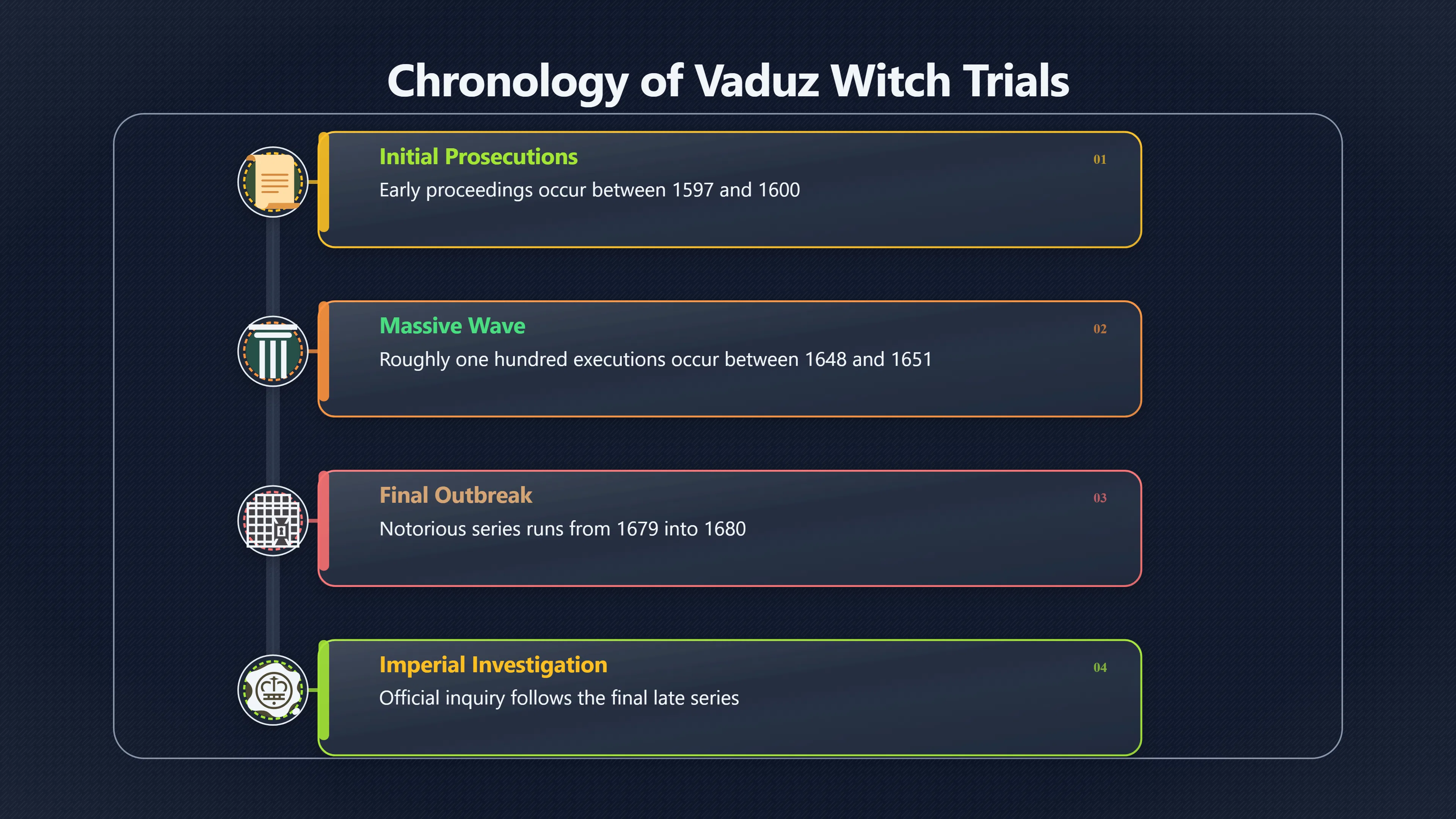
The first documented prosecutions occurred in Vaduz in 1597, 1598 and 1600. These early proceedings resulted in at least eleven executions by burning. Historians suspect that earlier or intervening cases may have existed, but the surviving evidence is incomplete because many judicial records were later destroyed or removed from official archives.[Liechtenstein Historical Lexicon]historisches-lexikon.liLiechtenstein Historical LexiconHexenverfolgungDie ersten datierbaren Gerichtsverfahren gegen vermeintliche Hexen in Vaduz fanden 1597, 1…
A much larger wave followed between 1648 and 1651, during which roughly one hundred people were executed. The final and best-documented series ran from 1679 into 1680 (sometimes extending to 1682 in broader historical accounts because of the imperial investigation that followed). This last outbreak became notorious across the Holy Roman Empire and has been described as one of the largest late witch-trial series of its era.[historisches-lexikon.li]historisches-lexikon.liLiechtenstein Historical LexiconHexenverfolgungDie ersten datierbaren Gerichtsverfahren gegen vermeintliche Hexen in Vaduz fanden 1597, 1…
What makes these episodes remarkable is not simply the death toll but their persistence. Elsewhere in Europe, scepticism towards witch trials was beginning to grow during the later seventeenth century. In Vaduz and Schellenberg, however, prosecutions intensified just as many neighbouring regions were abandoning them.[Historisches Lexikon Bayerns]historisches-lexikon-bayerns.deEN:Persecution of witchesHistorisches Lexikon BayernsEN:Persecution of witchesFeb 25, 2025 — The majority of trials against alleged witches and sorcerers occurred…
Why accusations spread so easily
The accusations followed familiar European patterns but acquired particular force within these tiny Alpine territories.
Confessions were commonly extracted under torture. Once one prisoner admitted attending imaginary witches’ gatherings or making pacts with the Devil, they were pressured to identify others. Those newly accused were arrested, interrogated and often produced further names, creating a self-reinforcing chain of prosecutions. Modern historians regard these confessions as products of coercion rather than reliable evidence of genuine belief or criminal activity.[historisches-lexikon.li]historisches-lexikon.liLiechtenstein Historical LexiconHexenverfolgungDie ersten datierbaren Gerichtsverfahren gegen vermeintliche Hexen in Vaduz fanden 1597, 1…
The charges themselves mixed everyday misfortunes with supernatural fears:
- unexplained illness or death;
- livestock losses;
- crop failure;
- destructive weather;
- alleged magical attacks on neighbours;
- participation in nocturnal gatherings with the Devil.
To contemporaries these accusations formed a coherent worldview. To modern readers they illustrate how communities interpreted natural disasters, personal tragedy and social conflict through a supernatural framework endorsed by the legal system.[Liechtenstein Historical Lexicon]historisches-lexikon.liLiechtenstein Historical LexiconHexenverfolgungDie ersten datierbaren Gerichtsverfahren gegen vermeintliche Hexen in Vaduz fanden 1597, 1…

Accusations, money and local power
One reason the Liechtenstein persecutions continue to fascinate historians is that they expose the overlap between belief and political interests.
During the great trials of 1679–1680, the territories were ruled by Count Ferdinand Karl von Hohenems, whose finances were in severe difficulty. Contemporary evidence and later historical research show that property belonging to convicted witches could be confiscated, creating an economic incentive that has become central to interpretations of the trials. Although financial gain alone cannot explain the panic, historians increasingly view confiscation as one factor helping to sustain the prosecutions once they were under way.[Wikipedia]WikipediaLiechtenstein witch trialsLiechtenstein witch trials
The trials also reveal struggles over authority. Local officials, judges and governors exercised extraordinary powers during investigations. Ordinary disputes between neighbours could become matters of criminal prosecution, while torture produced expanding lists of alleged accomplices. In a small society, accusations rapidly spread through family and village networks, making almost anyone vulnerable.[Liechtenstein Historical Lexicon]historisches-lexikon.liLiechtenstein Historical LexiconHexenverfolgungDie ersten datierbaren Gerichtsverfahren gegen vermeintliche Hexen in Vaduz fanden 1597, 1…
This combination of supernatural certainty, legal authority and financial pressure is one reason the persecutions stand out within Liechtenstein’s historical record. They demonstrate how extraordinary beliefs became institutionalised rather than remaining private superstition.
The people who challenged the panic
An important part of the story is that resistance emerged before the persecutions had completely run their course.
One of the most significant figures was the parish priest Valentin von Kriss of Triesen. He questioned the legality of the proceedings and helped support appeals on behalf of some accused individuals. Survivors and relatives also fled the territory or petitioned higher authorities, arguing that the trials relied on unlawful procedures. Their complaints eventually reached Emperor Leopold I.[Wikipedia]WikipediaHexenprozesse in TriesenHexenprozesse in Triesen
The imperial response proved decisive. A commission investigated the conduct of the trials and concluded that the prosecutions had violated proper legal standards. The investigations were halted, the later judgments were overturned and imperial administration eventually replaced the disgraced local regime. The political consequences extended well beyond the witch hunts themselves, contributing to the collapse of Hohenems authority in Vaduz and Schellenberg.[wikipedia.org]WikipediaLiechtenstein witch trialsLiechtenstein witch trials
Why the trials matter to Forteana
For readers interested in strange history, the Liechtenstein witch trials occupy a distinctive position.
Most Fortean subjects involve uncertain reports, folklore or unexplained experiences. Here the supernatural claims themselves are not supported by evidence, but belief in them is. Thousands of pages of legal proceedings, petitions and historical research document that educated officials genuinely accepted impossible accusations and imposed death sentences because of them. The extraordinary element lies not in proving witches existed, but in demonstrating how completely a society accepted that they did.[Liechtenstein Historical Lexicon]historisches-lexikon.liLiechtenstein Historical LexiconHexenverfolgungDie ersten datierbaren Gerichtsverfahren gegen vermeintliche Hexen in Vaduz fanden 1597, 1…
This makes the persecutions an unusually well-documented example of collective supernatural belief becoming state policy. Instead of asking whether magical events really occurred, historians ask why intelligent communities became convinced they had, and why those convictions survived despite mounting legal objections.
From historical trauma to folklore
witch trials(#endnote-2 “Endnote 2”) ials also left an imprint on local legend.[Wikipedia]WikipediaLiechtenstein witch trialsLiechtenstein witch trials
Later traditions transformed memories of injustice into stories about restless spirits and cursed figures. One of the best-known examples is the Tobelhocker, a spectral being associated with ravines whose legend has been interpreted as reflecting the lingering guilt and social divisions left by the persecutions. Whether or not individual tales preserve authentic memories, they demonstrate how historical violence was absorbed into Liechtenstein’s folklore rather than forgotten entirely.[Liechtenstein Historical Lexicon]historisches-lexikon.liLiechtenstein Historical LexiconHexenverfolgungDie ersten datierbaren Gerichtsverfahren gegen vermeintliche Hexen in Vaduz fanden 1597, 1…
Modern Liechtenstein presents these events as part of its historical heritage rather than as evidence for witchcraft itself. Researchers continue to study the surviving documents because they illuminate the interaction of law, religion, fear, politics and folklore in one of Europe’s smallest states.
A documented mystery rather than a supernatural one
The enduring fascination of Liechtenstein’s witch trials comes from a paradox. The supernatural accusations have no credible evidential basis, yet the consequences are among the country’s best-attested historical facts.
For Forteana, that distinction matters. The trials remind us that the strangest episodes in history are not always unexplained phenomena but moments when extraordinary beliefs became accepted reality within courts, governments and communities. In Liechtenstein, that transformation left behind one of the clearest and most unsettling records of how fear, law and local power combined to produce a genuine historical catastrophe.[historisches-lexikon.li]historisches-lexikon.liLiechtenstein Historical LexiconHexenverfolgungDie ersten datierbaren Gerichtsverfahren gegen vermeintliche Hexen in Vaduz fanden 1597, 1…
Amazon book picks
Further Reading
Books and field guides related to When Strange Belief Became Law. Use these as the next step if you want deeper reading beyond the article.


The Oxford illustrated history of witchcraft and magic
Provides broad historical context for the Liechtenstein trials.

The Penguin book of witches
Collects historical documents illuminating witch beliefs and prosecutions.
WITCHFINDERS: A SEVENTEENTH-CENTURY ENGLISH TRAGEDY
Shows how witch panics operated in early modern Europe.
eBay marketplace picks
Marketplace Samples
Live-tested eBay searches with available results related to this page.




Endnotes
1.
Source: historisches-lexikon.li
Link:https://historisches-lexikon.li/Hexenverfolgung
Source snippet
Liechtenstein Historical LexiconHexenverfolgungDie ersten datierbaren Gerichtsverfahren gegen vermeintliche Hexen in Vaduz fanden 1597, 1...
2.
Source: Wikipedia
Title: Liechtenstein witch trials
Link:https://en.wikipedia.org/wiki/Liechtenstein_witch_trials
3.
Source: liechtenstein-institut.li
Link:https://liechtenstein-institut.li/en/research-projects/die-kaiserliche-administration-der-reichsgrafschaft-vaduz-und-der-reichsherrschaft-schellenberg-1684-16991712
Source snippet
and the sale of the Lordship of Schellenberg (1699) and the County of Vaduz...Read more...
4.
Source: Wikipedia
Title: Hexenprozesse in Triesen
Link:https://de.wikipedia.org/wiki/Hexenprozesse_in_Triesen
5.
Source: historisches-lexikon-bayerns.de
Title: EN:Persecution of witches
Link:https://www.historisches-lexikon-bayerns.de/Lexikon/EN%3APersecution_of_witches
Source snippet
Historisches Lexikon BayernsEN:Persecution of witchesFeb 25, 2025 — The majority of trials against alleged witches and sorcerers occurred...
6.
Source: law.berkeley.edu
Link:https://www.law.berkeley.edu/research/the-robbins-collection/exhibitions/witch-trials-in-early-modern-europe-and-new-england/
Source snippet
UC Berkeley LawWitch Trials in Early Modern Europe and New EnglandHistorians have identified a number of crucial legal developments that...
7.
Source: jerseyheritage.org
Link:https://www.jerseyheritage.org/history/witch-trials-in-jersey/
Source snippet
Witch Trials In Jersey | Jersey HeritageShe was imprisoned after a number of people had testified that she had used her diabolical spells...
8.
Source: worldstatesmen.org
Link:https://www.worldstatesmen.org/Liechtenstein.htm
Source snippet
Counts of Werdenberg (called of Sargans) and (from 1390/95) Lords of Vaduz (in Vaduz) (title Graf von Werdenberg, genannt von Sargans, [1...
9.
Source: science.smith.edu
Title: witch trials
Link:https://www.science.smith.edu/climatelit/witch-trials/
Source snippet
1500–1700) - Climate in Arts and HistoryThroughout the 16th and 17th century, witch trials and the persecution and punishment of suspecte...
Additional References
10.
Source: eliechtensteinensia.li
Link:https://www.eliechtensteinensia.li/viewer/fulltext/000469227/48/
Source snippet
In good handsThe witchcraft trials in Vaduz have been documented in detail by the Liechtenstein local historian Otto Seger. He points “wi...
11.
Source: ebsco.com
Link:https://www.ebsco.com/research-starters/history/witch-hunts-and-witch-trials
Source snippet
Witch-Hunts and Witch Trials | History | Research StartersWitch-hunts and witch trials refer to the historical phenomenon in which indivi...
12.
Source: youtube.com
Link:https://www.youtube.com/watch?v=1wC2iHX2dX4
13.
Source: repec.graduateinstitute.ch
Title: We start by using climate data to proxy for income levels. This.Read more
Link:https://repec.graduateinstitute.ch/pdfs/Working_papers/HEIDWP11-2016.pdf
Source snippet
Trials: Discontent in Early Modern Europeby C Hudson · Cited by 3 — This paper examines the relationship between income and witch trials...
14.
Source: blog.nationalmuseum.ch
Link:https://blog.nationalmuseum.ch/en/2024/08/how-the-principality-of-liechtenstein-came-into-being/
Source snippet
Swiss History BlogHow the Principality of Liechtenstein came into beingAug 20, 2024 — The 17th century was one of the most difficult peri...
15.
Source: youtube.com
Title: The Witch Hunts That Transformed Christian Europe Into a Land of Terror
Link:http://www.youtube.com/watch?v=zIkH7mFLPXU
Source snippet
When Europe Went Mad: The Witch Hunts That Terrorized Millions...
16.
Source: gendercide.org
Title: case witchhunts
Link:https://www.gendercide.org/case_witchhunts.html
Source snippet
Witch-hunts in early modern Europe (circa 1450-1750)In this article we will take a look at the European witch hunts of circa 1450-1750, a...
17.
Source: youtube.com
Title: Liechtenstein’s Dark Forgotten History Facts
Link:http://www.youtube.com/watch?v=PWl1Qv0Lpos
Source snippet
The Witch Hunts That Transformed Christian Europe Into a Land of Terror...
18.
Source: youtube.com
Title: The Dark History of Liechtenstein You Never Knew!
Link:http://www.youtube.com/watch?v=ej_v6cpTfBU
Source snippet
Liechtenstein's Dark Forgotten History Facts...
Topic Tree