Within Burkina Faso Forteana
Was Gao Guenie One Meteorite Fall or Two?
The Gao-Guenie fall shows how one spectacular skyfall became a decades-long naming puzzle in science and strange-history records.
On this page
- The 1960 fall near Gao
- Why Gao and Guenie were separated
- What the renamed meteorite teaches strange archives
Page outline Jump by section
Introduction
The Gao-Guenie meteorite is one of Burkina Faso’s best documented strange historical events, yet the mystery surrounding it is not whether stones really fell from the sky. They did. The puzzle is that, for decades, scientists believed two separate meteorite showers had struck the same area in 1960. What eventually emerged was a fascinating lesson in how eyewitness reports, specimen collecting and scientific classification can complicate the historical record. Rather than exposing a paranormal mystery, the Gao-Guenie story shows how even a well-observed natural event can acquire an unexpected second life through archives, catalogues and changing interpretations.
For readers interested in Forteana, it is a perfect example of an anomaly that becomes stranger not because the underlying event is unexplained, but because the documentary trail proves surprisingly difficult to untangle.
The 1960 fall near Gao
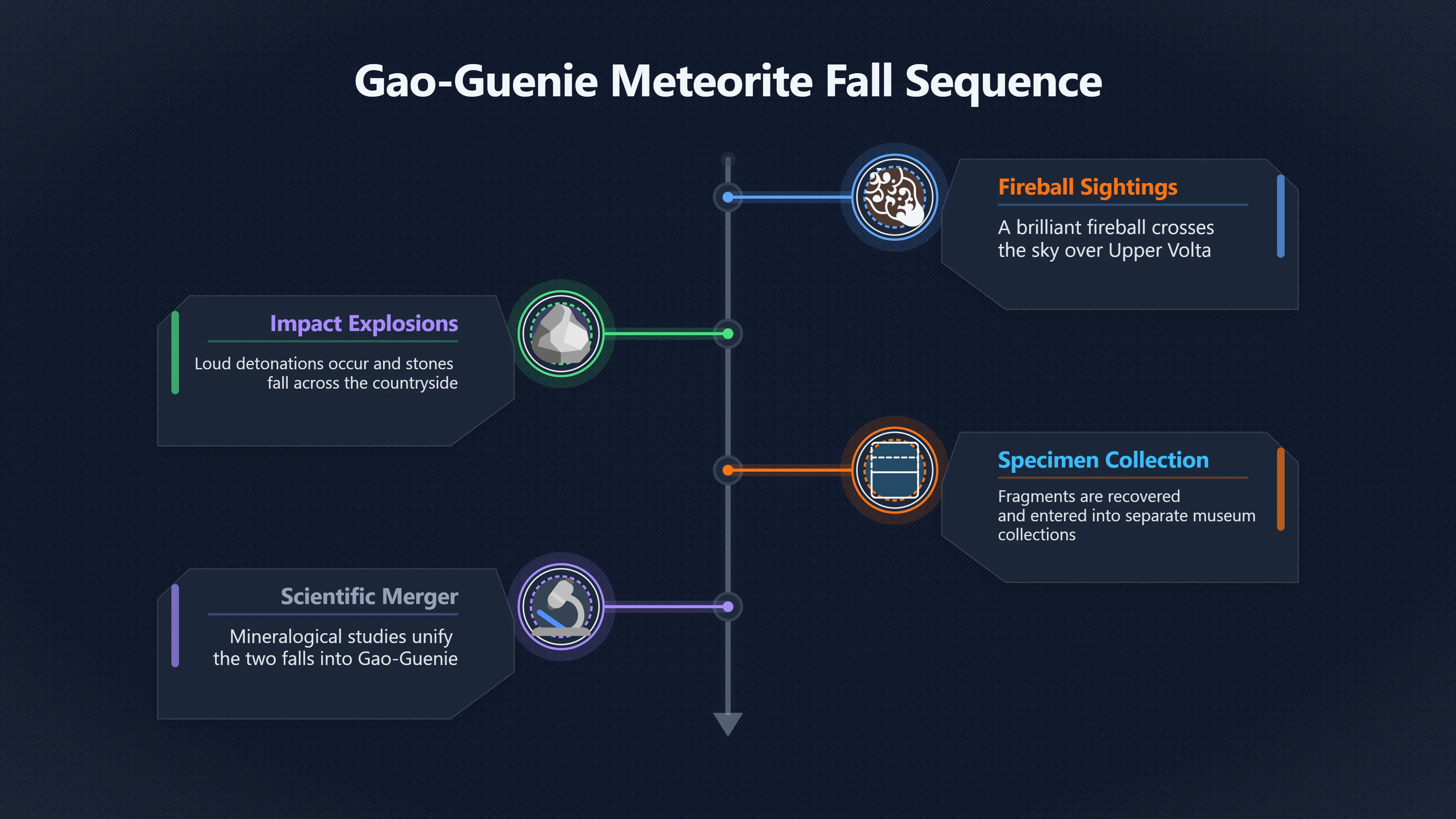
On the afternoon of 5 March 1960, a brilliant fireball crossed the sky over what was then Upper Volta, now Burkina Faso. Around 5 p.m., witnesses near the village of Gao reported loud explosions followed by a shower of stones falling across the countryside. Contemporary accounts describe multiple detonations, with the sound reportedly heard more than 100 kilometres away, reaching as far as Ouagadougou. Several recovered stones damaged trees and buildings, demonstrating that this was not simply a spectacular light in the sky but a genuine meteorite fall.[meteorites.asu.edu]meteorites.asu.eduBuseck Center for Meteorite Studies30 Jan 2013 — According to the Meteoritical Bulletin (MB 39, MB 57, MB 83), approximately 16 stones we…
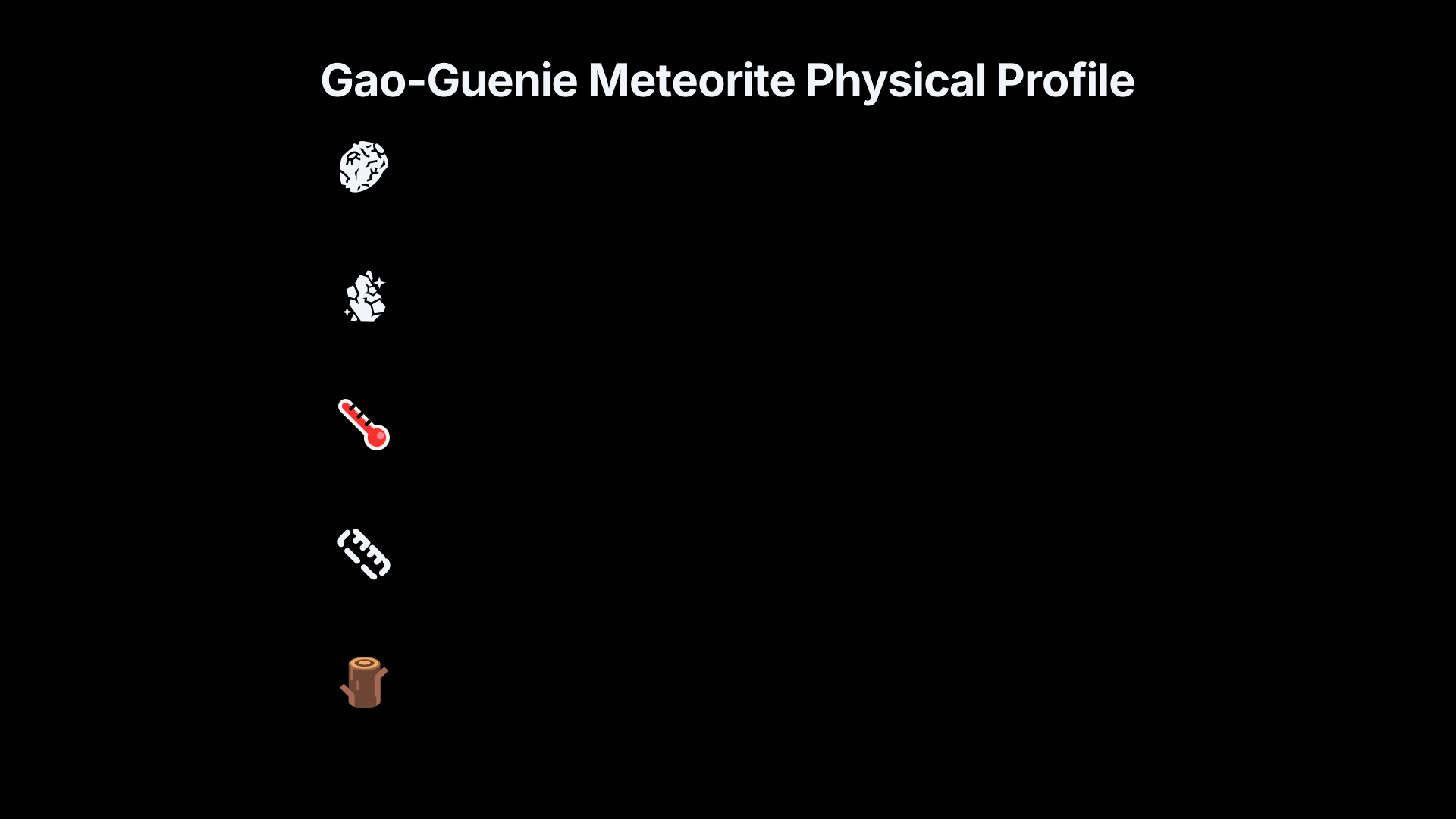
The meteorite is classified as an H5 ordinary chondrite, a common type of stony meteorite formed within the asteroid belt. “H” refers to its relatively high iron content, while “5” indicates the degree of heating and alteration experienced inside its parent asteroid before eventually reaching Earth. Although scientifically ordinary, the fall itself was exceptional because of the large number of fragments scattered across the landscape. Estimates suggest that thousands of stones landed within a strewn field extending roughly 30 kilometres, making Gao-Guenie one of Africa’s largest historically observed meteorite showers.[usra.edu]lpi.usra.eduMeteoritical Bulletin: Entry for Gao-GuenieIt had been reported that two meteorite showers occurred one month apart in 1960 in the cou…
Why Gao and Guenie were separated
The truly unusual part of the story emerged only after the original event.
Reports later appeared suggesting that another meteorite shower had fallen roughly a month after the March event, only about 10 kilometres away near the village of Guenie. Because specimens from the two locations entered museum collections separately, meteorite catalogues gradually treated them as distinct falls. One became known simply as Gao, while the other acquired the name Guenie.[meteorites.asu.edu]meteorites.asu.eduBuseck Center for Meteorite Studies30 Jan 2013 — According to the Meteoritical Bulletin (MB 39, MB 57, MB 83), approximately 16 stones we…
For many years this seemed perfectly reasonable. Meteorite falls are uncommon, but not impossible to occur close together. As a result, scientific literature, museum labels and private collections often listed two different meteorites from the region.
The problem was that the evidence increasingly refused to fit that interpretation.
Detailed mineralogical studies during the 1990s showed that specimens labelled Gao and Guenie were virtually indistinguishable. Their mineral chemistry, texture, weathering and physical characteristics all pointed towards the same parent body. Researchers also reconsidered the witness accounts and concluded that the supposed second shower was more likely the continued recovery or delayed reporting of fragments from the original, exceptionally wide strewn field.[usra.edu]lpi.usra.eduMeteoritical Bulletin: Entry for Gao-GuenieIt had been reported that two meteorite showers occurred one month apart in 1960 in the cou…
This persuaded the Meteoritical Society’s Nomenclature Committee—the international body responsible for official meteorite names—to merge the records under the combined name Gao-Guenie. The change formally acknowledged that what had long been catalogued as two meteorite falls was almost certainly one large event.[LPI]lpi.usra.eduMeteoritical Bulletin: Entry for Gao-GuenieIt had been reported that two meteorite showers occurred one month apart in 1960 in the cou…
Why the naming mattered
At first glance, changing a name may seem like a minor administrative correction. In reality, it illustrates several broader lessons about strange historical records.
Meteorites are often identified from scattered eyewitness accounts, local reports and specimens collected long after the fireball has disappeared. In rural areas, fragments may be found weeks, months or even years later. Without precise mapping or modern observation networks, it is easy for later discoveries to appear unrelated to the original event.
The Gao-Guenie case also shows that scientific knowledge is not static. Meteorite catalogues are continually revised as new evidence appears. Rather than weakening confidence in the science, the renaming demonstrates the willingness of researchers to correct earlier interpretations when better data become available.[LPI]lpi.usra.eduMeteoritical Bulletin: Entry for Gao-GuenieIt had been reported that two meteorite showers occurred one month apart in 1960 in the cou…
For historians of unusual phenomena, this is equally important. A dramatic story of “two mysterious meteorite showers” is undoubtedly more striking than “one large meteorite shower with confusing documentation.” Yet the latter explanation fits the evidence far better.
What the renamed meteorite teaches strange archives
The Gao-Guenie episode offers an unusually clear example of how archives can generate mysteries that did not exist in nature.
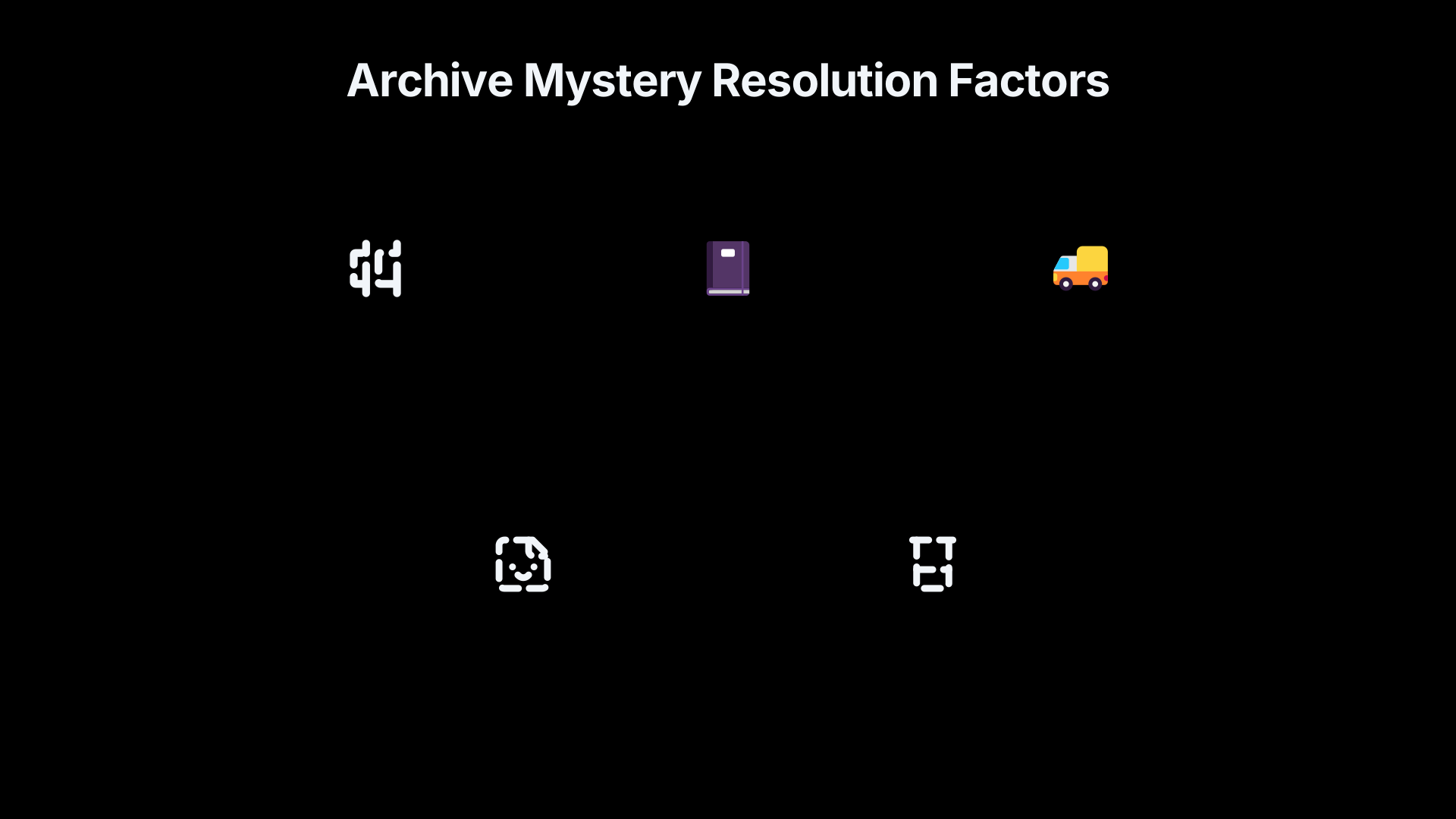
Several factors combined to produce the confusion:
- a spectacular meteorite shower scattered fragments over a wide area;
- stones entered collections through different routes and at different times;
- witness reports were incomplete and sometimes delayed;
- catalogue names became established before comprehensive comparison of the specimens.
None of these is unusual individually. Together, however, they created a scientific puzzle that lasted for decades before being resolved through careful laboratory work and historical reconstruction.[usra.edu]lpi.usra.eduMeteoritical Bulletin: Entry for Gao-GuenieIt had been reported that two meteorite showers occurred one month apart in 1960 in the cou…
For anyone interested in Fortean history, the case is a useful reminder that anomalies do not always arise from unexplained events. Sometimes the mystery lies in the paperwork.
Why Gao-Guenie remains important in Burkina Faso’s strange history
Burkina Faso contains many stories rooted in folklore, sacred landscapes and local traditions, but Gao-Guenie occupies a different place. It is a fully documented natural event whose reputation became more intriguing because of the way science recorded it.
That makes it valuable both to meteorite researchers and to readers interested in the history of unusual reports. The falling stones themselves require no supernatural explanation. The enduring fascination comes from watching a spectacular event evolve through witness testimony, museum collections and international scientific debate until the historical record finally settled on a single conclusion: the famous “two falls” were almost certainly one remarkable meteorite shower remembered under two different names.[usra.edu]lpi.usra.eduMeteoritical Bulletin: Entry for Gao-GuenieIt had been reported that two meteorite showers occurred one month apart in 1960 in the cou…
Amazon book picks
Further Reading
Books and field guides related to Was Gao-Guenie One Meteorite Fall or Two?. Use these as the next step if you want deeper reading beyond the article.

METEORITES: A PETROLOGIC, CHEMICAL AND ISOTOPIC SYNTHESIS
Directly supports understanding of H5 chondrites and documented falls.
eBay marketplace picks
Marketplace Samples
Live-tested eBay searches with available results related to this page.

Endnotes
1.
Source: meteorites.asu.edu
Link:https://meteorites.asu.edu/meteorites/gao-guenie
Source snippet
Buseck Center for Meteorite Studies30 Jan 2013 — According to the Meteoritical Bulletin (MB 39, MB 57, MB 83), approximately 16 stones we...
2.
Source: lpi.usra.edu
Link:https://www.lpi.usra.edu/meteor/metbull.php?code=10854
Source snippet
Meteoritical Bulletin: Entry for Gao-GuenieIt had been reported that two meteorite showers occurred one month apart in 1960 in the cou...
3.
Source: onlinelibrary.wiley.com
Link:https://onlinelibrary.wiley.com/doi/10.1111/maps.12642
Source snippet
Wiley Online LibraryThe Gao‐Guenie impact melt breccia—Sampling a rapidly...17 Apr 2016 — Gao-Guenie, classified in the Meteoritical Bul...
4.
Source: meteorites.asu.edu
Link:https://meteorites.asu.edu/meteorites/gaoguenie
Source snippet
Gao-Guenie - Buseck Center for Meteorite Studies1 Mar 2022 — Gao-Guenie is an H5 ordinary chondrite that fell in the province of Sissili...
5.
Source: meteorite-times.com
Link:https://www.meteorite-times.com/gao-guenie-meteorites-change-is-a-constant-in-meteorite-science-get-ready-for-more/
Source snippet
Gao-Guenie Meteorite(s): Change is a constant in...1 Nov 2023 — Gao-Guenie is a fall from March 5, 1960 that once was thought to be two...
Published: March 5, 1960
6.
Source: meteoritical.org
Link:https://meteoritical.org/publications/meteoritical-bulletin
Source snippet
Meteoritical SocietyThe Meteoritical BulletinThe Meteoritical Bulletin contains listings of all newly recognized and reclassified meteori...
Additional References
7.
Source: polandmet.com
Link:https://www.polandmet.com/gao-guenie-oriented-45-6-gram/
Source snippet
GAO-GUENIE Oriented (45.6 gram)GAO-GUENIE Oriented (45.6 gram); Classification: Chondrite H5; Place/Time: Fall March 5, 1960, about 170...
Published: March 5, 1960
8.
Source: turnstone.ca
Link:https://turnstone.ca/rom227ms.htm
Source snippet
The Gao-Guenie H5 meteorite shower, Burkina FasoThe Gao-Guenie H5 ordinary-chondrite meteorite shower was a significant event, in which a...
9.
Source: meteoritemarket.com
Link:https://www.meteoritemarket.com/GAO.htm
Source snippet
Location: Sissili, Burkina Faso (formerly Upper Volta) 11° 39'N, 2° 11'W Fell: 1960, March 5, about 1700 hours.Read more...
10.
Source: galactic-stone.com
Link:https://galactic-stone.com/gao-guenie-1960-witnessed-fall-from-burkina-faso-micromount/
Source snippet
Gao Guenie, 1960 Witnessed Fall from Burkina Faso...On March 5th, 1960, a bright fireball exploded over the largely rural area of Burkin...
11.
Source: mindat.org
Link:https://www.mindat.org/locentry-1231090.html
Source snippet
ssification. Type: H5 chondrite meteorite. Confirmation.Read more...
12.
Source: Wikipedia
Title: Gao Guenie (Meteorit)
Link:https://de.wikipedia.org/wiki/Gao-Guenie_%28Meteorit%29
Source snippet
Gao-Guenie (Meteorit)H5 (Olivin-Bronzit). Masse (total), ≥ 2,5 kg + 3,6 kg. Herkunft, Asteroidengürtel. Referenzen. Meteoritical Bulle...
13.
Source: Wikipedia
Title: Gao–Guenie meteorite
Link:https://en.wikipedia.org/wiki/Gao%E2%80%93Guenie_meteorite
Source snippet
Gao–Guenie meteoriteGao–Guenie is a H5 ordinary chondrite meteorite that fell on Burkina Faso, West Africa, on March 5, 1960. The fall...
Published: March 5, 1960
14.
Source: youtube.com
Title: Meteorite Gao-Guenie
Link:https://www.youtube.com/watch?v=nf24sUibh2I
Source snippet
Gao Guenie Meteorites! What are they? Why buy them?...
15.
Source: youtube.com
Title: Meteorite Gao-Guenie Chondrite H5
Link:https://www.youtube.com/watch?v=Q3-r3qcQL-k
Source snippet
Meteorite Gao-Guenie - New shipment of 16kg...
16.
Source: mindat.org
Title: loc 301693
Link:https://www.mindat.org/loc-301693.html
Source snippet
Olivine-bronzite chondrite. Select Mineral List Type. Standard Detailed Gallery...Read more...
Topic Tree