Within Strange Syria
Why Did Saydnaya's Icon Become a Miracle Geography?
Saydnaya's veiled icon, miracle oil and pilgrimage stories made a mountain monastery near Damascus into a tactile wonder-site.
On this page
- The veiled icon and reported oil
- Pilgrims, relics and travelling holy matter
- Belief, material detail and cautious reading
Page outline Jump by section
Introduction
The miracle icon of Our Lady of Saydnaya has long been one of Syria’s most remarkable religious wonders, not because it is associated with a single spectacular miracle, but because generations of pilgrims believed the icon itself became a source of tangible holy matter. Medieval travellers described an image that mysteriously exuded fragrant oil, healed the sick and attracted Christians from across the eastern Mediterranean, while also drawing Muslim visitors seeking blessing. Whether understood as divine intervention, devotional tradition or the growth of a powerful pilgrimage legend, Saydnaya’s icon transformed a mountain monastery into what might be called a “miracle geography”: a place where sacred power was thought to flow into physical substances that could be touched, collected and carried away.

For readers interested in Syrian Forteana, Saydnaya is significant because its reputation rests not on ghost stories or unexplained lights but on repeated claims that matter itself behaved differently in a holy setting. The stories have been recorded by pilgrims, chroniclers and church traditions over many centuries, while historians have also examined how such accounts evolved as they travelled across cultures and languages.[Antioch Patriarchate]antiochpatriarchate.orgA sumptuous iconostasis separates the nave fromAntioch PatriarchateOur Lady of Saydnaya Patriarchal Monastery - AntiochAccording to tradition, this image was painted by St Luke himself…
Why did the icon become a miracle geography?
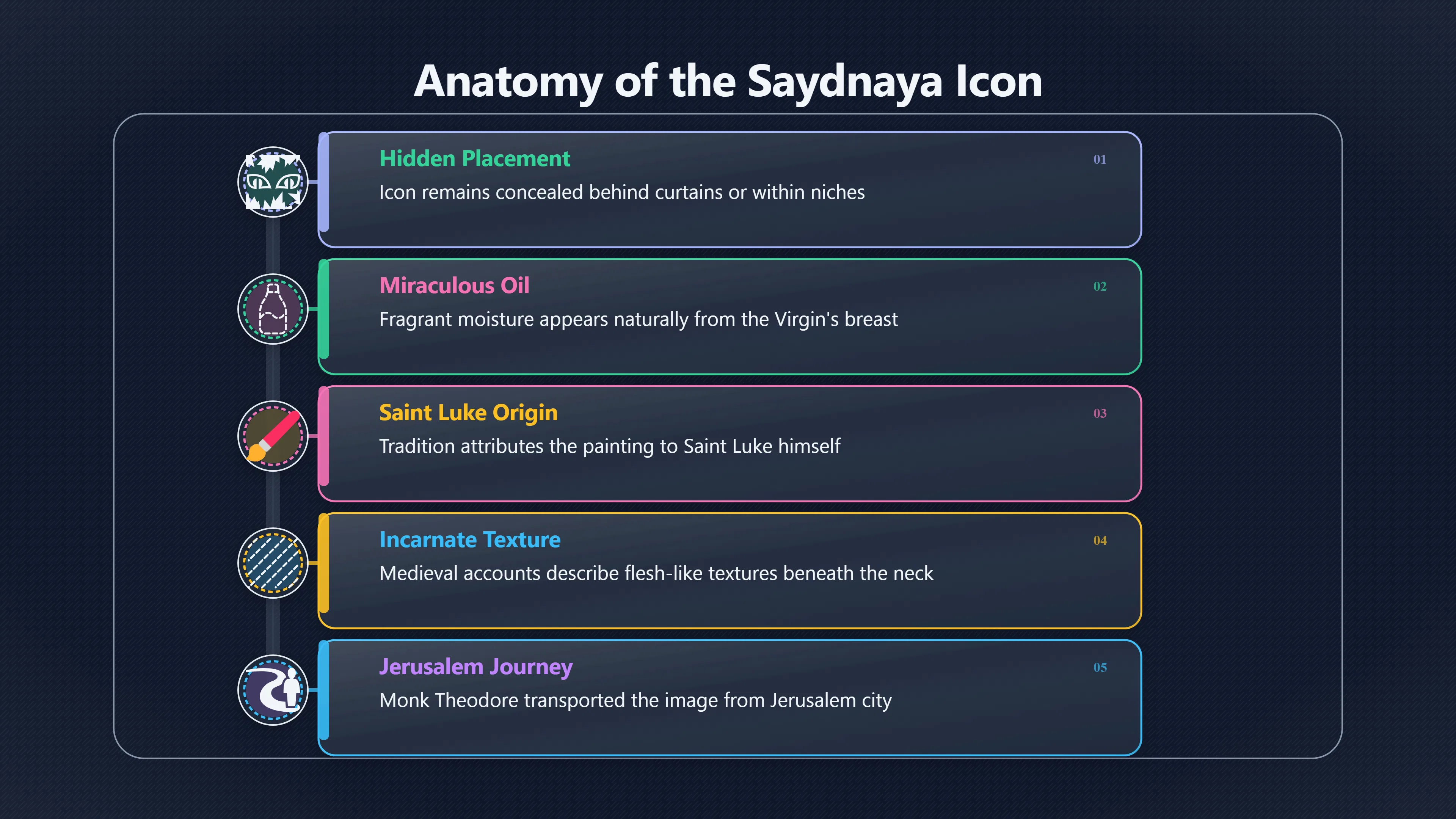
Unlike many famous miracle-working images, the icon at Saydnaya was traditionally kept hidden behind curtains or within a niche rather than permanently displayed. Pilgrims often experienced it indirectly, seeing only glimpses during liturgical ceremonies. That concealment became part of its mystique rather than a weakness in the tradition.
According to the monastery’s own tradition, the image was brought from Jerusalem by the monk Theodore after a series of miraculous events convinced him that the Virgin herself intended the icon to remain at Saydnaya. The icon was later identified as one attributed to Saint Luke, a common but prestigious claim attached to several ancient Marian icons across the Christian world. The monastery continues to describe it as the focus of centuries of reported miracles.[Antioch Patriarchate]antiochpatriarchate.orgA sumptuous iconostasis separates the nave fromAntioch PatriarchateOur Lady of Saydnaya Patriarchal Monastery - AntiochAccording to tradition, this image was painted by St Luke himself…
The earliest detailed written descriptions, however, come not from modern church literature but from medieval pilgrims travelling through Syria during the Crusader period. Their reports established Saydnaya’s international reputation.
The veiled icon and the reported miracle oil
The most distinctive feature of the Saydnaya tradition is not simply that the icon healed people. It was said to produce a miraculous liquid.
Twelfth- and thirteenth-century Latin pilgrims repeatedly described oil or fragrant moisture appearing from the icon, especially from the breast of the Virgin. The substance was carefully collected by the monastery and distributed to visitors, who believed it could cure illness, assist fertility and provide divine protection. The icon therefore functioned almost like a living relic rather than merely a painted object.[Academia]academia.eduAcademia(PDF) The Monastery of Our Lady of Saydnaya and Its IconThe icon known as Chaghoura is associated with miraculous oil that suppos…
Several features of these reports stand out.
- The oil was described as appearing naturally rather than being poured onto the icon.
- Pilgrims usually received only tiny quantities, increasing its perceived value.
- Healing stories accumulated gradually rather than being tied to one single famous miracle.
- The icon itself was often hidden beneath cloths, meaning pilgrims encountered both mystery and ritual simultaneously.
Some medieval writers even described the icon as being “incarnate” or flesh-like beneath the neck. Modern historians note that these striking descriptions appear primarily in Latin pilgrimage accounts rather than contemporary Arabic Christian sources, suggesting that western pilgrims may have interpreted what they saw through familiar medieval ideas about miraculous images.[Academia]academia.eduAcademia(PDF) The Monastery of Our Lady of Saydnaya and Its IconThe icon known as Chaghoura is associated with miraculous oil that suppos…
That difference between source traditions is one of the most interesting aspects of the evidence. Rather than proving or disproving the miracle, it shows how the same shrine could acquire different reputations depending on who was describing it.

Pilgrims, relics and travelling holy matter
The oil mattered because it could travel.
Unlike the monastery itself, tiny flasks of blessed oil could accompany pilgrims back to Europe, Anatolia or neighbouring parts of the Middle East. Medieval historians believe these portable relics helped spread the fame of Saydnaya far beyond Syria. Reports of miraculous cures circulated alongside the oil itself, reinforcing the shrine’s reputation with each successful pilgrimage.[Academia]academia.eduAcademia(PDF) The Monastery of Our Lady of Saydnaya and Its IconThe icon known as Chaghoura is associated with miraculous oil that suppos…
This movement of holy matter also explains why Saydnaya appears so frequently in medieval travel writing. Pilgrims did not merely describe an impressive monastery; they described obtaining something physically connected to divine grace.
Accounts from the thirteenth century even suggest that members of the Knights Templar visited Saydnaya to obtain the miraculous oil for churches in Europe. Although individual details remain difficult to verify, historians regard the repeated references across independent pilgrimage narratives as evidence that the shrine occupied an important place within medieval pilgrimage networks.[Wikipedia]WikipediaOur Lady of Saidnaya MonasteryOur Lady of Saidnaya Monastery
The shrine also developed an unusually broad appeal. Christian denominations that otherwise differed sharply in theology visited the monastery, and Muslim pilgrims likewise came seeking healing or blessing from the Virgin Mary, who is honoured in Islam as the mother of Jesus. This shared devotional culture helped sustain the site’s importance across changing political periods.[Antioch Patriarchate]antiochpatriarchate.orgA sumptuous iconostasis separates the nave fromAntioch PatriarchateOur Lady of Saydnaya Patriarchal Monastery - AntiochAccording to tradition, this image was painted by St Luke himself…
How strong is the historical evidence?
The evidence falls into several distinct categories rather than one continuous record.
Church tradition preserves the monastery’s own account of the icon’s origins and continuing miracles. Medieval pilgrimage narratives provide independent descriptions written by travellers who claimed to have visited the site. Archaeological and historical studies confirm Saydnaya’s importance as a major pilgrimage destination throughout the Middle Ages, although they cannot verify supernatural claims themselves.[Antioch Patriarchate]antiochpatriarchate.orgA sumptuous iconostasis separates the nave fromAntioch PatriarchateOur Lady of Saydnaya Patriarchal Monastery - AntiochAccording to tradition, this image was painted by St Luke himself…
Historians generally distinguish between three questions.
- Did pilgrims genuinely believe miracles occurred? Almost certainly. The consistency of pilgrimage testimony over centuries leaves little doubt that the shrine enjoyed an extraordinary reputation.
- Was the monastery distributing oil associated with the icon? Medieval sources strongly suggest it was.
- Can modern historians establish that the oil appeared supernaturally? No. The surviving evidence consists of testimony, devotional literature and pilgrimage reports rather than observations that can be independently tested today.
This layered evidence makes Saydnaya a particularly interesting Fortean case. The historical phenomenon—the widespread belief—is firmly documented even though the miraculous mechanism remains a matter of faith rather than historical proof.

Belief, material detail and cautious reading
Modern readers encounter Saydnaya through two very different lenses.
Believers see the icon as one of Christianity’s enduring miracle-working images, with the oil representing God’s grace acting through the Virgin Mary. Within this understanding, the countless pilgrim testimonies reinforce one another as evidence of continuing divine intervention.
More sceptical interpretations look at the stories as products of medieval pilgrimage culture. Shrines throughout Europe and the eastern Mediterranean competed for pilgrims, donations and prestige, and miracle traditions often expanded over generations. Some historians also note that miraculous liquids, fragrant substances and weeping images appear repeatedly in medieval religious literature, suggesting that Saydnaya fitted into a wider pattern of sacred storytelling as well as local devotion.[Academia]academia.eduAcademia(PDF) The Monastery of Our Lady of Saydnaya and Its IconThe icon known as Chaghoura is associated with miraculous oil that suppos…
Yet reducing the phenomenon to simple invention would overlook its cultural importance. Whether or not one accepts the miraculous claims, the icon undeniably reshaped the monastery’s identity. Pilgrims travelled hundreds of kilometres because they expected not merely to pray before an image but to encounter holiness made tangible through oil, touch and relics.
That combination of physical substance, enduring testimony and cross-cultural pilgrimage explains why Saydnaya occupies a distinctive place in Syria’s strange religious history. It is less a tale of one extraordinary event than of centuries during which countless visitors believed sacred matter could emerge from an icon and carry blessing far beyond the monastery walls.
Amazon book picks
Further Reading
Books and field guides related to Why Did Saydnaya's Icon Become a Miracle Geography?. Use these as the next step if you want deeper reading beyond the article.
The cult of the saints
First published 1981. Subjects: Cult, Christian saints, History, Addresses, essays, lectures, Saints chrétiens.
The Syrian Goddess
First published 1913. Subjects: Religion, Cults, Cultes, Traductions anglaises (vieil anglais), Littérature grecque.
Pilgrimage
First published 1975. Subjects: Christian pilgrims and pilgrimages, Church history, History, Medieval Travel, Wallfahrt.
eBay marketplace picks
Marketplace Samples
Live-tested eBay searches with available results related to this page.
Endnotes
1.
Source: academia.edu
Link:https://www.academia.edu/18864700/The_Monastery_of_Our_Lady_of_Saydnaya_and_Its_Icon
Source snippet
Academia(PDF) The Monastery of Our Lady of Saydnaya and Its IconThe icon known as Chaghoura is associated with miraculous oil that suppos...
2.
Source: Wikipedia
Title: Our Lady of Saidnaya Monastery
Link:https://en.wikipedia.org/wiki/Our_Lady_of_Saidnaya_Monastery
3.
Source: Wikipedia
Title: Sednaya Prison
Link:https://en.wikipedia.org/wiki/Sednaya_Prison
Source snippet
Sednaya PrisonSednaya Prison also known as the "Human Slaughterhouse" (المسلخ البشري), was a Syrian military prison and death camp th...
4.
Source: Wikipedia
Link:https://en.wikipedia.org/wiki/Saidnaya
Source snippet
SaidnayaSaidnaya (Arabic: صيدنايا, romanized: Ṣaydnāyā), also transliterated as Saydnaya, Seidnaya or Sednaya, is a city located in t...
5.
Source: antiochpatriarchate.org
Title: A sumptuous iconostasis separates the nave from
Link:https://antiochpatriarchate.org/en/page/our-lady-of-saydnaya-patriarchal-monastery/146/
Source snippet
Antioch PatriarchateOur Lady of Saydnaya Patriarchal Monastery - AntiochAccording to tradition, this image was painted by St Luke himself...
6.
Source: forensic-architecture.org
Link:https://forensic-architecture.org/investigation/saydnaya
Source snippet
Torture In Saydnaya PrisonSince 2011, thousands have died in prisons and detention facilities operated by the Syrian government. Tens of...
7.
Source: saydnaya.amnesty.org
Link:https://saydnaya.amnesty.org/en/saydnaya.html
Source snippet
Military Prison is located 30km north of Damascus, Syria. The prison is under the jurisdiction of the Minister of Defence and op...
8.
Source: russianicons.wordpress.com
Title: saydnaya icon
Link:https://russianicons.wordpress.com/tag/saydnaya-icon/
Source snippet
icon - icons and their interpretation21 Aug 2020 — The icon depicts Mary enthroned, with Christ Emmanuel seated on her lap. Above them ar...
Additional References
9.
Source: designmuseum.org
Link:https://designmuseum.org/exhibitions/beazley-designs-of-the-year/digital-20x/saydnaya-inside-a-syrian-torture-prison
Source snippet
Saydnaya: Inside a Syrian Torture PrisonAn interactive 3D recreation of Saydnaya, a Syrian torture prison near Damascus, constructed thro...
10.
Source: researchgate.net
Link:https://www.researchgate.net/publication/250135839_The_Monastery_of_Our_Lady_of_Saydnaya_and_Its_Icon
Source snippet
The Monastery of Our Lady of Saydnaya and Its IconThe article discusses the selection of saints and their iconography within the Old Beli...
11.
Source: youtube.com
Link:https://www.youtube.com/playlist?list=PLKWYJya-M6b8xj7HNZ45fVMmKO2ZQtHHP
Source snippet
SaydnayaForensic Architecture. 2.6K views • 7 years ago. 27:41. Torture in Saydnaya Prison. Forensic Architecture. 70K views • 8 years ag...
12.
Source: aleteia.org
Title: the syrian monastery of saydnaya faith and resilience
Link:https://aleteia.org/2023/11/29/the-syrian-monastery-of-saydnaya-faith-and-resilience/
Source snippet
The Syrian monastery of Saydnaya: Faith and resilience29 Nov 2023 — According to local tradition, the Virgin Mary appeared to emperor Jus...
13.
Source: ica.art
Title: torture and killing in saydnaya prison
Link:https://www.ica.art/exhibitions/forensic-architecture-counter-investigations/recent-investigations/torture-and-killing-in-saydnaya-prison
Source snippet
Torture in Saydnaya Prison(Investigation 2015 – 2016). Working with Amnesty International, Forensic Architecture reconstructed an a...
14.
Source: roman-catholic-saints.com
Title: our lady of saideneida
Link:https://www.roman-catholic-saints.com/our-lady-of-saideneida.html
Source snippet
3 Feb 2018 — The icon, called Our Lady of Saideneida and attributed to St. Luke, was said to have been brought to its home in the year 87...
15.
Source: instagram.com
Link:https://www.instagram.com/p/DGSvIsAM_O7/
Source snippet
A4 This icon depicts the Theotokos enthroned, with Christ...The icon is linked to the Saydnaya Monastery, founded in the 6th century by...
16.
Source: youtube.com
Title: Convent of Our Lady of Sednaya
Link:https://www.youtube.com/watch?v=zDe20MIi6H4
Source snippet
Saydnaya, Syria: An icon of the East and a city of coexistence for fifteen hundred years...
17.
Source: facebook.com
Link:https://www.facebook.com/groups/2537002723151737/posts/2768346343350706/
Source snippet
The Saidnaya icon exudes a wonderful fragrance25 Mar 2025 — Founded by the Byzantine Emperor Justinian in the 6th century, It houses one...
18.
Source: amnesty.org
Link:https://www.amnesty.org/en/documents/mde24/5415/2017/en/
Source snippet
Mass hangings and extermination at Saydnaya Prison, Syria7 Feb 2017 — At Saydnaya Military Prison, the Syrian authorities have quietly an...
Topic Tree