Within Mexico Mysteries
Was Mexico's First UFO Photo Astronomy?
The 1883 Bonilla photographs show how a serious astronomical record became part of later UFO culture.
On this page
- What Bonilla reported in Zacatecas
- Why the photographs still matter
- Comets, insects and later UFO readings
Page outline Jump by section
Introduction
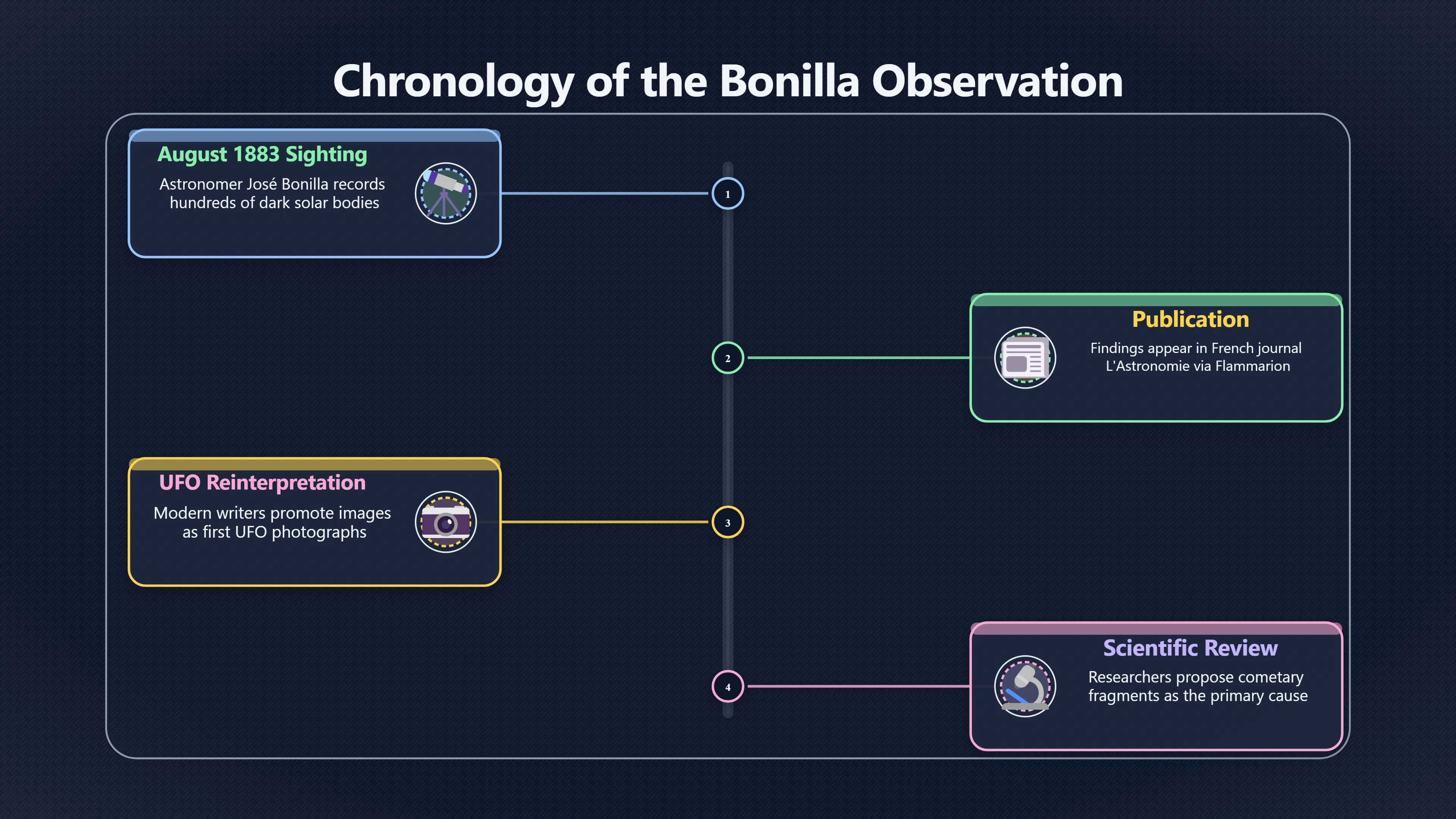
The Bonilla observation is one of Mexico’s most intriguing contributions to the history of unusual sky reports because it began as a careful piece of astronomical work rather than a tale of mystery. On 12 and 13 August 1883, Mexican astronomer José A. y Bonilla watched hundreds of dark objects pass across the face of the Sun from the observatory at Zacatecas, recording many of them photographically. More than a century later, those images would be promoted by some writers as the world’s first “UFO photographs”. Yet the case remains interesting precisely because it sits between scientific observation and later popular mythology. It shows how an unexplained astronomical record can acquire entirely new meanings as culture changes, while still inviting serious debate about what was actually seen.[arXiv]arxiv.orgInterpretation of the observations made in 1883…October 12, 2011 — by HJD Manterola · 2011 · Cited by 4 — In 1883, on the 12th an…
What Bonilla reported in Zacatecas
José Bonilla was director of the recently established observatory on Cerro de la Bufa in Zacatecas when he was observing the Sun during August 1883. Instead of seeing only solar features, he noticed numerous dark, elongated bodies crossing the solar disc at high speed. Over roughly two days he counted 447 separate passages and managed to photograph many of them using wet-collodion photographic plates, an impressive technical achievement for the period. His account eventually appeared in the French astronomy journal L’Astronomie in 1886 after being sent to the astronomer and populariser Camille Flammarion.[Universe Today]universetoday.comwas the first photographed ufo a cometUniverse TodayWas the "First Photographed UFO" a Comet?14 Oct 2011 — On August 12th, 1883, Mexican astronomer José Bonilla was preparing…
Bonilla described the objects as dark with diffuse or misty outlines, and several appeared to possess tail-like extensions. Because they crossed only the tiny apparent diameter of the Sun, each transit lasted only a fraction of a second. Other observatories did not report the same spectacle, a detail that would later become central to attempts to explain the event.[arXiv]arxiv.orgInterpretation of the observations made in 1883…October 12, 2011 — by HJD Manterola · 2011 · Cited by 4 — In 1883, on the 12th an…
The surviving photographs are crude by modern standards. They show irregular dark shapes against the bright solar image rather than detailed objects. Even so, they are historically important because they document an unexplained observation made through astronomical equipment instead of relying solely on eyewitness memory.
Why the photographs still matter
For historians of astronomy, Bonilla’s photographs are valuable because they demonstrate how rapidly nineteenth-century astronomers were beginning to combine telescopes with photography. They preserve an observation that otherwise might have disappeared into an observer’s notebook.
For Fortean writers and UFO enthusiasts, however, the photographs acquired a very different significance. Long after the term “UFO” had entered popular culture, Bonilla’s images were reinterpreted as possible evidence that unidentified craft had been photographed decades before the flying-saucer era. That reinterpretation says as much about twentieth-century culture as it does about the nineteenth-century event itself. The photographs did not change; the cultural framework used to interpret them did.[Wikipedia]WikipediaBonilla observationBonilla observation
The Bonilla case therefore occupies an unusual position in Mexico’s catalogue of strange reports. Unlike many famous UFO stories, it began within mainstream science, was recorded by a trained observer, and entered paranormal literature only many decades later. That history makes it an important example of how old scientific anomalies can be absorbed into modern mystery traditions.

Comets, insects and later UFO readings
Almost from the moment Bonilla’s report was published, astronomers looked for ordinary explanations. Camille Flammarion suggested that Bonilla had probably observed birds, insects or dust passing close to the telescope rather than enormous bodies in space. Because no comparable observations had been reported elsewhere, nearby objects seemed a plausible explanation.[Wikipedia]WikipediaBonilla observationBonilla observation
The debate changed significantly in 2011 when researchers from the National Autonomous University of Mexico re-examined Bonilla’s measurements and photographs. They argued that the objects were more consistent with fragments of a comet passing extremely close to Earth. Their calculations proposed that only observers within a narrow geographical corridor would have seen the fragments crossing the Sun, potentially explaining why other observatories missed the event. They also estimated that the swarm may have contained hundreds of fragments from a disintegrating comet, although the precise distance and size depend heavily on assumptions about the objects’ speed and geometry.[arxiv.org]arxiv.orgInterpretation of the observations made in 1883…October 12, 2011 — by HJD Manterola · 2011 · Cited by 4 — In 1883, on the 12th an…
That reinterpretation attracted considerable media attention because, if correct, it implied an unusually close encounter with cometary debris. Many astronomers have nevertheless treated the proposal cautiously, noting that it rests on inferred rather than directly measured distances and velocities. The original photographs simply do not contain enough information to determine the objects’ true scale with certainty. As a result, neither the nearby-insect explanation nor the fragmented-comet hypothesis has achieved universal acceptance.[arXiv]arxiv.orgIn 1886 in the L'Astronomie magazine, he reported his observations…Read more…
The extraterrestrial interpretation is the least well supported. No evidence from Bonilla’s observations specifically indicates artificial craft, intelligent control or behaviour inconsistent with natural objects. The connection with UFOs arises mainly because the photographed objects remained unidentified for many years, not because the observations themselves point towards alien technology.[Wikipedia]WikipediaBonilla observationBonilla observation
Why the Bonilla case remains part of Mexico’s strange-history record
The Bonilla observation continues to appear in discussions of Mexico’s unusual history because it occupies a rare middle ground between science and mystery. It is neither straightforward folklore nor a simple modern UFO report. Instead, it is a documented astronomical puzzle whose meaning has shifted repeatedly over nearly a century and a half.
For sceptics, the case illustrates how incomplete observations can generate elaborate later interpretations. For believers in anomalous phenomena, it demonstrates that puzzling sky events were being recorded long before twentieth-century UFO culture emerged. For historians, it provides a fascinating example of nineteenth-century Mexican astronomy reaching an international audience through photography and scientific publication.
Whatever the ultimate explanation proves to have been, the Bonilla observation remains one of the earliest well-documented instances in which an unexplained sky phenomenon was not only witnessed but photographed, ensuring its lasting place in both the history of astronomy and Mexico’s wider tradition of Fortean curiosities.
Amazon book picks
Further Reading
Books and field guides related to Was Mexico's First UFO Photo Astronomy?. Use these as the next step if you want deeper reading beyond the article.

UFOs : Generals, Pilots, and Government Officials Go on the R...
Provides context for later reinterpretations of unusual sky observations.

eBay marketplace picks
Marketplace Samples
Live-tested eBay searches with available results related to this page.
Endnotes
1.
Source: arxiv.org
Link:https://arxiv.org/abs/1110.2798
Source snippet
Interpretation of the observations made in 1883...October 12, 2011 — by HJD Manterola · 2011 · Cited by 4 — In 1883, on the 12th an...
Published: October 12, 2011
2.
Source: universetoday.com
Title: was the first photographed ufo a comet
Link:https://www.universetoday.com/articles/was-the-first-photographed-ufo-a-comet
Source snippet
Universe TodayWas the "First Photographed UFO" a Comet?14 Oct 2011 — On August 12th, 1883, Mexican astronomer José Bonilla was preparing...
3.
Source: Wikipedia
Title: Bonilla observation
Link:https://en.wikipedia.org/wiki/Bonilla_observation
4.
Source: phys.org
Title: 2011 10 mexican astronomers bonilla sighting comet
Link:https://phys.org/news/2011-10-mexican-astronomers-bonilla-sighting-comet.html
Source snippet
Mexican astronomers suggest Bonilla sighting might have...19 Oct 2011 — Mexican astronomer José Bonilla recorded in 1883 passing in fron...
5.
Source: arxiv.org
Link:https://arxiv.org/pdf/1110.2798
Source snippet
In 1886 in the L'Astronomie magazine, he reported his observations...Read more...
Additional References
6.
Source: youtube.com
Title: Top 10 Mysterious UFO Sightings
Link:https://www.youtube.com/watch?v=5dkZseelDN4
Source snippet
LEMMiNO Grazed by the Apocalypse Grazed by the Apocalypse TheReposter OfVideos...
7.
Source: youtube.com
Title: Every Time The World Almost Ended
Link:https://www.youtube.com/watch?v=52dREVKV0QM
Source snippet
Top 10 Mysterious UFO Sightings - Fact or Fiction...
8.
Source: youtube.com
Title: The Reposter Of Videos
Link:https://youtube.com/watch?v=2GcwAD_7tJY
Source snippet
Grazed By The Apocalypse | Lemmino | ImBumi Reaction ImBumi Reacts...
9.
Source: youtube.com
Title: Top 10 Disturbing Anomalies in Science That Shouldn’t Exist
Link:https://www.youtube.com/watch?v=C7LhJXcRckc
Source snippet
Every Time The World Almost Ended...
Topic Tree