Within Liberia Weird
Why Liberian Masks Became Paranormal Misreadings
Liberian masks can look uncanny to outsiders, but their meaning lies in initiation, authority, beauty and social order.
On this page
- Sande and Poro societies in cultural context
- How outsiders turned ritual performance into occult spectacle
- Reading masks without flattening them into monsters
Page outline Jump by section
Introduction
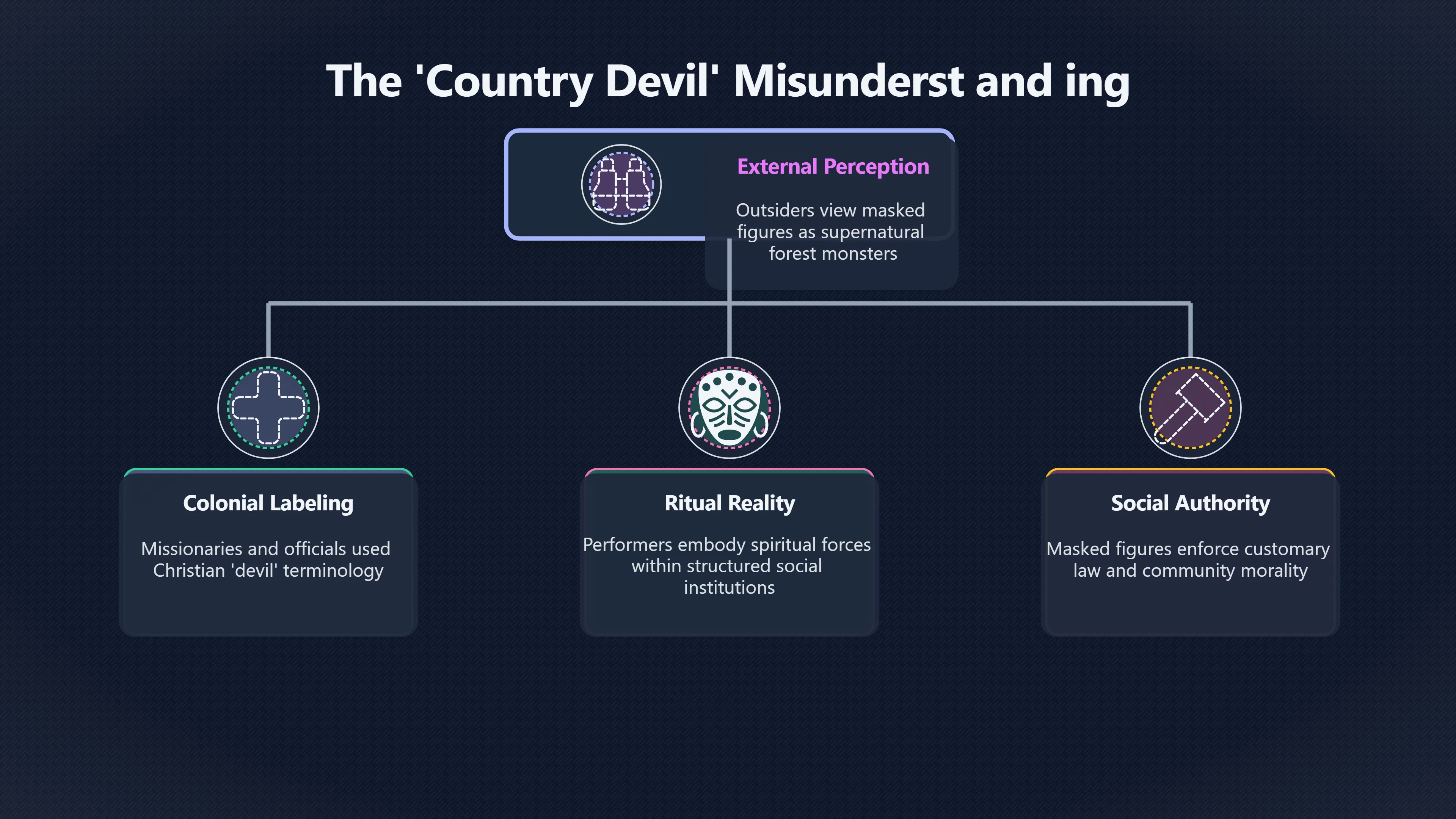
One of the most persistent misunderstandings in Liberia’s strange-history tradition is the idea of the “country devil” as a supernatural monster roaming the forest. In reality, the term usually refers to masked figures associated with the Poro (men’s) and Sande (women’s) initiation societies, institutions that have shaped community life across much of Liberia for centuries. To outsiders—especially colonial officials, missionaries, journalists and later internet storytellers—the sudden appearance of elaborately costumed masked figures emerging from the bush could seem uncanny or frightening. Yet within the communities that created them, these performances are not horror stories but expressions of authority, education, morality and spiritual symbolism. Understanding how ritual masquerades became recast as occult spectacles explains why Liberian folklore has sometimes been mistaken for evidence of paranormal beings rather than living cultural traditions.[njas.fi]njas.fiBoth exist in Liberia, Côte d'IvoireOn Liberian secret societies and conflict resolutionJuly 9, 2019 — The largest such societies found across the Mano river region are the…
Sande and Poro societies in cultural context
Across Liberia and neighbouring Sierra Leone and Guinea, Poro and Sande societies have long served as institutions that guide young people into adulthood, regulate aspects of community life and preserve cultural knowledge. They are not simply religious organisations or secret clubs but social institutions intertwined with leadership, dispute resolution and local identity.[njas.fi]njas.fiBoth exist in Liberia, Côte d'IvoireOn Liberian secret societies and conflict resolutionJuly 9, 2019 — The largest such societies found across the Mano river region are the…
The masks associated with these societies are therefore not decorative objects worn for entertainment. During masquerades, the masked figure is widely understood within the tradition to embody or make present a spiritual force connected with the society. Anthropologists have repeatedly noted that participants generally do not describe the performer as “a person wearing a mask” but treat the masquerade as the visible appearance of the spirit itself within a carefully defined ritual setting.[Tianmu Anglican Church]tianmu.orgTianmu Anglican ChurchSande and Poro — The Sacred SocietiesLike the Sande's sowei, the Poro masquerade is not understood as a human weari…
The best-known Sande helmet masks, particularly those from the wider Upper Guinea Coast, present an idealised image rather than a frightening one. Their smooth black surfaces, elaborate hairstyles, lowered eyes and balanced proportions symbolise beauty, composure, wisdom, self-control and social maturity. The imagery often carries associations with water, fertility and transformation instead of menace.[Wikipedia]WikipediaSande societySande society
Regional traditions vary considerably. Among some Liberian peoples, including the Gola, scholars have documented different understandings of the spirits represented by Sande masks, reminding readers that there is no single “Liberian mask tradition.” Local meanings change between communities while sharing a broader cultural framework.[Wikipedia]WikipediaGola peopleGola people
How outsiders turned ritual performance into occult spectacle
The phrase “country devil” illustrates how translation and cultural misunderstanding transformed ritual into apparent paranormal activity.
European missionaries frequently described masked performers as “devils”, borrowing Christian language for spiritual beings that did not fit familiar religious categories. Colonial administrators often repeated the term in official reports, even though it reflected outsider vocabulary rather than indigenous belief. The label proved memorable, surviving long after its original context was forgotten.[Re-Entanglements]re-entanglements.netPoro Archives20 Dec 2020 — 'Bundu devils' or Ndoli jowei masquerades of the women's society, photographed in February 191…
Several features of the masquerades encouraged misunderstanding:
- Performers emerged unexpectedly from forest areas that were restricted to initiates.
- Large costumes concealed the entire human body.
- Voices were intentionally altered through tubes or other devices.
- Non-members were expected to keep their distance.
- Ritual secrecy meant explanations were often unavailable to curious outsiders.[Wikipedia]WikipediaOpen source on wikipedia.org.
To someone unfamiliar with the cultural setting, these elements could easily become stories of mysterious forest beings rather than organised ceremonial performances.
Travellers’ accounts and later popular writing often amplified this impression. Reports that a “country devil” had appeared could be retold without explaining that the figure was participating in a recognised initiation ceremony or public event. Detached from its social context, the image became increasingly exotic in foreign imaginations.
Why the myth remained so powerful
The “country devil” was never simply a costume. It carried genuine social authority.
In many communities, masked appearances announced important ceremonies, reinforced customary law or marked transitions such as initiation into adulthood. Children and non-members might be expected to avoid certain places or respect temporary restrictions associated with ceremonies. That practical authority made the masked figures feel genuinely powerful, even without assuming they were supernatural monsters.[njas.fi]njas.fiBoth exist in Liberia, Côte d'IvoireOn Liberian secret societies and conflict resolutionJuly 9, 2019 — The largest such societies found across the Mano river region are the…
Modern reports demonstrate that the phrase continues to have social force. During Liberia’s post-war reconstruction, for example, a United Nations human rights report recorded an incident in 2008 in which a community elder reportedly threatened to bring the “country devil” to disrupt a rule-of-law workshop, causing participants to flee. The episode illustrates that the figure’s authority remained culturally significant even in contemporary political settings. It does not demonstrate paranormal activity; rather, it shows how ritual symbolism can influence real-world behaviour.[ECOI.net]ecoi.netLiberia – State protection – Traditional practices – PoroApril 13, 2010 — UNMIL reported an incident on 10 April 2008 in which a rule of law workshop was interrupted by an elder reportedly threa…
This continuing cultural importance helps explain why rumours involving masked figures can spread rapidly. Stories often mix genuine ceremonial practice with exaggeration, fear, political tension or local gossip, making it difficult for outsiders to separate folklore from observed events.
Reading masks without flattening them into monsters
For readers interested in Liberia’s Fortean traditions, the most useful lesson is that apparent mysteries often emerge from cultural translation rather than unexplained phenomena.
A masked figure disappearing into dense rainforest after a ceremony may sound like the beginning of a ghost story. A distorted voice echoing through the trees can easily become a tale of an inhuman being. Yet anthropological research consistently shows that these experiences belong within carefully structured systems of ritual performance, education and community authority rather than evidence for literal forest monsters.[njas.fi]njas.fiBoth exist in Liberia, Côte d'IvoireOn Liberian secret societies and conflict resolutionJuly 9, 2019 — The largest such societies found across the Mano river region are the…
That does not make the traditions any less fascinating. On the contrary, recognising their intended meanings reveals a richer story than the simplified “country devil” myth. The masks express ideas about adulthood, leadership, beauty, morality, secrecy and the relationship between the visible and invisible worlds. Their mystery lies not in proving the paranormal but in demonstrating how powerful ritual can appear when viewed through unfamiliar cultural assumptions.
Within Liberia’s wider catalogue of strange traditions, the “country devil” is therefore best understood as a case study in how folklore, colonial language, secrecy and misunderstanding combined to create one of West Africa’s most enduring paranormal misreadings.

eBay marketplace picks
Marketplace Samples
Live-tested eBay searches with available results related to this page.
Endnotes
1.
Source: njas.fi
Title: Both exist in Liberia, Côte d’Ivoire
Link:https://www.njas.fi/njas/article/download/404/362/773
Source snippet
On Liberian secret societies and conflict resolutionJuly 9, 2019 — The largest such societies found across the Mano river region are the...
Published: July 9, 2019
2.
Source: Wikipedia
Title: Sande society
Link:https://en.wikipedia.org/wiki/Sande_society
3.
Source: tianmu.org
Link:https://tianmu.org/good-work-library/living-traditions/africa/sande-and-poro-the-sacred-societies
Source snippet
Tianmu Anglican ChurchSande and Poro — The Sacred SocietiesLike the Sande's sowei, the Poro masquerade is not understood as a human weari...
4.
Source: Wikipedia
Title: Masquerade in Mende culture
Link:https://en.wikipedia.org/wiki/Masquerade_in_Mende_culture
5.
Source: Wikipedia
Title: Bassa people (Liberia)
Link:https://en.wikipedia.org/wiki/Bassa_people_%28Liberia%29
6.
Source: Wikipedia
Title: Gola people
Link:https://en.wikipedia.org/wiki/Gola_people
7.
Source: re-entanglements.net
Link:https://re-entanglements.net/tag/poro/
Source snippet
Poro Archives20 Dec 2020 — 'Bundu devils' or Ndoli jowei masquerades of the women's society, photographed in February 191...
8.
Source: Wikipedia
Link:https://en.wikipedia.org/wiki/Poro
9.
Source: ecoi.net
Title: Liberia – State protection – Traditional practices – Poro
Link:https://www.ecoi.net/en/file/local/1355369/1930_1293473714_lbr35260.pdf
Source snippet
April 13, 2010 — UNMIL reported an incident on 10 April 2008 in which a rule of law workshop was interrupted by an elder reportedly threa...
Published: April 13, 2010
Additional References
10.
Source: sierraleoneheritage.org
Link:https://sierraleoneheritage.org/v12.6/glossary/word.php?id=poro
Source snippet
PoroA name used throughout Sierra Leone for the men's society that is responsible for organising the initiation that prepares boys and yo...
11.
Source: facebook.com
Link:https://www.facebook.com/groups/abrahamduo/posts/4349696505260409/
Source snippet
to say rubbish. How can you say Poro belongs to women and Sande...
12.
Source: academia.edu
Link:https://www.academia.edu/26901983/The_Shaping_of_Men_and_the_Making_of_Metaphors_The_Meaning_of_White_Clay_in_Poro_and_Sande_Initiation_Society_Rituals
Source snippet
White clay serves as a metaphor for transformation during the...
13.
Source: youtube.com
Title: Liberian Culture Dance: Gola Drumming and Poro Society Dance/Gbetu Mask Dance
Link:https://www.youtube.com/watch?v=HEnRoN_M3tE
Source snippet
SIERRA LEONE: "PORO" SECRET SOCIETY CEREMONY...
14.
Source: youtube.com
Title: Unveiling West Africa’s Sacred Masks: The Sande and Poro Traditions
Link:https://www.youtube.com/watch?v=5rT8Xj7p2wY
Source snippet
Poro and Sande Societies: The Heart of Liberian Tradition...
15.
Source: youtube.com
Title: Poro and Sande Societies: The Heart of Liberian Tradition
Link:https://www.youtube.com/watch?v=Zc21jA8K6E0
Source snippet
Beyond the 'Country Devil' Myth: The Real Sande Masks...
16.
Source: youtube.com
Title: Beyond the ‘Country Devil’ Myth: The Real Sande Masks
Link:https://www.youtube.com/watch?v=V-G0z8bA95s
Source snippet
Tradition and Modernity: Ritual Masquerades in Liberia...
17.
Source: youtube.com
Title: Poro Society Traditional Dance
Link:https://www.youtube.com/watch?v=F3tBvSIn5q0
Source snippet
Unveiling West Africa's Sacred Masks: The Sande and Poro Traditions...
18.
Source: youtube.com
Title: Inside the Secret Society of the Sande Women | Untold Traditions of West Africa
Link:https://www.youtube.com/watch?v=l3Bi2OBM9YQ
Source snippet
The Kpelle People...
19.
Source: youtube.com
Title: Tradition and Modernity: Ritual Masquerades in Liberia
Link:https://www.youtube.com/watch?v=Q-8S-5JbWz4
Source snippet
You stopped this response...
Topic Tree