Within Burundi
Was Gustave a Monster or a Crocodile?
Gustave shows how a real Nile crocodile became Burundi's most famous monster story without needing to be supernatural.
On this page
- The Rusizi and Lake Tanganyika setting
- What the reports actually claim
- Why one animal became a legend
Page outline Jump by section
Introduction
Gustave is often described as Burundi’s “lake monster”, but the story is more interesting than a simple cryptid tale. At its heart is a very real Nile crocodile that became so large, elusive and feared that it crossed the line between dangerous wildlife and modern folklore. Reported sightings place him around the lower Rusizi River and the northern end of Lake Tanganyika, where stories of fatal attacks accumulated over decades. While some accounts credit him with hundreds of deaths, the evidence suggests a more complicated picture: an exceptionally large crocodile almost certainly existed, but many attacks were probably attributed to the same famous animal whether or not he was responsible. Rather than proving the existence of a supernatural monster, the Gustave legend shows how an identifiable predator can become a country’s closest equivalent to a lake monster through repetition, uncertainty and fear.[National Geographic]nationalgeographic.comserial killer croc gustave spotted in burundiNational GeographicSerial Killer Croc Gustave Spotted in Burundi16 Mar 2009 — Records of his attacks on villagers living on the northeast…
The Rusizi and Lake Tanganyika setting
The legend belongs to a very specific landscape. The Rusizi River flows south from Lake Kivu before emptying into the northern end of Lake Tanganyika through marshes, channels and reed beds. This environment is ideal habitat for Nile crocodiles, with slow-moving water, abundant fish and large mammals, alongside fishing villages where people regularly enter the water.[Wikipedia]WikipediaRuzizi RiverRuzizi River
Unlike many famous lake-monster stories, there is no mystery about whether crocodiles live here—they do. What made Gustave unusual was the repeated description of one animal that appeared far larger than normal. Witnesses consistently described an immense crocodile with a distinctive scar on the top of its head, making it easier for local people to believe they were encountering the same individual over many years.[National Geographic]nationalgeographic.comserial killer croc gustave spotted in burundiNational GeographicSerial Killer Croc Gustave Spotted in Burundi16 Mar 2009 — Records of his attacks on villagers living on the northeast…
This setting helps explain why the story sits comfortably within Fortean culture. The waters of northern Lake Tanganyika are vast enough for fleeting sightings, difficult enough to patrol consistently, and dangerous enough that rumours can spread faster than verified reports.
What the reports actually claim
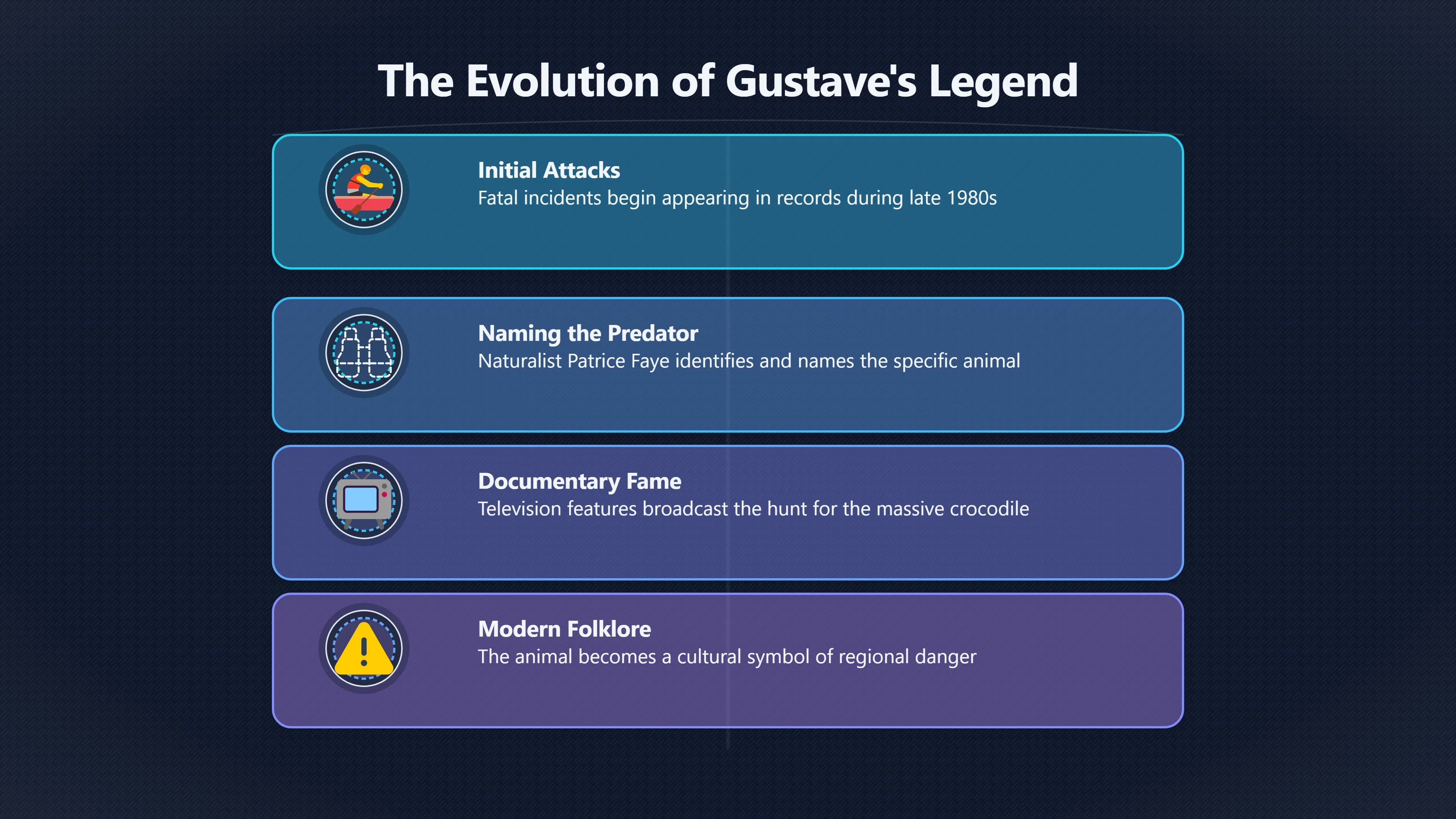
Most versions of the story begin with reports of attacks from the late 1980s. Naturalist Patrice Faye, who devoted years to tracking the crocodile, named him “Gustave” and argued that eyewitnesses were describing one exceptionally large animal rather than many ordinary crocodiles. According to Faye’s observations, Gustave measured around six metres in length, weighed close to a tonne and could be recognised by scars thought to have resulted from failed attempts to shoot him.[National Geographic]nationalgeographic.comserial killer croc gustave spotted in burundiNational GeographicSerial Killer Croc Gustave Spotted in Burundi16 Mar 2009 — Records of his attacks on villagers living on the northeast…
The claim most often repeated is that Gustave killed between 200 and 300 people. This figure has become inseparable from his legend, appearing in documentaries, newspaper features and popular retellings. Yet even sources that helped make Gustave internationally famous also caution against accepting the number literally. National Geographic noted that although attacks on villagers had been recorded since 1987, it was doubtful that every death later blamed on Gustave could genuinely have been caused by one crocodile.[National Geographic]nationalgeographic.comserial killer croc gustave spotted in burundiNational GeographicSerial Killer Croc Gustave Spotted in Burundi16 Mar 2009 — Records of his attacks on villagers living on the northeast…
That distinction is important. The evidence supports several points with reasonable confidence:
- An unusually large Nile crocodile lived in the Rusizi River and northern Lake Tanganyika region.
- Numerous witnesses independently described a crocodile with recognisable scars.
- Fatal crocodile attacks genuinely occurred in the area.
- The precise number of victims attributed to Gustave cannot be verified from reliable records.[National Geographic]nationalgeographic.comserial killer croc gustave spotted in burundiNational GeographicSerial Killer Croc Gustave Spotted in Burundi16 Mar 2009 — Records of his attacks on villagers living on the northeast…
This makes Gustave unusual among famous “monsters”. The debate is not over whether the creature existed, but over how much of the legend belongs to one identifiable animal.

Why one animal became a legend
Large predators often acquire names, but relatively few become folklore. Gustave achieved that status because several factors reinforced one another.
First was his apparent size. Mature Nile crocodiles can become enormous, but individuals approaching six metres are exceptionally rare. Such an animal would naturally dominate local stories even without supernatural embellishment.[National Geographic]nationalgeographic.comserial killer croc gustave spotted in burundiNational GeographicSerial Killer Croc Gustave Spotted in Burundi16 Mar 2009 — Records of his attacks on villagers living on the northeast…
Second was his ability to evade capture. Multiple attempts were made to trap him, including the widely documented expedition featured in the television documentary Capturing the Killer Croc. Heavy traps, bait animals and monitoring equipment all failed to secure him, reinforcing his reputation as an almost uncanny survivor. Equipment failures and poor weather during the expedition only added to the story’s mystique.[Wikipedia]WikipediaGustave (crocodileMarch 24, 2026 — Gustave is a man-eating male Nile crocodile rumored to have killed as many as 200-300 people in the area of the Ruzizi r…
Third was the human history surrounding the region. Burundi experienced decades of political violence, civil war and disrupted record-keeping. National Geographic suggested that this turbulent background made it especially difficult to separate documented attacks from rumour and hearsay. In such conditions, a single notorious crocodile became an explanation for disappearances that could not always be investigated properly.[National Geographic]nationalgeographic.comserial killer croc gustave spotted in burundiNational GeographicSerial Killer Croc Gustave Spotted in Burundi16 Mar 2009 — Records of his attacks on villagers living on the northeast…
In folklore terms, Gustave became a convenient focal point. Fear attached itself to one memorable name instead of remaining scattered among countless anonymous crocodiles.
Monster or misunderstood predator?
Calling Gustave a “lake monster” depends largely on what the phrase means.
If it implies an unknown species lurking beneath Lake Tanganyika, the evidence does not support it. Gustave fits comfortably within the biology of the Nile crocodile, a species capable of reaching formidable size under favourable conditions. No credible evidence suggests he represented anything biologically unknown.[National Geographic]nationalgeographic.comserial killer croc gustave spotted in burundiNational GeographicSerial Killer Croc Gustave Spotted in Burundi16 Mar 2009 — Records of his attacks on villagers living on the northeast…
If, however, “lake monster” means an animal whose reputation grows beyond measurable fact, then Gustave fits the description remarkably well. Like the Beast of Gévaudan or unusually large sharks that become local legends, he occupies the borderland between documented wildlife and storytelling.
His legend also differs from classic cryptids such as the Loch Ness Monster. Nessie is famous because no one can prove the animal exists. Gustave became famous precisely because a real animal almost certainly did exist, even if the surrounding claims became exaggerated.
Why the legend still matters
Gustave remains Burundi’s best-known strange animal story because it demonstrates how myth can emerge without requiring the supernatural. The crocodile became larger in the imagination than in any tape measure, accumulating stories, rumours and tragedies until he represented the dangers of an entire stretch of river.
Films, documentaries and sensational headlines sometimes blur the distinction between documented attacks and legendary reputation, presenting Gustave as an unstoppable serial killer of the waterways. Yet the more enduring lesson is subtler. The legend survives because it combines verifiable wildlife, incomplete records, dramatic eyewitness testimony and an environment where genuine danger was already part of everyday life.[National Geographic]nationalgeographic.comserial killer croc gustave spotted in burundiNational GeographicSerial Killer Croc Gustave Spotted in Burundi16 Mar 2009 — Records of his attacks on villagers living on the northeast…
Within Burundi’s wider catalogue of Fortean stories, Gustave therefore stands out not as evidence for an unknown monster hiding in Lake Tanganyika, but as perhaps the clearest example of a real animal becoming folklore. The boundary between zoology and legend proved far thinner than the water separating the Rusizi River from the lake itself.
Amazon book picks
Further Reading
Books and field guides related to Was Gustave a Monster or a Crocodile?. Use these as the next step if you want deeper reading beyond the article.

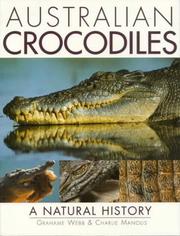
Crocodiles of Australia
First published 1998. Subjects: Crocodiles, Wild animals, Australia, Reptiles & Amphibians, Nature.

Burundi
First published 1994. Subjects: Politics and government, Violence, Ethnic relations, Genocide, Political aspects.
The Atlas of Mysterious Places by Westwood, Jennifer (1997) H...
First published 1609.
eBay marketplace picks
Marketplace Samples
Live-tested eBay searches with available results related to this page.



Endnotes
1.
Source: Wikipedia
Title: Ruzizi River
Link:https://en.wikipedia.org/wiki/Ruzizi_River
2.
Source: Wikipedia
Title: Gustave (crocodile)
Link:https://en.wikipedia.org/wiki/Gustave_%28crocodile%29
Source snippet
March 24, 2026 — Gustave is a man-eating male Nile crocodile rumored to have killed as many as 200-300 people in the area of the Ruzizi r...
Published: March 24, 2026
3.
Source: Wikipedia
Title: Gustave (crocodile)
Link:https://fr.wikipedia.org/wiki/Gustave_%28crocodile%29
4.
Source: nationalgeographic.com
Title: serial killer croc gustave spotted in burundi
Link:https://www.nationalgeographic.com/adventure/article/serial-killer-croc-gustave-spotted-in-burundi
Source snippet
National GeographicSerial Killer Croc Gustave Spotted in Burundi16 Mar 2009 — Records of his attacks on villagers living on the northeast...
5.
Source: darktales.blog
Link:https://darktales.blog/2019/12/17/gustave/
Source snippet
Dark Tales17 Dec 2019 — One of the largest wild crocodiles ever recorded, the animal known as Gustave has hunted the waters of Lake Tanga...
6.
Source: unresolved.me
Link:https://unresolved.me/gustave
Source snippet
9 Sept 2018 — Gustave was a large male Nile Crocodile, who was rumored to be upwards of twenty feet long. It would be impossible to verif...
Additional References
7.
Source: facebook.com
Link:https://www.facebook.com/groups/21786920284/posts/10171717190035285/
Source snippet
Africa's largest crocodile attacks in BurundiThe natives believe that Gustave attacked and plagued at least 300 people along the banks of...
8.
Source: youtube.com
Link:https://www.youtube.com/watch?v=BVeCdc9u9xo
Source snippet
The monster of Lake TanganyikaPatrice Faye, identified the source of the evil: "Gustave", an eating Nile crocodile of men over eight mete...
9.
Source: newsweek.com
Title: giant crocodile eaten 300 people never kill fun gustave nile 1766034
Link:https://www.newsweek.com/giant-crocodile-eaten-300-people-never-kill-fun-gustave-nile-1766034
Source snippet
Giant Crocodile Said To Have Eaten 300 People9 Dec 2022 — The Nile crocodile is rumored to have killed over 300 people and has earned leg...
10.
Source: blackbeastsandboogeymen.com
Title: Estimates put him at somewhere between five and a half and six metres in length,
Link:https://blackbeastsandboogeymen.com/2026/06/08/man-eater-monday-gustave-the-crocodile/
Source snippet
Man-eater Monday: Gustave the CrocodileJune 8, 2026 — Gustave is — or was — a Nile crocodile of extraordinary size...
Published: June 8, 2026
11.
Source: facebook.com
Link:https://www.facebook.com/spookyearth99/videos/the-giant-crocodile-named-gustave-africas-most-feared-real-life-river-monster/757882719983026/
Source snippet
giant crocodile, not just a big one. A prehistoric sized beast...
12.
Source: pulse.com.gh
Title: gustave the crocodile kills more than 300 people in africa 2024072419183854967
Link:https://www.pulse.com.gh/articles/lifestyle/gustave-the-crocodile-kills-more-than-300-people-in-africa-2024072419183854967
Source snippet
herpetologist, Patrice Faye, Ruzizi River near...
13.
Source: youtube.com
Link:https://www.youtube.com/watch?v=CT-u6HSI1us
Source snippet
iving near Lake Tanganyika, in...
14.
Source: youtube.com
Title: The Legend of Gustave: The Man-Eating Crocodile
Link:https://www.youtube.com/watch?v=Tta7QApFL2Y
Source snippet
This Crocodile Killed 300 People | Gustave...
15.
Source: youtube.com
Title: Gustave: Truth Behind the Killer
Link:https://www.youtube.com/watch?v=NajgWwFgde8
Source snippet
GUSTAVE, THE INVINCIBLE MONSTER OF BURUNDI...
16.
Source: youtube.com
Title: GUSTAVE, THE INVINCIBLE MONSTER OF BURUNDI
Link:https://www.youtube.com/watch?v=_yxVZ6FQcpE
Source snippet
Gustave: The Maneater of Barundi...
Topic Tree