Within Mongolia Weird
Did the Gobi Death Worm Ever Exist?
The death worm is Mongolia's most famous mystery because its vivid legend has outlived every failed search for proof.
On this page
- What the legend claims
- Roy Chapman Andrews and the missing specimen
- Misidentification, media searches and sceptical explanations
Page outline Jump by section
Introduction
The Gobi death worm is Mongolia’s most famous cryptid because it combines a vivid local legend with a complete absence of convincing physical evidence. For more than a century, explorers, journalists, cryptozoologists and television crews have searched the Gobi Desert for a thick, red, burrowing creature said to kill people and animals with venom, electric shocks or both. Yet no verified specimen, photograph, DNA sample or fossil has ever been produced.
That gap between an enduring tradition and missing evidence is precisely what keeps the story alive. Rather than asking whether the worm is simply “real” or “fake”, it is more useful to examine what the evidence actually consists of, why searches have repeatedly failed, and which explanations best fit the available facts.
What the legend claims
The creature usually described in English as the Gobi death worm is said to inhabit the remote deserts of southern and western Mongolia. Most accounts portray it as a reddish, sausage-shaped animal around 60–150 centimetres long, lacking obvious limbs or a distinct head. It is reputed to spend most of its life beneath loose sand, surfacing only occasionally after rain or during the warmer months.[Wikipedia]WikipediaMongolian death wormMongolian death worm
The most dramatic part of the legend concerns its supposed methods of killing. Depending on the version, the worm can:
- spray a lethal venom over several metres;
- kill through direct contact with powerful poison;
- deliver an electrical discharge from a distance;
- attack livestock as well as people.
These extraordinary abilities immediately distinguish the death worm from ordinary cryptozoological reports. Many alleged mystery animals are simply unusual mammals or reptiles. The death worm, by contrast, is usually credited with biological abilities unknown in any recognised terrestrial animal living in the Gobi Desert.[skeptoid.com]skeptoid.comOlgoi-Khorkhoi: The Mongolian Death Worm8 Jan 2013 — Mongolian tradition holds that a strange and deadly worm lives beneath the sands of…
Roy Chapman Andrews and the missing specimen
The death worm became internationally famous largely because of American explorer and palaeontologist Roy Chapman Andrews, leader of the American Museum of Natural History’s Central Asiatic Expeditions during the 1920s. Andrews himself never claimed to have seen the creature. Instead, he recorded conversations with Mongolian officials who firmly believed it existed despite admitting that none of them had personally encountered it.[Wikipedia]WikipediaMongolian death wormMongolian death worm
In On the Trail of Ancient Man (1926), Andrews described the alleged animal in striking detail while remaining openly sceptical. He noted that local officials insisted it was so poisonous that merely touching it would be fatal, yet no preserved specimen could be produced.
This distinction matters. Andrews did not discover the death worm. He documented a belief already circulating among Mongolians and introduced it to English-speaking readers. His account became the foundation for nearly every later discussion, meaning that much modern reporting ultimately traces back to a handful of conversations rather than a chain of independently verified observations.[Wikipedia]WikipediaMongolian death wormMongolian death worm
What evidence actually exists?
When the legend is separated from later embellishments, the evidential picture is surprisingly thin.
There are repeated claims that local people reported dangerous burrowing creatures, but there are no authenticated museum specimens, skeletal remains, skins, photographs, casts, DNA samples or scientifically documented observations. Modern expeditions have likewise failed to recover physical evidence despite improved transport, photography and satellite navigation.[Wikipedia]WikipediaMongolian death wormMongolian death worm
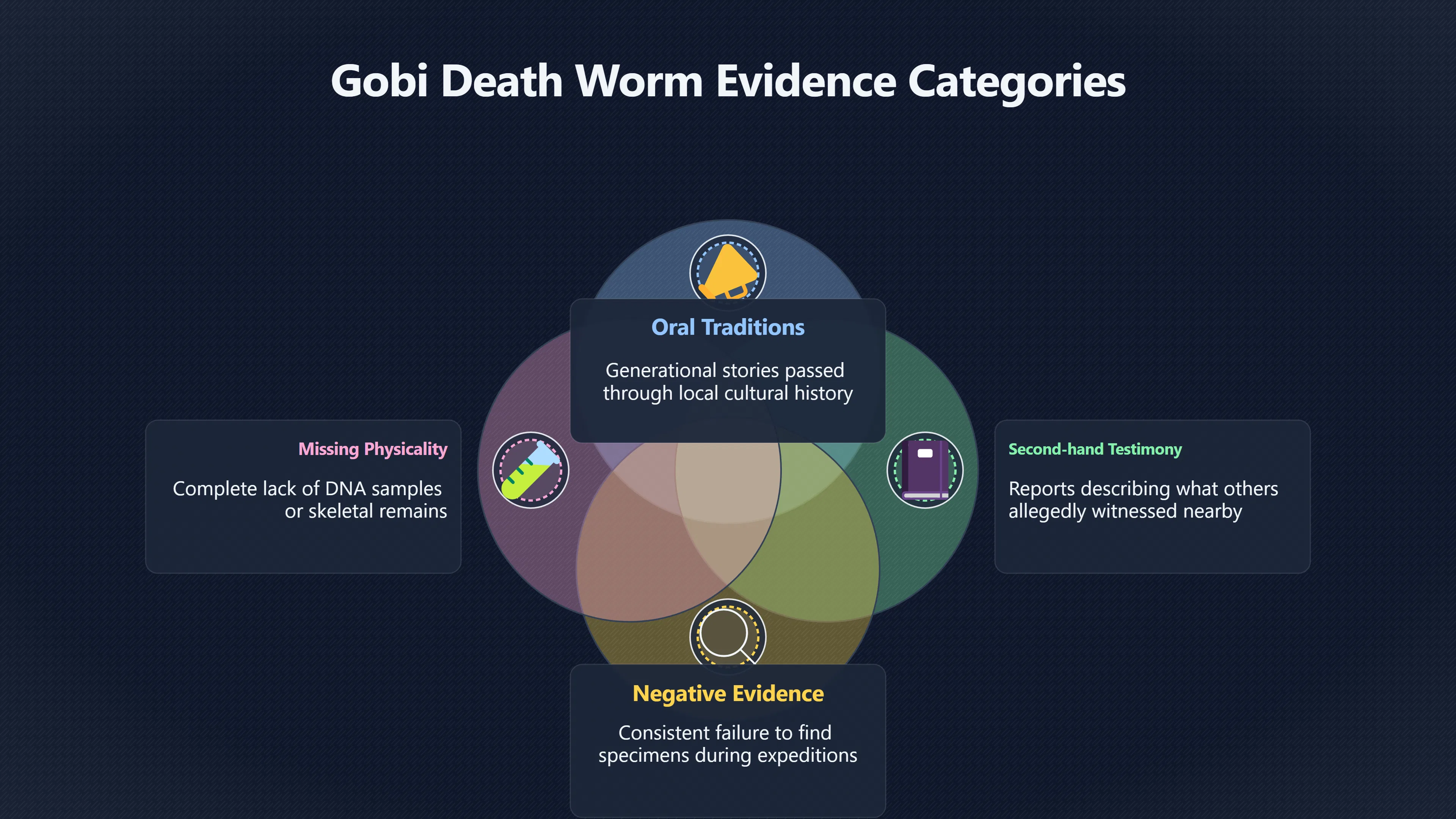
The available evidence therefore falls into three broad categories.
Oral tradition. Stories passed between generations are genuine cultural evidence that people have long discussed such a creature. They are not, however, biological proof.
Second-hand testimony. Much of the literature consists of reports from people describing what someone else supposedly saw, rather than direct eyewitness accounts recorded under controlled conditions.
Negative evidence. Decades of searches have consistently failed to find a specimen. While failure to discover an animal does not prove it cannot exist, repeated unsuccessful expeditions reduce the likelihood of a large, dangerous vertebrate remaining completely undocumented.
Why have expeditions found nothing?
The Gobi Desert is enormous, sparsely populated and difficult to survey thoroughly. Believers therefore argue that an elusive burrowing species could simply have escaped detection.
Several well-known expeditions have tested that possibility.
Czech explorer Ivan Mackerle organised searches in the early 1990s, even experimenting with mechanical devices inspired by Dune in the hope of attracting hidden animals beneath the sand. Despite collecting stories from local residents, his team found no convincing evidence.[Wikipedia]WikipediaMongolian death wormMongolian death worm
In 2005, zoological journalist Richard Freeman and the Centre for Fortean Zoology mounted another expedition. Again, no specimen was recovered. Freeman concluded that while unusual burrowing reptiles might account for some reports, the worm’s legendary powers almost certainly belonged to folklore rather than zoology.[Wikipedia]WikipediaMongolian death wormMongolian death worm
Later television expeditions, including Destination Truth, similarly produced dramatic footage but no verifiable biological evidence.[Wikipedia]WikipediaMongolian death wormMongolian death worm
Repeated failures do not prove that every unknown desert animal has been discovered. They do, however, make the existence of a large, highly dangerous species increasingly difficult to reconcile with the available evidence.
Misidentification and sceptical explanations
The most widely discussed natural explanation is simple misidentification.
Several desert reptiles already resemble parts of the traditional description. The strongest candidate is the Tartar sand boa, a thick-bodied snake that spends much of its time buried beneath loose sand. Its blunt head and cylindrical body can easily appear “worm-like”, especially during brief encounters. According to accounts published by herpetologists, when a preserved sand boa was shown to Mongolian residents in the 1980s, some identified it as the same creature known locally as the death worm.[Wikipedia]WikipediaMongolian death wormMongolian death worm
Other suggestions include:
- an unusually large but ordinary burrowing snake;
- confusion with limbless lizards or worm lizards, even though true amphisbaenians are not known from Mongolia today;
- gradual exaggeration as stories passed between communities;
- symbolic folklore warning travellers about dangerous desert environments rather than describing a literal animal.[facebook.com]facebook.comFor decades, cryptozoologists have searched for the…The most probable explanation is that the deathworm is a new species of am…
The alleged electrical attack presents a particular scientific problem. While some aquatic animals generate electricity, no known terrestrial burrowing reptile possesses an organ capable of projecting lethal electrical discharges through dry desert sand. Likewise, the combination of long-range venom spraying, instant lethality and underground hunting would require a biology unlike that of any recognised animal inhabiting the region.[skeptoid.com]skeptoid.comOlgoi-Khorkhoi: The Mongolian Death Worm8 Jan 2013 — Mongolian tradition holds that a strange and deadly worm lives beneath the sands of…
Why the legend survives
The death worm persists because it occupies an unusual middle ground between folklore and exploration.
Unlike dragons or giants, it is placed in a real landscape that remains vast and intimidating. The Gobi Desert still contains remote regions where few people travel regularly, making complete certainty impossible. Every unsuccessful expedition can therefore be interpreted in two opposite ways: sceptics see another failed search, while believers see proof that the desert continues to keep its secrets.
Media has also reinforced the legend. Books on cryptozoology, documentaries, television series and films have repeatedly introduced the death worm to new audiences, often emphasising its dramatic killing powers more than the weakness of the underlying evidence. As a result, the creature has become one of the world’s best-known cryptids despite possessing one of the sparsest evidential records.
The balance of evidence
Taken as zoology, the evidence for the Gobi death worm is extremely weak. More than a century after Roy Chapman Andrews first popularised the story, there remains no verified specimen or observation that satisfies modern scientific standards.
Taken as folklore, however, the death worm is remarkably successful. It preserves local ideas about the dangers of the Gobi, reflects the power of oral tradition in remote landscapes, and illustrates how a story can become internationally famous without ever acquiring the physical evidence needed to confirm it.
That combination of compelling legend, repeated investigation and persistent absence of proof explains why the Gobi death worm remains Mongolia’s signature mystery animal: not because the evidence is strong, but because the mystery itself has proved unusually durable.
Amazon book picks
Further Reading
Books and field guides related to Did the Gobi Death Worm Ever Exist?. Use these as the next step if you want deeper reading beyond the article.


Hunt for the Skinwalker
The author of the controversial bestseller Brain Trust brings his scientific expertise to the chilling true story of unexplained phenomen...
eBay marketplace picks
Marketplace Samples
Live-tested eBay searches with available results related to this page.

Endnotes
1.
Source: Wikipedia
Title: Mongolian death worm
Link:https://en.wikipedia.org/wiki/Mongolian_death_worm
2.
Source: skeptoid.com
Link:https://skeptoid.com/episodes/344
Source snippet
Olgoi-Khorkhoi: The Mongolian Death Worm8 Jan 2013 — Mongolian tradition holds that a strange and deadly worm lives beneath the sands of...
3.
Source: facebook.com
Link:https://www.facebook.com/theanimalrescuesite/posts/for-decades-cryptozoologists-have-searched-for-the-mongolian-death-worm-a-five-f/1585605786257770/
Source snippet
For decades, cryptozoologists have searched for the...The most probable explanation is that the deathworm is a new species of am...
4.
Source: youtube.com
Title: The Mystery of the Gobi Desert Monster
Link:https://www.youtube.com/watch?v=JtX_NgnA1SQ
Source snippet
Gobi Death Worm | MonsterQuest...
5.
Source: itsmth.fandom.com
Title: Mongolian Death Worm
Link:https://itsmth.fandom.com/wiki/Mongolian_Death_Worm
Source snippet
Death Worm | It's Something Wiki | FandomThey found no evidence of its existence, but could not rule out that it might live deep in the G...
Additional References
6.
Source: amnh.org
Link:https://www.amnh.org/explore/ology/paleontology/going-gobi2/going-gobi-roy-chapman-andrews
Source snippet
American Museum of Natural HistoryGoing Gobi: Roy Chapman AndrewsCard 023: Roy Chapman Andrews. This real-life "Indiana Jones" led the fi...
7.
Source: youtube.com
Link:https://www.youtube.com/watch?v=VvVEiq7G8i8
Source snippet
Destination Truth: Haunted Island / Deathworm (Season 2, Episode 2)[https://www.youtube.com/watch*](https://www.youtube.com/watch*) Query: [YouTube Gobi Death Worm Evidenc...
8.
Source: karlshuker.blogspot.com
Title: the mongolian death worm shocking
Link:https://karlshuker.blogspot.com/2012/08/the-mongolian-death-worm-shocking.html
Source snippet
THE MONGOLIAN DEATH WORM – A SHOCKING...4 Aug 2012 — Roy Chapman Andrews's straight-faced promise to the Mongolian premier back in 1922...
9.
Source: reddit.com
Link:https://www.reddit.com/r/Cryptozoology/comments/1spjgzm/why_is_the_mongolian_death_worm_often_dismissed/
Source snippet
osed to have are REALLY out there.Read more...
10.
Source: paranormalarabia.com
Title: the mongolian death worm
Link:https://www.paranormalarabia.com/en/investigations/2025/10/the-mongolian-death-worm
Source snippet
22 Oct 2025 — - So far, there is no definitive scientific evidence proving the existence of the worm as described in the legend. - Howeve...
11.
Source: youtube.com
Link:https://www.youtube.com/watch?v=F5ZwimI-VlE
Source snippet
· 3 years ago. Cryptids Across the Atlas...more. Cryptids Across...
12.
Source: youtube.com
Title: How Mongolian Death Worm Could Have Evolved
Link:https://www.youtube.com/watch?v=xp9SDxVbnFQ
Source snippet
All verified watch links. All relevant. Titles matched. Format correct.1. Mongolian Death Worm: The Lethal Desert Monster of the Gobi...
Topic Tree