Where Ethiopia's Sacred History Turns Strange
Ethiopia has one of the richest strange-history records in Africa, but not because it offers a neat parade of monsters and flying saucers. Its strongest Fortean material sits where sacred history, folklore, weather oddities, living ritual and archaeology overlap.
Page outline Jump by section
Why Ethiopia’s strange record is unusually hard to separate from sacred history
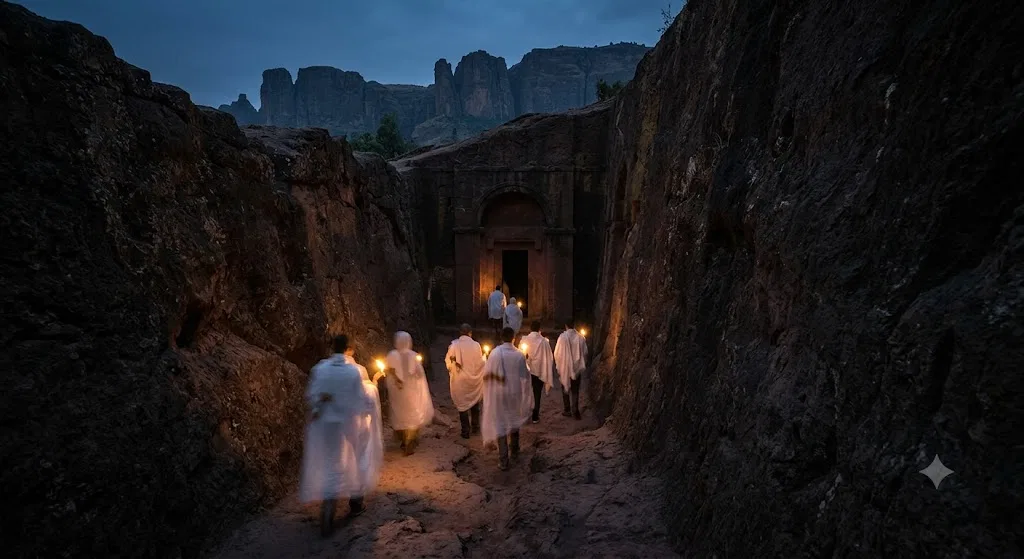
Many countries have ghost stories, local monsters and odd newspaper items. Ethiopia’s Fortean material is different because several of its strangest claims are embedded in institutions that are still living, protected and meaningful. Aksum, Lalibela, Lake Tana and Harar are not abandoned “mystery sites” in the pulp-magazine sense. They are working religious and cultural places, often recognised by UNESCO or national heritage bodies, where myth, ritual and historical memory continue to shape how people move through the landscape. UNESCO describes Lalibela as a group of eleven medieval rock-hewn churches attributed to King Lalibela, who sought to create a “New Jerusalem” after pilgrimages to the Holy Land became harder in the twelfth century.[UNESCO World Heritage Centre]whc.unesco.orgOpen source on unesco.org.
That matters for the tone of any serious strange-history reading of Ethiopia. The weirdness is not just in isolated claims. It is in the way a carved church, a guarded chapel, a night-feeding hyena, a healing rite or an undeciphered stone can carry several meanings at once. To a believer, it may be sacred truth. To an anthropologist, it may be a social system expressed through spirits and animals. To a sceptic, it may be misinterpretation, secrecy, politics, tourism or legend-making. To a Fortean reader, it is precisely the collision between these explanations that makes the material interesting.
Ethiopia also resists the imported “ancient aliens” style of mystery writing. The country’s built heritage is already extraordinary without needing extraterrestrial architects. Lalibela’s churches were cut from volcanic rock by human communities with deep religious motivation, technical skill and political purpose; later legends about angelic assistance belong to the site’s sacred biography, not to a gap in human capability. The Metropolitan Museum of Art notes that King Lalibela’s hagiography says the churches were carved over twenty-four years with the assistance of angels, while the World Monuments Fund summarises the same tradition as a legend in which Christ directs the king and angels aid the work.[The Metropolitan Museum of Art]metmuseum.orgThe Metropolitan Museum of Art The Rock-hewn Churches of LalibelaThe Metropolitan Museum of Art The Rock-hewn Churches of Lalibela
The Ark at Aksum: faith, secrecy and the perfect unsolved object
The most famous Ethiopian mystery is the claim that the Ark of the Covenant is kept in Aksum, at the Church of Our Lady Mary of Zion. In Ethiopian Orthodox tradition, the Ark came to Ethiopia through Menelik I, son of Solomon and the Queen of Sheba, and is now guarded by a dedicated custodian. The Smithsonian’s long-form account describes the Ethiopian Christian claim as a living belief rather than an archaeological finding, and Tablet notes the associated tradition that replicas of the Ark’s sacred tablets are kept in every Ethiopian church.[Smithsonian Magazine]smithsonianmag.comSmithsonian Magazine Keepers of the Lost Ark?Smithsonian Magazine Keepers of the Lost Ark?
As a Fortean case, the Ark story has almost everything: an object of immense religious power, a restricted location, a guardian figure, a national sacred narrative, rival scholarly interpretations and a long trail of outside speculation. Its strength as folklore is also its weakness as evidence. The alleged object is not available for normal inspection. The rules around its concealment are part of its sanctity. That means the claim cannot be tested in the way an archaeologist would test a newly excavated artefact.
The Ethiopian tradition is not a recent internet invention. The Ark’s connection to Ethiopian sacred history is tied to the medieval national epic often known as the Kebra Nagast and to broader Ethiopian Orthodox practice, including the central role of consecrated tablets in churches. Yet the leap from “a powerful and old tradition exists” to “the biblical Ark has been physically verified” is much larger than popular retellings admit. A 2024 research summary on the Aksum tradition states plainly that definitive evidence confirming the Ark’s existence in Ethiopia has not been found.[ResearchGate]researchgate.netResearch Gate The Ark of the Covenant in Ethiopia: Analyzing the LegendResearch Gate The Ark of the Covenant in Ethiopia: Analyzing the Legend
The story’s pull comes from that tension. Believers do not need a museum display to make the Ark meaningful; secrecy is part of the sacred order. Sceptics see the lack of inspection as the central problem. Fortean readers should notice how neatly the case turns an evidential absence into narrative power. The more inaccessible the object is, the more it becomes a perfect mystery.
Lake Tana adds a second layer to the Ark tradition. UNESCO’s tentative listing for Lake Tana’s island monasteries records the legend that the Ark was brought by Menelik I to Tana Qirqos and remained there for about six hundred years before being taken to Aksum.[UNESCO World Heritage Centre]whc.unesco.orgOpen source on unesco.org. In other words, Ethiopia’s Ark story is not just “an object in a chapel”. It is a sacred itinerary across the landscape: island, monastery, royal memory, guarded shrine.

Lalibela: angels, engineering and the danger of false mysteries
Lalibela is often pulled into fringe claims because it looks impossible at first glance. Eleven churches, some carved down into solid rock and connected by trenches and tunnels, appear to have been made by subtraction rather than construction. That visual shock has made the site a magnet for mystical explanations. But a grounded reading is more interesting than the lazy claim that “no one knows how humans did this”.
UNESCO places the churches in a clear historical and religious frame: a medieval Christian royal project associated with King Lalibela and the idea of a “New Jerusalem”.[UNESCO World Heritage Centre]whc.unesco.orgOpen source on unesco.org. The strangeness lies not in a lack of human explanation, but in the combination of scale, symbolism and living devotion. These are churches carved into the ground, not monuments merely built on top of it. The visitor descends into sacred architecture, moving through trenches and passageways that can feel like a journey through death, pilgrimage and rebirth.
The angel tradition should not be treated as a failed engineering report. It is a sacred way of describing a project believed to have divine approval. The Met’s account of the king’s hagiography says angels assisted the carving, while the World Monuments Fund repeats the local legend of Christ’s instruction and angelic aid.[The Metropolitan Museum of Art]metmuseum.orgThe Metropolitan Museum of Art The Rock-hewn Churches of LalibelaThe Metropolitan Museum of Art The Rock-hewn Churches of Lalibela A sceptical account can accept the human labour and still recognise why the angel story mattered: it gave the churches cosmic authorship as well as royal authorship.
This is where Ethiopia offers a useful warning for Fortean writing. “Ancient aliens” and similar claims often flatten real cultures by pretending that impressive work requires outside intervention. Lalibela needs no such rescue. The mystery worth keeping is not “could people have carved this?” but “how did a medieval Ethiopian sacred project become so architecturally, ritually and symbolically complete that later generations remembered it as angelic?”
Harar’s hyenas: animals, spirits and a city that feeds the night
Harar gives Ethiopia one of its most vivid living strange traditions. The walled city is recognised by UNESCO as Harar Jugol, a fortified historic town and important Islamic cultural centre.[UNESCO World Heritage Centre]whc.unesco.orgOpen source on unesco.org. Yet for many visitors, its most unforgettable feature is nocturnal: wild spotted hyenas that enter the city’s story not only as scavengers, but as spiritually charged neighbours.
The modern spectacle of hyena feeding is often described as a tourist attraction, but the beliefs around Harar’s hyenas go deeper than performance. The Guardian reported in 2024 that Harari tradition credits hyenas with protecting residents from harmful spirits, while anthropologist Marcus Baynes-Rock has argued from fieldwork that the animals are understood by some residents as operating in a world humans cannot fully see.[The Guardian]theguardian.comOpen source on theguardian.com. Bradt’s travel writing likewise notes the belief that hyenas clear the town of invisible spirits and that the exact origin of the feeding practice remains debated.[Bradt Guides]bradtguides.comBradt Guides The hyena men of HararBradt Guides The hyena men of Harar
This is a classic Fortean overlap: real animals, real ecological behaviour, real urban adaptation, and supernatural interpretation. Hyenas do enter human spaces. They do consume refuse and carrion. Their night calls, bone-crushing jaws and uncanny confidence around settlements make them unusually easy to mythologise. In Harar, however, the animal is not simply a monster. It is feared, respected, fed and folded into ideas of protection.
The sceptical explanation is not “nothing strange is happening”. Something strange is happening: a long-running human-predator relationship exists in a historic walled city. The question is whether the spiritual interpretation is taken as literal fact, symbolic ecology, local theology, or all three at once. That ambiguity is why Harar belongs in Ethiopia’s weird-history record.
Werehyenas and the evil eye: folklore with social consequences
Ethiopia’s werehyena material is among the country’s most striking folklore, but it needs careful handling. In popular retellings, the story is simple: certain people can transform into hyenas and attack at night. In the scholarly record, the belief is more socially charged. Ronald Reminick’s classic study of evil-eye belief among the Amhara, available in PDF form, states that the Amhara hold such beliefs and examines them in the context of central highland communities.[Rights in Exile]rightsinexile.orgRights in Exile The Evil Eye Belief among the Amhara of EthiopiaRights in Exile The Evil Eye Belief among the Amhara of Ethiopia Marcus Baynes-Rock’s article “Ethiopian Buda as Hyenas” argues that accounts which reduce buda to “evil eye” can miss the importance of the hyena transformation element itself.[JSTOR]jstor.orgOpen source on jstor.org.
The important point is that this is not merely a spooky creature story. Evil-eye accusations often attach to social outsiders, artisan groups or people considered liminal. Niall Finneran’s work on Ethiopian evil-eye belief and iron working is repeatedly cited in this area because metalworkers and other skilled craft groups have been associated with dangerous hidden power in parts of Ethiopian tradition.[Lewis Twiby's Past and Present]lewisrhystwiby.wordpress.comLewis Twiby's Past and Present Myths, Legends, Religion, and Faith: WerehyenasLewis Twiby's Past and Present Myths, Legends, Religion, and Faith: Werehyenas The folklore therefore has a double life: it produces frightening night imagery, but it also reflects anxieties about envy, craft, status, marginality and the boundary between human and animal.
For believers, the hyena is not just a disguise. It is a mode of hidden action. For sceptics, the werehyena is a social accusation given animal form. For historians of the strange, the most revealing question is not “do werehyenas exist?” but “why did the hyena become the body through which fear of hidden human malice was imagined?”
This distinction matters ethically. Fortean subjects are often fun because they are strange; this one can be dangerous because accusations of occult harm can stigmatise real people. A responsible account keeps the eerie night-world of the story intact while making clear that the evidence supports a powerful belief system, not verified shapeshifting.
Zār: possession, illness and ritual as a negotiated haunting
Zār is another Ethiopian-linked tradition that sits between spirit belief, healing practice and social history. It is usually described as a spirit-possession complex found across Ethiopia and the wider Red Sea and north-east African world. A medical-humanities review in the National Library of Medicine notes that twentieth-century scholars proposed Ethiopian or Abyssinian origins for zār, while also recording competing theories of origin.[PMC]pmc.ncbi.nlm.nih.govPMCZār Spirit Possession in Iran and African CountriesPMCZār Spirit Possession in Iran and African Countries Brill’s Encyclopaedia entry describes zār in Ethiopia as a ritual world devoted to spirits believed capable of causing illness and life misfortune in those they possess.[Brill Reference Works]referenceworks.brill.comOpen source on brill.com.
From a Fortean angle, zār is not a “ghost case” in the simple haunted-house sense. It is closer to a negotiated relationship with afflicting forces. The person is not always imagined as needing a one-time dramatic expulsion; in many zār contexts, the spirit may be managed, placated or ritually accommodated. That makes it different from the cinematic exorcism model familiar to many English-speaking readers.
The evidence here is ethnographic and clinical rather than physical. Scholars document beliefs, rituals, songs, diagnoses and social roles. Medical accounts have also examined how zār possession may be understood in relation to mental and bodily distress. One older medical abstract on Ethiopian immigrants reports that belief in being possessed by zār could be linked by believers to somatic and mental disturbances, and describes ritual responses in that context.[Europe PMC]europepmc.orgOpen source on europepmc.org.
The sceptical and sympathetic readings need not cancel each other. A clinician may see distress expressed through a culturally available idiom. A participant may see a spirit relationship. A historian may see gender, marginality, migration and healing woven into ritual form. The Fortean interest lies in that layered reality: an invisible presence becomes socially real through symptoms, music, diagnosis and communal action.

Tiya: stones that are genuinely mysterious without needing fantasy
The stelae at Tiya are among Ethiopia’s most satisfying archaeological mysteries because the uncertainty is real and officially acknowledged. UNESCO says the site, south of Addis Ababa, contains 36 monuments, including 32 carved stelae with symbols that are mostly difficult to decipher, and describes them as remains of an ancient Ethiopian culture whose age has not been precisely determined.[UNESCO World Heritage Centre]whc.unesco.orgOpen source on unesco.org. A separate UNESCO activity page adds that excavations show the site contains graves, and that the stelae bear swords and enigmatic signs unlike those of other regions.[UNESCO World Heritage Centre]whc.unesco.orgWorld Heritage Centre TiyaWorld Heritage Centre Tiya
This is not the same kind of mystery as the Ark. The stones are visible. They can be mapped, excavated, compared and conserved. The mystery is interpretive: who made them, exactly what the symbols meant, how the site related to the wider megalithic traditions of southern Ethiopia, and how memory of the dead was encoded in stone.
Tiya is a useful antidote to overblown mystery writing. There is no need to claim a lost super-civilisation or occult code. The undeciphered symbols are enough. Swords, human-like forms and repeated marks suggest social meaning, probably connected to burial and status, but the precise grammar is missing. That missing grammar gives the site its strange dignity.
For a country-level Forteana page, Tiya matters because it shows that not every “mystery” belongs to folklore or fringe religion. Some mysteries are archaeological silences. The stones are not paranormal, yet they still produce the classic Fortean sensation: a message has survived, but the key has not.
Lake Tana: holy islands, hidden relics and watery memory
Lake Tana is Ethiopia’s largest lake, the source of the Blue Nile, and one of the country’s richest reservoirs of sacred geography. UNESCO’s Man and the Biosphere programme describes the Lake Tana reserve as having significant cultural, historical and aesthetic value, with Ethiopian Orthodox churches and monasteries, some dating back to the thirteenth century, preserving important Christian treasures.[UNESCO]unesco.orgLake TanaLake Tana NABU, which works on Lake Tana conservation, notes that the lake has 37 islands, 20 of which host Ethiopian Orthodox churches and monasteries hidden in remaining native forests. NABU - Naturschutzbund Deutschland e.V.[en.nabu.de]en.nabu.deNaturschutzbund Deutschland e.V.Lake TanaNaturschutzbund Deutschland e.V.Lake Tana
Its Fortean texture comes from concealment and continuity. Islands are natural keepers of secrets. Monasteries preserve relics, manuscripts and royal memory. Legends place the Ark’s Ethiopian journey through Tana Qirqos before Aksum.[UNESCO World Heritage Centre]whc.unesco.orgOpen source on unesco.org. Daga Estefanos is associated with imperial remains; a Lake Tana biosphere visitor resource describes mummified remains of five Ethiopian emperors displayed in glass-sided coffins.[laketana-biosphere.com]laketana-biosphere.comOpen source on laketana-biosphere.com.
This is not lake-monster material in the usual cryptozoological sense. Lake Tana’s weirdness is monastic rather than zoological. Its islands make sacred objects feel plausibly hidden, not because there is evidence for every legend, but because the physical setting supports stories of guarded survival. In Fortean terms, Lake Tana is a memory machine: water, islands, forests, relics and restricted access combine to make history feel half-visible.
Dire Dawa’s “fish rain”: a modern anomalous fall with ordinary possibilities
Animal falls are a classic Fortean category, and Ethiopia has a modern example in the reported fish rain at Dire Dawa. AllAfrica carried an Ethiopian Herald report saying fish allegedly fell from the sky in Dire Dawa, eastern Ethiopia, at around 11:30 pm on a Sunday in early 2016, affecting both rural and urban areas for a few minutes.[allAfrica.com]allafrica.comall Africa.com It 'Rained Fish' in Ethiopiaall Africa.com It 'Rained Fish' in Ethiopia Newsweek later included the Dire Dawa case in a brief history of fish-rain reports, noting that residents reportedly collected the fallen fish and interpreted the event as a blessing.[Newsweek]newsweek.comA Fish Falls in Mexico: A Brief History of the StrangeA Fish Falls in Mexico: A Brief History of the Strange
As with many anomalous falls, the report is intriguing but thin. The strongest versions of such cases require details that are often missing: exact weather conditions, species identification, distance from water, whether fish were alive or damaged, whether birds were present, and whether anyone actually saw the fish falling rather than finding them after rain.
The Library of Congress gives the standard cautious explanation for animal rains: it does not literally “rain” frogs or fish as water rains; proposed explanations include waterspouts, strong winds, flooding, animal movement after storms, or other local mechanisms.[The Library of Congress]loc.govOpen source on loc.gov. General reviews of animal-rain cases also note that some apparent falls may be caused by birds dropping or regurgitating fish, while others may involve animals displaced by storms rather than lifted high into the sky.[Wikipedia]WikipediaRain of animalsRain of animals
Dire Dawa therefore sits in the proper Fortean middle ground. It is too specific to ignore, too lightly documented to overclaim, and too familiar as a global pattern to require supernatural explanation. The interesting detail is how quickly an unusual weather-and-animal event can become meaningful: a nuisance, a blessing, a marvel, a joke, a headline, or a data point in the long history of things said to fall from the sky.
Fireballs, meteorites and the UFO temptation
Ethiopia has a small but real meteorite record, which matters because bright meteors and fireballs are often misremembered or retold as UFO events. The Meteoritical Bulletin lists Gursum as an official Ethiopian meteorite name, an observed fall in 1981, with a mass of 34.65 kg and classification history in the ordinary chondrite range.[LPI]lpi.usra.eduOpen source on usra.edu. Its database search also returns multiple meteorites from Ethiopia, showing that the country belongs to the normal global record of recovered extraterrestrial rocks.[LPI]lpi.usra.eduOpen source on usra.edu.
That is a useful corrective to more sensational online claims. Ethiopia appears in scattered UFO retellings, including a dramatic alleged 1970 “red fireball” village-damage incident sometimes called the Saladare case, but accessible sourcing is poor and much of the modern circulation is through Reddit posts, blogs and derivative summaries rather than robust primary documentation.[Reddit]reddit.comOpen source on reddit.com. A cautious country-level account should not treat that case as established fact.
The broader lesson is that sky anomalies need good records. Modern UAP researchers argue for multimodal observation — cameras, spectra, radar, acoustic sensors and environmental data — precisely because single-witness or poorly documented events are hard to interpret after the fact.[arXiv]arxiv.orgOpen source on arxiv.org. In Ethiopia, as elsewhere, a bright object in the sky may be a meteor, space debris, aircraft, military activity, weather phenomenon, hoax, rumour or genuinely unidentified observation. “Unidentified” is a starting point, not a conclusion.

What Ethiopia’s Forteana is really about
Ethiopia’s strange-history record is not best understood as a checklist of monsters and miracles. Its most durable material is about guarded things, transforming things and half-readable things.
The guarded things include the Ark at Aksum, the sacred treasures of Lake Tana and the restricted holy spaces of monasteries and churches. Their mystery depends on reverence, access and the limits of inspection. The transforming things include hyenas that are animals, protectors, spirit-eaters and feared alter egos; zār spirits that are illness, presence and social relationship; and fish that may be weather debris, blessing or marvel depending on who tells the story. The half-readable things include Tiya’s carved stones and Lalibela’s architecture, both of which invite awe without needing bogus explanations.
The best sceptical reading does not flatten these stories into “all nonsense”. It asks what kind of claim is being made. The Ark is a sacred custody claim with no public physical verification. Lalibela’s angel legends are devotional memory attached to a real human-made masterpiece. Harar’s hyenas are real urban carnivores surrounded by spiritual interpretation. Buda and werehyena belief is folklore with serious social meaning. Zār is a ritual system for negotiating affliction and identity. Tiya is an archaeological puzzle. Dire Dawa’s fish rain is a reported anomalous fall with plausible natural explanations but incomplete documentation.
That mixture is what makes Ethiopia so important in country-level Forteana. The uncanny does not sit outside ordinary life. It moves through churches, stones, animals, weather, healing, pilgrimage and city walls. Ethiopia’s weird record is strongest when read not as proof of the paranormal, but as evidence that human beings make meaning at the border of the seen and unseen — and that in Ethiopia, that border has left unusually vivid marks.
Amazon book picks
Further Reading
Books and field guides related to Where Ethiopia's Sacred History Turns Strange. Use these as the next step if you want deeper reading beyond the article.


The Ethiopians
Comprehensive background for Ethiopia's sacred and historical traditions.

The Sign and the Seal
Introduces the Ark tradition and Ethiopian historical mysteries.
eBay marketplace picks
Marketplace Samples
Live-tested eBay searches with available results related to this page.


Endnotes
1.
Source: whc.unesco.org
Link:https://whc.unesco.org/en/list/18/
2.
Source: researchgate.net
Title: Research Gate The Ark of the Covenant in Ethiopia: Analyzing the Legend
Link:https://www.researchgate.net/publication/385138402_The_Ark_of_the_Covenant_in_Ethiopia_Analyzing_the_Legend_Tradition_and_Religious_Significance_of_the_Church_of_Our_Lady_Mary_of_Zion
3.
Source: whc.unesco.org
Link:https://whc.unesco.org/en/tentativelists/6580/
4.
Source: whc.unesco.org
Link:https://whc.unesco.org/en/list/1189/
5.
Source: whc.unesco.org
Title: World Heritage Centre Harar
Link:https://whc.unesco.org/en/activities/158/
6.
Source: jstor.org
Link:https://www.jstor.org/stable/24774337
7.
Source: researchgate.net
Title: Research Gate Ethiopian Buda as Hyenas: Where the Social is More than
Link:https://www.researchgate.net/publication/290474849_Ethiopian_Buda_as_Hyenas_Where_the_Social_is_More_than_Human
8.
Source: referenceworks.brill.com
Link:https://referenceworks.brill.com/display/entries/EIEO/COM-1381.xml
9.
Source: europepmc.org
Link:https://europepmc.org/article/med/7926995
10.
Source: whc.unesco.org
Link:https://whc.unesco.org/en/list/12/
11.
Source: whc.unesco.org
Title: World Heritage Centre Tiya
Link:https://whc.unesco.org/en/activities/159/
12.
Source: unesco.org
Title: Lake Tana
Link:https://www.unesco.org/en/mab/lake-tana
13.
Source: en.nabu.de
Title: Naturschutzbund Deutschland e.V.Lake Tana
Link:https://en.nabu.de/topics/protected-areas/lake-tana/area.html
14.
Source: laketana-biosphere.com
Link:https://www.laketana-biosphere.com/visit/monasteries/
15.
Source: allafrica.com
Title: all Africa.com It ‘Rained Fish’ in Ethiopia
Link:https://allafrica.com/view/group/main/main/id/00041177.html
16.
Source: newsweek.com
Title: A Fish Falls in Mexico: A Brief History of the Strange
Link:https://www.newsweek.com/raining-fish-mexico-673533
17.
Source: Wikipedia
Title: Rain of animals
Link:https://en.wikipedia.org/wiki/Rain_of_animals
18.
Source: lpi.usra.edu
Link:https://www.lpi.usra.edu/meteor/metbull.php?code=11465
19.
Source: lpi.usra.edu
Link:https://www.lpi.usra.edu/meteor/metbull.cfm?country=Ethiopia&lrec=1000&sea=&sfor=names&srt=type&stype=contains
20.
Source: reddit.com
Link:https://www.reddit.com/r/Ethiopia/comments/chmcva/destruction_from_a_reported_ufo_incident_1970_in/
21.
Source: arxiv.org
Link:https://arxiv.org/abs/2305.18566
22.
Source: Wikipedia
Title: Superstition in Ethiopia
Link:https://en.wikipedia.org/wiki/Superstition_in_Ethiopia
23.
Source: Wikipedia
Title: List of reported UFO sightings
Link:https://en.wikipedia.org/wiki/List_of_reported_UFO_sightings
24.
Source: Wikipedia
Title: Buda (folklore)
Link:https://en.wikipedia.org/wiki/Buda_%28folklore%29
25.
Source: Wikipedia
Title: Church of Our Lady Mary of Zion
Link:https://en.wikipedia.org/wiki/Church_of_Our_Lady_Mary_of_Zion
26.
Source: Wikipedia
Link:https://en.wikipedia.org/wiki/Z%C4%81r
27.
Source: Wikipedia
Title: Ark of the Covenant
Link:https://en.wikipedia.org/wiki/Ark_of_the_Covenant
28.
Source: Wikipedia
Title: Rock Hewn Churches, Lalibela
Link:https://en.wikipedia.org/wiki/Rock-Hewn_Churches%2C_Lalibela
29.
Source: Wikipedia
Title: Meteorite fall
Link:https://en.wikipedia.org/wiki/Meteorite_fall
30.
Source: Wikipedia
Title: UFO sightings in Africa
Link:https://en.wikipedia.org/wiki/UFO_sightings_in_Africa
31.
Source: Wikipedia
Title: Tiya (archaeological site)
Link:https://en.wikipedia.org/wiki/Tiya_%28archaeological_site%29
32.
Source: forums.forteana.org
Link:https://forums.forteana.org/index.php?threads%2Fwonders-prodigiorum-chronicon.71149%2Fpost-2343164=
33.
Source: reddit.com
Link:https://www.reddit.com/r/mythologymemes/comments/1n7lk5g/werehyenas_in_ethiopia/
34.
Source: reddit.com
Link:https://www.reddit.com/r/mythologymemes/comments/quflb3/looking_into_werewolves_and_after_falling_down_a/
35.
Source: reddit.com
Link:https://www.reddit.com/r/Ethiopia/comments/1jgp55x/folklore_of_ethiopia/
36.
Source: reddit.com
Link:https://www.reddit.com/r/AskHistorians/comments/1ma6oyw/is_there_any_evidence_that_edward_ullendorf_saw/
37.
Source: reddit.com
Link:https://www.reddit.com/r/Ethiopia/comments/1gahzj9/can_anyone_explain_the_whole_arc_of_the_covenant/
38.
Source: reddit.com
Title: the shocking destruction of an ethiopian village
Link:https://www.reddit.com/r/UFOs/comments/1f47ua1/the_shocking_destruction_of_an_ethiopian_village/
39.
Source: reddit.com
Link:https://www.reddit.com/r/Archeology/comments/1odb5eu/pair_of_holy_islands_in_eerily_green_african_lake/
40.
Source: whc.unesco.org
Link:https://whc.unesco.org/en/activities/796/
41.
Source: jstor.org
Link:https://www.jstor.org/stable/26897049
42.
Source: researchgate.net
Link:https://www.researchgate.net/publication/249007157_Built_by_angels_Towards_a_buildings_archaeology_context_for_the_rock-hewn_medieval_churches_of_Ethiopia
43.
Source: researchgate.net
Link:https://www.researchgate.net/publication/315863731_Establishment_of_the_Lake_Tana_Biosphere_Reserve_within_the_UNESCO_World_Network_of_Biosphere_Reserves
44.
Source: laketana-biosphere.com
Link:https://www.laketana-biosphere.com/
45.
Source: en.nabu.de
Link:https://en.nabu.de/topics/regional-development/water-for-life/population.html
46.
Source: metmuseum.org
Title: The Metropolitan Museum of Art The Rock-hewn Churches of Lalibela
Link:https://www.metmuseum.org/essays/the-rock-hewn-churches-of-lalibela
47.
Source: smithsonianmag.com
Title: Smithsonian Magazine Keepers of the Lost Ark?
Link:https://www.smithsonianmag.com/travel/keepers-of-the-lost-ark-179998820/
48.
Source: theguardian.com
Link:https://www.theguardian.com/environment/2024/apr/05/hyenas-harar-ethiopia-how-city-fell-in-love-with-its-bone-crunching-scavengers-aoe
49.
Source: bradtguides.com
Title: Bradt Guides The hyena men of Harar
Link:https://www.bradtguides.com/the-hyena-men-of-harar/
50.
Source: rightsinexile.org
Title: Rights in Exile The Evil Eye Belief among the Amhara of Ethiopia
Link:https://rightsinexile.org/wp-content/uploads/2023/04/Reminick-TheEvilEyeBeliefAmongAmharaEthiopia_again.pdf
51.
Source: lewisrhystwiby.wordpress.com
Title: Lewis Twiby’s Past and Present Myths, Legends, Religion, and Faith: Werehyenas
Link:https://lewisrhystwiby.wordpress.com/2025/10/04/myths-legends-religion-and-faith-werehyenas/
52.
Source: pmc.ncbi.nlm.nih.gov
Title: PMCZār Spirit Possession in Iran and African Countries
Link:https://pmc.ncbi.nlm.nih.gov/articles/PMC4801492/
53.
Source: loc.gov
Link:https://www.loc.gov/everyday-mysteries/browse-all-questions/item/can-it-rain-frogs-fish-and-other-objects/
54.
Source: hararifreethinkers.wordpress.com
Title: an exploration of ancestral harari spirituality from indigenous beliefs to islam
Link:https://hararifreethinkers.wordpress.com/2023/10/24/an-exploration-of-ancestral-harari-spirituality-from-indigenous-beliefs-to-islam/
55.
Source: abrahamat.wordpress.com
Title: comunidentified flying objects UFO’s over Ethiopia
Link:https://abrahamat.wordpress.com/2017/07/02/unidentified-flying-objects-ufos-over-ethiopia/
56.
Source: imo.net
Link:https://www.imo.net/observations/fireballs/fireballs/
57.
Source: cemmis.edu.gr
Link:https://cemmis.edu.gr/publications/zar-spirit-possession-or-ritual-healing-2/
58.
Source: thehistoryblog.com
Link:https://www.thehistoryblog.com/archives/58476
59.
Source: smithsonianmag.com
Title: strange rain why fish frogs and golf balls fall skies 180956527
Link:https://www.smithsonianmag.com/science-nature/strange-rain-why-fish-frogs-and-golf-balls-fall-skies-180956527/
60.
Source: lpi.usra.edu
Link:https://www.lpi.usra.edu/meteor/metbull.php?code=2304
Additional References
61.
Source: youtube.com
Title: Were These Churches Built by Angels. The Ethiopian Churches of Lalibela
Link:https://www.youtube.com/watch?v=itRuWu4cpho
Source snippet
Lalibela: A place where faith, mystery and miracles coexist...
62.
Source: youtube.com
Title: The Forbidden Ark: Ethiopia’s 3,000-Year Secret
Link:https://www.youtube.com/watch?v=Q86jWhQ1GVk
Source snippet
Were These Churches Built by Angels. The Ethiopian Churches of Lalibela...
63.
Source: facebook.com
Link:https://www.facebook.com/pastorjasonanswers/posts/the-ark-of-the-covenant-one-of-the-most-treasured-artifacts-of-biblical-history-/1628482285953577/
64.
Source: fidelethiopiatour.com
Link:https://www.fidelethiopiatour.com/trip/4-days-harar-jugol-unesco-heritage-hyena-feeding-tour/
65.
Source: romanicodigital.com
Link:https://www.romanicodigital.com/sites/default/files/2022-10/C37-28_Kupfer.pdf
66.
Source: enhaut.ca
Link:https://www.enhaut.ca/projects/foc/repo/autobiog/aoc.html
67.
Source: facebook.com
Link:https://www.facebook.com/100082898334912/posts/another-sunday-to-see-an-african-wonderin-harar-ethiopia-men-feed-hyenas-using-a/809721521801118/
68.
Source: facebook.com
Link:https://www.facebook.com/RicWTSP/posts/can-fish-really-fall-from-the-sky-actually-yes-but-its-rare-of-course-the-fish-d/1041286680695506/
69.
Source: facebook.com
Link:https://www.facebook.com/61560340460264/posts/remember-that-scene-in-signsin-dunsky-it-was-not-an-alienit-was-a-gnomestrange-s/122222412338344682/
70.
Source: facebook.com
Link:https://www.facebook.com/wtae4/posts/did-you-see-it-people-have-been-reporting-seeing-a-fireball-in-the-sky-across-pe/1384629153703892/
Topic Tree
Follow this branch
Related pages 192
- Afghan Forteana
- Antigua Uncanny
- Bosnian Mysteries
- Botswana Weird
- Brazil Strange
- +187 more in sidebar