Within Tuvalu Strange
How Did an Eel and a Flounder Create Tuvalu?
The best-known origin stories explain why Tuvalu's atolls, coconut palms, and sacred landscapes look the way they do.
On this page
- The Eel and the Flounder
- Island by island origin traditions
- Myth, landscape, and identity
Page outline Jump by section
Introduction
Tuvalu’s best-known creation stories do not simply explain how the islands came into being. They explain why the land is low, why coconut palms are central to life, why particular places are sacred, and why different islands trace their identities to different ancestors. Rather than offering a single creation narrative, Tuvalu preserves a collection of oral traditions in which geography, genealogy and survival are tightly woven together. For anyone interested in the country’s strange folklore, these stories are the foundation of its unusual cultural landscape: the islands themselves are treated as the lasting imprint of extraordinary beings rather than as anonymous pieces of coral reef.[Wikipedia]WikipediaTuvaluan mythologyTuvaluan mythology
Unlike many creation myths elsewhere, these traditions coexist comfortably with modern scientific explanations of coral atolls. Tuvaluans can recognise Darwin’s geological account of reef formation while continuing to value ancestral stories as explanations of cultural identity and belonging rather than literal geology. That distinction helps explain why these myths remain central to Tuvalu’s heritage instead of being dismissed as relics of the past.[UNESCO]unesco.orgThe Pacific islands: so much more than just sun, sand and seaThe Pacific islands: so much more than just sun, sand and seaAugust 26, 2025…
How Did an Eel and a Flounder Create Tuvalu?
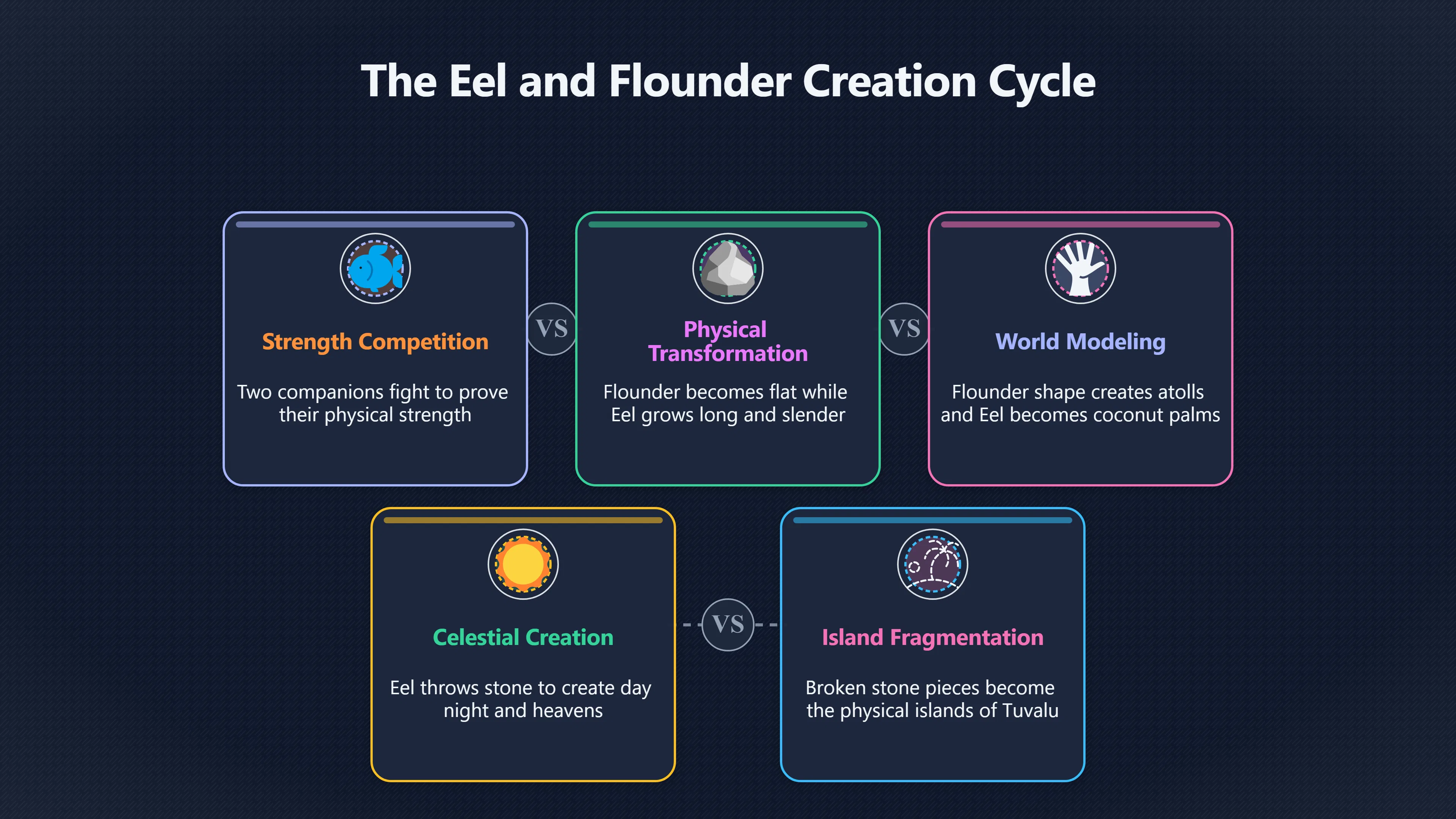
The most widely shared origin story across Tuvalu is known as the tale of the Eel and the Flounder (te Pusi mo te Ali). Although details differ between retellings, the core narrative is remarkably consistent.
According to the tradition, the Eel and the Flounder were once companions. After competing to prove their strength, the two fought. During the struggle the Flounder was crushed beneath a great stone, leaving it permanently broad and flat, while the Eel became long and slender as it escaped. Their transformed bodies became the model for the world that followed. The Flounder’s flattened shape became the pattern for Tuvalu’s low coral atolls, while the Eel’s long body became the form of the coconut palm, the tree on which traditional island life depended for food, fibre, timber and drink.[Wikipedia]WikipediaTuvaluan mythologyTuvaluan mythology
Many versions continue beyond this transformation. The Eel throws the great stone repeatedly into the sky, helping to create the cycle of day and night, the sea and the heavens. Finally the stone is broken into pieces that become the islands of Tuvalu themselves. The tale therefore explains not only landforms but also the structure of the wider world.[Wikipedia]WikipediaTuvaluan mythologyTuvaluan mythology
An intriguing cultural consequence of the myth is that moray eels acquired a sacred status in many communities. Because the Eel was regarded as an ancestral creator, eating moray eels became taboo in parts of Tuvalu, demonstrating how mythology influenced everyday behaviour as well as storytelling.[Wikipedia]WikipediaTuvaluan mythologyTuvaluan mythology
Island-by-island origin traditions
The Eel and the Flounder is often presented as the Tuvaluan creation story, but that simplification hides the remarkable diversity of local traditions. Every inhabited island preserves its own accounts of founders, migrations and sacred ancestors.
Several recurring themes appear across the archipelago:
- Funafuti and Vaitupu traditionally trace their principal founding ancestor to a giant or heroic figure arriving from Samoa, usually identified as Telematua (or a closely related name).[Wikipedia]WikipediaTuvaluan mythologyTuvaluan mythology
- Nanumea links its origins primarily to Tonga through the semi-supernatural ancestor Tefolaha, who is described in some traditions as partly human and partly spirit.[Wikipedia]WikipediaTuvaluan mythologyTuvaluan mythology
- Nanumaga preserves traditions involving a spirit associated with a sea serpent, alongside other accounts reflecting connections with both Tonga and Samoa.[Wikipedia]WikipediaTuvaluan mythologyTuvaluan mythology
- Nui tells of spirits raising its islets from beneath the sea before later ancestors arrived by canoe from Samoa.[Wikipedia]WikipediaTuvaluan mythologyTuvaluan mythology
- Niutao preserves traditions emphasising settlement from Samoa during the medieval period rather than a purely supernatural creation.[Wikipedia]WikipediaHistory of TuvaluHistory of Tuvalu
These accounts reveal that Tuvalu’s mythology combines supernatural creation with remembered migration. The islands are simultaneously products of mythic events and homes established by real ancestral voyagers whose journeys connected Samoa, Tonga and neighbouring parts of western Polynesia. Oral tradition therefore preserves cultural memory alongside sacred narrative.[Wikipedia]WikipediaTuvaluan mythologyTuvaluan mythology

Why the landscape itself became sacred
Creation stories in Tuvalu are unusually tied to visible features of the environment. The myths are not abstract accounts of distant gods but explanations for familiar things people encounter every day.
The country’s remarkably flat atolls become understandable through the body of the Flounder. Coconut palms cease to be ordinary plants and become descendants of a creator being. Individual rocks, reef passages and islets often acquire names linked to ancestors or legendary events, making geography itself into a record of history and myth.[Wikipedia]WikipediaTuvaluan mythologyTuvaluan mythology
This close relationship between narrative and place is one reason Tuvalu’s oral traditions have endured. The stories are continually reinforced by the landscape. Every coconut grove and every narrow coral island becomes a reminder of ancestral events rather than merely a physical resource.
UNESCO has highlighted this relationship by noting that Tuvalu’s cultural landscape depends heavily upon oral tradition, with sacred natural places and historically significant sites retaining importance long after the arrival of Christianity.[UNESCO]unesco.orgThe Pacific islands: so much more than just sun, sand and seaThe Pacific islands: so much more than just sun, sand and seaAugust 26, 2025…
Myth, migration and historical memory
For historians, these traditions are valuable because they preserve more than supernatural imagery. They also contain clues about how Tuvaluans understood their own origins.
Archaeology, linguistics and Polynesian navigation studies indicate that Tuvalu was settled through long-distance voyaging from western Polynesia, particularly Samoa and Tonga. The island traditions broadly reflect this pattern, although each community adapted the stories to emphasise its own ancestors and local landmarks. Rather than contradicting one another, migration traditions and creation myths often exist side by side.[Wikipedia]WikipediaHistory of TuvaluHistory of Tuvalu
One of the earliest detailed written records came in 1896–97, when geologist William J. Sollas documented oral histories from Funafuti during the Royal Society’s coral reef expedition. His account, based on testimony from Chief Erivara, records early kings, revered ancestors and the transformation of deceased figures into protective spirits. Although filtered through a colonial-era observer and translator, it remains one of the most important historical records of Tuvaluan oral tradition before missionary influence became overwhelming.[Nature]nature.comThe Legendary History of Funafuti, Ellice Group1 | NatureThe Legendary History of Funafuti, Ellice Group1 | Nature…

Why these stories matter in Tuvalu’s Fortean tradition
From a Fortean perspective, Tuvalu’s creation myths are unusual because the mystery lies not in an unexplained modern incident but in a landscape interpreted through extraordinary beings. There are no hidden monsters lurking beneath the reef in these stories. Instead, the reef itself is the evidence of myth.
Believers traditionally understand the stories as inherited truths about ancestry and place. Modern scholars generally interpret them as examples of geomythology and cultural memory: narratives that explain distinctive landscapes while reinforcing social identity and moral relationships with the environment. Neither approach requires treating the myths as geological fact to recognise their enduring importance.[Wikipedia]WikipediaTuvaluan mythologyTuvaluan mythology
The myths also illuminate why Tuvalu occupies a distinctive place in Pacific folklore. On islands where the highest ground often stands only a few metres above sea level, creation is inseparable from survival. A flat reef, a coconut tree and a named stretch of coral are not merely natural features. They are reminders that, in Tuvaluan tradition, the land itself is descended from living beings whose stories continue to shape the nation’s identity.
Amazon book picks
Further Reading
Books and field guides related to How Did an Eel and a Flounder Create Tuvalu?. Use these as the next step if you want deeper reading beyond the article.

Polynesian Mythology and Ancient Traditional History of the N...
First published 2005.
eBay marketplace picks
Marketplace Samples
Live-tested eBay searches with available results related to this page.



Endnotes
1.
Source: Wikipedia
Title: Tuvaluan mythology
Link:https://en.wikipedia.org/wiki/Tuvaluan_mythology
2.
Source: Wikipedia
Title: History of Tuvalu
Link:https://en.wikipedia.org/wiki/History_of_Tuvalu
3.
Source: nature.com
Title: The Legendary History of Funafuti, Ellice Group1 | Nature
Link:https://www.nature.com/articles/055353a0
Source snippet
The Legendary History of Funafuti, Ellice Group1 | Nature...
4.
Source: unesco.org
Title: The Pacific islands: so much more than just sun, sand and sea
Link:https://www.unesco.org/en/articles/pacific-islands-so-much-more-just-sun-sand-and-sea
Source snippet
The Pacific islands: so much more than just sun, sand and seaAugust 26, 2025...
Published: August 26, 2025
5.
Source: Wikipedia
Link:https://en.wikipedia.org/wiki/Funafuti
6.
Source: Wikipedia
Link:https://en.wikipedia.org/wiki/Tuvalu
7.
Source: whc.unesco.org
Link:https://whc.unesco.org/en/tentativelists/6707/
Source snippet
Pacific atoll-island cultural landscape of Tuvalu - UNESCO World Heritage CentreJanuary 24, 2024 — THE PACIFIC ATOLL-ISLAND CULTURAL LAND...
Published: January 24, 2024
8.
Source: youtube.com
Link:https://www.youtube.com/watch?v=WM1WhySdkaU
Source snippet
Te Pusi mo te Ali — Tuvalu Creation Myth (Eel & Flounder) | The Mythic Vault...
9.
Source: geo.wikisort.org
Link:https://geo.wikisort.org/island/en/Island/Tuvalu
Source snippet
Main article: History of Tuvalu See also: Timeline of the history of Tuvalu and Outline of Tuvalu PREHISTORY The origins of the people of...
10.
Source: smoketreemanor.com
Link:https://www.smoketreemanor.com/tuvalu/2/
Source snippet
Page 2 of 8 - Smoke Tree ManorTUVALU Flags / childhood, economy, flags, geography, history, islands, pacific ocean, Pacific Ocean Islands...
Additional References
11.
Source: everything.explained.today
Link:https://everything.explained.today/History_of_Tuvalu/
Source snippet
of Tuvalu explainedHISTORY OF TUVALU EXPLAINED The first inhabitants of Tuvalu were Polynesians, so the origins of the people of Tuvalu c...
12.
Source: kolibri.teacherinabox.org.au
Link:https://kolibri.teacherinabox.org.au/modules/en-wikipedia_for_schools-static/wp/t/Tuvalu.htm
Source snippet
Therefore the origins of the people of Tuvalu are addressed in the theories regarding the spread of humans...
13.
Source: science.nasa.gov
Title: funafuti atoll tuvalu 153047
Link:https://science.nasa.gov/earth/earth-observatory/funafuti-atoll-tuvalu-153047/
Source snippet
Atoll, Tuvalu - NASA ScienceJuly 24, 2024 — Earth Observatory 4 min read FUNAFUTI ATOLL, TUVALU Image of the Day for July 24, 2024 The Pa...
Published: July 24, 2024
14.
Source: traveligo.com
Title: During pre-European-con
Link:https://www.traveligo.com/travel/australia-and-pacific-ocean/tuvalu/history-language-culture
Source snippet
History, Language & Culture TuvaluHISTORY, LANGUAGE & CULTURE TUVALU The origins of the people of Tuvalu are addressed in the theories re...
15.
Source: youtube.com
Link:https://www.youtube.com/watch?v=MxbBDvMm4wY
Source snippet
TUVALU: THE COUNTRY THAT IS DISAPPEARING BENEATH THE SEA...
16.
Source: youtube.com
Title: Tuvalu A Journey Through Time and Tide
Link:https://www.youtube.com/watch?v=cJo7o_uLOcw
Source snippet
The History of Tuvalu / From Ancient Polynesian Voyagers to Climate Change Challenges...
17.
Source: youtube.com
Title: Te Pusi mo te Ali — Tuvalu Creation Myth (Eel & Flounder) | The Mythic Vault
Link:https://www.youtube.com/watch?v=y2NEi8NnFVg
Source snippet
Tuvalu A Journey Through Time and Tide...
18.
Source: es.scribd.com
Title: Tuvalu 2
Link:https://es.scribd.com/document/393721224/Tuvalu-2
Source snippet
Eight of Tuvalu's nine islands were inhabited at this ti...
19.
Source: youtube.com
Title: TUVALU: THE COUNTRY THAT IS DISAPPEARING BENEATH THE SEA
Link:https://www.youtube.com/watch?v=swBF-fFfLjo
Topic Tree