Within Yemen Strange
Why Does Socotra Look Like a Legend?
Socotra's strange trees and red resin show how rare ecology can look like myth before any monster enters the story.
On this page
- The island landscape that invites wonder
- Blood red resin and origin stories
- Conservation, rarity and modern myth making
Page outline Jump by section
Introduction
Socotra’s dragon’s-blood trees are one of the clearest examples of how an extraordinary natural landscape can generate legends without needing any hidden monsters. Part of Yemen’s Socotra Archipelago, these umbrella-shaped trees produce a deep red resin that has fascinated travellers for thousands of years. Their strange appearance, remarkable isolation and crimson “bleeding” sap encouraged stories about dragons, giant beasts and magical healing long before modern botany explained what the trees actually are. At the same time, the island’s unusual ecology has become so distinctive that it is now protected as a UNESCO World Heritage Site, even as scientists warn that its most famous tree faces an uncertain future.[unesco.org]unesco.orgnature and people socotra archipelagoNature and people in the Socotra Archipelago | UNESCOJanuary 1, 2022…
Within Yemen’s wider catalogue of strange places and uncanny traditions, Socotra occupies a different niche. Rather than being famous for ghost stories or unexplained sightings, it shows how an environment can appear almost mythical simply because evolution has produced life unlike almost anywhere else on Earth.
Why does Socotra look like a legend?
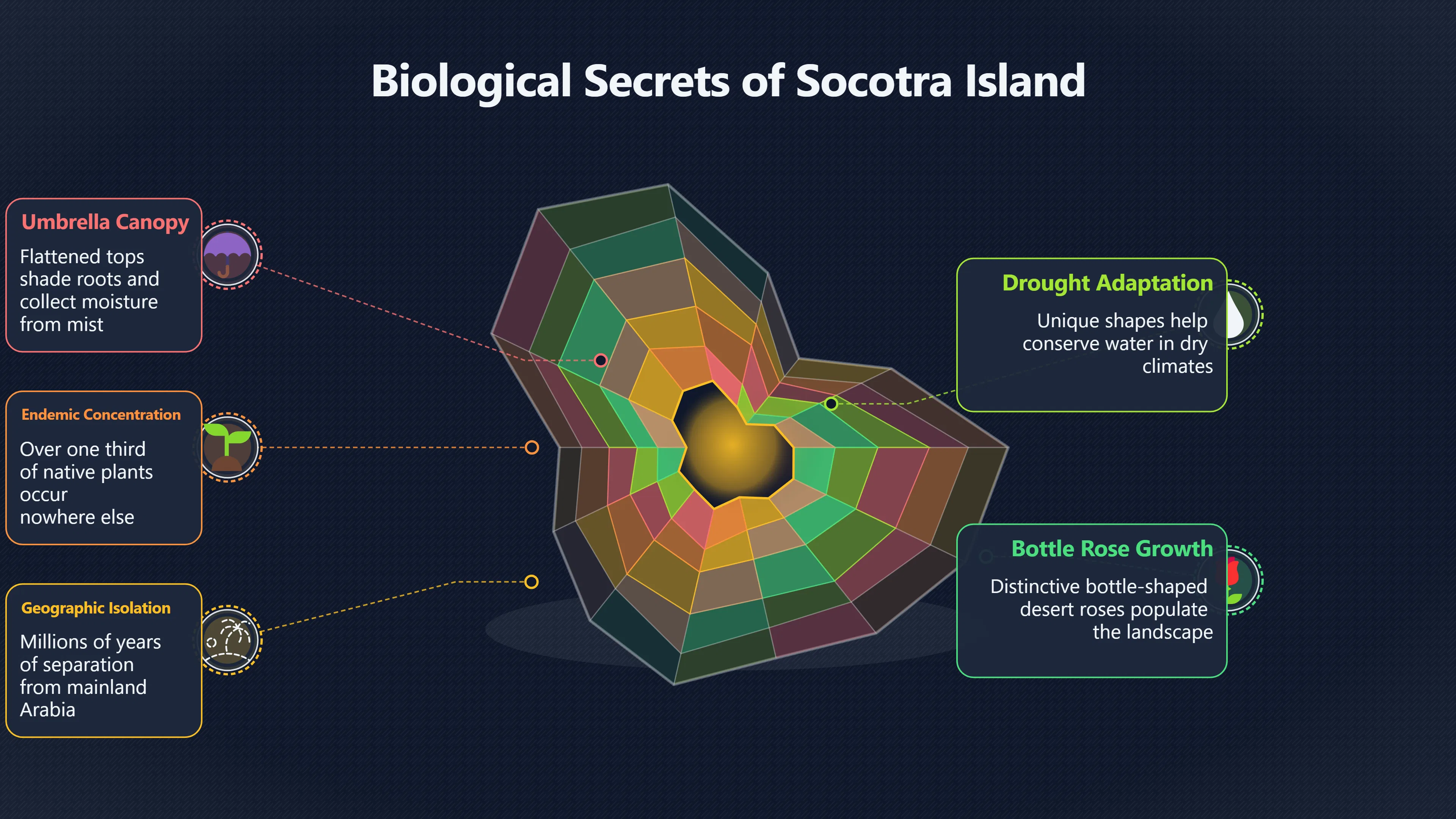
Socotra lies in the Arabian Sea, separated from mainland Arabia for millions of years. That long isolation allowed plants and animals to evolve independently, producing one of the world’s highest concentrations of endemic species. More than a third of its native plant species occur nowhere else. The dragon’s-blood tree (Dracaena cinnabari) has become the emblem of this extraordinary landscape.[UNESCO]unesco.orgnature and people socotra archipelagoNature and people in the Socotra Archipelago | UNESCOJanuary 1, 2022…
Its appearance is immediately striking. Mature trees develop a dense, flattened canopy resembling an enormous green umbrella balanced on a single trunk. This shape is not decorative but practical. It shades the roots from intense sunlight and helps collect moisture from mist and light rain, an important adaptation in Socotra’s dry climate. What looks fantastically artificial is actually a highly effective survival strategy.[MDPI]mdpi.comSustainable Land Use Management Needed to Conserve the Dragon’s Blood Tree of Socotra Island, a Vulnerable Endemic Umbrella Species…
To many visitors, however, the island scarcely resembles familiar desert scenery. Alongside dragon’s-blood trees stand bottle-shaped desert roses, cucumber trees and unusual frankincense species, creating landscapes that modern photographers often compare with fantasy films or alien planets. Such comparisons are contemporary echoes of much older traditions in which remote islands became natural homes for marvels.
Blood-red resin and the stories it inspired
The tree earns its name from the dark crimson resin released when the bark is cut. Once exposed to air, the sap hardens into a red substance long traded around the ancient Mediterranean and Middle East.
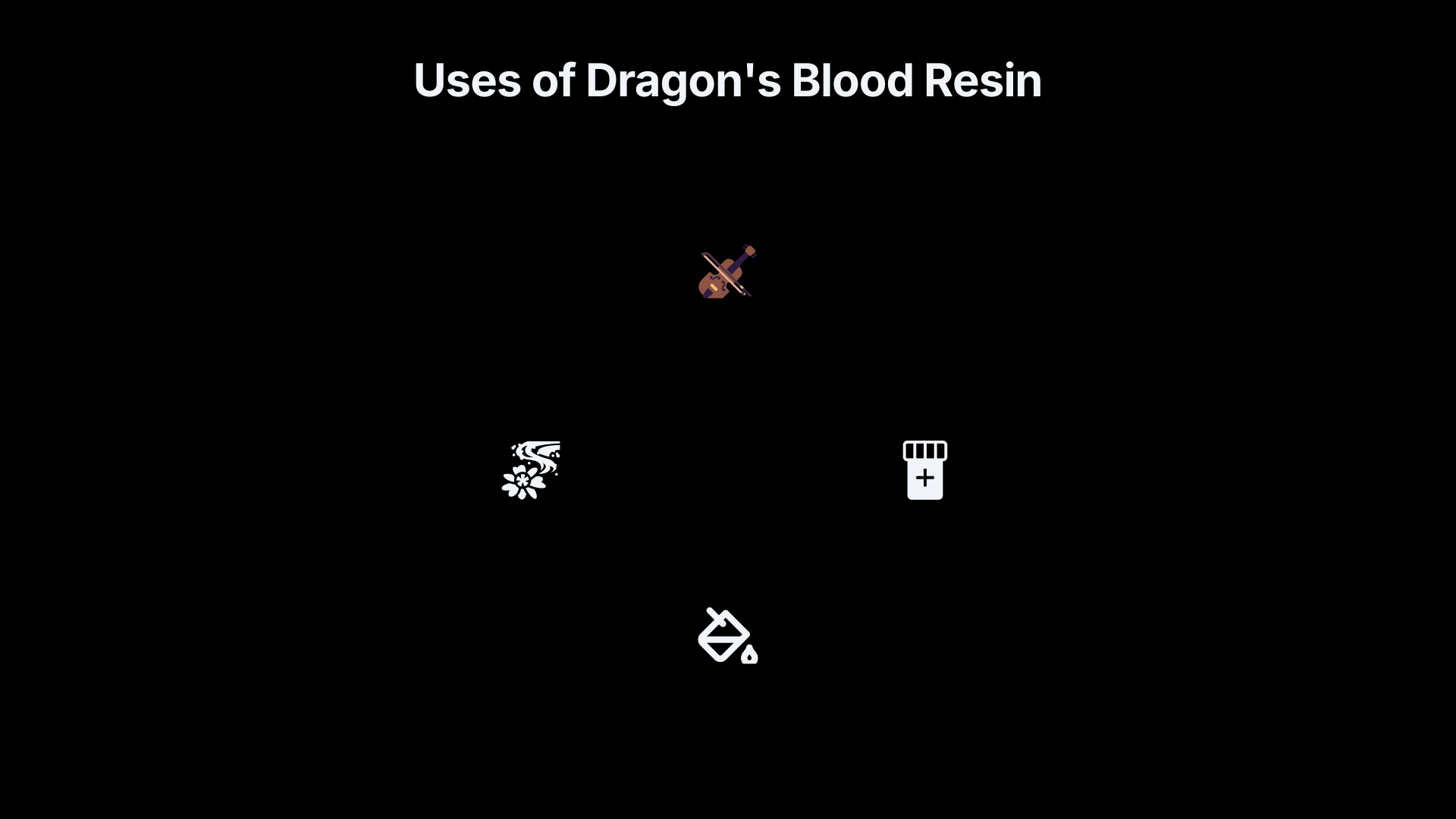
For centuries this resin was valued for many purposes, including dyes, varnishes, medicines and incense. Historical sources describe its use in treating wounds and digestive ailments, while craftsmen prized it as a pigment and finish for woodwork and musical instruments. Modern scientific research continues to investigate its chemical composition, although traditional medicinal claims should not be confused with proven clinical effectiveness.[MDPI]mdpi.comLocal Management System of Dragon’s Blood Tree (Dracaena cinnabari Balf. f.) Resin in Firmihin Forest, Socotra Island, Yemen…
The dramatic colour naturally encouraged mythical explanations. Across the ancient world, “dragon’s blood” became associated with stories in which dragons or giant serpents died in combat and their blood soaked into the earth, giving rise to these remarkable trees. Different versions circulated through Greek, Roman and later medieval traditions. None originated from a single authoritative tale; instead, the resin’s appearance invited repeated storytelling wherever it entered trade networks.
This distinction matters for understanding Socotra’s Fortean appeal. The legends did not emerge because anyone genuinely discovered dragon blood. Rather, an unusual natural product encouraged people to interpret an unfamiliar landscape through the language of myth.
The island landscape that invites wonder
Socotra accumulated an unusually rich reputation among sailors, merchants and travellers. Ancient and medieval writers described it as an island of rare perfumes, medicinal plants and remarkable natural curiosities. Later travel literature added tales of hidden valleys, strange creatures and isolated communities living among extraordinary trees.
Some traditions portrayed Socotra as an island inhabited by supernatural beings or spirits, while others treated it as a place where the normal rules of nature seemed suspended. Such stories reflect a common pattern in maritime folklore: distant islands often became canvases for marvels precisely because few outsiders could verify what lay there.
Unlike many legendary islands, however, Socotra genuinely possesses biological features that appear improbable to first-time visitors. The island therefore occupies an unusual position where reality continually reinforces the atmosphere that once generated myth.
How folklore and science meet
Dragon’s-blood trees demonstrate an important Fortean principle: remarkable observations do not require supernatural explanations to become culturally powerful.
Believers in traditional stories may regard the crimson resin as evidence of ancient events or symbolic truths. Botanists instead explain it as a protective resin produced by the tree after injury. Evolution explains the umbrella canopy through adaptation to drought, sunlight and water conservation rather than mysterious forces.[MDPI]mdpi.comSustainable Land Use Management Needed to Conserve the Dragon’s Blood Tree of Socotra Island, a Vulnerable Endemic Umbrella Species…
Neither perspective entirely replaces the other. Scientific explanations account for the tree’s biology, while folklore explains why generations of people found these trees emotionally and imaginatively compelling. The myths are part of the cultural history surrounding a genuinely extraordinary species rather than failed attempts at science.

Conservation, rarity and modern myth-making
Today’s greatest mystery surrounding the dragon’s-blood tree is not its origin story but its future.
Researchers have found that many surviving populations consist largely of mature trees, with relatively few young specimens replacing them. Grazing by goats limits natural regeneration, while stronger cyclones, changing rainfall patterns and habitat disturbance add further pressure. Several studies warn that some populations could decline dramatically unless active conservation continues.[MDPI]mdpi.comSustainable Land Use Management Needed to Conserve the Dragon’s Blood Tree of Socotra Island, a Vulnerable Endemic Umbrella Species…
UNESCO recognises the Socotra Archipelago for its exceptional biodiversity, and local conservation projects increasingly combine traditional ecological knowledge with scientific management. Protective fencing, nurseries and careful resin harvesting aim to preserve both the species and the cultural practices associated with it.[UNESCO]unesco.orgnature and people socotra archipelagoNature and people in the Socotra Archipelago | UNESCOJanuary 1, 2022…
Ironically, the internet has created a new generation of legends. Photographs of the dragon’s-blood forests regularly circulate online under captions describing Socotra as “Earth’s most alien island”, “the lost world” or “the island from another planet”. These descriptions exaggerate for effect, yet they echo centuries of travellers portraying the archipelago as somewhere beyond ordinary experience.
Why the dragon’s-blood tree remains a Fortean icon
Socotra’s dragon’s-blood trees occupy a distinctive place in Yemen’s strange cultural landscape because they blur the boundary between natural history and myth. Their bizarre silhouette, blood-red resin and isolated habitat encouraged stories that have endured from antiquity into the social media age.
Unlike many Fortean subjects, the central mystery is not whether the trees exist—they plainly do—but why something so unusual evolved at all, and how people have repeatedly interpreted that rarity through legends of dragons, spirits and enchanted islands. The science makes the trees no less astonishing. If anything, understanding that such an extraordinary landscape arose through evolution and isolation makes Socotra’s genuine story every bit as memorable as the myths it inspired.
Amazon book picks
Further Reading
Books and field guides related to Why Does Socotra Look Like a Legend?. Use these as the next step if you want deeper reading beyond the article.

The Song of the Dodo
Explains why isolated islands evolve extraordinary species like Socotra's flora.

Arabia Felix, the Danish expedition of
First published 1964. Subjects: Description and travel.
eBay marketplace picks
Marketplace Samples
Live-tested eBay searches with available results related to this page.


Endnotes
1.
Source: unesco.org
Title: nature and people socotra archipelago
Link:https://www.unesco.org/en/articles/nature-and-people-socotra-archipelago?hub=891
Source snippet
Nature and people in the Socotra Archipelago | UNESCOJanuary 1, 2022...
Published: January 1, 2022
2.
Source: mdpi.com
Link:https://www.mdpi.com/2071-1050/11/13/3557
Source snippet
Sustainable Land Use Management Needed to Conserve the Dragon’s Blood Tree of Socotra Island, a Vulnerable Endemic Umbrella Species...
3.
Source: mdpi.com
Link:https://www.mdpi.com/1999-4907/11/4/389
Source snippet
Local Management System of Dragon’s Blood Tree (Dracaena cinnabari Balf. f.) Resin in Firmihin Forest, Socotra Island, Yemen...
4.
Source: unesco.org
Title: Unwelcome guests: Socotra confronted with invasive aliens | UNESCO
Link:https://www.unesco.org/en/articles/unwelcome-guests-socotra-confronted-invasive-aliens
Source snippet
Unwelcome guests: Socotra confronted with invasive aliens | UNESCO...
5.
Source: socotra.info
Title: Dragon’s blood (Dracaena Cinnabari)
Link:https://socotra.info/dragons-blood-resin-from-socotra.html
Source snippet
a unique resin from the island of SocotraMay 26, 2012 — DRAGON'S BLOOD (DRACAENA CINNABARI) - A UNIQUE RESIN FROM SOCOTRA Image Dragon's...
Published: May 26, 2012
6.
Source: whc.unesco.org
Title: Download File file_download Title Dragon’s Blood trees at Socotra Archipela
Link:https://whc.unesco.org/en/documents/136995
Source snippet
World Heritage Centre - Document - Dragon’s Blood trees at Socotra Archipelago (Yemen) are included on the IUCN Red List, indicated as a...
7.
Source: unesco.org
Title: It is recognized as a regional centre
Link:https://www.unesco.org/en/mab/socotra-archipelago?hub=66369
Source snippet
Socotra Archipelago - Man and the Biosphere Programme (MAB)SOCOTRA ARCHIPELAGO General information The Socotra Archipelago is located off...
8.
Source: socotra.cz
Title: From a botanical perspective, the Socotr
Link:https://www.socotra.cz/en/endemic-flora
Source snippet
Things to do / Endemic Flora | SOCOTRA.CZENDEMIC FLORA FLORA OF SOCOTRA ISLAND Socotra The island’s entire living nature is unique, large...
9.
Source: youtube.com
Title: The Hidden World of Socotra, Yemen
Link:https://www.youtube.com/watch?v=xSAW7pmG7JA
Source snippet
Dragon Blood - A Photographer's Journey to Socotra, Yemen...
10.
Source: youtube.com
Title: Dragon Blood
Link:https://www.youtube.com/watch?v=y-ckI811gII
11.
Source: toursocotra.com
Link:https://toursocotra.com/socotra-myths/
Source snippet
Myths | Stories of the Dragon's Blood Tree & Beyond | Tour SocotraMYTHS AND LEGENDS * Socotra, Yemen is a land of mystique and wonder, st...
Additional References
12.
Source: sciencedirect.com
Link:https://www.sciencedirect.com/science/article/abs/pii/S1386142501006023
Source snippet
SPECTROCHIMICA ACTA PART A: MOLECULAR AND BIOMOLECULAR SPECTROSCOPY Volume 57, Issue 14, December 2001, Pages 2831-2842 RAMA...
Published: December 2001
13.
Source: sciencedirect.com
Link:https://www.sciencedirect.com/science/article/pii/S1617138116301959
Source snippet
February 1, 2017 — JOURNAL FOR NATURE CONSERVATION Volume 35, February 2017, Pages 20-23 THE BEAUTY AND THE BEAST: ENDEMIC M...
Published: February 1, 2017
14.
Source: sciencedirect.com
Link:https://www.sciencedirect.com/science/article/abs/pii/B9780443222146000107
Source snippet
STUDIES IN NATURAL PRODUCTS CHEMISTRY Volume 83, 2024, Pages 431-463 CHAPTER 14 - TRADITIONAL USE OF DRACAENA CINNABARI, IMP...
15.
Source: cambridge.org
Link:https://www.cambridge.org/core/journals/earth-and-environmental-science-transactions-of-royal-society-of-edinburgh/article/abs/xxviithe-dragons-blood-tree-of-socotra-dracaena-cinnabari-balf-fil/ED0BE863F4C0C360B0BA2EFA071EF832
Source snippet
fil.) | Earth and Environmental Science Transactions of The Royal Society of Edinburgh | Cambridge CoreJuly 6, 2012 — XXVII.—THE DRAGON'S...
Published: July 6, 2012
16.
Source: ouci.dntb.gov.ua
Link:https://ouci.dntb.gov.ua/en/works/4VwBdXWl/
Source snippet
dntb.gov.uaDragon’s Blood Tree (<i>Dracaena cinnabari</i>): A Cenozoic RelictDRAGON’S BLOOD TREE (<I>DRACAENA CINNABARI</I>): A CENOZOIC...
17.
Source: cntraveler.com
Title: One such spot is the island of Socotra, part of the Republic of Yemen
Link:https://www.cntraveler.com/stories/2010-10-05/in-the-land-of-the-dragon-s-blood-tree
Source snippet
Socotra Island: Exploring the Land of the Dragon's Blood Tree | Condé Nast TravelerOctober 5, 2010 — SOCOTRA ISLAND: EXPLORING THE LAND O...
Published: October 5, 2010
18.
Source: nationalgeographic.com
Title: Can Socotra, Yemen’s ‘Dragon’s Blood Island,’ be saved?
Link:https://www.nationalgeographic.com/environment/article/socotra-yemen-biodiversity-photography
Source snippet
National GeographicNovember 13, 2018 — Image: a dragon's blood tree * ENVIRONMENT * NEWS CAN SOCOTRA, YEMEN’S ‘DRAGON'S BLOOD ISLAND,'...
Published: November 13, 2018
19.
Source: apnews.com
Title: AP News These surreal trees survived for centuries
Link:https://apnews.com/article/3968466a5ce2653e64a59b545ef94660
Source snippet
Scientists worry for their futureOn the island of Socotra, Yemen, the iconic dragon's blood tree faces a dire future due to intensifying...
20.
Source: nationalgeographic.com
Title: Conservationists fear that poor reproductio
Link:https://www.nationalgeographic.com/magazine/article/socotra
Source snippet
Where the Weird Things Are | National GeographicImage: a dragon's blood tree in Socotra Botanical icon of Socotra, the dragon’s blood tre...
21.
Source: pmc.ncbi.nlm.nih.gov
Link:https://pmc.ncbi.nlm.nih.gov/articles/PMC8324360/
Source snippet
Received 2021 Apr 12; Accepted 2021 Jul 14; Collection date 2021. Copyright © 2021 Yahya S. Al-Awthan and Omar Salem Bahattab. This is...
Topic Tree