Within Tuvalu Strange
Why Do Tuvalu's Islands Tell Different Supernatural Stories?
Different islands preserve distinctive stories of sea-serpents, spirit founders, and supernatural ancestors tied to local places.
On this page
- Sea serpent founders
- Half spirit ancestors
- Comparing island traditions
Page outline Jump by section
Introduction
Tuvalu does not have a single national legend explaining how every island came to be. Instead, each inhabited island preserves its own founding traditions, often blending remembered migrations with supernatural ancestors, sea creatures and spirits. That diversity is one of the most distinctive features of Tuvaluan folklore. Some islands trace their origins to voyagers from Samoa or Tonga, while others describe founders who were only partly human, or spirits that emerged from the sea itself. These traditions are not simply colourful stories. They explain why particular places are sacred, why certain animals are treated with respect, and why neighbouring islands sometimes preserve strikingly different identities despite sharing a common culture. Modern historians and anthropologists generally read them as a mixture of oral history, symbolic geography and religious tradition rather than literal history, yet they remain central to understanding Tuvalu’s cultural landscape.[Wikipedia]WikipediaTuvaluan mythologyTuvaluan mythology
Sea-serpent founders
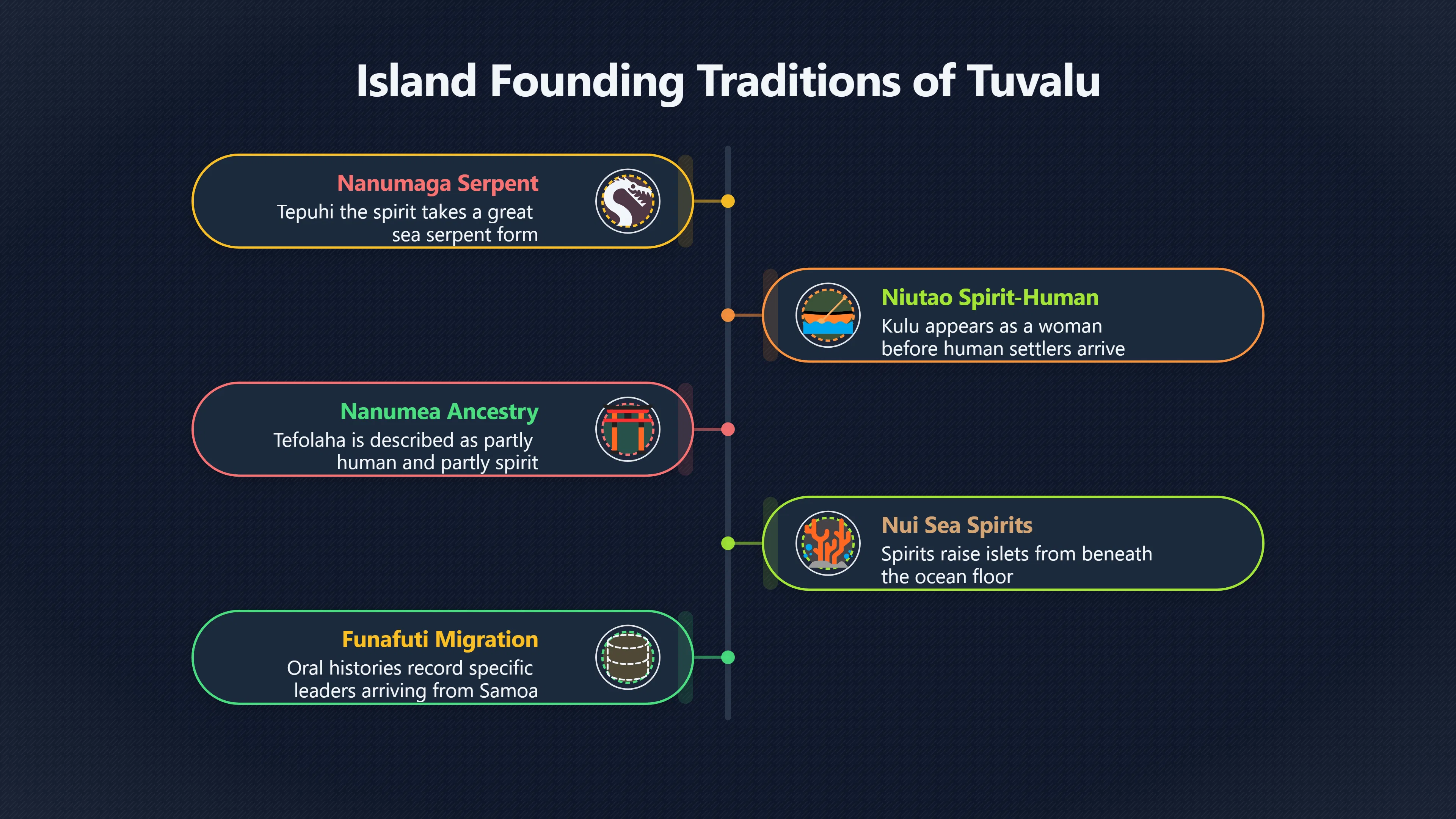
The most dramatic of Tuvalu’s island-specific founder traditions belongs to Nanumaga. Local accounts describe the founding ancestor Tepuhi not as an ordinary human but as a spirit taking the form of a great sea serpent. Rather than being portrayed as a monster threatening people, the serpent functions as a culture founder whose arrival establishes the island’s earliest community. Other versions also connect Nanumaga’s earliest settlement with later migrations from Tonga or Samoa, showing how supernatural and historical traditions became intertwined rather than existing as separate stories.[Wikipedia]WikipediaTuvaluan mythologyTuvaluan mythology
This distinction is important. In European folklore, sea serpents are often frightening unknown creatures. In Nanumaga’s tradition, the serpent belongs to a wider Polynesian pattern in which powerful marine beings are respected ancestors, guardians or creators. The sea, which provided transport, food and danger in equal measure, naturally became the setting for stories in which extraordinary beings crossed between the human and spirit worlds.
The serpent founder also illustrates how oral traditions preserve multiple layers of meaning. Modern researchers see at least three possible functions operating at once:
- a symbolic explanation for the island’s sacred origins;
- a memory of ancient migration expressed through mythic language;
- an assertion that the island possesses its own unique ancestry distinct from neighbouring atolls.
None of these interpretations excludes the others, and local traditions rarely separate history from sacred narrative as sharply as modern readers often expect.[Wikipedia]WikipediaTuvaluan mythologyTuvaluan mythology
Half-spirit ancestors
Not every island attributes its beginnings to animal founders. On Niutao, traditions describe the earliest inhabitants as beings who were both spirit and human. Their leader, Kulu, is said to have taken the form of a woman before later canoe voyagers from Samoa established the first recognisably human settlement during the medieval period.[Wikipedia]WikipediaTuvaluan mythologyTuvaluan mythology
Stories like this blur the boundary between mythological time and remembered history. Rather than suggesting two incompatible accounts, they create a sequence in which an island first belongs to supernatural beings before becoming the home of ordinary people. Comparable patterns appear elsewhere across Polynesia, where founding spirits often prepare land for later human communities.
The traditions also reinforce the idea that ancestry extends beyond biological descent. In many early Tuvaluan belief systems, spirits remained active participants in community life, protecting places, influencing success at sea and maintaining links between the living and earlier generations. Nineteenth-century missionary and expedition records describe widespread ancestor veneration and ritual specialists who mediated between people and spirits before Christianity became dominant.[Wikipedia]WikipediaHistory of TuvaluHistory of Tuvalu
Why neighbouring islands tell different stories
One striking feature of Tuvaluan mythology is that no single founding narrative replaced the others. Instead, each island maintained its own identity.
Examples include:
- Nanumea – traces its principal ancestor, Tefolaha, to Tonga; he is described as partly human and partly spirit.
- Funafuti and Vaitupu – identify founding ancestors arriving from Samoa, with local oral histories recording particular named leaders rather than animal founders.
- Nukufetau – preserves traditions connecting its earliest ancestors with Tonga.
- Nui – combines a story of spirits raising the islets from beneath the sea with later human settlers arriving from Samoa.
- Niutao – remembers half-spirit inhabitants followed by Samoan migrants.
- Nanumaga – centres on the sea-serpent spirit Tepuhi while also preserving migration traditions.[Wikipedia]WikipediaTuvaluan mythologyTuvaluan mythology
To modern historians, these differences probably reflect centuries of independent settlement, regional voyaging and local political identity. Tuvalu’s islands were connected by regular canoe travel, yet each community maintained its own chiefly traditions and sacred places. Oral histories therefore evolved independently while still sharing broad Polynesian themes.
What makes these traditions Fortean?
From a Fortean perspective, the fascination lies less in proving supernatural beings existed than in how consistently extraordinary founders appear across different islands.
The stories include recurring motifs:
- ancestors who are simultaneously human and spirit;
- powerful sea creatures acting as founders rather than monsters;
- spirits physically creating islands or raising land from the ocean;
- sacred landscapes whose names preserve encounters with supernatural beings.
Unlike modern reports of mysterious animals, these traditions belong to sacred history. They were never presented merely as strange sightings but as explanations for why communities occupied particular places and why those places deserved ritual respect.
That distinction matters because it separates Tuvalu’s folklore from sensational cryptozoology. The sea-serpent of Nanumaga is not described as an unidentified animal awaiting scientific discovery. It functions within a religious and cultural worldview in which extraordinary beings establish social order, ancestry and identity.[Wikipedia]WikipediaTuvaluan mythologyTuvaluan mythology
How scholars interpret the island legends today
Researchers generally approach these narratives as layered traditions rather than historical records in the modern sense. Archaeology, linguistics and comparative Polynesian studies support repeated migration between Samoa, Tonga and Tuvalu before European contact, while oral traditions preserve those movements in symbolic form. Supernatural founders may therefore encode memories of real voyages, political alliances or distinctive local identities that became increasingly mythologised over generations.[Wikipedia]WikipediaOpen source on wikipedia.org.
At the same time, heritage specialists emphasise that oral tradition remains an authoritative way in which many Tuvaluans understand place and ancestry. UNESCO’s assessment of Tuvalu’s proposed World Heritage cultural landscape specifically notes that each island retains distinctive traditions and spiritually significant places that long predate Christian missionisation. Rather than treating these accounts as curiosities displaced by archaeology, contemporary scholarship increasingly recognises them as an essential part of the islands’ cultural history.[UNESCO World Heritage Centre]whc.unesco.orgWorld Heritage Centre The Pacific atoll-island cultural landscape of TuvaluUNESCO World Heritage CentreThe Pacific atoll-island cultural landscape of Tuvalu - UNESCO World Heritage Centre…
Amazon book picks
Further Reading
Books and field guides related to Why Do Tuvalu's Islands Tell Different Supernatural Stories?. Use these as the next step if you want deeper reading beyond the article.

Polynesian Mythology and Ancient Traditional History of the N...
First published 2005.
eBay marketplace picks
Marketplace Samples
Live-tested eBay searches with available results related to this page.

Endnotes
1.
Source: Wikipedia
Title: Tuvaluan mythology
Link:https://en.wikipedia.org/wiki/Tuvaluan_mythology
2.
Source: whc.unesco.org
Title: World Heritage Centre The Pacific atoll-island cultural landscape of Tuvalu
Link:https://whc.unesco.org/en/tentativelists/6707/
Source snippet
UNESCO World Heritage CentreThe Pacific atoll-island cultural landscape of Tuvalu - UNESCO World Heritage Centre...
3.
Source: Wikipedia
Title: History of Tuvalu
Link:https://en.wikipedia.org/wiki/History_of_Tuvalu
4.
Source: Wikipedia
Link:https://en.wikipedia.org/wiki/Tuvalu
5.
Source: Wikipedia
Link:https://en.wikipedia.org/wiki/Funafuti
6.
Source: wp.mujica.org
Link:https://www.wp.mujica.org/wp/t/Tuvalu.htm
Source snippet
OF TUVALU PRE-HISTORY AND HISTORY The first inhabitants of Tuvalu were Polynesians. Therefore the origins of the people of Tuvalu are add...
Additional References
7.
Source: teara.govt.nz
Link:https://teara.govt.nz/en/tangaroa-the-sea
Source snippet
Tangaroa – the sea | Te Ara Encyclopedia of New ZealandJune 12, 2006 — STORY: TANGAROA – THE SEA In Māori culture the sea is often consid...
Published: June 12, 2006
8.
Source: nps.gov
Title: The Samoan Creation Legend
Link:https://www.nps.gov/npsa/learn/historyculture/legendpo.htm
Source snippet
National Park Service)September 30, 2024 — THE SAMOAN CREATION LEGEND Image Si'u Point, a good place to view the south coast of Ta'u. NPS...
Published: September 30, 2024
9.
Source: mythicremembering.com
Title: Tongan Myths and Legends by Oral Tradition
Link:https://mythicremembering.com/books/tongan-myths-and-legends/
Source snippet
Pacific Mythology | Mythic RememberingTONGAN MYTHS AND LEGENDS by Oral Tradition Also known as: Tongan Folktales, Legends of Tonga Image...
10.
Source: fabulahub.com
Title: The first rains fell differe
Link:https://fabulahub.com/en/story/legend-two-brothers-and-great-serpent/sid-2558
Source snippet
The Legend of the Two Brothers and the Great Serpent | FijiOctober 15, 2025 — FROM SCALES TO SOIL: THE MAKING OF PEOPLE AND PRACTICES Aft...
Published: October 15, 2025
11.
Source: mexicohistorico.com
Title: These narratives serve as
Link:https://www.mexicohistorico.com/paginas/the-oral-traditions-of-tuvalu-a-cultural-exploration-c7de4c8c.html
Source snippet
The Oral Traditions of Tuvalu: A Cultural ExplorationEXPLORING THE THEMES AND NARRATIVES Tuvalu's oral traditions are a rich tapestry of...
12.
Source: wallis-futuna.travel
Link:https://www.wallis-futuna.travel/en/discover-our-islands/traditional-skills-crafts
Source snippet
Traditional skills & crafts - Tourisme à Wallis et FutunaTALES AND LEGENDS When homes in Wallis and Futuna had no television or internet...
13.
Source: traveligo.com
Title: During pre-European-con
Link:https://www.traveligo.com/travel/australia-and-pacific-ocean/tuvalu/history-language-culture
Source snippet
History, Language & Culture TuvaluHISTORY, LANGUAGE & CULTURE TUVALU The origins of the people of Tuvalu are addressed in the theories re...
14.
Source: youtube.com
Title: Tuvalu: The Country That Is Disappearing Beneath The Sea
Link:https://www.youtube.com/watch?v=swBF-fFfLjo
Source snippet
Te Pusi mo te Ali — Tuvalu Creation Myth (Eel & Flounder) | The Mythic Vault...
15.
Source: everything.explained.today
Title: History of Tuvalu
Link:https://everything.explained.today/History_of_Tuvalu/
Source snippet
of Tuvalu explainedPRE-CHRISTIAN BELIEFS Laumua Kofe (1983) describes the objects of worship as varying from island to island, although a...
16.
Source: jarniascyril.com
Link:https://www.jarniascyril.com/expatriation/expatriate-installation-tuvalu-complete-guide/history-of-the-country-in-tuvalu/
Source snippet
History of Tuvalu: From Polynesian Canoes to a Nation Threatened by the SeaMay 8, 2026 — FROM POLYNESIAN ORIGINS TO THE “EIGHT ISLANDS TH...
Published: May 8, 2026
Topic Tree