Within Bolivia Weird
Are Bolivia's Ruins Stranger Without Aliens?
The real puzzle of Tiwanaku is not alien technology, but damaged architecture, Andean engineering and centuries of mythmaking.
On this page
- What archaeology says about Tiwanaku and Puma Punku
- Why precision stonework attracts fringe claims
- Samaipata and the landing pad myth
Page outline Jump by section
Introduction
Bolivia’s ruins at Tiwanaku and Puma Punku are among the world’s most frequently cited “ancient mystery” sites. Television documentaries, bestselling books and internet videos have claimed that their precisely cut stone blocks are too advanced for pre-Columbian builders, suggesting everything from lost super-civilisations to extraterrestrial engineers. Yet the genuine archaeological story is both stranger and more convincing. The monuments survive only as damaged fragments of a once much larger ceremonial landscape, many stones have been moved from their original positions, and decades of excavation, surveying and experimental archaeology have shown that the Tiwanaku civilisation possessed sophisticated engineering skills entirely consistent with human achievement. The real mystery is not whether aliens built the site, but how centuries of destruction, misunderstanding and modern mythmaking transformed remarkable Andean architecture into one of the world’s favourite pseudoarchaeological stories.[Wikipedia]WikipediaOpen source on wikipedia.org.
What archaeology says about Tiwanaku and Puma Punku
Tiwanaku flourished on the southern shore of Lake Titicaca between roughly the sixth and eleventh centuries AD, becoming one of the most influential states in the central Andes long before the Inca Empire. Puma Punku was one monumental complex within that wider ceremonial city rather than a separate civilisation. Archaeological dating, excavation and architectural analysis place its construction firmly within the Tiwanaku cultural tradition rather than in a remote lost age.[Wikipedia]WikipediaOpen source on wikipedia.org.
One reason the ruins appear baffling is that visitors rarely see them as their builders intended. Looting began centuries ago, colonial builders quarried dressed stone for churches and houses, railway construction removed further material, and some early archaeological reconstructions were inaccurate by modern standards. As a result, many of the famous stone blocks now lie scattered across the site, encouraging the impression of an impossible jigsaw assembled by unknown forces rather than the remains of collapsed ceremonial buildings.[Wikipedia]WikipediaOpen source on wikipedia.org.
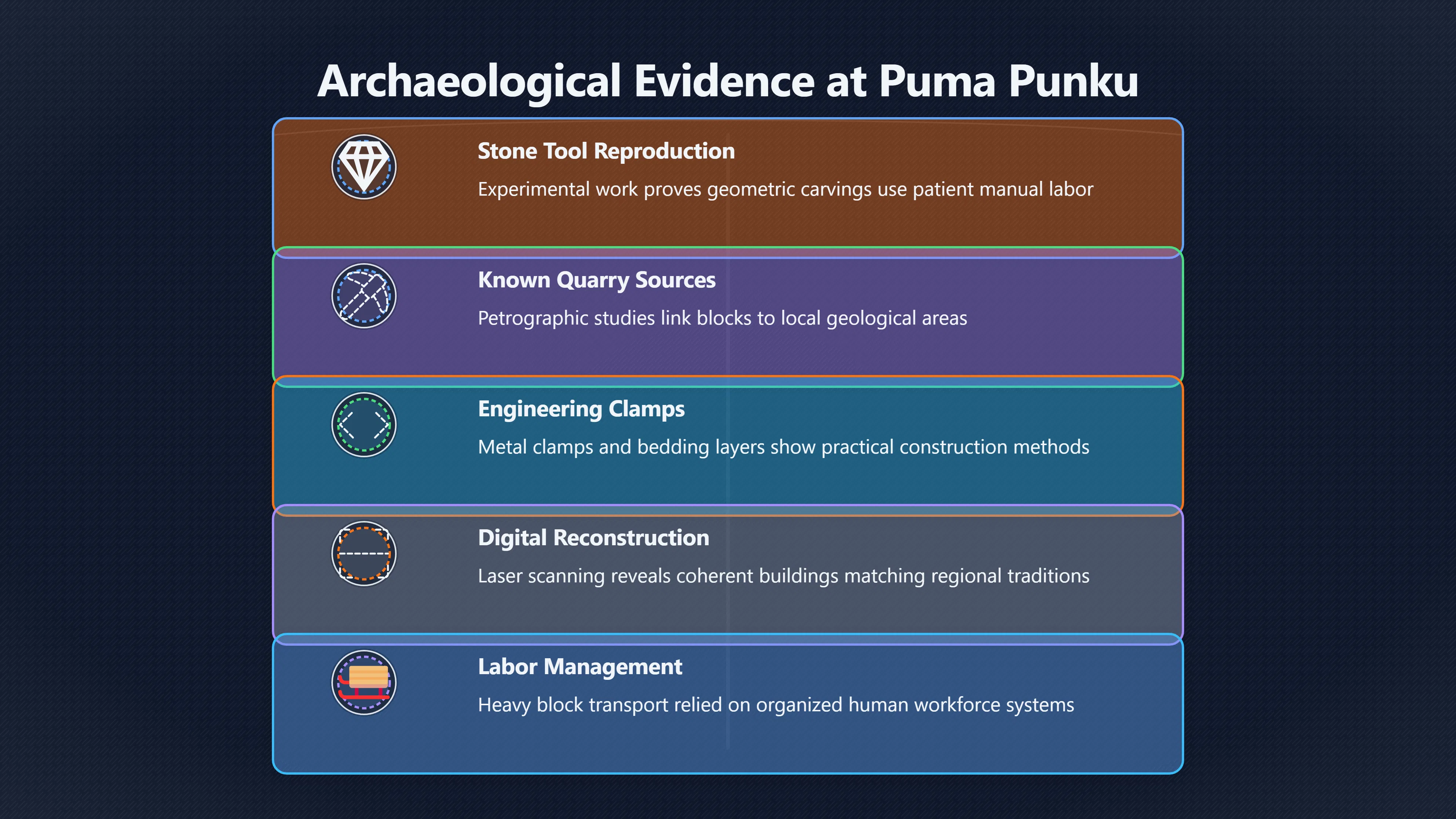
Recent archaeological work has actually made the monuments less mysterious by revealing more of their original plan. Laser scanning, aerial mapping and digital reconstruction have allowed researchers, including Alexei Vranich, to test how the surviving architectural elements fitted together. Instead of suggesting impossible engineering, these reconstructions show coherent buildings that match other Tiwanaku architectural traditions.[Wikipedia]WikipediaOpen source on wikipedia.org.
Why precision stonework attracts fringe claims
The most famous photographs of Puma Punku focus on finely cut andesite blocks with sharply defined grooves, drilled holes and repeated H-shaped forms. These images are visually striking, especially when isolated from their archaeological context, making them ideal material for television programmes and social media posts claiming that the stones resemble machine-made components.
Several recurring claims dominate fringe discussions:
- The cuts are “too precise” for ancient tools.
- The stones fit together with impossible accuracy.
- No human society could have transported such heavy blocks.
- The site is so old that no known civilisation could have built it.
Each claim sounds impressive until examined against archaeological evidence.
Experimental work by Jean-Pierre Protzen and Stella Nair demonstrated that the characteristic carvings can be reproduced using stone tools, patient workmanship and careful measurement rather than modern machinery. Their experiments showed that creating the famous geometric recesses required considerable labour but not impossible technology. The research also highlights that skilled craftspeople improve through experience, making experimental timings conservative rather than absolute limits.[Wikipedia]WikipediaOpen source on wikipedia.org.
Transporting the largest sandstone and andesite blocks undoubtedly demanded organisation, but archaeologists regard this as a question of labour management rather than supernatural intervention. Petrographic studies indicate that the stones originated from known quarry areas rather than mysterious vanished sources. Exactly which combinations of ramps, sledges, ropes and workforce organisation were used remains debated, but uncertainty over logistics is not evidence for extraterrestrials. Many ancient societies moved similarly impressive stones using techniques that remain only partly understood.[Wikipedia]WikipediaOpen source on wikipedia.org.
The often-repeated claim that the stones possess impossibly perfect joints is also exaggerated. While some masonry is exceptionally fine, the surviving blocks display variation, unfinished work and signs of practical construction methods rather than machine manufacture. Archaeologists have identified features such as thin bedding layers and metal clamps that fit known engineering practices of the Tiwanaku builders.[Wikipedia]WikipediaPuma PunkuPuma Punku

Why the ancient alien theory became so popular
Puma Punku entered global popular culture through a combination of spectacular photography, limited public knowledge of Andean archaeology and the success of ancient-mystery publishing from the late twentieth century onwards. Writers such as Erich von Däniken argued that the site’s apparent geometric perfection required alien technology, an idea later amplified by television series devoted to “ancient astronauts”.[Wikipedia]WikipediaOpen source on wikipedia.org.
Professional archaeologists have criticised these interpretations for more than simply getting the engineering wrong. Alexei Vranich, Jeb Card and Franco D. Rossi argue that such narratives often dismiss the capabilities of Indigenous American societies while presenting extraordinary construction as inexplicable. Ironically, archaeological discoveries of earlier regional architecture have strengthened the mainstream picture by showing that Tiwanaku monumental building evolved from local traditions rather than appearing suddenly from nowhere.[Wikipedia]WikipediaOpen source on wikipedia.org.
This explains why Tiwanaku occupies an important place in Bolivia’s Fortean landscape. The site genuinely inspires awe, but its mystery lies in how incomplete ruins invite imaginative storytelling. Broken monuments naturally encourage people to fill gaps with dramatic explanations.
Samaipata and the “landing pad” myth
The rock complex of Samaipata, in eastern Bolivia, has often been drawn into the same orbit of speculation despite being culturally and geographically distinct from Tiwanaku.
Its enormous carved sandstone ridge has been described in fringe literature as an ancient landing strip or spacecraft platform. The idea rests largely on appearance: broad flattened surfaces, long channels and geometric carvings are interpreted as technological features when viewed from particular angles.
Archaeological research instead identifies Samaipata as a ceremonial, administrative and defensive site used over different periods, with the surviving carvings representing ritual and cultural activity rather than aviation infrastructure. The supposed landing pad has none of the characteristics expected of an engineered runway, and no physical evidence connects it with advanced technology or extraterrestrial visitors. Like Puma Punku, its unusual appearance has encouraged imaginative reinterpretation long after its original purpose was forgotten.
Together, Tiwanaku, Puma Punku and Samaipata illustrate a recurring pattern in Bolivian weird history: remarkable monuments become blank canvases onto which later generations project their own ideas about forgotten knowledge and vanished worlds.
The real puzzle is more interesting than the myth
Removing aliens from the story does not make Tiwanaku less remarkable. If anything, it highlights the achievements of the people who built one of South America’s greatest ceremonial centres in a harsh high-altitude environment.
Important questions remain genuinely open. Archaeologists continue to debate details of construction sequences, political organisation, religious symbolism, workforce mobilisation and the precise causes of Tiwanaku’s decline. Those are active research questions supported by excavation, dating, geological analysis and digital reconstruction rather than speculation.
For readers interested in Bolivia’s stranger history, Tiwanaku and Puma Punku deserve attention not because they overturn archaeology, but because they reveal how archaeological uncertainty can evolve into modern folklore. The damaged stones have become a mirror reflecting changing cultural hopes and anxieties: nineteenth-century romanticism, twentieth-century lost-civilisation theories, television-era ancient aliens and today’s internet mythology. The ruins remain mysterious, but the mystery is ultimately about human history, memory and imagination rather than visitors from another world.
Amazon book picks
Further Reading
Books and field guides related to Are Bolivia's Ruins Stranger Without Aliens?. Use these as the next step if you want deeper reading beyond the article.

Fingerprints of the gods
Represents the fringe claims discussed and critiqued on the page.
Oxford Handbook of the Incas
Explains the broader Andean world that followed Tiwanaku.
eBay marketplace picks
Marketplace Samples
Live-tested eBay searches with available results related to this page.


Endnotes
1.
Source: Wikipedia
Link:https://en.wikipedia.org/wiki/Tiwanaku
2.
Source: Wikipedia
Link:https://en.wikipedia.org/wiki/Pumapunku
3.
Source: Wikipedia
Title: Puma Punku
Link:https://es.wikipedia.org/wiki/Puma_Punku
4.
Source: Wikipedia
Link:https://de.wikipedia.org/wiki/Tiwanaku
5.
Source: Wikipedia
Link:https://en.wikipedia.org/wiki/Pseudoarchaeology
6.
Source: Wikipedia
Link:https://de.wikipedia.org/wiki/Pumapunku
Additional References
7.
Source: academia.edu
Link:https://www.academia.edu/5631443/The_Enduring_Enigma_Of_Puma_Punku_in_Bolivia
Source snippet
(DOC) The Enduring Enigma Of Puma Punku in BoliviaPuma Punku, a lesser-known site near the famous Tiwanaku complex in Bolivia, presents e...
8.
Source: facebook.com
Link:https://www.facebook.com/61555920213781/posts/mysteries-of-puma-punkupuma-punku-with-its-huge-stones-and-intricate-puzzle-like/122298356312197340/
Source snippet
MYSTERIES OF PUMA PUNKU Puma Punku, with its huge...Puma Punku's baffling architecture: perfectly interlocking stones hint at ancient en...
9.
Source: facebook.com
Link:https://www.facebook.com/groups/1424720167832570/posts/3744724335832130/
Source snippet
Puma Punku ancient stone structures in BoliviaPuma Punku, ancient stone structures built by the Tiwanaku civilization in the Tiwanaku com...
10.
Source: geopolymer.org
Link:https://www.geopolymer.org/wp-content/uploads/TIWANAKU-PUMAPUNKU.pdf
Source snippet
J Davidovitsa · Cited by 10 — The study carried out on the monumental stones constituting the Pumapunku site in Tiahuanaco...
11.
Source: reddit.com
Title: Aliens didn’t build Pumapunku, so who did?
Link:https://www.reddit.com/r/AskHistorians/comments/6btvj6/aliens_didnt_build_pumapunku_so_who_did/
Source snippet
r/AskHistoriansWatched a few minutes of Ancient Aliens on Pumapunku, and felt that the entire thing was incredibly sensationalized. Havin...
12.
Source: instagram.com
Link:https://www.instagram.com/p/DQXFdMqjlMX/?hl=en
Source snippet
ation that flourished centuries before the Inca Empire.Read more...
13.
Source: instagram.com
Link:https://www.instagram.com/reel/DX4Y6H4sYfy/
Source snippet
It’s never aliens 👽🛸 Tiwanaku in Bolivia was already ancient...Tiwanaku's most famous structure is Puma Punku, known for its H-Blocks an...
14.
Source: youtube.com
Title: Scientists Finally Solved the Puma Punku Mystery
Link:https://www.youtube.com/watch?v=oSpCDWJxSDg
Source snippet
have released new data on Puma Punku, and the findings may reshape how we understand the history of the Andes...
15.
Source: youtube.com
Title: Scientific Evidence that the Puma Punku H-Blocks Are Artificial Geopolymer
Link:https://www.youtube.com/watch?v=0Q1f0YBm4ic
Source snippet
Pre-Inca Gold Artefacts Discovered Near Tiwanaku, Bolivia...
16.
Source: youtube.com
Title: The Age of Tiwanaku: What They Aren’t Telling You
Link:https://www.youtube.com/watch?v=rxIiDwngvVQ
Source snippet
Scientific Evidence that the Puma Punku H-Blocks Are Artificial Geopolymer...
Topic Tree