Where Congo's Mysteries Meet the Real Forest
DR Congo’s strange-history record is not built around one neat “national mystery”. It is a tangle of deep forest, immense rivers, colonial rumour, living religious traditions, volcanic danger and a few spectacularly stubborn cryptid stories.
Page outline Jump by section
Why DR Congo attracts strange stories
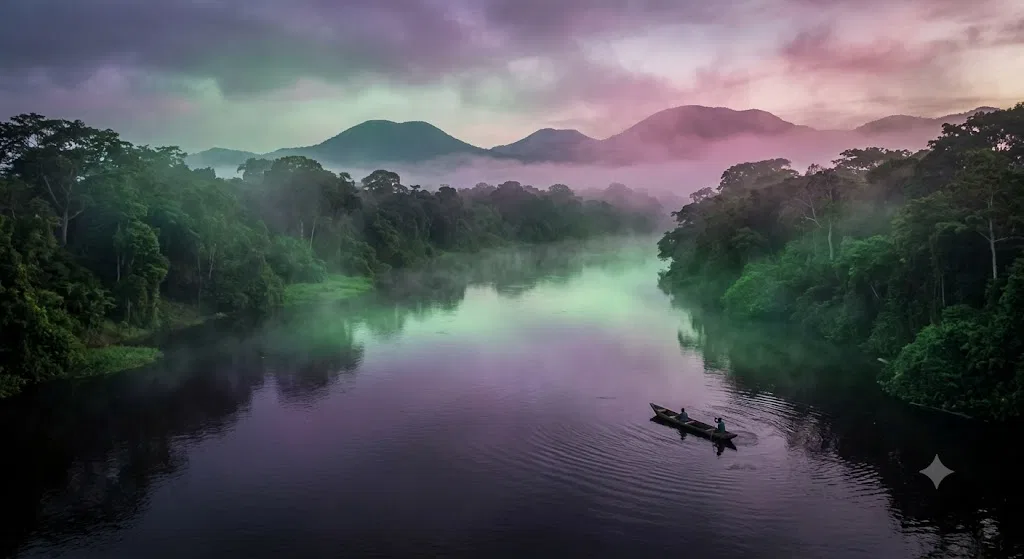
DR Congo is one of the few countries where the landscape itself still makes old-fashioned mystery feel plausible. The Congo Basin is the world’s second-largest tropical forest after the Amazon, and DR Congo contains much of its dense, biodiverse heartland. That matters because many Fortean stories depend on remoteness: a river bend no outsider has mapped, a swamp where a large animal might be misread at a distance, a forest track where a local warning becomes a traveller’s monster tale.[World Wildlife Fund]worldwildlife.orgOpen source on worldwildlife.org.
The east of the country adds a different kind of strangeness. Virunga National Park, a UNESCO World Heritage Site, includes active volcanoes, rare animals and dramatic terrain. Mount Nyiragongo, near Goma, has long been famous for its lava lake and dangerous flank eruptions, while nearby Lake Kivu stores large quantities of dissolved gases. These are not paranormal features, but they produce experiences that can look almost mythic: glowing craters, invisible suffocating gas, a lake that scientists discuss in terms of a possible limnic eruption.[unesco.org]whc.unesco.orgOpen source on unesco.org.
The final ingredient is history. Under Belgian colonial rule, missionary reports, expedition writing and European newspapers often filtered Congolese traditions through exoticising assumptions. Later cryptozoologists, creationist writers, wildlife journalists and internet storytellers added their own layers. The result is a country whose weird-history file contains both genuine local traditions and heavily reworked foreign fantasies.
The “living dinosaur” that became Congo’s best-known cryptid
The most famous Congolese Fortean creature is usually called mokele-mbembe: a water-dwelling being associated with the wider Congo Basin, commonly translated as something like “one who stops the flow of rivers”. In modern popular culture it is often described as a sauropod-like animal with a long neck, a bulky body and a semi-aquatic life in rivers, lakes or swamps. Its range in storytelling is not confined neatly to today’s DR Congo; many modern expeditions focused on the Republic of Congo, while the legend is usually framed as a Congo Basin tradition crossing present borders. For a DR Congo page, that distinction matters: the story belongs to the regional river-and-forest imagination, but not every famous expedition happened inside DR Congo’s current territory.[The University of Chicago Magazine]mag.uchicago.eduOpen source on uchicago.edu.
The modern version owes a great deal to Western retelling. Early twentieth-century speculation about African “prehistoric survivors” helped turn varied local accounts of large river creatures, spirits or dangerous animals into a dinosaur hunt. Roy Mackal, a University of Chicago biologist better known for his interest in Loch Ness, helped popularise the quest after expeditions in the early 1980s. A University of Chicago profile notes that Mackal became fascinated by the creature through fellow investigator James Powell, while a 1981 Washington Post report describes Mackal using animal pictures, including a brontosaurus, when questioning local witnesses.[The University of Chicago Magazine]mag.uchicago.eduOpen source on uchicago.edu.
That method is one reason sceptics remain unimpressed. Showing people dinosaur illustrations can shape answers, especially when money, attention, translation and politeness are all in play. Modern summaries of the evidence repeatedly note the lack of physical proof: no bones, no clear photographs, no bodies, no environmental DNA record that would support a surviving sauropod-sized animal. EBSCO’s research overview states that expeditions have not produced hard evidence and that reported features conflict, with some accounts treating the being as a spirit rather than a biological animal.[EBSCO]ebsco.comOpen source on ebsco.com.
The most grounded explanations are ordinary but not dull. Forest elephants, hippos, crocodiles, manatees in some Central African waterways, remembered rhinoceroses, drifting logs and warning tales about dangerous river places can all feed the pool of description. National Geographic’s 2025 reporting on renewed “dinosaur” sightings in the Congo Basin explicitly ties some modern reports to deforestation and animal displacement, including a witness who later laughed that what she saw was probably a very large forest elephant.[National Geographic]nationalgeographic.comcongo basin mokele mbembe deforestationcongo basin mokele mbembe deforestation
The creature’s cultural pull comes from that mixture. Believers see a last pocket of the prehistoric world hiding in a vast forest. Sceptics see a classic case of folklore, bad interviewing and romantic expedition culture. A more careful reading leaves room for local water-being traditions without turning them into a literal dinosaur. The story is strongest as a study in transformation: a river warning becomes a monster; a monster becomes a sauropod; a sauropod becomes internet folklore.
Kasai Rex and the problem of the convenient photograph
If mokele-mbembe is the grand old Congo Basin cryptid, Kasai Rex is its pulpy cousin. The story usually places a huge carnivorous reptile or theropod-like beast in the Kasai region of DR Congo, with the core claim often traced to a supposed 1932 encounter by an adventurer named J. C. Johanson. In retellings, the animal attacks, devours or menaces large prey, and the tale is sometimes accompanied by alleged photographs.[cryptidarchives.fandom.com]cryptidarchives.fandom.comKasai rex | Encyclopaedia of CryptozoologyKasai rex | Encyclopaedia of Cryptozoology
The difficulty is that Kasai Rex is a weak case even by cryptozoological standards. The best-known images have the look and history of composites or outright fabrications, and specialist cryptid catalogues treat the episode as a hoax rather than a credible mystery. The useful lesson is not “a dinosaur may have survived in Kasai”, but “a dramatic photograph can keep a poor story alive for decades”. Once a creature has a name, a place and an image, even a dubious one, it becomes easy for later writers to recycle it as if it were a stable tradition.[cryptidarchives.fandom.com]cryptidarchives.fandom.comKasai rex | Encyclopaedia of CryptozoologyKasai rex | Encyclopaedia of Cryptozoology
Kasai Rex also shows how DR Congo’s real remoteness can be exploited. A forested, underreported place is made to carry the burden of someone else’s fantasy. The result may entertain, but it tells us more about colonial adventure fiction and online monster culture than about Congolese wildlife.
The Bili apes: when a “mystery beast” becomes biology
The Bili or Bondo “mystery apes” are more rewarding because they begin like a cryptid story and end in actual field science. Around Bili and the wider Bili-Uéré region of northern DR Congo, reports circulated of unusually large, ground-nesting, fearless apes. Popular accounts sometimes made them sound like “lion killers”, ape-men or a possible chimpanzee-gorilla hybrid.[Wikipedia]WikipediaBili apeBili ape
Research changed the picture. Genetic and field evidence showed that these animals were not a new ape species, but eastern chimpanzees, Pan troglodytes schweinfurthii. That does not make them boring. A major 2019 study described Bili-Uéré chimpanzees across at least 50,000 square kilometres of northern DR Congo, documenting distinctive tool use, feeding traces, dung, nests and other artefacts over a 12-year period.[PubMed]pubmed.ncbi.nlm.nih.govOpen source on nih.gov.
The Max Planck Society reported in 2014 that surveys in the remote Bili-Gangu forest indicated a large chimpanzee population, stable between 2005 and 2012, and important enough to be treated as a conservation priority for the eastern subspecies. That is the twist: the “mystery ape” was not a monster, but it did point scientists towards a significant and comparatively little-studied chimpanzee population.[MPG]mpg.dechimpanzee population congochimpanzee population congo
For Fortean readers, the Bili apes are a useful antidote to both easy belief and easy dismissal. Local reports were exaggerated in popular media, but they were not meaningless. They signalled unusual behaviour in a real animal population living in a region that science had not adequately documented. Sometimes the correct answer to “is the monster real?” is “the monster is wrong, but the animal is interesting”.
Lake Kivu and the uncanny science of invisible danger
Some of DR Congo’s strangest material is not folklore at all. Lake Kivu, shared by DR Congo and Rwanda, is one of the world’s rare gas-rich lakes. Nature reported that it contains roughly 300 cubic kilometres of dissolved carbon dioxide and 60 cubic kilometres of methane, with toxic hydrogen sulphide also present. The feared scenario is a limnic eruption: a sudden overturn or gas release that could send suffocating gases across nearby settlements.[Nature]nature.comOpen source on nature.com.
This is not a fantasy hazard. Lake Nyos in Cameroon suffered a catastrophic limnic eruption in 1986, killing more than 1,700 people, and scientists use that disaster as a warning model when discussing Kivu. The difference is that Lake Kivu is far larger and has major lakeside populations, including Goma and Bukavu on the Congolese side.[Wikipedia]WikipediaLake Nyos disasterLake Nyos disaster
There is an important caveat. The most alarming version of the story can slide into disaster porn. A 2020 PLOS ONE study found no evidence that Lake Kivu’s risk of catastrophic gas eruption was increasing at present, although it did not dismiss the underlying hazard. Eawag, the Swiss aquatic research institute, similarly summarised newer measurements as showing methane concentrations more stable than previously assumed, while stressing that the danger is not gone.[PLOS]journals.plos.orgOpen source on plos.org.
Kivu belongs in a Fortean survey because it sounds like an impossible lake from folklore: calm on the surface, charged with invisible force below. The responsible reading is scientific rather than supernatural. Its strangeness lies in geology, chemistry and risk management.
Mazuku: the “evil wind” around Goma
Near Goma, invisible volcanic gas also appears in a more local, intimate form: mazuku. The word is commonly glossed as “evil wind”, and scientists use it for pockets of carbon dioxide-rich air that collect in low places because carbon dioxide is heavier than ordinary air. These pockets can form around vents, fissures, depressions, basements and other poorly ventilated spaces.[Wikipedia]WikipediaOpen source on wikipedia.org.
The phrase may sound folkloric, but the hazard is real. Studies of the Goma region describe mazuku as abundant near Nyiragongo and Nyamulagira, especially around fault and fissure networks close to the northern shore of Lake Kivu. UNOPS, describing volcanic-risk work in the area, notes that lethal low-lying carbon dioxide pockets have been responsible for deaths around Goma.[ScienceDirect]sciencedirect.comOpen source on sciencedirect.com.
This is a perfect example of how “weird” language can preserve practical knowledge. Calling a gas pocket an evil wind does not mean local people failed to understand danger. It marks an invisible killer in memorable terms. Recent reporting from Goma has continued to treat mazuku as a public safety problem, especially for displaced people living in exposed or poorly protected conditions.[Voice of America]voaafrica.comVoice of America Toxic Volcanic Gas Kills DRC's Goma ResidentsVoice of America Toxic Volcanic Gas Kills DRC's Goma Residents
Prophecy, healing and the Kimbanguist shock of 1921
DR Congo’s strange-history record is not only about animals and landscapes. It also includes visionary religion, especially the rise of Simon Kimbangu. In 1921, in what was then the Belgian Congo, Kimbangu’s short public ministry drew crowds through reports of healing, prophecy and spiritual authority. Accounts preserved by religious-history sources say he was widely reported to cure the sick and even raise the dead, while academic work notes that his first miracle was understood by followers as the healing of a dying young woman at Nkamba on 6 April 1921.[African Christian Biography]dacb.orgOpen source on dacb.org.
For believers, this was sacred history. For Belgian colonial authorities, it was alarming mass mobilisation. Kimbangu was arrested, sentenced to death, then had the sentence commuted to life imprisonment. He died in custody in 1951, far from Nkamba. Today, the Kimbanguist Church remains one of Africa’s major independent Christian movements, with Nkamba treated by adherents as a spiritual centre.[African Christian Biography]dacb.orgOpen source on dacb.org.
A Fortean treatment should not try to prove or disprove Kimbangu’s miracles as if they were laboratory claims. The important point is how visionary events became historical force. Healing reports brought crowds; crowds frightened a colonial state; repression helped turn a preacher into a national religious symbol. Since 2023, 6 April has been marked in DR Congo as Kimbangu Day, honouring the struggle of Simon Kimbangu and African consciousness.[AP News]apnews.comThe Kimbanguist Church, known for its independence and peaceful values, promotes social cohesion through communal activities, educational…
River spirits, power objects and the risk of exoticising belief
DR Congo is also linked to Central African traditions of water spirits and spirit-empowered objects. Along the Congo River and its tributaries, versions of Mami Wata or related water-spirit traditions are described as haunting riverbanks, seducing or endangering people, and serving as cautionary tales about fluvial danger. A University of Basel research note on Congo River stories describes Mami Wata as a figure who thrives through rumour and whose meaning shifts across time and place.[Ethnologie Universität Basel]ethnologie.philhist.unibas.chEthnologie Universität Basel Tales from the Congo River: Catching Mami WataEthnologie Universität Basel Tales from the Congo River: Catching Mami Wata
Kongo and related Central African traditions also include minkisi: spiritually charged containers, figures or objects associated with healing, protection, oath enforcement, divination and communication with the dead. Museum and art-historical sources stress that these are not “spooky dolls” in the cheap horror sense, but ritual technologies embedded in systems of law, medicine, morality and spiritual mediation.[wikipedia.org]WikipediaOpen source on wikipedia.org.
These traditions are relevant to country-level Forteana only if handled carefully. They are not “paranormal curios” to be stripped from context. Their value here is that they show a different category of strange material: not a one-off anomaly, but a living or historically rooted way of describing agency, danger, illness, justice and the unseen. For readers used to UFOs and lake monsters, they widen the frame.
How to read DR Congo’s weird-history file
The best way to read DR Congo’s Fortean material is to separate five layers that often get mixed together.
First, there are real animals seen under difficult conditions: elephants in forest, hippos in water, chimpanzees with unfamiliar behaviour. Second, there are local traditions that may treat rivers, forests, illness and danger through spiritual language. Third, there are colonial and missionary filters, which often reshaped Congolese accounts for European audiences. Fourth, there are modern cryptozoological agendas, especially the desire to find “living dinosaurs”. Fifth, there are genuine natural hazards so strange that they barely need embellishment: glowing lava lakes, invisible volcanic gas and a gas-charged lake.[nationalgeographic.com]nationalgeographic.comcongo basin mokele mbembe deforestationcongo basin mokele mbembe deforestation
That layered reading makes the country’s strange record more interesting, not less. Mokele-mbembe is not strengthened by pretending it is proven; it becomes more revealing when seen as a river tradition transformed by expedition culture. The Bili apes are not diminished by being chimpanzees; they become a rare case where a mystery-beast rumour led towards serious primatology. Lake Kivu and mazuku do not need ghosts; their invisible chemistry already has the eerie force of a warning tale.
DR Congo’s Forteana, at its best, is therefore not a cabinet of disconnected oddities. It is a study in how people make sense of vast landscapes, dangerous places, unfamiliar creatures and extraordinary claims. The country’s weird history remains compelling because it sits where folklore, science, colonial history and lived risk meet.
Amazon book picks
Further Reading
Books and field guides related to Where Congo's Mysteries Meet the Real Forest. Use these as the next step if you want deeper reading beyond the article.
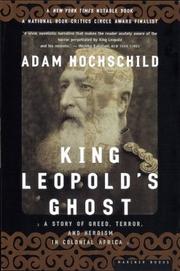
In the Heart of the Congo
Provides essential context for Congo's landscape and history.
eBay marketplace picks
Marketplace Samples
Live-tested eBay searches with available results related to this page.

Endnotes
1.
Source: whc.unesco.org
Link:https://whc.unesco.org/en/list/63/
2.
Source: nature.com
Link:https://www.nature.com/immersive/d41586-021-02523-5/index.html
3.
Source: ebsco.com
Link:https://www.ebsco.com/research-starters/science/mokele-mbembe-cryptozoology
4.
Source: cryptidarchives.fandom.com
Title: Kasai rex | Encyclopaedia of Cryptozoology
Link:https://cryptidarchives.fandom.com/wiki/Kasai_rex
5.
Source: cryptidz.fandom.com
Title: Cryptid Wiki Kasai Rex
Link:https://cryptidz.fandom.com/wiki/Kasai_Rex
6.
Source: Wikipedia
Title: Bili ape
Link:https://en.wikipedia.org/wiki/Bili_ape
7.
Source: karger.com
Link:https://karger.com/fpr/article/90/1/3/143924/Bili-Uere-A-Chimpanzee-Behavioural-Realm-in
8.
Source: mpg.de
Title: chimpanzee population congo
Link:https://www.mpg.de/7896302/chimpanzee_population_congo
9.
Source: Wikipedia
Title: Lake Nyos disaster
Link:https://en.wikipedia.org/wiki/Lake_Nyos_disaster
10.
Source: journals.plos.org
Link:https://journals.plos.org/plosone/article?id=10.1371%2Fjournal.pone.0237836
11.
Source: eawag.ch
Link:https://www.eawag.ch/en/info/portal/news/news-detail/lake-kivu-danger-of-a-lethal-gas-eruption-is-not-increasing
12.
Source: Wikipedia
Link:https://en.wikipedia.org/wiki/Mazuku
13.
Source: nhess.copernicus.org
Link:https://nhess.copernicus.org/articles/26/1141/2026/nhess-26-1141-2026.html
14.
Source: sciencedirect.com
Link:https://www.sciencedirect.com/science/article/abs/pii/S1464343X10000828
15.
Source: unops.org
Link:https://www.unops.org/news-and-stories/stories/unops20-monitoring-volcanoes-in-the-democratic-republic-of-the-congo
16.
Source: Wikipedia
Link:https://en.wikipedia.org/wiki/Nkisi
17.
Source: smarthistory.org
Link:https://smarthistory.org/nkisi-nkondi-kongo-people/
18.
Source: Wikipedia
Title: Mokele mbembe
Link:https://en.wikipedia.org/wiki/Mokele-mbembe
19.
Source: Wikipedia
Title: Kitum Cave
Link:https://en.wikipedia.org/wiki/Kitum_Cave
20.
Source: Wikipedia
Title: Lake Kivu
Link:https://en.wikipedia.org/wiki/Lake_Kivu
21.
Source: Wikipedia
Title: Simon Kimbangu
Link:https://en.wikipedia.org/wiki/Simon_Kimbangu
22.
Source: Wikipedia
Link:https://en.wikipedia.org/wiki/Kimbanguism
23.
Source: Wikipedia
Title: Mami Wata
Link:https://en.wikipedia.org/wiki/Mami_Wata
24.
Source: Wikipedia
Title: Virunga National Park
Link:https://en.wikipedia.org/wiki/Virunga_National_Park
25.
Source: Wikipedia
Title: Congo Basin
Link:https://en.wikipedia.org/wiki/Congo_Basin
26.
Source: Wikipedia
Title: UFO sightings in Africa
Link:https://en.wikipedia.org/wiki/UFO_sightings_in_Africa
27.
Source: Wikipedia
Title: Meteorite fall
Link:https://en.wikipedia.org/wiki/Meteorite_fall
28.
Source: cryptidz.fandom.com
Title: Mokèlé mbèmbé
Link:https://cryptidz.fandom.com/wiki/Mok%C3%A8l%C3%A9-mb%C3%A8mb%C3%A9
29.
Source: mythus.fandom.com
Title: Mokélé mbembé
Link:https://mythus.fandom.com/wiki/Mok%C3%A9l%C3%A9-mbemb%C3%A9
30.
Source: cryptidarchives.fandom.com
Title: Mokele mbembe
Link:https://cryptidarchives.fandom.com/wiki/Mokele-mbembe
31.
Source: cryptozoologycryptids.fandom.com
Title: Kasai Rex
Link:https://cryptozoologycryptids.fandom.com/wiki/Kasai_Rex
32.
Source: villains.fandom.com
Title: Kasai Rex
Link:https://villains.fandom.com/wiki/Kasai_Rex
33.
Source: amazon.de
Link:https://www.amazon.de/Bili-U%C3%A9r%C3%A9-Chimpanzee-Behavioural-Democratic-Primatologica/dp/3318064920?tag=searcht-20
34.
Source: sciencedirect.com
Link:https://www.sciencedirect.com/science/article/abs/pii/S0006320714000044
35.
Source: sciencedirect.com
Link:https://www.sciencedirect.com/science/article/abs/pii/S1464343X19303279
36.
Source: sciencedirect.com
Link:https://www.sciencedirect.com/science/article/pii/S0012821X25002766
37.
Source: staff.washington.edu
Title: Drewal Mami Wata AfAr.2008.41.2
Link:https://staff.washington.edu/ellingsn/Drewal-Mami_Wata-AfAr.2008.41.2.pdf
38.
Source: unesco.nl
Title: Nationaal park Virunga
Link:https://www.unesco.nl/werelderfgoed/nationaal-park-virunga
39.
Source: virunga.org
Link:https://virunga.org/about/
40.
Source: ebsco.com
Link:https://www.ebsco.com/research-starters/history/kimbanguism
41.
Source: ebsco.com
Link:https://www.ebsco.com/research-starters/religion-and-philosophy/mami-wata-african-myth
42.
Source: unesco.org
Title: life edge geoscientists probe one worlds most volatile regions
Link:https://www.unesco.org/en/articles/life-edge-geoscientists-probe-one-worlds-most-volatile-regions
43.
Source: whc.unesco.org
Link:https://whc.unesco.org/en/decisions/1377/
44.
Source: whc.unesco.org
Link:https://whc.unesco.org/en/list/63/documents/
45.
Source: worldwildlife.org
Link:https://www.worldwildlife.org/places/congo-basin/
46.
Source: volcano.si.edu
Link:https://volcano.si.edu/volcano.cfm?vn=223030
47.
Source: mag.uchicago.edu
Link:https://mag.uchicago.edu/science-medicine/roy-mackals-wild-speculation
48.
Source: nationalgeographic.com
Title: congo basin mokele mbembe deforestation
Link:https://www.nationalgeographic.com/environment/article/congo-basin-mokele-mbembe-deforestation
49.
Source: pubmed.ncbi.nlm.nih.gov
Link:https://pubmed.ncbi.nlm.nih.gov/30799412/
50.
Source: rema.gov.rw
Title: ldcf iii 7
Link:https://www.rema.gov.rw/our-work-1/projects/ldcf-iii-7
51.
Source: voaafrica.com
Title: Voice of America Toxic Volcanic Gas Kills DRC’s Goma Residents
Link:https://www.voaafrica.com/a/toxic-volcanic-gas-kills-drc-s-goma-residents/7541151.html
52.
Source: dacb.org
Link:https://dacb.org/stories/democratic-republic-of-congo/kimbangu4-simon/
53.
Source: dacb.org
Link:https://dacb.org/stories/democratic-republic-of-congo/kimbangu-simon/
54.
Source: apnews.com
Link:https://apnews.com/article/c7ba1dfff9e99e74d91840d9ba75f6f7
Source snippet
The Kimbanguist Church, known for its independence and peaceful values, promotes social cohesion through communal activities, educational...
55.
Source: ethnologie.philhist.unibas.ch
Title: Ethnologie Universität Basel Tales from the Congo River: Catching Mami Wata
Link:https://ethnologie.philhist.unibas.ch/en/default-pages/news/details/tales-from-the-congo-river-catching-mami-wata/
56.
Source: world-heritage-datasheets.unep-wcmc.org
Title: virunga national park
Link:https://world-heritage-datasheets.unep-wcmc.org/datasheet/output/site/virunga-national-park
57.
Source: pmc.ncbi.nlm.nih.gov
Link:https://pmc.ncbi.nlm.nih.gov/articles/PMC8836609/
58.
Source: pmc.ncbi.nlm.nih.gov
Link:https://pmc.ncbi.nlm.nih.gov/articles/PMC9433316/
59.
Source: cdamm.org
Title: Simon Kimbangu
Link:https://www.cdamm.org/articles/simon-kimbangu
60.
Source: elibrary.donnuet.edu.ua
Title: Ostapenko manual 10 09 2021
Link:https://elibrary.donnuet.edu.ua/2482/1/Ostapenko_manual_10_09_2021.pdf
61.
Source: jstor.org
Link:https://www.jstor.org/stable/25757709
62.
Source: national-parks.org
Link:https://national-parks.org/congo-dr/virunga/
63.
Source: nationalgeographic.com
Title: congo basin carbon research climate change
Link:https://www.nationalgeographic.com/environment/article/congo-basin-carbon-research-climate-change
64.
Source: nationalgeographic.com
Title: 110308 meteor impact crater found confirmed congo ferriere science
Link:https://www.nationalgeographic.com/science/article/110308-meteor-impact-crater-found-confirmed-congo-ferriere-science
65.
Source: africangreatlakesinform.org
Title: Lake Kivu | AGLI
Link:https://www.africangreatlakesinform.org/page/lake-kivu
Additional References
66.
Source: youtube.com
Link:https://www.youtube.com/watch?v=Fb_JFALwxlo
Source snippet
This Lake Can Cause a Disaster the World Has Never Seen...
67.
Source: youtube.com
Title: The Mokele-Mbembe Mystery: Dinosaur, Myth, or Unknown Animal?
Link:https://www.youtube.com/watch?v=sTVTuo48ZpQ
Source snippet
The Dinosaur That May Still Be Alive in the Congo Rainforest? The Hidden World Inside Africa...
68.
Source: youtube.com
Title: The Deadliest Volcanic Disaster which Hasn’t Happened Yet
Link:https://www.youtube.com/watch?v=5vmEQmS1ppM
Source snippet
Deadly Lava Lakes Of Congo's Mount Nyiragongo Volcano | Angry Planet...
69.
Source: youtube.com
Title: This Lake Can Cause a Disaster the World Has Never Seen
Link:https://www.youtube.com/watch?v=lsJZY8NLifQ
Source snippet
The Deadliest Volcanic Disaster which Hasn't Happened Yet...
70.
Source: phys.org
Link:https://phys.org/pdf541325765.pdf
71.
Source: academia.edu
Link:https://www.academia.edu/108769679/THE_EMERGENCE_OF_A_CONGO_PROPHET_Simon_Kimbangu_1921de_la_pr%C3%A9dication%C3%A0la_d%C3%A9portation_Les_Sources_Edited_by_JEAN_LUC_VELLUT_Brussels_Acad%C3%A9mie_Royale_des_Sciences_d_Outre_Mer_2005_Pp_xxxiii_178_No_price_given_ISBN_90_75652_35_6
72.
Source: researchgate.net
Link:https://www.researchgate.net/publication/355735551_Tales_From_the_Congo_River_Catching_Mami_Wata
73.
Source: researchgate.net
Link:https://www.researchgate.net/publication/236841263_Dry_gas_vents_mazuku_in_Goma_region_North-Kivu_Democratic_Republic_of_Congo_Formation_and_risk_assessment
74.
Source: researchgate.net
Link:https://www.researchgate.net/publication/332111470_BILI_UERE_PROTECTED_AREA_COMPLEX_DRC_Analysis_of_the_density_and_distribution_of_chimpanzees_and_elephants_in_the_southern_forest_core_area_African_Wildlife_Foundation
75.
Source: researchgate.net
Link:https://www.researchgate.net/publication/347969086_Book_ReviewBili-Uere_A_chimpanzee_behavioural_realm_in_northern_Democratic_Republic_Congo_By_Thurston_C_Hicks_Hjalmar_S_Kuehl_Christophe_Boesch_Paula_Dieguez_Ayuk_Emmanuel_Ayimisin_Rumen_Martin_Fernan
Topic Tree
Follow this branch
Related pages 192
- Afghan Forteana
- Antigua Uncanny
- Bosnian Mysteries
- Botswana Weird
- Brazil Strange
- +187 more in sidebar