Within Malawi Forteana
Did A Ghost Story Shake Malawi's Presidency?
The 2005 haunted-palace affair is less proof of ghosts than a revealing case of rumour, ridicule and press freedom.
On this page
- The reported haunting and the disputed source
- Why journalists were arrested over the story
- What the case reveals about ghosts and power
Page outline Jump by section
Introduction
In 2005, one of Malawi’s strangest modern political stories centred not on an alleged ghost, but on what happened after journalists reported one. Claims that President Bingu wa Mutharika had abandoned a newly occupied presidential palace because it was haunted rapidly became an international news story. Within days, the focus had shifted from unexplained noises and rumours of evil spirits to arrests, criminal charges and a wider debate about press freedom. The affair remains part of Malawi’s modern Fortean history not because there is convincing evidence that the palace was haunted, but because a ghost story briefly collided with presidential authority, political symbolism and the limits of free reporting.
The Reported Haunting and the Disputed Source
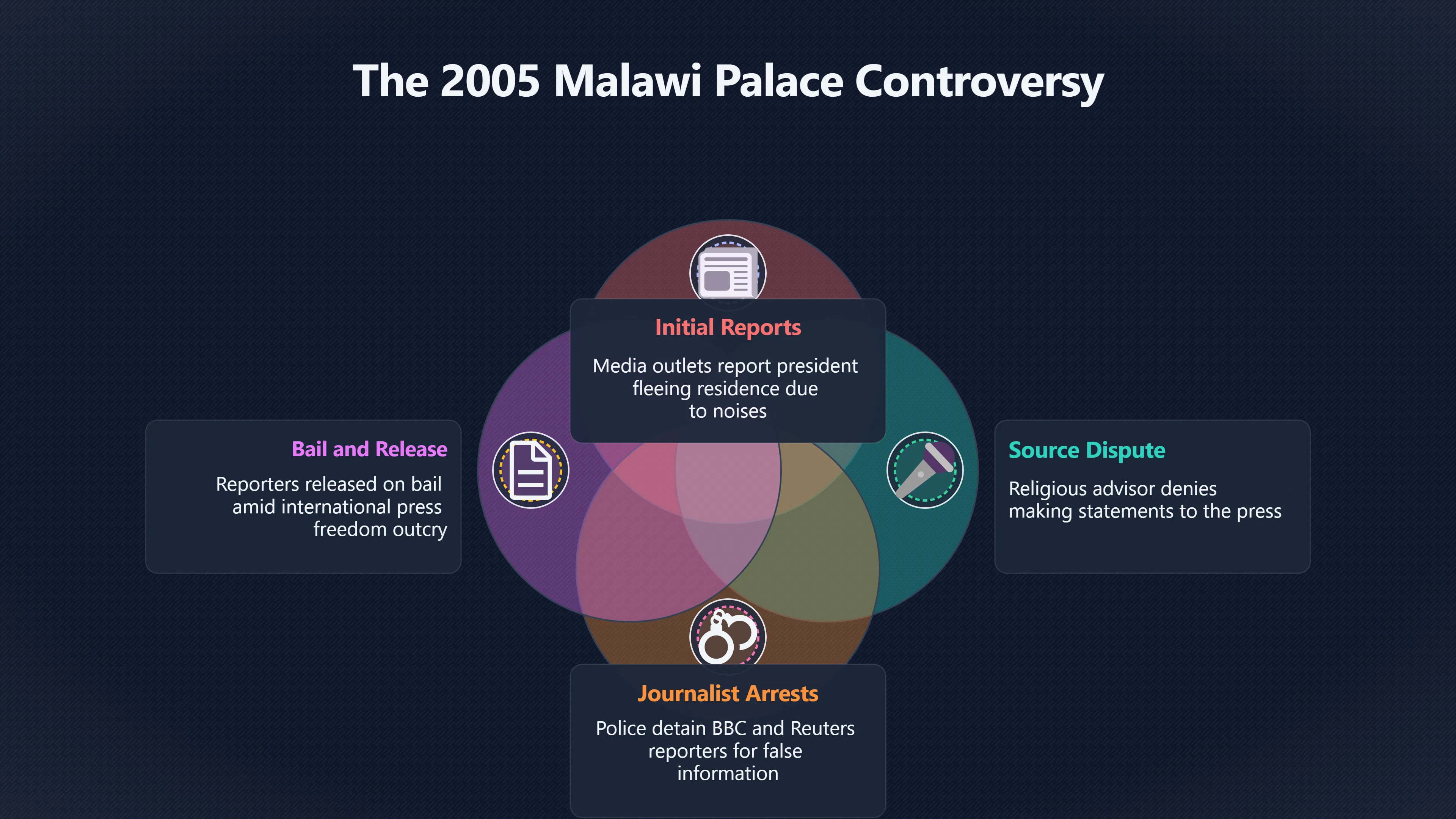
The controversy began in March 2005, less than a year after Bingu wa Mutharika became president. Reports appeared in Malawian and international media claiming that he had stopped sleeping in the vast presidential residence outside Lilongwe because of disturbing experiences inside the building.
According to the published accounts, the president was said to have heard unexplained noises during the night and even felt what seemed like rodents or an unseen presence moving across his body while he slept. Some reports also claimed Christian clergy had been invited to pray over the residence or perform an exorcism because evil spirits were believed to be present.[Mail & Guardian]mg.co.zaMail & Guardian Journalists arrested over presidential ghost reportMail & GuardianJournalists arrested over presidential ghost reportMarch 15, 2005 — 15 Mar 2005 — Two journalists in Malawi were arrested…
The alleged source was Reverend Malani Mtonga, the president’s adviser on religious affairs. Journalists quoted him as explaining that the president had left the residence because of these unsettling experiences. Soon afterwards, however, Mtonga publicly denied making those statements. President Mutharika also rejected the entire story, insisting he had never feared ghosts and accusing political opponents of spreading false rumours.[Committee to Protect Journalists]cpj.orgCommittee to Protect JournalistsTwo journalists arrested after writing about president's fear…March 15, 2005 — 15 Mar 2005 — According…
This disagreement over who actually said what became the central factual dispute. There has never been publicly available evidence confirming that the president personally described supernatural experiences or authorised claims that the palace required exorcism.
Why Journalists Were Arrested Over the Story
The ghost story became a far bigger national issue when police arrested two respected journalists: BBC correspondent Raphael Tenthani and The Nation reporter Mabvuto Banda, who also worked for Reuters. Both had reported versions of the story based on their sources.
The journalists were arrested at their homes in Blantyre, transported to police headquarters in Lilongwe and accused of publishing false information likely to cause public alarm. A third individual, Horace Nyaka, an aide to Vice-President Cassim Chilumpha, was also arrested in connection with the affair.[Mail & Guardian]mg.co.zaMail & Guardian Journalists arrested over presidential ghost reportMail & GuardianJournalists arrested over presidential ghost reportMarch 15, 2005 — 15 Mar 2005 — Two journalists in Malawi were arrested…
International press-freedom organisations reacted quickly. The Committee to Protect Journalists argued that the arrests represented an attack on independent reporting rather than a legitimate criminal investigation, while IFEX circulated appeals highlighting concerns about the criminalisation of routine journalism.[Committee to Protect Journalists]cpj.orgCommittee to Protect JournalistsTwo journalists arrested after writing about president's fear…March 15, 2005 — 15 Mar 2005 — According…
The journalists were later released on bail, although uncertainty remained for some time over whether prosecutions would proceed. The episode nevertheless became one of the first significant press-freedom controversies of Mutharika’s presidency.[The Guardian]theguardian.comThe GuardianReporters held over 'haunted house' story released | Media17 Mar 2005 — Two journalists arrested this week in Malawi after re…
Why This Palace Was Already Politically Sensitive
The location itself helped turn an unusual rumour into a national political drama.
The building involved was the enormous presidential residence originally constructed under Hastings Kamuzu Banda. Costing around US$100 million and containing roughly 300 rooms on an immense estate, it had long been controversial because many Malawians regarded it as an extravagant symbol of presidential power.
President Bakili Muluzi had largely refused to live there, arguing that the complex was unnecessarily lavish. After taking office in 2004, Bingu wa Mutharika decided to use it as his official residence, making any suggestion that he had abandoned it especially politically embarrassing.[Mail & Guardian]mg.co.zaMail & Guardian Journalists arrested over presidential ghost reportMail & GuardianJournalists arrested over presidential ghost reportMarch 15, 2005 — 15 Mar 2005 — Two journalists in Malawi were arrested…
Because the palace already represented questions of prestige, authority and public spending, rumours that unseen forces had driven out its new occupant carried symbolic weight far beyond an ordinary ghost story.

What Evidence Exists for a Haunting?
From a Fortean perspective, the evidence for paranormal activity is remarkably thin.
The reports rested almost entirely on disputed testimony attributed to presidential insiders. No independent witnesses produced corroborating accounts of unexplained events inside the palace. No physical evidence was presented, and the central source later denied making the quoted remarks.
That leaves several possible interpretations:
- A genuine misunderstanding, with comments being misheard or exaggerated during political gossip.
- A rumour amplified through the media, growing more dramatic as it spread.
- Political manoeuvring, with rivals or insiders exploiting the story to embarrass the new administration.
- An authentic personal experience, perhaps involving unexplained sounds or disturbed sleep, that became transformed into a ghost narrative through retelling.
None of these explanations can be conclusively proved from the available evidence. What can be established is the sequence of reporting, official denials and legal action that followed.
What the Case Reveals About Ghosts and Power
The haunted-palace affair illustrates an enduring feature of Fortean history: stories about the supernatural often become significant because of their social consequences rather than their paranormal evidence.
In Malawi, the case demonstrated how ghost rumours could intersect with state authority. The alleged haunting questioned the symbolic security of the presidency itself. A residence intended to project stability instead became associated with invisible forces, whether understood as spirits, gossip or political intrigue.
The government’s response shifted attention away from the supposed haunting and onto freedom of expression. International coverage increasingly framed the affair as a press-freedom dispute rather than a supernatural mystery, and the arrests drew criticism from media-rights organisations that viewed criminal charges against reporters as a disproportionate response to contested reporting.[cpj.org]cpj.orgCommittee to Protect JournalistsTwo journalists arrested after writing about president's fear…March 15, 2005 — 15 Mar 2005 — According…
For students of Forteana, this makes the episode especially revealing. The lasting mystery is not whether ghosts inhabited the palace. It is how quickly an unverified supernatural claim exposed tensions over political image, official credibility and the role of journalism in a democratic society.
More than twenty years later, the “haunted palace” remains one of Malawi’s most memorable strange stories precisely because it sits at the unusual meeting point of folklore, rumour, governance and the power of belief.
Amazon book picks
Further Reading
Books and field guides related to Did A Ghost Story Shake Malawi's Presidency?. Use these as the next step if you want deeper reading beyond the article.
Extraordinary Popular Delusions and the Madness of Crowds
Rating: 4.0/5 from 5 Google Books ratings
Relevant to rumor, media and public belief.

The anthropology of religion, magic, and witchcraft
Explains supernatural belief in social and political settings.

eBay marketplace picks
Marketplace Samples
Live-tested eBay searches with available results related to this page.

Endnotes
1.
Source: mg.co.za
Title: Mail & Guardian Journalists arrested over presidential ghost report
Link:https://mg.co.za/news/south-africa/2005-03-15-journalists-arrested-over-presidential-ghost-report/
Source snippet
Mail & GuardianJournalists arrested over presidential ghost reportMarch 15, 2005 — 15 Mar 2005 — Two journalists in Malawi were arrested...
Published: March 15, 2005
2.
Source: cpj.org
Link:https://cpj.org/2005/03/two-journalists-arrested-after-writing-about-presi/
Source snippet
Committee to Protect JournalistsTwo journalists arrested after writing about president's fear...March 15, 2005 — 15 Mar 2005 — According...
Published: March 15, 2005
3.
Source: theguardian.com
Link:https://www.theguardian.com/media/2005/mar/17/pressandpublishing.internationalnews
Source snippet
The GuardianReporters held over 'haunted house' story released | Media17 Mar 2005 — Two journalists arrested this week in Malawi after re...
4.
Source: ifex.org
Link:https://ifex.org/two-journalists-arrested-after-writing-about-presidents-fear-of-ghosts/
Source snippet
alists arrested after writing about president's fear of ghosts New York, March 15, 2005...Read more...
Published: March 15, 2005
Additional References
5.
Source: abc.net.au
Title: malawi ghost story lands journalists in jail
Link:https://www.abc.net.au/news/2005-03-16/malawi-ghost-story-lands-journalists-in-jail/1534142
Source snippet
15 Mar 2005 — Two journalists have been arrested in the east African nation of Malawi after reporting that their president had left his p...
6.
Source: facebook.com
Link:https://www.facebook.com/100063863448595/posts/the-presidential-palace-of-malawi-called-kamuzu-palace-has-300-rooms-is-set-on-5/1278070834331686/
Source snippet
hectares, and cost $100 million...
7.
Source: allafrica.com
Link:https://allafrica.com/stories/200503160867.html
Source snippet
Malawi: Scared President And Haunted Villa17 Mar 2005 — Three journalists, one of them an aide to Vice-President Cassim Chilumpha, were a...
8.
Source: youtube.com
Title: Malawi President Fires Cabinet Amid Graft Concerns
Link:https://www.youtube.com/watch?v=yNrBOj5yfWc
Source snippet
Mtt Structures International - Kamuzu Palace State house, Malawi...
9.
Source: youtube.com
Title: VP Takes Over Following Mutharika’s Death
Link:https://www.youtube.com/watch?v=W1Oxz38Pzoo
Source snippet
Malawi President Fires Cabinet Amid Graft Concerns...
10.
Source: youtube.com
Title: Interview: Political uncertainty in Malawi
Link:https://www.youtube.com/watch?v=9b0af1zwPfU
Source snippet
VP Takes Over Following Mutharika's Death...
11.
Source: youtube.com
Title: Malawi’s Bingu Wa Mutharika Intrigue
Link:https://www.youtube.com/watch?v=jWheFOjOJcA
Source snippet
Interview: Political uncertainty in Malawi...
12.
Source: youtube.com
Title: Mtt Structures International
Link:https://www.youtube.com/watch?v=EGnBtx1IdUE
13.
Source: Wikipedia
Title: Kamuzu Palace
Link:https://en.wikipedia.org/wiki/Kamuzu_Palace
Topic Tree