Within Bahamas Strange
Why Did Andros Fear The Chickcharney?
The chickcharney is an owl-like Andros spirit whose stories mix bush etiquette, extinct-owl speculation and sharp political humour.
On this page
- The owl spirit in Andros folklore
- Luck, manners and warnings in the bush
- Extinct owls, plantation stories and Chamberlain
Page outline Jump by section
Introduction
The chickcharney is one of the most distinctive figures in Bahamian folklore: an owl-like forest being said to inhabit the pine woods of Andros. Unlike many legendary creatures that exist only to frighten people, the chickcharney occupies a more complicated place in local tradition. It is mischievous rather than purely malevolent, capable of rewarding courtesy as readily as punishing arrogance. Stories about it function as practical warnings about behaviour in the bush, expressions of respect for the island’s forests, and reminders that strangers ignore local knowledge at their own risk. While later writers have suggested that memories of an unusually large extinct owl may have contributed to the legend, there is no evidence that the chickcharney itself was ever a real animal. Its enduring importance lies in the way folklore, landscape, history and humour have become woven together on Andros.[Wikipedia]WikipediaOpen source on wikipedia.org.

Why did Andros fear the chickcharney?
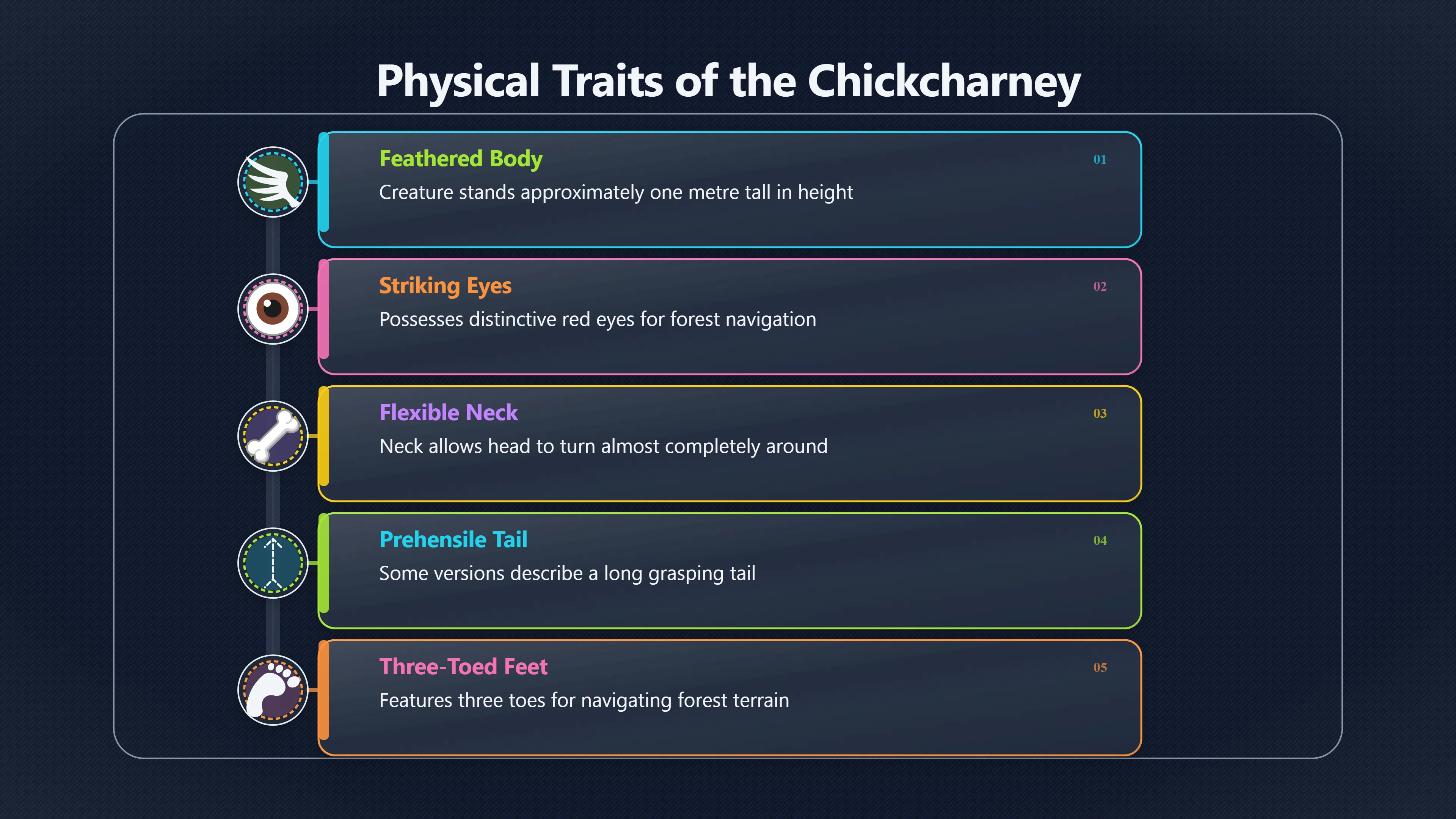
Descriptions vary, but the chickcharney is usually portrayed as a feathered creature around a metre tall with striking red eyes, three-toed feet, long arms or wing-like limbs, and an unusually flexible neck that allows its head to turn almost completely around. Some versions also give it a long prehensile tail. It is said to nest by bending or tying together the tops of Caribbean pine trees, creating distinctive clusters in the forest canopy that storytellers point to as signs of its presence.[Wikipedia]WikipediaOpen source on wikipedia.org.
The creature is not normally described as a hunter of people. Instead, it tests character. Travellers who greet it politely, offer flowers or brightly coloured cloth, or simply show respect may receive good fortune. Those who insult it, laugh at it, damage its home or behave carelessly in the forest risk accidents, illness or persistent bad luck. In this sense the chickcharney resembles many traditional guardian spirits whose stories encourage proper behaviour rather than supernatural terror. Lisa G. Buckley, Ph.D.[lisagbuckley.com]lisagbuckley.comLisa GBuckley, Ph.D.Andros Island - Lisa G. Buckley, Ph.D.15 Sept 2019 — Chickcharney (or Chickcharnee/Chickcharnie) calls the pine and hardwoo…
For Andros, whose interior contains vast pine forests, wetlands and difficult terrain, such tales also carried practical value. Wandering carelessly through the bush, destroying trees or ignoring experienced local guides could have very real consequences. The supernatural warning reinforced sensible conduct in an environment that was genuinely easy to become lost in.
Luck, manners and warnings in the bush
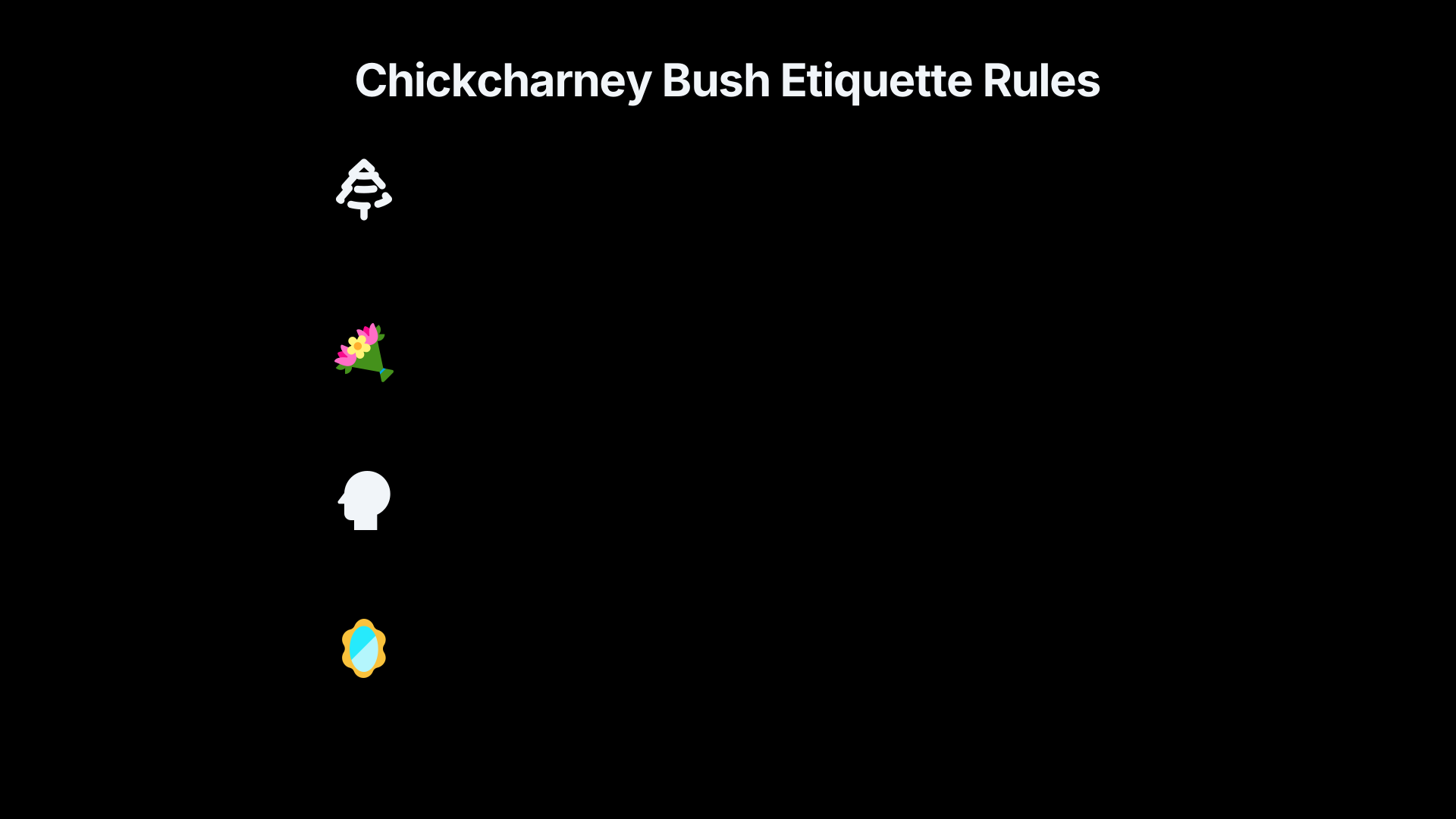
The chickcharney legend operates as a code of bush etiquette as much as a ghost story. Several recurring themes appear across different tellings.
Respect the forest. The pine woods are treated as the creature’s home. Needless destruction of trees, especially mature pines, risks provoking its anger.
Treat strangers well. Even an ugly or frightening-looking being deserves courtesy. Judging by appearances invites misfortune.
Do not mock local beliefs. Outsiders who dismiss island traditions are common targets in the stories. The point is less that disbelief is dangerous than that arrogance is.
Nature responds to human behaviour. The legend suggests that the landscape itself notices how people act within it, an idea common in many Indigenous and island traditions.
Taken together, these themes make the chickcharney less of a monster than a moral referee for life beyond settled communities. Rather than explaining mysterious disappearances or violent attacks, the folklore explains why respect, patience and humility matter in isolated natural places.[Wikipedia]WikipediaOpen source on wikipedia.org.
Extinct owls, plantation stories and Chamberlain
One reason the chickcharney attracts modern interest is the suggestion that it may preserve a distant memory of a genuine large owl.
In 1995, forester Bruce Marcot proposed that the legend might have been inspired by the extinct giant owl Tyto pollens. Later writers, including palaeontologist Lisa Buckley, argued that this possibility deserves consideration because large prehistoric owls and early human inhabitants could conceivably have overlapped in time. The theory is attractive because the legendary creature’s appearance is broadly owl-like and because giant birds often leave strong impressions in oral traditions.[Wikipedia]WikipediaOpen source on wikipedia.org.
However, the evidence is much less certain than popular retellings sometimes suggest. Fossils of Tyto pollens have not been recovered from Andros itself, and later reviews have pointed out that several details commonly repeated in modern accounts—such as the owl being flightless, standing a full metre tall, or certainly living in Andros pine forests—go beyond the available fossil evidence. As a result, the extinct-owl explanation should be viewed as an interesting hypothesis rather than an established origin story.[Wikipedia]WikipediaTyto pollensTyto pollens
Another famous tale links the chickcharney to the British politician Neville Chamberlain. Before entering politics, Chamberlain managed a sisal plantation on Andros in the 1890s on behalf of his father, Joseph Chamberlain. Local folklore later claimed that the plantation failed because trees sacred to the chickcharney had been cleared or because the future Prime Minister mocked the creatures. The curse supposedly followed him throughout his life, even contributing symbolically to the failure of the 1938 Munich Agreement.
Historically, the plantation’s collapse is readily explained by poor economic performance and unsuitable growing conditions for sisal. The supposed curse appears only in later humorous folklore rather than contemporary records. Nevertheless, the story remains revealing because it transforms a colonial business failure into a moral tale about ignoring local wisdom and disrespecting the island’s landscape. Even the international politics attached to Chamberlain become part of the joke, showing how Bahamian folklore can combine sharp political satire with traditional supernatural motifs.[Wikipedia]WikipediaOpen source on wikipedia.org.
Why the legend still matters
Unlike legends that depend on repeated eyewitness reports, the chickcharney survives because it remains culturally useful. It appears in Bahamian storytelling, artwork, tourism, environmental education and discussions of Andros identity. Conservation groups have also used the legend to spark interest in the island’s remarkable birdlife and forests, encouraging visitors to value habitats rather than merely consume supernatural tales.[YouTube]youtube.comThe Truth About the ChickcharneyJoin Scott Johnson of the Bahamas National Trust and BirdsCaribbean as they explore the amazing st…
The folklore also stands apart from many modern cryptid traditions. Believers sometimes discuss the chickcharney as a hidden species, but historically it functioned primarily as folklore rather than zoology. Its importance lies in the lessons attached to encounters rather than in attempts to collect physical evidence.
Within the wider strange history of The Bahamas, the chickcharney complements rather than duplicates stories such as the Lusca of the blue holes. The Lusca embodies the dangers and mysteries of deep water; the chickcharney belongs to the pine forest. Together they illustrate how Bahamian landscapes themselves generate distinctive traditions, with each environment acquiring its own guardian, warnings and imaginative vocabulary.
How should the stories be understood?
From a historical perspective, there is no reliable evidence that a supernatural owl-spirit inhabits the forests of Andros. The strongest evidence instead supports three overlapping interpretations.
First, the chickcharney functions as traditional folklore that teaches respect for nature, good manners and caution in unfamiliar terrain.
Second, some physical features of the legend may have been influenced by knowledge—direct or inherited—of unusually large owls that once lived somewhere in the Bahamian archipelago, although that connection remains speculative rather than proven.[Wikipedia]WikipediaTyto pollensTyto pollens
Third, the legend has continually adapted to changing times. It absorbed plantation history through the Chamberlain story, gained new life through tourism and conservation, and continues to serve as one of the Bahamas’ most recognisable pieces of living folklore. That flexibility, more than any claim of literal sightings, explains why the chickcharney remains such a memorable figure in the country’s rich tradition of strange stories.
Amazon book picks
Further Reading
Books and field guides related to Why Did Andros Fear The Chickcharney?. Use these as the next step if you want deeper reading beyond the article.


The world atlas of mysteries
Covers legendary creatures and regional folklore traditions.
eBay marketplace picks
Marketplace Samples
Live-tested eBay searches with available results related to this page.

Endnotes
1.
Source: Wikipedia
Link:https://en.wikipedia.org/wiki/Chickcharney
2.
Source: Wikipedia
Title: Tyto pollens
Link:https://en.wikipedia.org/wiki/Tyto_pollens
3.
Source: lisagbuckley.com
Title: Lisa G
Link:https://lisagbuckley.com/tag/andros-island/
Source snippet
Buckley, Ph.D.Andros Island - Lisa G. Buckley, Ph.D.15 Sept 2019 — Chickcharney (or Chickcharnee/Chickcharnie) calls the pine and hardwoo...
4.
Source: youtube.com
Link:https://www.youtube.com/watch?v=4he10fma_ew
Source snippet
The Truth About the ChickcharneyJoin Scott Johnson of the Bahamas National Trust and BirdsCaribbean as they explore the amazing st...
5.
Source: youtube.com
Link:https://www.youtube.com/watch?v=9cYjqNCmbdM
6.
Source: youtube.com
Title: The Curse of Chickcharney: The Dark Tale of This Bahamian Cryptid
Link:https://www.youtube.com/watch?v=I4icf4Rc4dc
Source snippet
The Chickcharney | The Fate Changing Owls of the Bahamas...
7.
Source: youtube.com
Title: Folklore Friday E01: Meeting The Chickcharney
Link:https://www.youtube.com/watch?v=7OUmVxM4MAQ
Source snippet
GIANT ICE AGE OWLS!? 3 Biggest Owl Species Known-ORNIMEGALONYX, TYTO POLLENS, AND AN UNNAMED SPECIES...
8.
Source: youtube.com
Link:https://www.youtube.com/watch?v=fyM7ulXFmsY
9.
Source: warriorsofmyth.fandom.com
Link:https://warriorsofmyth.fandom.com/wiki/Chickcharney
Source snippet
Warriors Of Myth Wiki | FandomThe Chickcharney is a creature with origins in the mythology, legend and folklore of the Bahamas' Andros...
10.
Source: reddit.com
Link:https://www.reddit.com/r/alien/comments/1hcw4ed/the_chickcharney_the_fate_changing_owls_of_the/
Source snippet
kcharney | The Fate Changing Owls of the Bahamas. Play. Upvote 1...
Additional References
11.
Source: thecryptidatlas.com
Title: the curse of chickcharney the dark tale of this bahamian cryptid
Link:https://thecryptidatlas.com/the-curse-of-chickcharney-the-dark-tale-of-this-bahamian-cryptid/
Source snippet
The Curse of Chickcharney: The Dark Tale of This...3 Mar 2023 — The Chickcharney, while not believed to be an evil spirit, is often desc...
12.
Source: instagram.com
Link:https://www.instagram.com/reel/DMvbhnPxie1/?hl=en
Source snippet
🇧🇸🧚 The Chickcharnie – Bahamas' Mischievous Forest...Rooted in legend and possibly fact, some believe they evolved from a now-extinct gi...
Topic Tree