Within Solomon Strangeness
When Sharks, Ghosts and Ancestors Overlap
Makira and neighbouring island traditions blur the line between sea animals, ghosts, ancestors and dangerous sacred places.
On this page
- Adaro spirits in Makira tradition
- Sharks as ancestors and agents
- The sea as a haunted boundary
Page outline Jump by section
Introduction
Across parts of Makira (formerly known as San Cristobal) in the Solomon Islands, stories about adaro and shark ancestors occupy an unusual space between religion, social memory and what modern readers might call the paranormal. Rather than describing simple “sea monsters”, these traditions present the ocean as a place where the dead, the living and powerful non-human beings remain connected. Sharks may be dangerous animals, but they may also embody ancestral relationships, protective spirits or the continuing presence of the recently dead.

For anyone interested in the stranger side of Solomon Islands folklore, these beliefs are significant because they blur categories that many Western traditions keep separate. A shark is not necessarily just a shark, a ghost is not always invisible, and the sea is not merely a physical landscape but a boundary where spiritual and human worlds overlap. These traditions have been recorded by missionaries, anthropologists and local historians for more than a century, yet they are best understood as living cultural ideas rather than evidence for supernatural creatures.[wikipedia.org]WikipediaAdaro (mythologyAdaro (mythology
When does an adaro become a shark?
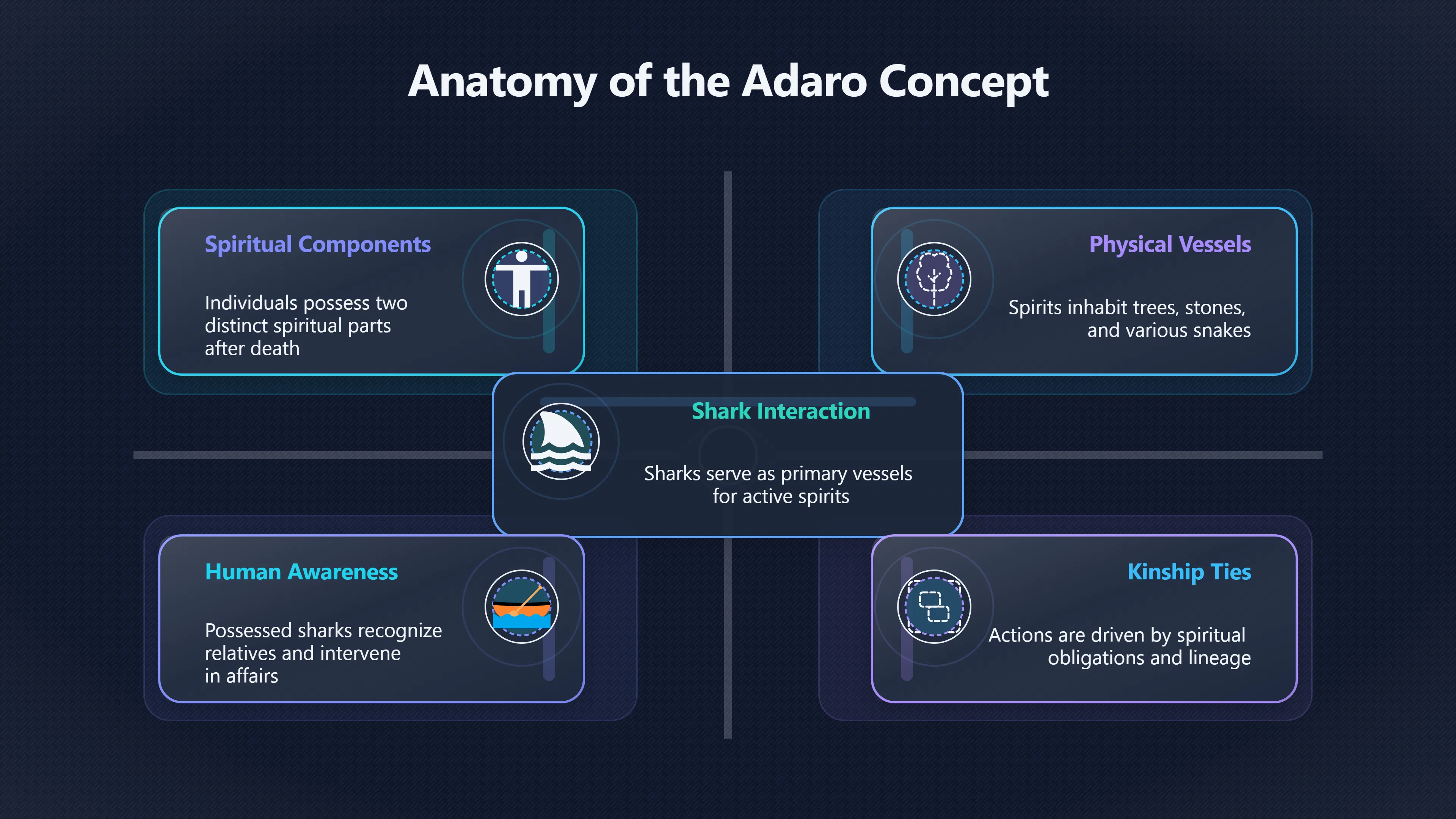
Early ethnographic work among Arosi-speaking communities on Makira revealed that adaro is a broader concept than a single mythical being. Depending on context, it can refer to a ghost, a spirit or one aspect of a person’s existence after death. According to Anglican missionary and linguist Charles E. Fox, people possessed two spiritual components: one continued peacefully after death, while the adaro remained much closer to the human world and could influence events among the living.[Wikipedia]WikipediaAdaro (mythologyAdaro (mythology
One of the most striking features of these traditions is that an adaro may inhabit a physical object or living creature. Trees, stones and snakes could all become vessels, but sharks held a particularly important place because they moved through the dangerous coastal waters where communities fished and travelled daily. A shark carrying an adaro was no longer regarded as an ordinary animal. It possessed human awareness, recognised relatives and could intervene—sometimes protectively, sometimes violently—in human affairs.[Wikipedia]WikipediaAdaro (mythologyAdaro (mythology
Older accounts even describe shark-adaro dragging victims from canoes, not as random attacks by predatory fish but as actions directed by relationships between the dead and the living. Such stories explain misfortune through kinship and spiritual obligation rather than through chance alone.[Wikipedia]WikipediaAdaro (mythologyAdaro (mythology
Sharks as ancestors and agents
Although outsiders often group all Solomon Islands shark beliefs together, traditions vary considerably from island to island.
On Makira, the emphasis often falls on sharks as possible embodiments of adaro or as beings capable of acting on behalf of deceased relatives. Elsewhere, particularly around Malaita, sharks are more commonly understood as powerful guardian beings connected with particular clans, ritual specialists or sacred places. These differences matter because they show that “shark worship” is an oversimplification imposed by many colonial writers.[wikipedia.org]WikipediaAdaro (mythologyAdaro (mythology
Historical descriptions of shark-calling ceremonies illustrate this diversity. In Langalanga Lagoon on Malaita, ritual experts were said to summon particular sharks using chants and offerings. Early colonial officials witnessed sharks approaching canoe passages to be fed pig entrails, apparently showing little fear of nearby people. Later anthropological work concluded that these sharks were regarded as spiritually significant protectors rather than simply tame wild animals. In some communities they were explicitly understood as containing spirits, although not necessarily ancestral ones.[Solomon Islands Encyclopaedia]solomonencyclopaedia.netSolomon Islands Encyclopaedia Shark CallingSolomon Islands EncyclopaediaShark Calling - Concept - Solomon Islands Encyclopaedia, 1893-1978…
These distinctions are easy to lose in modern paranormal retellings, which often merge all shark traditions into a single supernatural narrative. The historical record instead points to a spectrum of beliefs shaped by local history, clan identity and island-specific customs.

Why the sea becomes a haunted boundary
Makira’s traditions place exceptional importance on coastlines, reefs and narrow passages between islands. These are practical spaces where fishing, travel and survival depended upon intimate knowledge of tides and marine life. They are also places where accidents happen, storms strike quickly and sharks are genuine hazards.
Within this environment, the sea becomes more than geography. It is a frontier where invisible relationships remain active. Ghosts may continue to influence descendants. Spirits may inhabit marine creatures. Dangerous stretches of water acquire reputations that combine physical risk with moral or spiritual significance. Anthropologist Michael Scott argues that such beliefs are woven into broader Makiran ideas about kinship, origins and the island’s relationship with unseen powers, rather than existing as isolated ghost stories.[RAI Online Library]rai.onlinelibrary.wiley.comRAI Online LibraryTo be Makiran is to see like Mr Parrot: the anthropology of wonder in Solomon Islands - Scott - 2016 - Journal of the R…
This helps explain why stories involving sharks are often inseparable from questions of ancestry, land rights and family history. They are not merely attempts to explain shark attacks. They describe how people understand belonging, obligation and memory within a landscape shared by both the living and the dead.
Why outsiders often misunderstand these traditions
Missionaries and colonial administrators frequently interpreted adaro as demons or evil ghosts because those concepts fit familiar Christian categories. Later popular writers sometimes transformed them into sea monsters or cryptids, stripping away the social and religious context that gave the traditions their original meaning.[Wikipedia]WikipediaAdaro (mythologyAdaro (mythology
Modern Fortean literature occasionally goes further by presenting adaro as evidence of mysterious marine entities or hidden supernatural races. Yet the historical sources rarely support those interpretations. Instead, they describe a complex cosmology in which:
- spirits may remain active after death;
- certain animals can become vehicles for spiritual power;
- kinship continues beyond physical death;
- dangerous places require ritual respect rather than fearless exploration.
Seen in that light, the stories are less about discovering unknown species than about maintaining relationships with ancestors and navigating a morally charged environment.
How believers and sceptics interpret the stories today
For many Solomon Islanders, especially where traditional kastom continues alongside Christianity, stories about shark ancestors and adaro are not simply relics of the past. They remain part of cultural identity and local understandings of particular places, even if individual beliefs differ from village to village. Anthropologists caution against treating these traditions as either literal supernatural claims or quaint folklore, because they continue to influence how communities understand ancestry, respect and landscape.[RAI Online Library]rai.onlinelibrary.wiley.comRAI Online LibraryTo be Makiran is to see like Mr Parrot: the anthropology of wonder in Solomon Islands - Scott - 2016 - Journal of the R…
From a sceptical perspective, many reported encounters can be interpreted as cultural explanations for shark attacks, drownings or unusual behaviour by marine animals. Oral traditions also naturally evolve over generations, blending historical memories with symbolic storytelling. Neither interpretation fully cancels the other. The enduring importance of adaro lies less in proving paranormal events than in revealing how Makiran communities have long understood the relationship between humans, the sea and those who have gone before.
Within the wider strange history of the Solomon Islands, adaro traditions therefore stand apart from modern cryptid tales. They are not primarily stories about mysterious creatures waiting to be discovered, but about a worldview in which sharks, ghosts and ancestors are capable of overlapping in ways that remain culturally meaningful even today.
Amazon book picks
Further Reading
Books and field guides related to When Sharks, Ghosts and Ancestors Overlap. Use these as the next step if you want deeper reading beyond the article.

The Golden Bough
First published 1890. Subjects: Mythology, Magic, Superstition, Religion, Primitive Religion.

Sharks in the Time of Saviors
First published 2020. Subjects: American literature, Fiction, family life, Hawaii, fiction, Fiction, family life, general, Brothers and s...
Myths and symbols in pagan Europe
First published 1988. Subjects: Norse Mythology, Celtic Mythology, Religion, Celts, Mythology, Norse.
The Solomon Islands: A Historical Encyclopedia
Provides context for Makira traditions and ancestral beliefs.
eBay marketplace picks
Marketplace Samples
Live-tested eBay searches with available results related to this page.



Endnotes
1.
Source: Wikipedia
Title: Adaro (mythology)
Link:https://en.wikipedia.org/wiki/Adaro_%28mythology%29
2.
Source: rai.onlinelibrary.wiley.com
Link:https://rai.onlinelibrary.wiley.com/doi/10.1111/1467-9655.12442
Source snippet
RAI Online LibraryTo be Makiran is to see like Mr Parrot: the anthropology of wonder in Solomon Islands - Scott - 2016 - Journal of the R...
3.
Source: solomonencyclopaedia.net
Title: Solomon Islands Encyclopaedia Shark Calling
Link:https://www.solomonencyclopaedia.net/biogs/E000275b.htm
Source snippet
Solomon Islands EncyclopaediaShark Calling - Concept - Solomon Islands Encyclopaedia, 1893-1978...
4.
Source: onlinelibrary.wiley.com
Link:https://onlinelibrary.wiley.com/doi/full/10.1002/ocea.5286
Source snippet
the Missionary got his Mana: Charles Elliot Fox and the Power of Name‐Exchange in Solomon Islands - Scott - 2021 - Oceania - Wiley Online...
5.
Source: onlinelibrary.wiley.com
Link:https://onlinelibrary.wiley.com/doi/10.1002/ocea.5286
Source snippet
the Missionary got his Mana: Charles Elliot Fox and the Power of Name‐Exchange in Solomon Islands - Scott - 2021 - Oceania - Wiley Online...
6.
Source: godchecker.com
Title: ADAR O
Link:https://www.godchecker.com/melanesian-mythology/ADARO/
Source snippet
ADARO - the Melanesian Demons (Melanesian mythology)April 29, 2019 — MELANESIAN MYTHOLOGY THE GODS AND SPIRITS OF MELANESIA INTRO PANTHEO...
Published: April 29, 2019
7.
Source: arcanebeastsandcritters.wordpress.com
Link:https://arcanebeastsandcritters.wordpress.com/2018/04/21/adaro/
Source snippet
The Compendium of Arcane Beasts and CrittersApril 21, 2018 — ADARO April 21, 2018 by tashepard, posted in Blog Post Image: AB113 Adaro...
Published: April 21, 2018
8.
Source: solomonencyclopaedia.net
Link:https://www.solomonencyclopaedia.net/biogs/E000051b.htm
Source snippet
Biographical entry - Solomon Islands Encyclopaedia, 1893-1978SOLOMON ISLANDS HISTORICAL ENCYCLOPAEDIA 1893-1978 BIOGRAPHICAL ENTRY: CANNI...
Additional References
9.
Source: researchgate.net
Link:https://www.researchgate.net/publication/348502164_How_the_Missionary_got_his_Mana_Charles_Elliot_Fox_and_the_Power_of_Name-Exchange_in_Solomon_Islands
Source snippet
January 1, 2021 — Article PDF Available HOW THE MISSIONARY GOT HIS MANA: CHARLES ELLIOT FOX AND THE POWER OF NAME‐EXCHANGE IN SOLOMON ISL...
Published: January 1, 2021
10.
Source: cambridge.org
Link:https://www.cambridge.org/core/journals/oryx/article/buying-through-your-teeth-traditional-currency-and-conservation-of-flying-foxes-pteropus-spp-in-solomon-islands/1027CA1E63737A9B65B4E749C4578265
Source snippet
in Solomon Islands | Oryx | Cambridge CoreOctober 16, 2017 — BUYING THROUGH YOUR TEETH: TRADITIONAL CURRENCY AND CONSERVATION OF FLYING F...
Published: October 16, 2017
11.
Source: readkong.com
Link:https://www.readkong.com/page/how-the-missionary-got-his-mana-charles-elliot-fox-and-the-6952889
Source snippet
How the Missionary got his Mana: Charles Elliot Fox and the Power of Name-Exchange in Solomon IslandsHOW THE MISSIONARY GOT HIS MANA: CHA...
12.
Source: tandfonline.com
Link:https://www.tandfonline.com/doi/full/10.1080/02757206.2012.649276
Source snippet
Taylor & Francis OnlineThe Matter of Makira: Colonialism, Competition, and the Production of Gendered Peoples in Contemporary Solomon Isl...
13.
Source: tandfonline.com
Link:https://www.tandfonline.com/doi/abs/10.1080/02757206.2012.649276
Source snippet
Historically, the island has also been known as San Cristoval. The parallels are even closer between the Matter of Makira and those versi...
14.
Source: welovesharks.org
Link:https://welovesharks.org/shark-names-and-beliefs-in-different-cultures/
Source snippet
We Love Sharks!November 13, 2020 — SOLOMON ISLANDS: SHARK CALLING AND ANCESTOR SHARKS In parts of the Solomon Islands, particularly aroun...
Published: November 13, 2020
15.
Source: researchers.mq.edu.au
Link:https://researchers.mq.edu.au/en/publications/heirs-to-biblical-prophecy-the-all-peoples-prayer-assembly-in-sol
Source snippet
to Biblical prophecy: the All Peoples Prayer Assembly in Solomon Islands - Macquarie UniversityMay 1, 2015 — HEIRS TO BIBLICAL PROPHECY...
Published: May 1, 2015
17.
Source: nga.gov.au
Link:https://nga.gov.au/exhibitions/gods-ghosts-and-men/
Source snippet
Gods, Ghosts, and Men - National Gallery of AustraliaOctober 10, 2008 — The bridal veil (ambusap) with its painstakingly applied shell de...
Published: October 10, 2008
18.
Source: repository.usp.ac.fj
Title: and Heorake, Tony and Tegu, Esther T. and Oloni, Bronwyn and Simeon, Kellin
Link:https://repository.usp.ac.fj/id/eprint/4023/
Source snippet
revealed by myths in the Pacific: a study of Islands that have disappeared in Solomon Islands - USP Electronic Research RepositoryDecembe...
Topic Tree