Within Moldova Mysteries
The Spirits Behind Moldova's Old Folklore
Stories of strigoi, restless spirits, and supernatural beings reveal how Moldovan communities explained fear and uncertainty.
On this page
- Strigoi and beliefs about the dead
- Household spirits and village fears
- Folklore lessons about life and loss
Page outline Jump by section
Introduction
Moldovan spirit lore is built around a world where the boundary between the living and the dead could become uncertain. The best-known figures are the strigoi and related revenant traditions: stories of troubled dead, dangerous spirits, or uncanny beings that returned to trouble the living. These beliefs are not evidence that vampires existed as physical creatures, but they are important records of how communities in Moldova and the wider historical region of Moldavia explained illness, death, family misfortune, and the dangers of the unknown.[Jan Scientific Journals]revistaselectronicas.ujaen.esOpen source on ujaen.es.

Unlike the later literary vampire created through novels and cinema, traditional Moldovan vampire folklore was less about a glamorous immortal predator and more about disrupted relationships between people, ancestors, and the social order. A person who died wrongly, without proper rites, or under suspicious circumstances could become the subject of stories about a restless presence. These tales preserved fears about what happened when the normal rules surrounding death were broken.[Jan Scientific Journals]revistaselectronicas.ujaen.esOpen source on ujaen.es.
For Moldovas strange-history record, the importance of these traditions lies not in proving supernatural events but in understanding a long-lived cultural mechanism: folklore gave communities a language for experiences that were frightening, unexplained, or emotionally difficult.
Strigoi and beliefs about the dead
Why the restless dead became a powerful idea
The strigoi tradition is one of the clearest links between Moldovan folklore and wider eastern European vampire beliefs. The word is often translated using ideas such as vampire, revenant, or troubled spirit, but the traditional concept was broader than the modern image of a blood-drinking undead monster. Folklore accounts describe strigoi as beings connected with death, misfortune, and the possibility that a persons existence could continue in a harmful form after burial.[Jan Scientific Journals]revistaselectronicas.ujaen.esOpen source on ujaen.es.
Historical descriptions show that these beliefs were already being recorded in Moldavia centuries ago. The Moldavian scholar and ruler Dimitrie Cantemir discussed beliefs about striga in his early eighteenth-century work Descriptio Moldaviae. His account reflected the fears and explanations of his period, including ideas about harmful supernatural figures, although it did not describe vampires in the modern fictional sense.[Wikipedia]WikipediaDescriptio MoldaviaeDescriptio Moldaviae
Traditional stories often connected restless spirits with problems that affected ordinary life: unexplained sickness, repeated bad luck, deaths within a family, or disturbances that seemed to have no visible cause. In this sense, the strigoi functioned as an explanation for uncertainty. A mysterious event could be placed into a moral and spiritual framework: something had gone wrong, and the community needed to restore balance.
The vampire connection and the differences
Popular culture often places Moldova inside the wider vampire country image associated with the Carpathian region. However, folklore scholars generally separate traditional beliefs from the fictional vampire created by later literature. The strigoi was not simply a local version of the creature from modern horror films.
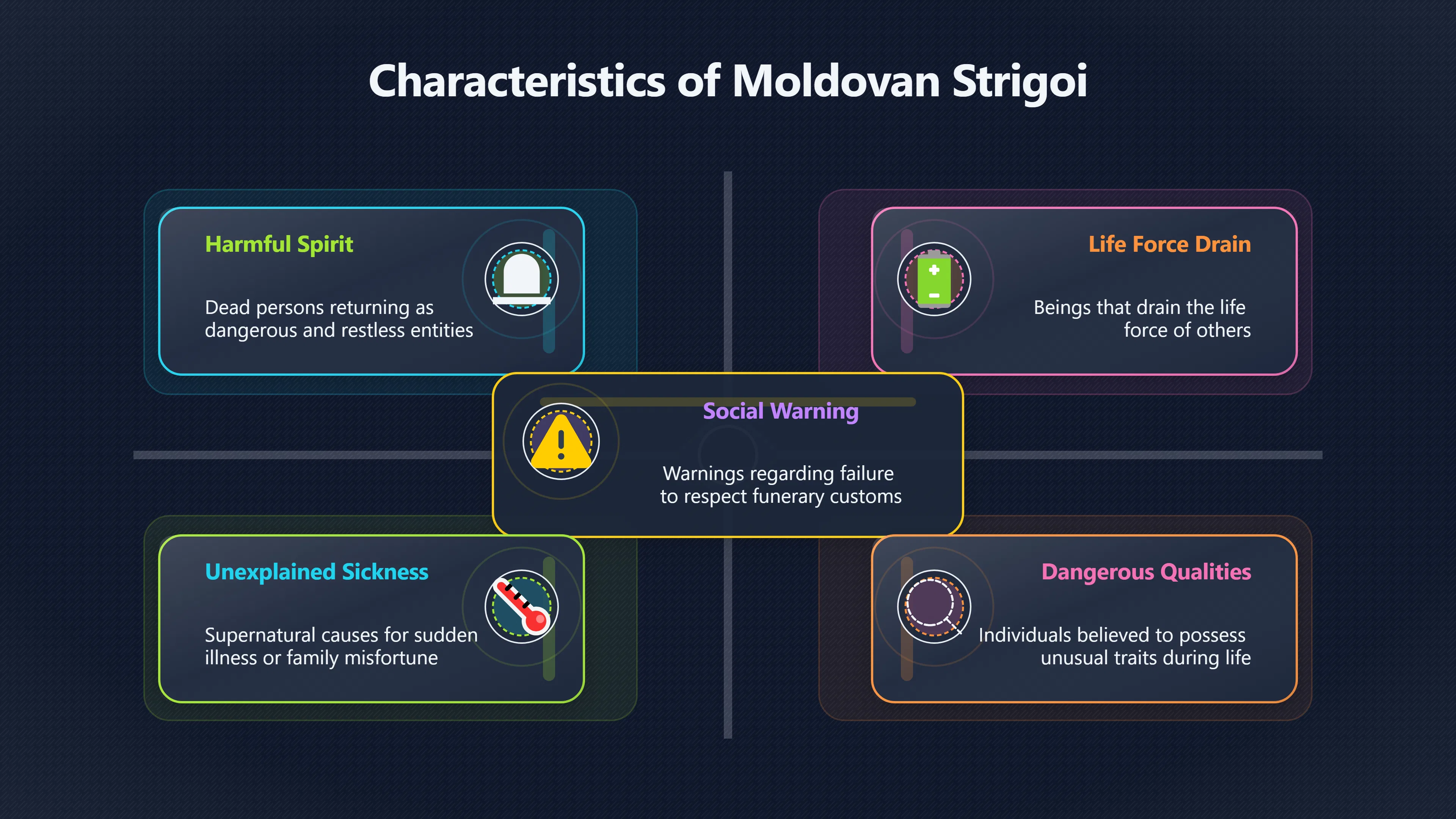
Traditional accounts include several overlapping ideas:
- a dead person returning as a harmful spirit;
- a person believed to possess unusual or dangerous qualities during life;
- a supernatural cause for illness or misfortune;
- a warning about failing to respect funerary customs and social obligations.[Jan Scientific Journals]revistaselectronicas.ujaen.esOpen source on ujaen.es.
This variety explains why vampire folklore has survived so strongly. The stories were flexible enough to absorb different fears. A vampire in a novel needs a fixed set of rules; a folklore spirit changes with the concerns of the people telling the story.
Household spirits and village fears
The supernatural inside everyday life
Moldovan supernatural traditions were not limited to graves and cemeteries. Many beliefs placed unseen forces within the home, fields, forests, and village boundaries. Household spirits across eastern European traditions often represented the idea that a home had its own character and needed respect. Similar Slavic traditions describe protective household beings connected with family, ancestry, and domestic space.[Wikipedia]WikipediaOpen source on wikipedia.org.
For rural communities, this created a spiritual map of daily life. The house was not merely a building; it was a place where family history accumulated. The boundary between safe and unsafe spaces mattered: the doorway, the hearth, the yard, and the surrounding land all carried symbolic meaning.
This way of thinking helped explain ordinary mysteries. A strange noise at night, an object moved from its place, an animal behaving unusually, or a run of household problems could become attached to an unseen cause. From a modern perspective, these stories may reflect misunderstanding, coincidence, memory, or social storytelling. Within the traditional worldview, however, they provided a meaningful explanation.
Protection rituals and respect for the dead
Beliefs about spirits also shaped behaviour. Customs surrounding death, burial, remembrance, and family obligations were not only religious acts but ways of maintaining harmony between generations.
A key theme across Moldovan traditions is that the dead remained part of the community. Later practices such as remembrance gatherings for deceased relatives show that the relationship between living and dead has remained culturally important. Modern commemorations such as Patele Blajinilor continue to centre on visiting graves, sharing food, and honouring ancestors. These customs are not vampire beliefs, but they belong to the same wider cultural landscape in which the dead are remembered as socially present rather than simply absent.[Le Monde.fr]lemonde.frLe Monde.fr In Moldova, families gather at cemeteries for 'Easter of the DeadHeld the Sunday after Orthodox Easter, it reunites families at cemeteries to commemorate deceased loved ones with food offerings, prayers…
The contrast is important: folklore did not only imagine frightening spirits. It also preserved ideas of connection, care, and responsibility between generations.
Folklore lessons about life and loss
What strigoi stories reveal about Moldovan culture
The lasting appeal of Moldovan spirit traditions comes from the human problems hidden beneath the supernatural surface. Strigoi stories are ultimately stories about grief, fear, injustice, and the difficulty of accepting death.
A belief in a returning dead person could express anxiety about an unfinished life. Someone who died suddenly, violently, or without proper farewell could become the focus of a story because the community struggled to place the loss into an understandable order. Folklore transformed emotional uncertainty into a narrative with causes, warnings, and possible solutions.[Jan Scientific Journals]revistaselectronicas.ujaen.esOpen source on ujaen.es.
The same pattern appears in many traditional cultures: supernatural explanations often emerge where people face events that feel beyond control. Before modern medicine, scientific explanations of disease, and detailed knowledge of natural processes, communities used available cultural tools to interpret frightening experiences.
Why vampire folklore still survives
Modern interest in Moldovan and eastern European vampire traditions comes partly from their influence on global horror culture. Yet the older folklore remains interesting precisely because it is stranger and more complicated than the fictional vampire.
The traditional strigoi was not simply a monster waiting in the dark. It was a symbol of disrupted relationships: between families and ancestors, between the living and the dead, and between human beings and the uncertainties of existence.
Seen through the lens of Fortean history, Moldovas vampire folklore is therefore less a record of unexplained creatures than a record of unexplained experiences. The mystery lies in how people interpreted the unknown, how stories travelled through generations, and why fears from centuries ago can still feel recognisable today.
Amazon book picks
Further Reading
Books and field guides related to The Spirits Behind Moldova's Old Folklore. Use these as the next step if you want deeper reading beyond the article.

The Golden Bough
First published 1890. Subjects: Mythology, Magic, Superstition, Religion, Primitive Religion.
The vampire
First published 1998. Subjects: Volkscultuur, Vampir, Vampires, Pathologie, Vampiers.
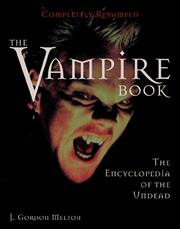
The Vampire Book
First published 1994. Subjects: Encyclopedias, Vampires, Dictionaries, Vampiers, Encyclopedieën (vorm).
The encyclopedia of spirits
First published 2009. Subjects: Supernatural, Spirits, Encyclopedias, Spirituality, Magic.
eBay marketplace picks
Marketplace Samples
Live-tested eBay searches with available results related to this page.
Endnotes
1.
Source: Wikipedia
Link:https://en.wikipedia.org/wiki/Strigoi
2.
Source: Wikipedia
Title: Descriptio Moldaviae
Link:https://es.wikipedia.org/wiki/Descriptio_Moldaviae
3.
Source: Wikipedia
Link:https://en.wikipedia.org/wiki/Domovoy
4.
Source: moldova.travel
Title: Our country is an interesting combination of cul
Link:https://moldova.travel/en/culture/
Source snippet
n Culture and Cultural Sites - Moldova TravelCULTURAL ATTRACTIONS If cultural travel and learning about history, traditions and fo...
5.
Source: everything.explained.today
Link:https://everything.explained.today/Strigoi/
Source snippet
The villager is believed to have been th...
6.
Source: youtube.com
Title: Before Dracula: The True Story of the Strigoi | Romanian Vampire Folklore
Link:https://www.youtube.com/watch?v=IMVPkTAZYLg
Source snippet
Strigoi | Dead and Living Vampire Witches in Romanian Folklore...
7.
Source: youtube.com
Title: Strigoi | Dead and Living Vampire Witches in Romanian Folklore
Link:https://www.youtube.com/watch?v=hp0Q8s6AeBA
Source snippet
Night of the Wolf | The Witches' Winter Sabbath on Saint Andrew's...
8.
Source: revistaselectronicas.ujaen.es
Link:https://revistaselectronicas.ujaen.es/index.php/blo/article/view/3655
9.
Source: lemonde.fr
Title: Le Monde.fr In Moldova, families gather at cemeteries for ‘Easter of the Dead’
Link:https://www.lemonde.fr/en/international/article/2026/04/25/in-moldova-families-gather-at-cemeteries-for-easter-of-the-dead_6752810_4.html
Source snippet
Held the Sunday after Orthodox Easter, it reunites families at cemeteries to commemorate deceased loved ones with food offerings, prayers...
10.
Source: mythpedia.fandom.com
Link:https://mythpedia.fandom.com/wiki/Strigoi
Source snippet
Some strigoi can be living people...
11.
Source: vampires.fandom.com
Link:https://vampires.fandom.com/wiki/Strigoi
Source snippet
STRIGOI TYPE OF VAMPIRE Living vampires...
12.
Source: la.wikisource.org
Title: Descriptio Moldaviae
Link:https://la.wikisource.org/wiki/Descriptio_Moldaviae
Source snippet
Moldaviae - WikisourceDESCRIPTIO MOLDAVIAE [Input] 1 language * Română Nexus recensere * Opus * Fons * Disputatio [Input] Latina * Legere...
13.
Source: editurajunimea.ro
Title: Descriptio Moldaviae
Link:https://editurajunimea.ro/carte/descriptio-moldaviae/
Source snippet
Editura Junimea, IașiDESCRIPTIO MOLDAVIAE AUTOR: CANTEMIR DIMITRIE 40,00 lei EDITOR / COORDONATOR: [Input: ] [Button: Adaugă în coș] Admi...
14.
Source: targulcartii.ro
Title: descrierea moldovei
Link:https://www.targulcartii.ro/dimitrie-cantemir/descrierea-moldovei
Source snippet
Dimitrie Cantemir - TargulCartii.roDESCRIEREA MOLDOVEI - DIMITRIE CANTEMIR [Select] [Select] [Select] [Select] [Select] Vezi -58% [Input]...
Additional References
15.
Source: himoldova.md
Link:https://www.himoldova.md/en/md/national-museum-of-ethnography-and-natural-history/
Source snippet
NATIONAL MUSEUM OF ETHNOGRAPHY AND NATURAL HISTORY NATIONAL MUSEUM OF ETHNOGRAPHY AND NATURAL HISTORY CULTURE The very first mus...
16.
Source: aboutmoldova.md
Link:https://aboutmoldova.md/en/view_articles_post.php?id=3579
Source snippet
September 10, 2025 — Date: 10 September 2025 • Author: Veronika Russo HOW MOLDOVAN FOLKLORE MYTHS AND SLAVIC MYTHOLOGY IN MOLDOVA SHAPE M...
Published: September 10, 2025
17.
Source: la.wikisource.org
Link:https://la.wikisource.org/wiki/Pagina%3ADimitrie_Cantemir_-Operele_Principelui_Demetriu_Cantemiru%2C_typ%C4%83rite_de_Societatea_Academic%C4%83_Rom%C3%A2n%C4%83._Volumul_1-_Descriptio_Moldaviae._Cu_charta_g.pdf/151
Source snippet
Volumul 1 - Descriptio Moldaviae. Cu charta g.pdf/151 - WikisourceMarch 20, 2024 — PAGINA:DIMITRIE CANTEMIR - OPERELE PRINCIPELUI DEMETRI...
Published: March 20, 2024
18.
Source: intellectdiscover.com
Link:https://intellectdiscover.com/content/journals/10.1386/jspc.1.1.43_1
Source snippet
March 1, 2018 — * # f (Free content) Pathogens, vermin and strigoi: Contagion science and vampire myth in Guillermo del Toro’s The Strain...
Published: March 1, 2018
19.
Source: sicro.md
Link:https://sicro.md/en/attractions/moldova/the-national-museum-of-ethnography-and-natural-history
Source snippet
The National Museum of Ethnography and Natural HistoryTHE NATIONAL MUSEUM OF ETHNOGRAPHY AND NATURAL HISTORY Chisinau 1,5 h Easy Image On...
20.
Source: shudderwick.com
Link:https://shudderwick.com/stories/the-strigoi
Source snippet
I want to be clear about this because the blood detail, while present, is not the main thing. The strigoi drains life. Life force. The wo...
21.
Source: muzeu.md
Link:https://www.muzeu.md/
Source snippet
l National de Etnografie si Istorie Naturala |ULTIMILE NOUTĂȚI EXPOZIȚIA DE PICTURĂ „ARMONII FLORALE ÎN CREAȚIA LUI MIHAI OSTAHI” Ex...
22.
Source: visit.chisinau.md
Link:https://visit.chisinau.md/en/obiective_turistice/muzeul-national-de-etnografie-si-istorie-naturala/
Source snippet
Museum of Ethnography and Natural History – ChisinauNATIONAL MUSEUM OF ETHNOGRAPHY AND NATURAL HISTORY Its history begins in 1889, when t...
23.
Source: secbcm.gov.md
Link:https://secbcm.gov.md/eng/national-museum-of-ethnography-and-natural-history
Source snippet
Museum of Ethnography and Natural Historysecbcm.gov.md Museums of Moldova National Museum of Ethnography and Natural History CHIȘINĂU Nat...
24.
Source: turism.gov.md
Link:https://turism.gov.md/en/obiective_turistice/muzeul-national-de-etnografie-si-istorie-naturala/
Source snippet
National Museum of Ethnography and Natural History | Moldova Turism* * # The National Museum of Ethnography and Natural History The Natio...
Topic Tree