Within Andorra Weird
Were Andorra's Witches Really Put on Trial?
Andorra's witchcraft record is strongest where legal archives show how rumour, illness and storms could turn neighbours into suspects.
On this page
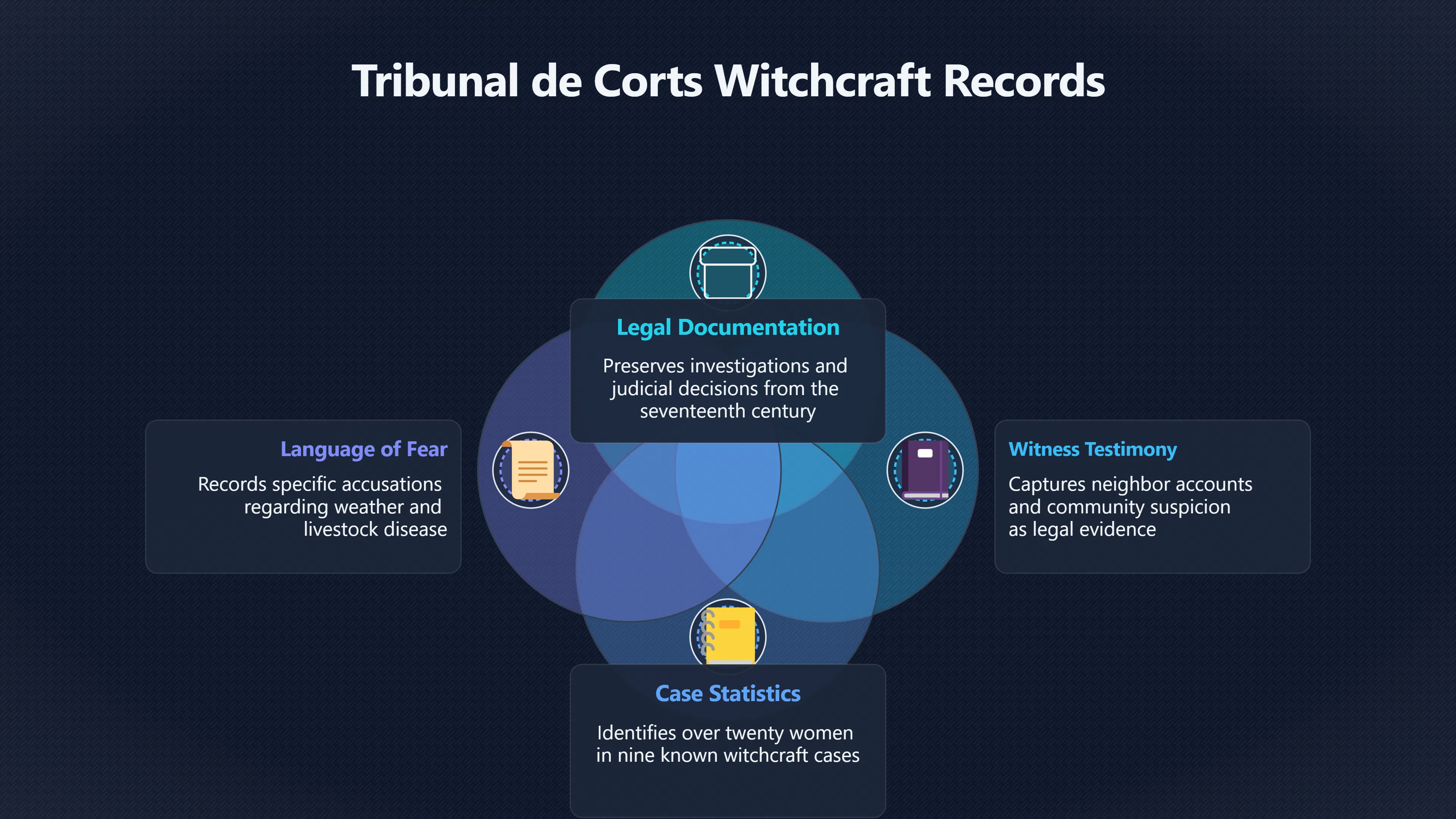
- What the Tribunal de Corts records preserve
- Accusations, neighbours and coercive justice
- Why the Pyrenees became early witch hunt country
Page outline Jump by section
Introduction
Were Andorra’s witches really put on trial? Yes—but not because anyone proved supernatural powers existed. The surviving legal records show that early modern Andorra experienced genuine witchcraft prosecutions in which neighbours accused neighbours of causing illness, storms, livestock deaths and other misfortunes. What makes these cases historically important is not evidence for magic, but evidence for fear. In a tiny mountain society where communities depended on one another for survival, rumour could become testimony, suspicion could become legal evidence, and ordinary women could find themselves facing the courts. The result is one of the richest documentary records of witch-hunting in the Pyrenees, making Andorra’s witch trials one of the country’s strongest pieces of historical Forteana rather than simply a collection of folk legends.[Patrimoni Cultural]patrimoni.gencat.catPatrimoni Cultural They were talked aboutand they were out thereover twenty women in connection with at least nine cases of alleged witchcraft between 1514 and 1522: Arxiu Nacion…
What the Tribunal de Corts records preserve
Unlike many folklore traditions that survive only through oral storytelling, Andorra’s witchcraft history is anchored in legal archives. The records of the Tribunal de Corts, the country’s highest court from the early seventeenth century onwards, preserve investigations into alleged witchcraft, witness testimony and judicial decisions. These documents provide rare insight into how a very small Pyrenean society interpreted disaster and assigned blame.[Patrimoni Cultural]patrimoni.gencat.catPatrimoni Cultural They were talked aboutand they were out thereover twenty women in connection with at least nine cases of alleged witchcraft between 1514 and 1522: Arxiu Nacion…
The surviving archive shows that accusations were not isolated oddities. Historians have identified more than twenty women connected with at least nine known witchcraft cases in the early sixteenth century, demonstrating that suspicion of witchcraft was an established legal concern rather than a single episode of panic. Although the number of prosecutions was modest compared with the largest European witch hunts, it is remarkable given Andorra’s tiny population.[Patrimoni Cultural]patrimoni.gencat.catPatrimoni Cultural They were talked aboutand they were out thereover twenty women in connection with at least nine cases of alleged witchcraft between 1514 and 1522: Arxiu Nacion…
The records also preserve the language of fear. Alleged witches were said to:
- bring destructive hailstorms and violent weather;
- spread disease among people or livestock;
- poison neighbours or damage crops;
- attend secret nocturnal gatherings;
- make pacts with the Devil.
To modern readers these accusations may appear fantastical, but within the legal culture of the sixteenth and seventeenth centuries they were treated as plausible explanations for genuine hardship. Similar accusations recur throughout the Pyrenees, allowing historians to compare Andorra’s cases with neighbouring Catalonia while recognising that the Andorran archive is unusually well preserved.[Patrimoni Cultural]patrimoni.gencat.catPatrimoni Cultural They were talked aboutand they were out thereover twenty women in connection with at least nine cases of alleged witchcraft between 1514 and 1522: Arxiu Nacion…
Accusations, neighbours and coercive justice
The most revealing aspect of the Andorran trials is who made the accusations. They were rarely the product of distant authorities arriving with a preconceived campaign. Instead, complaints usually emerged within local communities, where existing tensions could be transformed into criminal allegations.
A failed harvest, unexplained illness or a sudden storm demanded an explanation in a society with limited medical or scientific understanding. Someone already regarded as difficult, marginal, elderly, poor, widowed or unusually knowledgeable about herbs might become the obvious suspect. Once several neighbours repeated similar stories, those claims could enter the legal process as corroborating evidence rather than mere gossip.[The National Archives]nationalarchives.gov.ukThe National ArchivesEarly Modern witch trialsThis resource helps to highlight some of the reasons why people were accused of witchcraft…
The justice system itself intensified the danger. Across early modern Europe, witchcraft prosecutions often relied on coercive questioning and confessions obtained under severe pressure. Historians studying the Pyrenean trials emphasise that admissions of guilt cannot be read as reliable evidence that the accused genuinely believed they had supernatural powers. Instead, they reveal the enormous pressure created by judicial procedure and community expectation.[UC Berkeley Law]law.berkeley.eduUC Berkeley LawWitch Trials in Early Modern Europe and New EnglandHistorians have identified a number of crucial legal developments that…
For that reason, modern historians generally interpret the surviving testimony as evidence of social conflict rather than proof of occult practice. The real tragedy lay not in supernatural events, but in the willingness of frightened communities to transform misfortune into criminal guilt.
Why the Pyrenees became early witch-hunt country
Andorra did not experience its witch trials in isolation. The central Pyrenees formed one of Europe’s earliest and most active regions for witchcraft prosecutions, with neighbouring Catalonia developing distinctive patterns that differed from much of the rest of Spain.
Several factors came together:
- Mountain isolation. Small, closely connected settlements meant rumours spread quickly and personal disputes were difficult to escape.
- Environmental uncertainty. Crop failures, hailstorms and livestock disease threatened survival in high mountain valleys, encouraging searches for human causes.
- Local courts. In much of Catalonia and neighbouring territories, secular courts often pursued witchcraft cases more aggressively than the Spanish Inquisition, which was frequently more sceptical of spectacular witchcraft claims.
- Religious change. The upheavals of the Reformation and Counter-Reformation heightened concern about hidden threats to Christian society.[berkeley.edu]law.berkeley.eduUC Berkeley LawWitch Trials in Early Modern Europe and New EnglandHistorians have identified a number of crucial legal developments that…
This regional context helps explain why Andorra’s experience appears unusual. Spain as a whole is often remembered for the Inquisition, yet the most intense witch-hunting occurred in the Pyrenean borderlands through local institutions rather than inquisitorial tribunals. That places Andorra within a distinctive legal and cultural landscape stretching across the mountain valleys rather than within a single national story.[Wikipedia]WikipediaWitch trials in CataloniaWitch trials in Catalonia
The folklore behind the fear—and the fear behind the folklore
Stories of witches flying through mountain passes or gathering on lonely peaks remain part of Andorran folklore today. Such tales are culturally important, but the court records reveal something more unsettling: folklore and legal reality fed one another.
Legends about witches causing storms or meeting the Devil were not simply fireside entertainment. They supplied ready-made explanations when disaster struck. If hail destroyed crops after someone had quarrelled with a neighbour, an existing story about witches controlling the weather could suddenly appear convincing. Folklore therefore became part of the mental framework through which ordinary people interpreted misfortune.
The legal archive shows this process in reverse as well. Once prosecutions occurred, they reinforced belief that witches genuinely existed. Executions or convictions appeared to validate the rumours, encouraging later generations to remember the supernatural claims long after the social conflicts that produced them had been forgotten. The result is a feedback loop between story, suspicion and justice that helps explain why witch traditions remained so resilient in the Pyrenees.[Patrimoni Cultural]patrimoni.gencat.catPatrimoni Cultural They were talked aboutand they were out thereover twenty women in connection with at least nine cases of alleged witchcraft between 1514 and 1522: Arxiu Nacion…

Why the trials still matter
For readers interested in Andorra’s strange history, the witch trials stand apart from ghost stories or legendary lakes because they are documented rather than merely remembered. The archives demonstrate that belief in witchcraft produced tangible legal consequences, affecting real individuals whose names and accusations survive centuries later.
Modern scholarship increasingly treats these records as evidence of social history rather than supernatural history. Researchers study them to understand gender, local politics, environmental anxiety and the psychology of small communities under stress. The trials also connect naturally with other Andorran traditions—from landscapes associated with witches to mountain legends—showing how folklore and everyday life continually shaped one another.
That is the real fear behind Andorra’s witch folklore. The danger was never that witches could summon storms. It was that ordinary people, confronting disease, hunger and uncertainty, sincerely believed someone among them had. Once that belief entered the courtroom, folklore ceased to be just a story and became a matter of life and death.
Amazon book picks
Further Reading
Books and field guides related to Were Andorra's Witches Really Put on Trial?. Use these as the next step if you want deeper reading beyond the article.
The witch-hunt in early modern Europe
Provides the legal and historical framework for Andorra's trials.


The Penguin book of witches
Offers primary-source perspectives on witchcraft accusations.
eBay marketplace picks
Marketplace Samples
Live-tested eBay searches with available results related to this page.


Endnotes
1.
Source: Wikipedia
Link:https://en.wikipedia.org/wiki/Andorra
2.
Source: law.berkeley.edu
Link:https://www.law.berkeley.edu/research/the-robbins-collection/exhibitions/witch-trials-in-early-modern-europe-and-new-england/
Source snippet
UC Berkeley LawWitch Trials in Early Modern Europe and New EnglandHistorians have identified a number of crucial legal developments that...
3.
Source: Wikipedia
Title: Witch trials in Catalonia
Link:https://en.wikipedia.org/wiki/Witch_trials_in_Catalonia
4.
Source: patrimoni.gencat.cat
Title: Patrimoni Cultural They were talked about
Link:https://patrimoni.gencat.cat/sites/default/files/hd-images-zip/descarregues/llibreBRUIXES_eng_final.pdf
Source snippet
and they were out thereover twenty women in connection with at least nine cases of alleged witchcraft between 1514 and 1522: Arxiu Nacion...
5.
Source: nationalarchives.gov.uk
Link:https://www.nationalarchives.gov.uk/education/resources/early-modern-witch-trials/
Source snippet
The National ArchivesEarly Modern witch trialsThis resource helps to highlight some of the reasons why people were accused of witchcraft...
Additional References
6.
Source: amnesty.eu
Link:https://www.amnesty.eu/news/andorra-defamation-charge-against-activist-facing-trial-for-speaking-out-about-womens-rights-must-be-dropped/
Source snippet
Andorra: Defamation charge against activist facing trial for...16 Dec 2022 — In 2020 the public prosecutor brought three criminal defama...
7.
Source: multicoloreddiary.blogspot.com
Link:https://multicoloreddiary.blogspot.com/2018/12/land-of-witches-following-folktales.html
Source snippet
Land of witches (Following folktales around the world 95.Dec 10, 2018 — This legend explains the origins of the Bronze Age rock carvings...
8.
Source: facebook.com
Link:https://www.facebook.com/KTSM9News/posts/accused-witches-may-be-exonerated-centuries-later/557030016461410/
Source snippet
were also prosecuted. In some regions, such as parts of...Read more...
9.
Source: perennialpyrenees.com
Title: weekly article 10 [roc de les bruixes]({{ ‘witches-rock/’ | relative_url }})
Link:https://perennialpyrenees.com/2017/04/28/weekly-article-10-roc-de-les-bruixes/
Source snippet
Weekly Article #10 – Roc de les BruixesApr 28, 2017 — Frequently witches would gather upon the rock and cast spells, and at times the Dev...
10.
Source: ials.sas.ac.uk
Title: witch trials enshrined law
Link:https://ials.sas.ac.uk/news-events/blogs/witch-trials-enshrined-law
Source snippet
Witch Trials: enshrined in law30 Oct 2025 — The Witch Trials – a dark stain on the historical imagination – were a legal phenomenon that...
11.
Source: legalhistorymiscellany.com
Title: elizabethan witch trials
Link:https://legalhistorymiscellany.com/2019/06/30/elizabethan-witch-trials/
Source snippet
More Evidence (and a Map)30 Jun 2019 — Most of what we know of accusations of felony witchcraft in early modern England comes from the fe...
12.
Source: youtube.com
Link:https://www.youtube.com/watch?v=jKG07dEQlF4
Source snippet
itchcraft of these the vast majority were women...
13.
Source: youtube.com
Link:https://www.youtube.com/watch?v=6nxzZbmd6HU
Source snippet
The Dark Secret Behind the Basque Witch Trials...
14.
Source: perennialpyrenees.com
Link:https://perennialpyrenees.com/2017/04/24/weekly-article-1-the-witches-of-[engolasters
Source snippet
Weekly Article #1 – The Witches of Engolasters Lake24 Apr 2017 — Witchcraft and the Pyrenees have long been linked in popular memory, not...
15.
Source: theworld.org
Link:https://theworld.org/stories/2022/02/14/catalonia-pardons-women-accused-witchcraft-400-years-ago
Source snippet
Catalonia pardons women accused of witchcraft 400 years...14 Feb 2022 — About 400 hundred years ago, in the small Catalan village of Vil...
Topic Tree