Within Weird Denmark
Was Denmark's Sea Monk Ever Solved?
The sea monk turns one strange Renaissance report from the Oresund into a bigger story about monsters, science and uncertainty.
On this page
- The Oresund report and early naturalists
- Giant squid, angelshark or crafted curiosity
- Why the sea monk still matters
Page outline Jump by section
Introduction
The so-called Sea Monk is Denmark’s most famous historical sea monster, but it is also one of the best examples of how Renaissance natural history blurred the boundaries between eyewitness testimony, artistic interpretation and scientific curiosity. According to 16th-century accounts, a strange creature resembling a hooded monk was caught or washed ashore in the Øresund, the narrow stretch of water between Zealand and what is now southern Sweden, around 1546. The story spread rapidly across Europe through printed natural history books, royal correspondence and illustrated chronicles, becoming a celebrated curiosity rather than a local legend alone.[Cryptozoological Reference Library]cryptozoologicalreferencelibrary.files.wordpress.comCryptozoological Reference Librarya new interpretation of the sea monkSteenstrup suggested the sea monk of the Øresund was a giant squid (Architeuthis sp.). The evaluation of three, previously…Read more…
Unlike many legendary monsters, the Sea Monk has generated centuries of serious debate. Scholars have tried to identify the animal behind the reports, proposing everything from a giant squid to an angelshark, while others argue that no single animal fits the surviving descriptions. The case matters not because it proves an unknown creature existed, but because it reveals how evidence was collected, transmitted and transformed long before modern zoology.
The Øresund report and the early naturalists
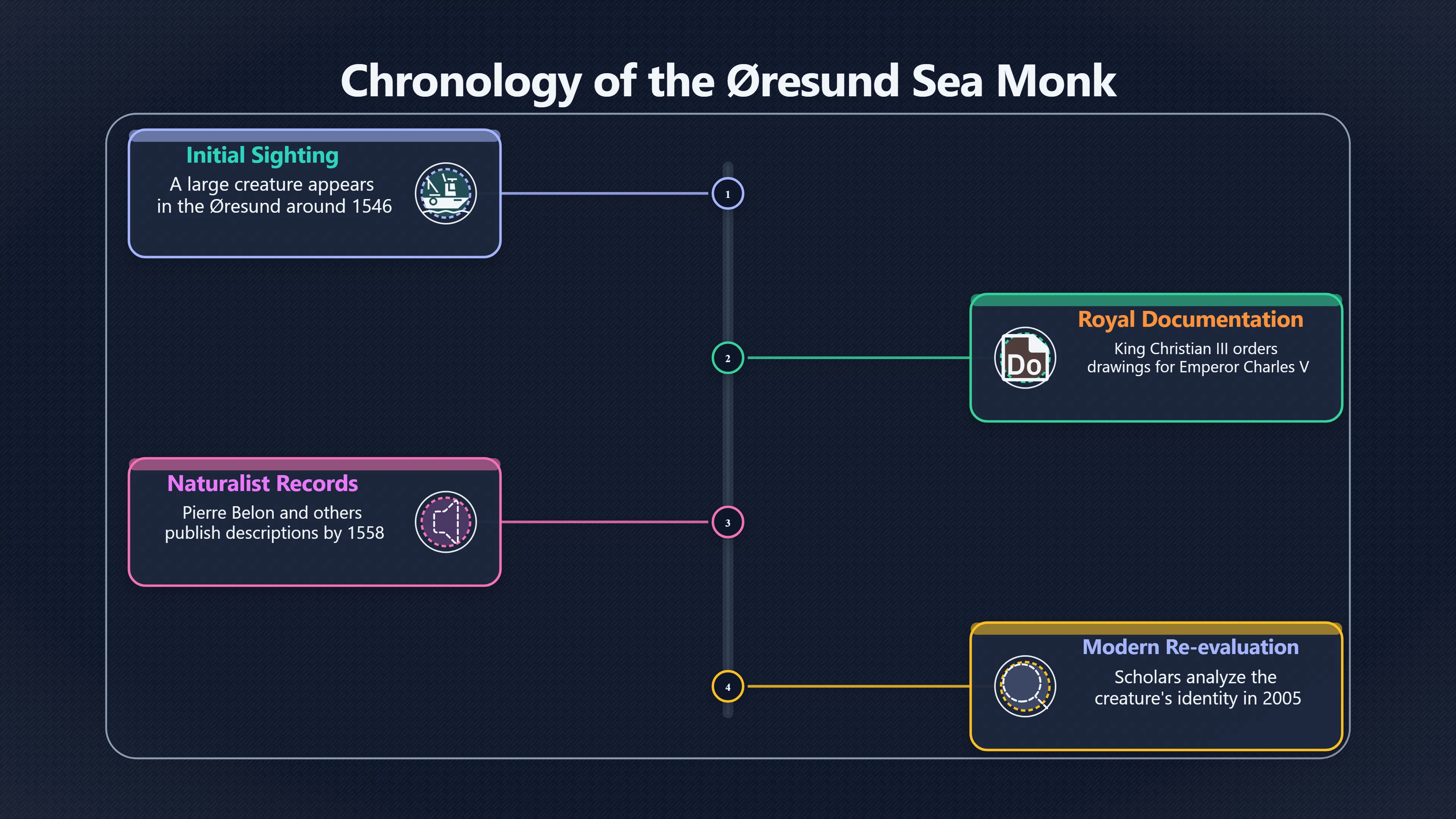
The core story is surprisingly consistent despite the passage of time. Sometime between 1545 and 1550—most likely in 1546—a large marine creature was reportedly caught in the Øresund. King Christian III of Denmark is said to have ordered drawings of the animal to be sent to Holy Roman Emperor Charles V, ensuring that news of the discovery travelled through Europe’s network of scholars and courts.[Cryptozoological Reference Library]cryptozoologicalreferencelibrary.files.wordpress.comCryptozoological Reference Librarya new interpretation of the sea monkSteenstrup suggested the sea monk of the Øresund was a giant squid (Architeuthis sp.). The evaluation of three, previously…Read more…
The creature’s fame rests largely on three Renaissance naturalists:
- Pierre Belon described the “monk fish” in 1553 and expanded his account in 1555.
- Guillaume Rondelet included an illustration in 1554 but openly warned that artists had probably exaggerated some features.
- Conrad Gesner incorporated the reports into his monumental Historia Animalium in 1558, helping establish the Sea Monk as part of Europe’s accepted catalogue of unusual creatures.[Cryptozoological Reference Library]cryptozoologicalreferencelibrary.files.wordpress.comCryptozoological Reference Librarya new interpretation of the sea monkSteenstrup suggested the sea monk of the Øresund was a giant squid (Architeuthis sp.). The evaluation of three, previously…Read more…
These authors were not simply copying folklore. They believed unusual animals deserved investigation, yet they worked in an age when firsthand observation, copied drawings, hearsay and classical authorities all carried scientific weight. Rondelet’s scepticism is particularly striking: although he accepted that an unusual animal had existed, he suspected painters had made it appear more marvellous than it really was. That caution gives modern historians an important clue that even contemporary observers recognised the dangers of embellished evidence.[Wikipedia]WikipediaSea monkSea monk
Descriptions vary, but several recurring features appear across the surviving accounts:
- a dark, rounded head resembling a monk’s tonsure;
- broad shoulder-like fins;
- a cloak-like covering or folded body;
- a tapered lower body ending in a tail;
- an overall human-like silhouette when viewed from the front.
Those characteristics became more memorable than anatomically precise, making later identification difficult.
Giant squid, angelshark or crafted curiosity?
For centuries the Sea Monk remained simply an unexplained curiosity. The first major scientific reinterpretation came in the nineteenth century from Danish zoologist Japetus Steenstrup.
The giant squid hypothesis
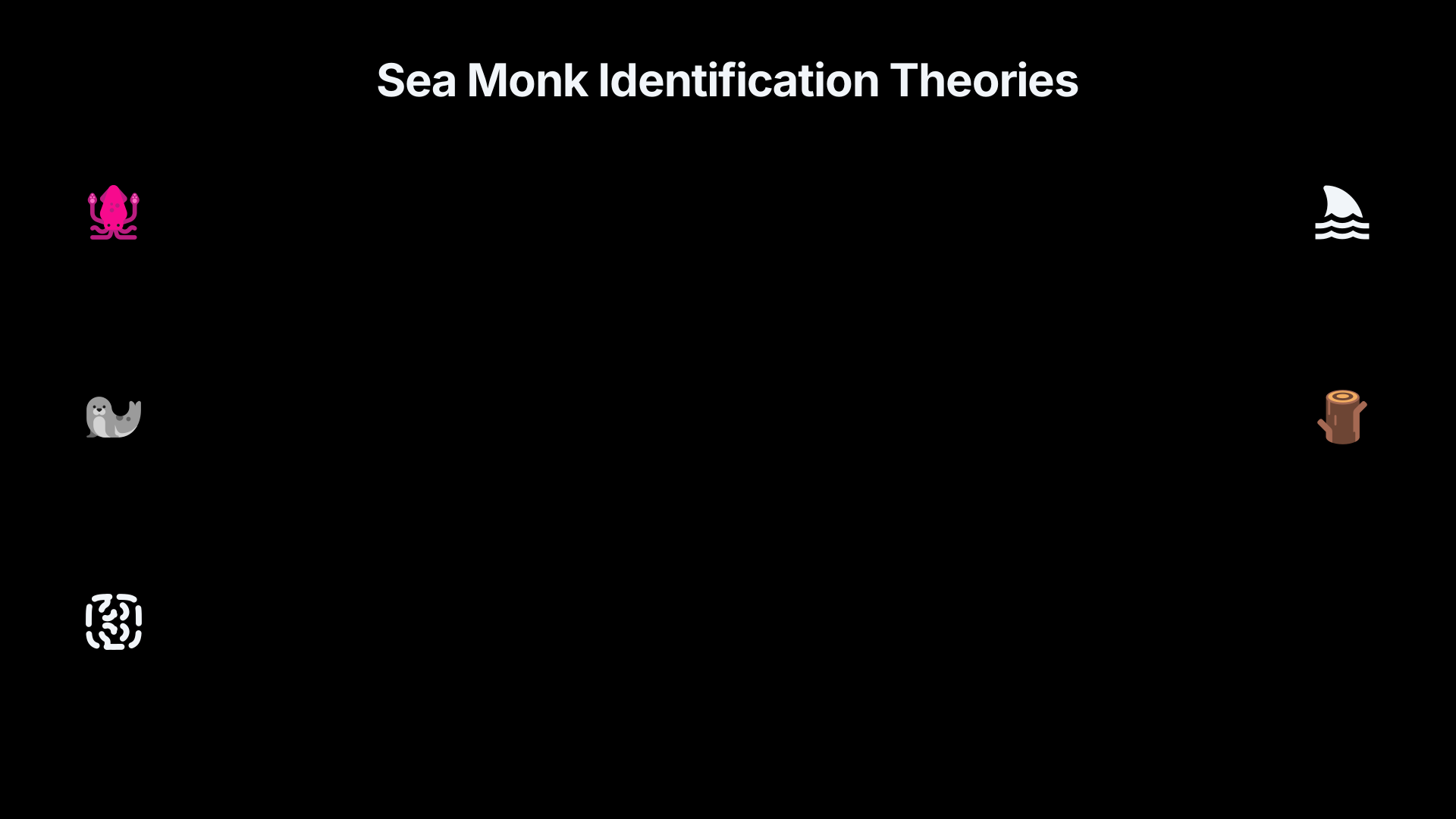
Steenstrup, whose pioneering work helped establish the reality of giant squid, argued that the Sea Monk had actually been a squid viewed upside down. He suggested the mantle became the apparent “head”, the fins looked like a hood or cloak, and the bundled arms resembled folded human limbs. He even proposed the scientific name Architeuthis monachus for the supposed animal.[wordpress.com]cryptozoologicalreferencelibrary.files.wordpress.comCryptozoological Reference Librarya new interpretation of the sea monkSteenstrup suggested the sea monk of the Øresund was a giant squid (Architeuthis sp.). The evaluation of three, previously…Read more…
His interpretation was influential because giant squid genuinely explained several mysterious sea monsters reported around northern Europe before specimens became scientifically recognised.
Why many researchers now favour the angelshark
A detailed re-examination published in Steenstrupia in 2005 revisited overlooked early documents and compared the historical descriptions with modern marine animals. The authors concluded that the giant squid explanation fits less well than previously believed.
Instead, they argued that an angelshark (Squatina squatina) offers a closer overall match. When viewed from above or distorted after death, an angelshark has:
- broad pectoral fins creating a shoulder-like outline;
- a flattened body resembling draped clothing;
- a head that can appear surprisingly human in profile;
- skin and proportions more consistent with several Renaissance descriptions than those of a squid.[Cryptozoological Reference Library]cryptozoologicalreferencelibrary.files.wordpress.comCryptozoological Reference Librarya new interpretation of the sea monkSteenstrup suggested the sea monk of the Øresund was a giant squid (Architeuthis sp.). The evaluation of three, previously…Read more…
The angelshark was historically present in northern European waters, including areas around Denmark, making it a geographically plausible candidate.
Other possibilities
No explanation has won universal acceptance. Other proposals include:
- a grey or hooded seal viewed under unusual circumstances;
- a distorted carcass altered by decomposition;
- a deliberately prepared curiosity resembling a later “Jenny Haniver”, in which dried rays or skates were cut and shaped into grotesque figures.
The Jenny Haniver idea is intriguing because such fabricated creatures were genuine Renaissance curiosities. However, it struggles to explain reports claiming the Sea Monk was captured alive and survived for some time after capture. Likewise, no known preserved specimen has survived for direct examination.[Cryptozoological Reference Library]cryptozoologicalreferencelibrary.files.wordpress.comCryptozoological Reference Librarya new interpretation of the sea monkSteenstrup suggested the sea monk of the Øresund was a giant squid (Architeuthis sp.). The evaluation of three, previously…Read more…
What kind of evidence actually survives?
The Sea Monk is often presented as though a complete eyewitness record exists, but the evidence is much thinner.
What survives today consists mainly of:
- printed illustrations copied from earlier images;
- descriptions by naturalists who usually relied on second-hand reports;
- references to royal correspondence describing drawings sent between courts;
- later chronicles repeating earlier accounts.
No skeleton, skin, preserved specimen or verified contemporary sketch from direct observation is known to survive. Every reconstruction therefore depends on documents that passed through multiple hands before publication.[Cryptozoological Reference Library]cryptozoologicalreferencelibrary.files.wordpress.comCryptozoological Reference Librarya new interpretation of the sea monkSteenstrup suggested the sea monk of the Øresund was a giant squid (Architeuthis sp.). The evaluation of three, previously…Read more…
That makes the Sea Monk an unusually valuable historical case study. Rather than asking whether a monster existed, historians ask how reliable Renaissance evidence becomes after repeated copying, translation and artistic interpretation.
Why the Sea Monk still matters
The Sea Monk continues to appear in books on cryptozoology, marine mysteries and Fortean history because it sits at the crossroads of several traditions.
For believers in mystery animals, it represents a possible encounter with an unfamiliar marine species before modern zoology. For historians of science, it illustrates how sixteenth-century scholars attempted to classify extraordinary reports using the best methods available to them. For folklorists, its monk-like appearance shows how people instinctively interpreted unfamiliar animals through familiar cultural images.
The story also reflects the religious atmosphere of its age. A creature resembling a monk appeared only a few years after the Protestant Reformation had transformed Denmark. Although modern historians are cautious about assigning symbolic intent, contemporaries naturally viewed remarkable creatures as possible divine signs or prodigies, giving the Sea Monk significance beyond simple zoology.[Mythical Creatures]mythicalcreatures.edwardworthlibrary.ieMythical CreaturesSea MonkWorth's collection includes some of the most famous depictions of the Sea Monk (also known as the Monk Fish).Re…
Unlike many famous sea monsters, the Sea Monk has gradually become less mysterious not because decisive proof emerged, but because better understanding of marine biology has provided increasingly plausible natural explanations. Yet none can be demonstrated beyond doubt.
That lingering uncertainty explains why the Sea Monk remains Denmark’s signature historical monster. It is not compelling because it defies science, but because it preserves a rare moment when observation, rumour, scholarship and imagination all converged around a single strange creature from the Øresund.

Amazon book picks
Further Reading
Books and field guides related to Was Denmark's Sea Monk Ever Solved?. Use these as the next step if you want deeper reading beyond the article.


Scandinavian folk belief and legend
First published 1988. Subjects: Legends, Folklore, Folklore, scandinavia.
eBay marketplace picks
Marketplace Samples
Live-tested eBay searches with available results related to this page.



Endnotes
1.
Source: Wikipedia
Title: Sea monk
Link:https://en.wikipedia.org/wiki/Sea_monk
2.
Source: iziko.org.za
Title: the giant squid architeuthis
Link:https://www.iziko.org.za/exhibitions/the-giant-squid-architeuthis/
Source snippet
The Giant Squid: ArchiteuthisIn a popular lecture to the Danish Natural History Society in 1854, the eminent biologist Japetus Steenstrup...
3.
Source: cryptozoologicalreferencelibrary.files.wordpress.com
Title: Cryptozoological Reference Librarya new interpretation of the sea monk
Link:https://cryptozoologicalreferencelibrary.files.wordpress.com/2019/10/paxton-holland-2005.pdf
Source snippet
Steenstrup suggested the sea monk of the Øresund was a giant squid (Architeuthis sp.). The evaluation of three, previously...Read more...
4.
Source: mythicalcreatures.edwardworthlibrary.ie
Link:https://mythicalcreatures.edwardworthlibrary.ie/sea-creatures/sea-monk/
Source snippet
Mythical CreaturesSea MonkWorth's collection includes some of the most famous depictions of the Sea Monk (also known as the Monk Fish).Re...
Additional References
5.
Source: yumpu.com
Title: Was Steenstrup Right?
Link:https://www.yumpu.com/en/document/view/21579984/was-steenstrup-right-a-new-interpretation-of-the-16th-century-sea-
Source snippet
A New Interpretation of the 16th...10 Nov 2013 —... sea monk was unlikely to have been a giant squid. The most likely alternative suspe...
6.
Source: researchgate.net
Link:https://www.researchgate.net/figure/Diagnostic-features-of-the-sea-monk-and-some-suspect-large-marine-animals_tbl1_237570554
Source snippet
Diagnostic features of the sea monk and some suspect...Three centuries later, Japetus Steenstrup suggested the sea monk of the Øresund w...
7.
Source: smithsonianmag.com
Link:https://www.smithsonianmag.com/smithsonian-institution/reports-sea-monster-looked-like-monk-wearing-fish-scales-horrified-renaissance-europe-180960885/
Source snippet
Smithsonian MagazineRenaissance Europe Was Horrified by Reports of a Sea...25 Oct 2016 — He noted that the sea monk's body was similar t...
8.
Source: youtube.com
Title: 100 Mythical Water Creatures That Will Give You Chills
Link:https://www.youtube.com/watch?v=0Ad-YJjWmm0
Source snippet
Sailing the Unknown: The Hidden Sea Creatures of the 1587 Monte Map...
9.
Source: facebook.com
Link:https://www.facebook.com/groups/517283791764390/posts/2996730897152988/
Source snippet
Mysterious sea creature resembling a monk reported in...8 Nov 2024 — The Sea Monk is a mysterious sea creature that reportedly resembled...
10.
Source: youtube.com
Title: 44 Times Explorers Completely Made Things Up
Link:https://www.youtube.com/watch?v=PPybRnJIic4
Source snippet
100 Mythical Water Creatures That Will Give You Chills...
11.
Source: youtube.com
Title: Every Underwater Monster Myth Explained
Link:https://www.youtube.com/watch?v=y3KbwUp4kj8
Source snippet
44 Times Explorers Completely Made Things Up...
12.
Source: youtube.com
Link:https://www.youtube.com/watch?v=IrjWy3wBsVA
13.
Source: youtube.com
Title: Every Deep Sea Cryptid Explained
Link:https://www.youtube.com/watch?v=_iKH9Or4X3A
Source snippet
Every Underwater Monster Myth Explained...
Topic Tree