Within Weird Japan
Why Japan's Waters Grew Their Own Monsters
Japan's water monsters range from child-warning river beings to modern lake legends shaped by tourism, memory and misidentification.
On this page
- Kappa as river warning and local spirit
- Issie and the modern lake monster pattern
- What sightings, stories and tourism do differently
Page outline Jump by section
Introduction
Japan’s best-known water legends fall into two rather different categories. The first centres on the kappa, a river-dwelling creature whose stories long served as memorable warnings about the real dangers of fast-moving water, irrigation channels and ponds. The second is much more modern: reports of mysterious creatures said to inhabit deep lakes, especially the famous “Issie” of Lake Ikeda. Together they show how Japanese water folklore has adapted to changing times. One tradition emerged from everyday encounters with hazardous rivers and became woven into local custom; the other grew in an age of newspapers, television and tourism, borrowing the template established by the Loch Ness Monster while attaching it to Japanese landscapes. Neither requires belief in literal monsters to explain its lasting appeal. Instead, both reveal how people transform dangerous or mysterious waters into stories that are easier to remember, retell and revisit.[Wikipedia]WikipediaKappa (folkloreKappa (folklore

Why dangerous water became populated with monsters
For much of Japanese history, rivers were essential for farming, transport and daily life, but they were also unpredictable. Children played near steep banks, irrigation canals could be deceptively deep, and seasonal floods regularly claimed lives. Before modern safety barriers and swimming education, a frightening tale could be an effective form of public education.
The kappa became one of the best-known embodiments of that danger. Although descriptions vary across regions, the creature is commonly portrayed as a turtle-like humanoid living in rivers or ponds. Older traditions often describe it as capable of dragging people, horses or cattle into the water. Rather than existing as a single fixed character, the kappa changed from district to district, acquiring different names, habits and personalities while keeping the same central association with hazardous water.[Wikipedia]WikipediaKappa (folkloreKappa (folklore
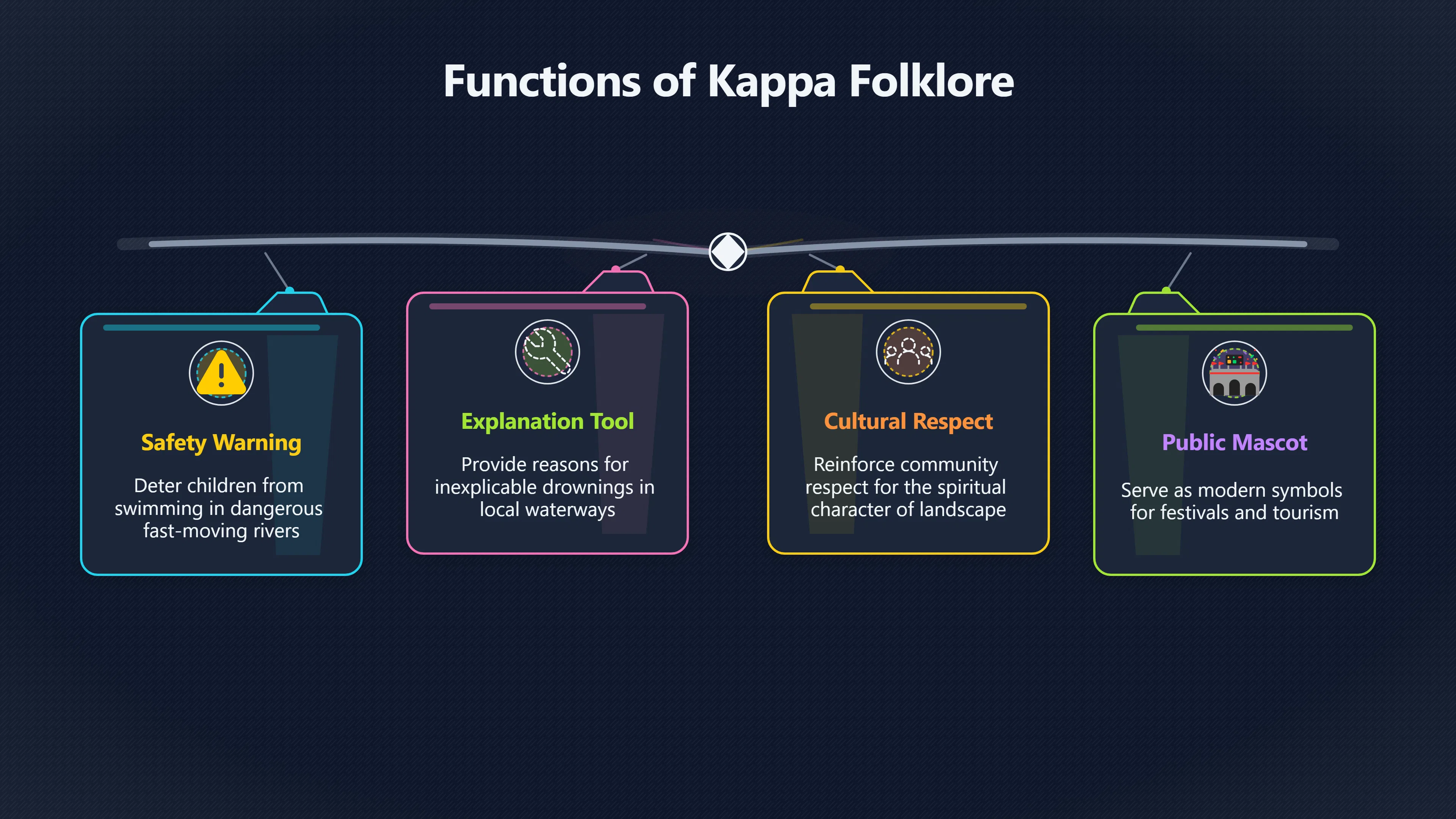
Modern scholars generally interpret these stories as serving several purposes simultaneously. They warned children away from dangerous places, explained otherwise inexplicable drownings, reinforced respect for local waterways and reflected the belief that particular stretches of landscape possessed their own spiritual character. The folklore worked precisely because it attached practical advice to a memorable creature rather than presenting a dry rule.
More than a simple bogeyman
Kappa stories are striking because they rarely portray the creature as purely evil. Alongside tales of attacks are stories in which humans outwit a kappa through politeness, exploit its strict sense of etiquette, or receive help after showing kindness.
This ambiguity reflects a broader feature of Japanese folklore. Rivers could provide food, irrigation and transport while also bringing floods and death. A creature embodying those waters was therefore naturally portrayed as both dangerous and capable of cooperation. Instead of representing absolute good or evil, the kappa mirrors an environment that rewards respect but punishes carelessness.
Many communities still embrace this dual image. Kappa appear as mascots, festival characters and tourist symbols, yet warning signs featuring friendly-looking kappa continue to mark rivers and ponds, especially where children might be tempted to play too close to the water. The frightening legend has gradually become a familiar public-safety symbol without entirely losing its older associations.[Wikipedia]WikipediaKappa (folkloreKappa (folklore
Issie and the modern lake-monster pattern
If the kappa belongs to long-established folklore, Issie belongs firmly to the twentieth century. The creature is associated with Lake Ikeda in Kagoshima Prefecture, a deep volcanic lake beneath Mount Kaimon on Kyushu.
Interest accelerated during the late 1970s when reports appeared claiming that a large unidentified animal had been seen moving across the lake’s surface. Newspapers covered the sightings, comparisons with Scotland’s Loch Ness Monster quickly followed, and the nickname “Issie” deliberately echoed “Nessie”. Witnesses described a dark shape with several humps or a long body moving through the water, although accounts differed considerably and no conclusive photographic or physical evidence emerged.[peak-experience-japan.com]peak-experience-japan.coma, located on Kyushu Island in Kagoshima Prefecture, with her foal.Read more…
Unlike the kappa, Issie was never deeply rooted in centuries of village tradition. Instead, it illustrates how an international cryptid template could be adapted to a Japanese setting. Once Loch Ness became globally famous, many countries developed their own resident lake monsters, often following remarkably similar patterns of eyewitness reports, media excitement and local identity.

Local legend meets modern tourism
Older folklore around Lake Ikeda included stories explaining unusual events on the lake, including traditions about a mare transformed by grief after losing her foal. Modern tellings sometimes connect this legend with Issie, although the cryptid itself emerged in a distinctly modern media environment rather than directly from ancient belief.[peak-experience-japan.com]peak-experience-japan.coma, located on Kyushu Island in Kagoshima Prefecture, with her foal.Read more…
The result is a blend of folklore and regional promotion. Rather than being treated solely as a zoological mystery, Issie became part of the area’s identity, encouraging visitors to imagine what might still inhabit the deep volcanic waters. This mirrors a pattern seen around other famous lake monsters worldwide, where the economic value of an enduring mystery often becomes almost as important as resolving it.
What explains the sightings?
No convincing evidence has established the existence of an unknown large animal in Lake Ikeda or other Japanese lakes. Instead, several ordinary explanations recur whenever sightings are examined.
Common possibilities include:
- Large fish briefly surfacing.
- Floating logs or drifting vegetation.
- Waves produced by wind or boats creating the illusion of moving humps.
- Optical effects caused by changing light and distance.
- The tendency for expectations to shape what witnesses believe they have seen after hearing previous reports.
The lake’s size and depth also contribute psychologically. Deep water naturally conceals whatever lies beneath the surface, making unusual observations difficult to verify and allowing speculation to flourish.
This does not mean witnesses necessarily invented their experiences. Most probably reported genuine observations that proved difficult to interpret. The uncertainty itself is what keeps lake-monster traditions alive.
What river spirits and lake monsters reveal about Japanese Forteana
Although kappa and Issie are often grouped together as Japanese water monsters, they represent two different ways that mysterious creatures become culturally significant.
The kappa is fundamentally a social legend. Its stories regulate behaviour, reinforce respect for dangerous places and express the idea that rivers deserve caution. Its survival owes as much to festivals, shrines, children’s stories and local identity as to belief in literal encounters.
Issie, by contrast, belongs to the modern world of newspaper reports, cryptozoology and tourism. Its appeal lies less in moral instruction than in the tantalising possibility that an unexplored lake might conceal an unknown animal. Whether interpreted as misidentification, folklore adapting to contemporary media, or an unresolved mystery, the legend demonstrates how quickly international monster traditions can acquire distinctly Japanese characteristics.
Taken together, these traditions show that Japan’s waters have accumulated more than monsters. They have become places where practical safety, local memory, commercial storytelling and genuine human curiosity continually overlap, ensuring that old river spirits and modern lake beasts remain part of the country’s enduring strange-history landscape.

Amazon book picks
Further Reading
Books and field guides related to Why Japan's Waters Grew Their Own Monsters. Use these as the next step if you want deeper reading beyond the article.

Kwaidan: Stories and Studies of Strange Things
Introduces classic supernatural storytelling traditions.


The Book of Yōkai
Useful comparative folklore reading for understanding how cultures transform fears and places into stories.

Pandemonium and Parade
Explains regional monster traditions and their cultural functions.
eBay marketplace picks
Marketplace Samples
Live-tested eBay searches with available results related to this page.




Endnotes
1.
Source: Wikipedia
Title: Kappa (folklore)
Link:https://en.wikipedia.org/wiki/Kappa_%28folklore%29
2.
Source: peak-experience-japan.com
Link:https://www.peak-experience-japan.com/blog/505
Source snippet
a, located on Kyushu Island in Kagoshima Prefecture, with her foal.Read more...
3.
Source: cryptidz.fandom.com
Link:https://cryptidz.fandom.com/wiki/Issie
Source snippet
Cryptid Wiki - FandomIssie (イッシー Isshī) is a legendary Japanese lake monster; it is said to lurk in Lake Ikeda, on Kyushu Island. The nam...
Additional References
4.
Source: yokai.com
Link:https://yokai.com/kappa/?srsltid=AfmBOori0MweUkfE9BmAcquuiNSnZLM91bUeGP2ZMaoiYrg_sywE7RMR
Source snippet
KappaKappa have been known to kidnap or rape swimming women, and kill people. A kappa's preferred method of attack is to drown its victim...
5.
Source: instagram.com
Link:https://www.instagram.com/reel/DVDkFwiCCVJ/
6.
Source: facebook.com
Link:https://www.facebook.com/shinzeroseven/posts/the-kappa-japans-mysterious-water-spirit-among-the-many-fascinating-creatures-of/6516421658503311/
Source snippet
It is a green human-like being with webbed hands and feet and a turtle-like carapace on the back. It has...Read more...
7.
Source: instagram.com
Link:https://www.instagram.com/p/DVjRBd_Di4L/
Source snippet
even the mythical Shirikodama—a mysterious ball believed to reside...Read more...
8.
Source: open.spotify.com
Link:https://open.spotify.com/episode/4Ax4DGZwPaYm57HKsvxmTU
Source snippet
Monster of Lake Ikeda: Issie - Supernatural Japan3 Jan 2026 — Discover eyewitness sightings, local folklore, and comparisons to other Jap...
9.
Source: youtube.com
Title: This Japanese Monster is Weirder Than You Think
Link:https://www.youtube.com/watch?v=C-7l_foPgqg
Source snippet
4 Kappa – The Strange Yokai of Japan's Lakes and Rivers...
10.
Source: youtube.com
Title: The Kappa: Hold onto Your Butts!
Link:https://www.youtube.com/watch?v=6OZL31PgDvU
Source snippet
2 Kappa: Japan's Child-Hunting River Monster...
11.
Source: youtube.com
Title: Kappa: Japan’s Child-Hunting River Monster
Link:https://www.youtube.com/watch?v=O7IB0ZGDQ0s
Source snippet
3 This Japanese Monster is Weirder Than You Think - The Kappa...
12.
Source: youtube.com
Title: Kappa – The Strange Yokai of Japan’s Lakes and Rivers
Link:https://www.youtube.com/watch?v=7GrJHlaAswM
Source snippet
5 The Monster of Lake Ikeda: Issie...
13.
Source: youtube.com
Title: The Monster of Lake Ikeda: Issie
Link:https://www.youtube.com/watch?v=BOcxCIOfcgk
Topic Tree