Why Belarus Keeps Its Weird Stories Close
Belarus has a quieter Fortean profile than countries with famous flying-saucer waves or headline lake monsters, but its strange-history record is still rich: haunted aristocratic castles, dragon-like lake folklore, post-Soviet “chupacabra” panics, miracle-icon traditions, and a striking Soviet-era UFO case over Minsk.
Page outline Jump by section
Introduction
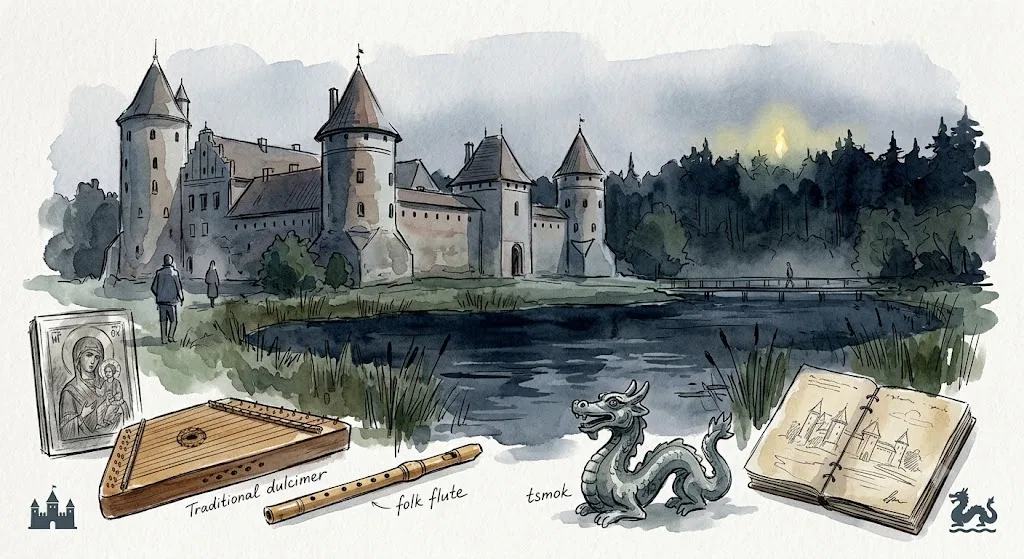
The centre of gravity is cultural rather than evidential. Nesvizh and Mir castles turn family tragedy into ghost lore; Lepel turns a water dragon into a local emblem; village livestock deaths become a travelling monster rumour; and an aircraft crew’s alarming sky sighting becomes a Cold War lesson in how rockets, secrecy and human perception can create durable UFO narratives. Belarusian Forteana is therefore best read not as a catalogue of monsters, but as a map of how strange stories survive when they attach themselves to real places.
Why Belarusian weird history is so place-based
Belarusian strange traditions are unusually anchored in landscape. Castles, lakes, forests, marshes and monasteries carry the stories. That matters because many of the country’s best-known uncanny tales are not free-floating internet folklore: they are attached to visitor sites, devotional journeys, regional identity, or older rural belief systems.
Two UNESCO-listed sites help explain the pull of the ghost stories. Mir Castle began as a late medieval fortified complex and was later reshaped through Renaissance and Baroque phases after damage and rebuilding; UNESCO describes it as a striking example of changing Central European architecture over several centuries.[UNESCO World Heritage Centre]whc.unesco.orgOpen source on unesco.org. Nesvizh, meanwhile, was the Radziwill family’s residential, cultural and architectural complex, including a palace, archive, arsenal, mausoleum-church and landscaped setting.[UNESCO World Heritage Centre]whc.unesco.orgOpen source on unesco.org. These are not vague “haunted ruins”. They are elite, theatrical places where dynastic memory, war damage, restoration and tourism have all helped legends stick.
The other major setting is the Belarusian countryside. Polesia and other rural regions preserved rich demonological and folk-healing material, including records of spirits, charms, witchcraft accusations, household powers and landscape beings. Recent scholarship notes that Belarusian folklore archives preserve song, prose, incantation and other field records, while also acknowledging the losses caused by war and occupation.[RCIN]rcin.org.plOpen source on rcin.org.pl. That archival fragility is important: it explains why some Belarusian weird traditions are well known locally but difficult to pin down in tidy English-language sources.
The Black Lady of Nesvizh: a ghost built from court history
The most famous Belarusian ghost is the Black Lady of Nesvizh, usually identified with Barbara Radziwill. The historical Barbara was a member of the Radziwill family, wife of Sigismund II Augustus, and Queen of Poland and Grand Duchess of Lithuania; Belarus’s official country portal gives her dates as 1520–1551 and notes that she became the heroine of many legends.[Belarus]belarus.bybarbara radziwillbarbara radziwill The official presidential tourism page also presents Nesvizh Castle as one of Belarus’s most mysterious places and states that legend has it the castle is haunted by Barbara’s ghost.[President of Belarus]president.gov.byOpen source on president.gov.by.
The Fortean interest lies in how neatly the legend fuses romance, aristocratic politics and a warning apparition. In common retellings, Barbara appears as a black-clad presence associated with grief, forbidden love and approaching misfortune. A Belarus tourism guide to Nesvizh even treats the “Black Lady” as part of the visitor landscape, listing a sculpture honouring Princess Barbara Radziwill and calling it the most mystical story of the palace.[Belarus]belarus.byOpen source on belarus.by.
A sceptical reading does not require sneering at the story. The Black Lady works because it has unusually good narrative machinery: a real woman, a famous family, a palace complex, an early death, and centuries of retelling. The ghost does not need to be accepted as a literal apparition to be culturally powerful. It is a memory-device: a way of turning dynastic history into something visitors can feel while walking through the rooms, park and courtyards.
Believers may treat the figure as a crisis-warning spirit, while sceptics see a classic aristocratic haunting: a tragic female ghost attached to a grand house. Either way, the legend has become part of Nesvizh’s public identity rather than a marginal campfire tale.
Mir Castle and the White Maiden: tragedy, water and a useful haunting
Mir Castle has its own ghost tradition, commonly called the White Maiden or White Lady. Recent tourism retellings identify her with Sofia Svyatopolk-Mirskaya, a young girl said to have died tragically, and connect the haunting with a pond created where an apple orchard once stood.[ТУРИСТАС]turistas.meТУРИСТАСMir Castle in Belarus: the legend of the White MaidenТУРИСТАСMir Castle in Belarus: the legend of the White Maiden This is a different sort of haunting from Nesvizh. Instead of royal romance and political scandal, it offers a smaller, more intimate pattern: a child, a changed landscape, a death, and a place that seems to remember.
The setting gives the story weight. Mir Castle’s official Belarus profile describes it as an outstanding example of 16th-century fortification art in the Grodno region, begun in the 1520s and later completed in Renaissance style by the Radziwills after it passed into their hands in 1568.[Belarus]belarus.byOpen source on belarus.by. UNESCO’s account adds that the castle was abandoned for nearly a century, damaged during the Napoleonic period, restored in the late 19th century, and landscaped with surrounding park elements.[UNESCO World Heritage Centre]whc.unesco.orgOpen source on unesco.org. A place with that much rebuilding almost invites stories about what was displaced, buried or unfinished.
The White Maiden legend also shows how Belarusian ghost lore often makes use of water. Ponds, wells, lakes and marshes are recurring uncanny settings because they hide things and change how a familiar place behaves. In practical terms, a pond can be landscape design; in folklore terms, it can become a wound in the ground.
The evidential position is thin: there is no strong public record that would turn the White Maiden into a documented apparitional case. Its value is folkloric. It helps explain how a restored heritage site becomes more than stonework: it becomes a stage where visitors are invited to imagine the emotional cost of the place.
The Lepel Tsmok: Belarus’s friendlier lake dragon
The Lepel Tsmok is probably Belarus’s closest equivalent to a country-level cryptid. It is usually described as a dragon-like or serpent-like water creature associated with Lake Lepel in the Vitebsk region. Belarus’s national tourism site presents it as a local mythological figure and notes that a tsmok is usually imagined as something between a snake and a dragon.[en.belarus.travel]en.belarus.travelThe Lepel TsmokThe Lepel Tsmok
The creature’s modern fame owes a great deal to literature and local branding. The tourism account links the Lepel tsmok with the Belarusian writer Vladimir Korotkevich, whose historical novel describes water dragons with thick necks, wide fins, seal-like bodies and heads resembling both deer and snakes.[en.belarus.travel]en.belarus.travelThe Lepel TsmokThe Lepel Tsmok In 2013, Belarus’s official press service reported that Lepel District authorities wanted to make the mythical tsmok a local tourist brand, stressing that the Belarusian tsmok was imagined as friendlier than the more destructive dragons of other traditions.[Belarus]belarus.bymythical tsmok to become tourist brand for lepel district i 0000005467mythical tsmok to become tourist brand for lepel district i 0000005467
That last detail is important. The Lepel Tsmok is not simply “Belarus’s Loch Ness Monster”. It is less a modern zoological claim than a hybrid of folklore, literature, public art and local identity. The monster has become useful because it is charming, regionally distinctive and marketable. It gives Lepel a mythic mascot.
A hard cryptozoological case would need sightings, physical traces, consistent descriptions and ecological plausibility. The tsmok has something else: a strong cultural niche. It belongs with dragon and serpent folklore found across Slavic and Baltic borderlands, where such beings can be linked with water, weather, treasure, danger or household fortune. Academic work on Belarusian and neighbouring serpent traditions notes motifs of fiery, flying or wealth-bringing serpents in Belarusian folklore, showing that “dragon” material here is broader than one lake monster.[ResearchGate]researchgate.netResearch Gate(PDF) Beliefs About Flying Serpents In Belarusian,Research Gate(PDF) Beliefs About Flying Serpents In Belarusian,
Chupacabra in Belarus: imported monster, local panic
One of the more modern Belarusian Fortean motifs is the “chupacabra” scare. The name comes from a Latin American monster legend, but by the 2000s and 2010s it had become a portable label for unexplained livestock deaths across many countries. Belarusian reports show how quickly a global cryptid can be localised.
In 2012, Euroradio reported rumours in Starobin about an uncatchable “chupacabra” said to have sucked the blood of domestic animals. The same outlet later reported that the Starobin mystery had been “solved”, with police sure that ordinary domestic animals were being attacked rather than a supernatural predator being involved.[Навіны Беларусі | euroradio.fm]euroradio.fmchupacabra attacks starobin photo 120251chupacabra attacks starobin photo 120251 In 2013, another Euroradio report described an unknown animal killed near a milk farm in Dokshytsy district, Vitebsk region, after attacks on cows and calves; the alleged “chupacabra” corpse then became strange news in its own right when it was reportedly stolen.[Навіны Беларусі | euroradio.fm]euroradio.fmНавіны Беларусі | euroradio.fm"Chupacabra" corpse stolen in DokshytsyНавіны Беларусі | euroradio.fm"Chupacabra" corpse stolen in Dokshytsy
These cases are classic modern Forteana: real dead animals, frightened owners, weak evidence, rumour, media amplification, and a monster-name ready to hand. The “bloodless” detail, common in chupacabra stories, is often unreliable because a carcass may look drained when blood has pooled internally or been consumed by scavengers. Wider sceptical work on chupacabra cases has repeatedly pointed to known predators, disease, mange, misidentified canids and exaggerated reports rather than a new species. National Geographic’s coverage of the legend has discussed scientific explanations for chupacabra sightings, while wildlife agencies in North America commonly explain “chupacabra-like” animals as foxes, coyotes, raccoons or dogs affected by mange or other conditions.[National Geographic]nationalgeographic.com101028 chupacabra evolution halloween science monsters chupacabras picture101028 chupacabra evolution halloween science monsters chupacabras picture
The Belarusian angle is not that a Caribbean monster secretly migrated to Vitebsk or Minsk regions. It is that the chupacabra became a ready-made explanation for rural unease. When livestock die in an alarming way and no predator is seen, a borrowed monster can feel more satisfying than a fox, dog, feral animal, illness, or confused chain of evidence.
The Minsk UFO case: a frightening sighting in a secretive sky
Belarus’s best-known UFO-related case is the 1984–85 Minsk incident, often described as an Aeroflot crew sighting during a flight over or near Minsk. Contemporary and later accounts say the crew saw a bright object or light effect, and some UFO retellings added claims of dangerous beams, pursuit, radiation-like effects or later illnesses among crew members. PBS’s “Life Beyond Earth” archive summarises the controversy and notes that UFO enthusiasts treated the alleged follow-up aircraft and crew illnesses as evidence, while sceptics dismissed the death-and-illness claims as coincidence and exaggeration.[PBS]pbs.orgLife Beyond EarthLife Beyond Earth
The case is a good example of why Soviet UFO stories are difficult. Cold War secrecy did not merely hide information; it created interpretive fog. PBS notes that Soviet officials, seeking to protect military secrets, denied the existence of Plesetsk Cosmodrome and instead offered an explanation involving refracted light on space debris, which fuelled arguments against a missile-launch explanation.[PBS]pbs.orgLife Beyond EarthLife Beyond Earth James Oberg’s later Skeptical Inquirer treatment framed the Minsk case as one of misperception and exaggeration, and broader sceptical history of Soviet state UFO research argues that many mass night sightings were eventually correlated with rocket launches or aerospace tests visible over long distances.[Skeptical Inquirer]skepticalinquirer.orgSkeptical Inquirer The Minsk UFO Case: Misperception and ExaggerationSkeptical Inquirer The Minsk UFO Case: Misperception and Exaggeration
This does not mean the crew saw “nothing”. It means the most likely lesson is about perception under poor conditions. A distant rocket plume or missile-related light can appear enormous, close, structured and intelligently moving when the observer lacks scale, range and context. Pilots are trained observers, but they are not immune to unusual optical geometry, especially at night.
For Belarusian Forteana, the Minsk case is valuable because it shows how Soviet secrecy could manufacture mystery even when a prosaic aerospace explanation was available. The state’s reluctance to admit sensitive launch activity gave UFO believers room to argue that official explanations were evasive. In a sense, the secrecy was part of the phenomenon.
Miracle icons and visionary geography
Belarus also has a strong tradition of miracle-working icons and sacred places. These are not “paranormal cases” in the same sense as UFOs or mystery animals, but they belong in a country-level strange-history survey because they involve claims of healing, protection, apparition-like discovery, and sacred objects behaving as more than ordinary images.
Belarus’s national tourism site describes a selection of ancient icons venerated as miracle-working, saying they are believed by the faithful to heal illness, help in difficult situations and save lives.[en.belarus.travel]en.belarus.travelAncient icons work miraclesAncient icons work miracles The Zhirovichi Icon of the Mother of God remains a living devotional focus: BelTA reported in May 2026 on celebrations at the Zhirovichi Monastery, including vigils and liturgies across the monastery’s churches.[eng.belta.by]eng.belta.byOrthodox believers celebrate Zhirovichi Icon of the MotherOrthodox believers celebrate Zhirovichi Icon of the Mother Other Belarusian Orthodox accounts present dramatic origin legends for icons such as the Belynichi and Krasnostok images, including rescue, hiddenness, transfer between communities and rediscovery.[obitel-minsk.org]obitel-minsk.orgthe sacred journey of the belynichi icon of the mother of godthe sacred journey of the belynichi icon of the mother of god
A Fortean reading should tread carefully here. For believers, miracle icons are sacred presences, not curiosities. For secular readers, they are best understood as devotional traditions supported by testimony, pilgrimage, ritual continuity and institutional memory rather than laboratory-style evidence. Their cultural pull lies in the way they localise hope. A miracle icon makes a village, monastery or church feel like a point of contact between ordinary suffering and divine attention.
The overlap with folklore is clear. Like ghost stories, miracle-icon legends attach extraordinary meaning to specific places. Unlike ghost stories, they are sustained by formal religious practice as well as popular storytelling. That gives them a different kind of durability.
Forests, marshes and household spirits: the older uncanny layer
Behind the named tourist legends sits an older Belarusian world of spirits, charms and rural protections. This is the layer in which household fortune, illness, animal behaviour, weather and mischance could be interpreted through unseen beings or magical harm.
Modern scholarship on Belarusian mythology studies notes that older researchers treated Belarusian “evil forces” as a broad category of beings shaped by Christianisation and folk dualism.[Folklore Estonia]folklore.eeEstonia Notes on Belarusian Mythology StudiesEstonia Notes on Belarusian Mythology Studies Work on Belarusian Polesia’s witchcraft traditions also describes continued study of healers, witch-doctors and changing magical practices through the 20th and early 21st centuries.[Academia]academia.eduOpen source on academia.edu. Such material is not Fortean because it proves spirits; it is Fortean because it shows a world in which misfortune had social, ritual and supernatural explanations all at once.
The forest spirit known across Slavic traditions as a guardian or trickster of the woods is often used in modern popular culture, but the Belarusian context is more specific than fantasy monsters. Forests and marshes were working landscapes: places of food, fuel, danger, disorientation and border-crossing. A being that leads travellers astray, guards animals, punishes disrespect or marks dangerous places is partly supernatural and partly practical folk ecology.
This older layer also helps explain why imported labels such as “chupacabra” can take root. Rural communities already had story-forms for strange predation, cursed livestock, night terrors and invisible harm. A modern media monster can slide into an older interpretive slot.
What is actually unexplained?
The honest answer is that much of Belarusian Forteana is culturally strong but evidentially weak. That is not a failure of the material; it is the nature of the subject.
The Black Lady and White Maiden are best treated as legends grounded in real aristocratic places. Their power comes from historical association, architecture and retelling, not from strong documentation of apparitional events. The Lepel Tsmok is a folklore-and-tourism creature rather than a robust biological mystery. The chupacabra scares contain real livestock deaths, but the most plausible explanations are ordinary predators, disease, scavenging, confusion and rumour. The Minsk UFO case is more serious as testimony, but the strongest sceptical reading points towards aerospace activity, distance misjudgement and Cold War secrecy.
The material that remains genuinely interesting is the pattern. Belarusian strange stories repeatedly emerge where facts are incomplete and emotions are high: grief at castles, fear in animal pens, awe in the sky, hope at shrines, caution in forests and marshes. These are exactly the conditions under which Fortean stories tend to survive.
Why Belarus’s strange stories still matter
Belarusian Forteana matters because it shows that “weird history” does not need a blockbuster monster to be revealing. The country’s uncanny record is quieter, more local and more entangled with heritage than many paranormal roundups suggest. Its best stories are not just about whether a ghost, dragon or UFO was “real”. They are about how communities use strange claims to organise memory.
Nesvizh turns a royal tragedy into a palace haunting. Mir turns a restored castle and altered landscape into a ghostly child story. Lepel turns a water dragon into a regional symbol. Starobin and Dokshytsy show how a global monster label can land in Belarusian farmyards. The Minsk UFO case shows how secrecy can make ordinary aerospace phenomena look conspiratorial. Miracle icons show how sacred objects gather testimony, gratitude and pilgrimage around them.
Taken together, these stories form a distinct Belarusian strange-history record: atmospheric, place-bound, often melancholy, sometimes comic, and usually more revealing as culture than as evidence for the impossible.


eBay marketplace picks
Marketplace Samples
Live-tested eBay searches with available results related to this page.

Endnotes
1.
Source: whc.unesco.org
Link:https://whc.unesco.org/en/list/625/
2.
Source: whc.unesco.org
Link:https://whc.unesco.org/en/list/1196/
3.
Source: rcin.org.pl
Link:https://rcin.org.pl/iae//Content/248535/285433.pdf
4.
Source: belarus.by
Title: barbara radziwill
Link:https://www.belarus.by/en/about-belarus/famous-belarusians/barbara-radziwill
5.
Source: belarus.by
Link:https://www.belarus.by/en/travel/top-guide-belarus/what-to-see-in-nesvizh-a-unesco-world-heritage-site-and-many-other-attractions_i_0000119730.html
6.
Source: belarus.by
Link:https://www.belarus.by/en/travel/belarus-life/mir-castle
7.
Source: en.belarus.travel
Title: The Lepel Tsmok
Link:https://en.belarus.travel/news/lepelsky-tsmok
8.
Source: belarus.by
Title: mythical tsmok to become tourist brand for lepel district i 0000005467
Link:https://www.belarus.by/en/press-center/press-release/mythical-tsmok-to-become-tourist-brand-for-lepel-district_i_0000005467.html
9.
Source: researchgate.net
Title: Research Gate(PDF) Beliefs About Flying Serpents In Belarusian,
Link:https://www.researchgate.net/publication/352889239_Beliefs_About_Flying_Serpents_In_Belarusian_Estonian_And_Russian_Estonian_Traditions
10.
Source: euroradio.fm
Title: chupacabra attacks starobin photo 120251
Link:https://euroradio.fm/en/report/chupacabra-attacks-starobin-photo-120251
11.
Source: euroradio.fm
Title: starobin chupacabra mystery solved 120531
Link:https://euroradio.fm/en/report/starobin-chupacabra-mystery-solved-120531
12.
Source: euroradio.fm
Title: Навіны Беларусі | euroradio.fm”Chupacabra” corpse stolen in Dokshytsy
Link:https://euroradio.fm/en/chupacabra-corpse-stolen-dokshytsy
13.
Source: pbs.org
Title: Life Beyond Earth
Link:https://www.pbs.org/lifebeyondearth/listening/minskpop.html
14.
Source: en.belarus.travel
Title: Ancient icons work miracles
Link:https://en.belarus.travel/news/ancient-icons-work-miracles
15.
Source: eng.belta.by
Title: Orthodox believers celebrate Zhirovichi Icon of the Mother
Link:https://eng.belta.by/society/view/orthodox-believers-celebrate-zhirovichi-icon-of-the-mother-of-god-180587-2026/
16.
Source: obitel-minsk.org
Title: the sacred journey of the belynichi icon of the mother of god
Link:https://obitel-minsk.org/en/the-sacred-journey-of-the-belynichi-icon-of-the-mother-of-god
17.
Source: obitel-minsk.org
Link:https://obitel-minsk.org/en/our-lady-of-krasnostok-wonderworker-and-comforter-of-belarusians
18.
Source: folklore.ee
Title: Estonia Notes on Belarusian Mythology Studies
Link:https://folklore.ee/sator/wp-content/uploads/2026/03/08.pdf
19.
Source: academia.edu
Link:https://www.academia.edu/14555072/%D0%AD%D0%B2%D0%B0%D0%BB%D1%8E%D1%86%D1%8B%D1%8F_%D0%B7%D0%BD%D0%B0%D1%85%D0%B0%D1%80%D1%81%D1%82%D0%B2%D0%B0%D1%9E%D0%91%D0%B5%D0%BB%D0%B0%D1%80%D1%83%D1%81%D0%BA%D1%96%D0%BC_%D0%9F%D0%B0%D0%BB%D0%B5%D1%81%D1%81%D1%96%D1%9E%D0%A5%D0%A5%D0%BF%D0%B0%D1%87%D0%B0%D1%82%D0%BA%D1%83%D0%A5%D0%A5%D0%86%D1%81%D1%82_Evolution_of_witchcraft_in_Belarusian_Polesia_in_the%D0%A5%D0%A5th_the_beginning_of_the_%D0%A5%D0%A5%D0%86st_century_Abstract_of_thesis_
20.
Source: researchgate.net
Title: 403218974 Notes on Belarusian Mythology Studies Personalities and Research
Link:https://www.researchgate.net/publication/403218974_Notes_on_Belarusian_Mythology_Studies_Personalities_and_Research
21.
Source: researchgate.net
Link:https://www.researchgate.net/publication/368765083_The_Polish_Nightmare_Being_Zmora_and_the_Problem_with_Defining_the_Category_of_Supernatural_Double-Souled_Beings
22.
Source: researchgate.net
Title: 366916700 Folk demonology of Podlasie based on own materials
Link:https://www.researchgate.net/publication/366916700_Folk_demonology_of_Podlasie_based_on_own_materials
23.
Source: war.gov
Title: USG UAP D001 Congress WhiteHouse UFO Correspondence 1998
Link:https://www.war.gov/medialink/ufo/061226/release_03/documents/USG-UAP-D001_Congress-WhiteHouse-UFO-Correspondence_1998.pdf
24.
Source: whc.unesco.org
Link:https://whc.unesco.org/document/169793
25.
Source: whc.unesco.org
Link:https://whc.unesco.org/document/152010
26.
Source: whc.unesco.org
Link:https://whc.unesco.org/uploads/nominations/1196.pdf
27.
Source: whc.unesco.org
Link:https://whc.unesco.org/uploads/nominations/625.pdf
28.
Source: academia.edu
Link:https://www.academia.edu/49499356/Beliefs_About_Flying_Serpents_In_Belarusian_Estonian_And_Russian_Estonian_Traditions
29.
Source: belarus.by
Link:https://www.belarus.by/en/press-center/press-release/pustynki-monastery-and-wonderworking-icon-the-legend-behind-the-famed-cloister-near-mstislavl_i_0000211342.html
30.
Source: belarus.by
Link:https://www.belarus.by/en/press-center/press-release/mir-castle-preserving-history-and-preparing-for-its-quincentenary_i_0000215918.html
31.
Source: nieborow.art.pl
Title: The Nesvizh Armoury
Link:https://www.nieborow.art.pl/en/visit/palace-tour/second-floor/the-nesvizh-armoury/
32.
Source: eng.belta.by
Title: mir castle preserving history and preparing for its quincentenary 182669 2026
Link:https://eng.belta.by/society/view/mir-castle-preserving-history-and-preparing-for-its-quincentenary-182669-2026/
33.
Source: president.gov.by
Link:https://president.gov.by/en/belarus/tourism/tourist-attractions
34.
Source: turistas.me
Title: ТУРИСТАСMir Castle in Belarus: the legend of the White Maiden
Link:https://turistas.me/en/posts/id1813-mir-castle-in-belarus-the-legend-of-the-white-maiden
35.
Source: nationalgeographic.com
Title: 101028 chupacabra evolution halloween science monsters chupacabras picture
Link:https://www.nationalgeographic.com/culture/article/101028-chupacabra-evolution-halloween-science-monsters-chupacabras-picture
36.
Source: skepticalinquirer.org
Title: Skeptical Inquirer The Minsk UFO Case: Misperception and Exaggeration
Link:https://skepticalinquirer.org/2009/01/the-minsk-ufo-case-misperception-and-exaggeration/
37.
Source: skepticalinquirer.org
Link:https://skepticalinquirer.org/newsletter/history-of-state-ufo-research-in-the-ussr/
38.
Source: Wikipedia
Title: Nesvizh Castle
Link:https://en.wikipedia.org/wiki/Nesvizh_Castle
39.
Source: Wikipedia
Link:https://en.wikipedia.org/wiki/Chupacabra
40.
Source: Wikipedia
Title: Belarus’taki UFO görülmeleri
Link:https://tr.wikipedia.org/wiki/Belarus%27taki_UFO_g%C3%B6r%C3%BClmeleri
41.
Source: cryptidz.fandom.com
Link:https://cryptidz.fandom.com/wiki/Tsmok
42.
Source: cryptidz.fandom.com
Title: Lake Monsters
Link:https://cryptidz.fandom.com/wiki/Lake_Monsters
43.
Source: cryptidz.fandom.com
Link:https://cryptidz.fandom.com/wiki/Chupacabra
44.
Source: belarus4you.wordpress.com
Title: top 5 most famous ghosts in belarus by migalayte
Link:https://belarus4you.wordpress.com/2012/08/14/top-5-most-famous-ghosts-in-belarus-by-migalayte/
45.
Source: instagram.com
Link:https://www.instagram.com/p/DaJLYI4jLgB/
46.
Source: skepticalinquirer.org
Title: mystery of the brazilian chupacabra
Link:https://skepticalinquirer.org/exclusive/mystery-of-the-brazilian-chupacabra/
47.
Source: allslavic.pl
Link:https://allslavic.pl/slavic-creatures/
48.
Source: belarus24.by
Title: mir castle a valuable monument of the national culture of belarus
Link:https://belarus24.by/en/articles/about-belarus/mir-castle-a-valuable-monument-of-the-national-culture-of-belarus/
49.
Source: tripadvisor.com
Title: Mir Castle
Link:https://www.tripadvisor.com/Attraction_Review-g1075850-d319498-Reviews-Mir_Castle-Mir_Grodno_Region.html
50.
Source: a-z-animals.com
Link:https://a-z-animals.com/blog/chupacabras/
51.
Source: tr.pinterest.com
Link:https://tr.pinterest.com/pin/305752262219610755/
52.
Source: belarusguide.com
Link:https://www.belarusguide.com/culture1/religion/icons/index.html
Additional References
53.
Source: youtube.com
Title: Nesvizh Castle in Belarus | UNESCO World Heritage | 8K VR180 Walking Tour
Link:https://www.youtube.com/watch?v=zg7EOmyfvZg
Source snippet
Mir Castle Belarus in 8K VR180 | Step Inside a UNESCO World Heritage Castle...
54.
Source: youtube.com
Title: Mir Castle Belarus in 8K VR180 | Step Inside a UNESCO World Heritage Castle
Link:https://www.youtube.com/watch?v=WLz2W3BVVcQ
Source snippet
Soviet Ancient Aliens: The Petrozavodsk Case | Documentary | Free Movie...
55.
Source: cia.gov
Link:https://www.cia.gov/readingroom/docs/DOC_0000042346.pdf
56.
Source: youtube.com
Title: Terrible creatures of Slavic mythology
Link:https://www.youtube.com/watch?v=D23Tl7a2q0k
Source snippet
Nesvizh Castle in Belarus | UNESCO World Heritage | 8K VR180 Walking Tour...
57.
Source: scirp.org
Link:https://www.scirp.org/journal/paperinformation?paperid=130050
58.
Source: whmnet.org
Link:https://whmnet.org/collection/site.php?site=1196
59.
Source: instagram.com
Link:https://www.instagram.com/p/DUVrUejiGKU/
60.
Source: facebook.com
Link:https://www.facebook.com/groups/852626898085269/posts/1617218231626128/
61.
Source: magicbook.com.ua
Link:https://magicbook.com.ua/en/product-573155.html?srsltid=AfmBOopaXqn05unqWlIr0dZUhS9Z-S1gkY_1P59TUWgLICUWJoZgsx_S
62.
Source: unteachablecourses.com
Link:https://unteachablecourses.com/fortean-phenomena-explained/
Topic Tree
Follow this branch
Related pages 192
- Afghan Forteana
- Antigua Uncanny
- Bosnian Mysteries
- Botswana Weird
- Brazil Strange
- +187 more in sidebar