Within Namibia
Why Is the Skeleton Coast So Haunted?
The Skeleton Coast's ghostly reputation comes from fog, cold currents, wreckage and survival stories rather than from a single supernatural claim.
On this page
- Fog, current and the wrecking coastline
- Shipwrecks as warning signs and tourist icons
- How a harsh landscape becomes folklore
Page outline Jump by section
Introduction
The Skeleton Coast has one of the most haunting reputations on Earth, but its eerie status owes far more to geography than to ghosts. Along Namibia’s north-west Atlantic shoreline, dense fog, freezing ocean currents, violent surf and an almost waterless desert combined to create one of history’s most dangerous coasts. Ships that survived the Atlantic often failed within sight of land, and sailors who reached the beach frequently found themselves trapped between the sea and an unforgiving desert. Over time, rusting wrecks, whale bones, survival stories and dramatic travel writing transformed a genuinely hazardous landscape into one of Namibia’s defining strange places. The result is a rare example of a “haunted” coast whose reputation rests largely on visible evidence rather than supernatural folklore.[Wikipedia]WikipediaSkeleton CoastSkeleton Coast
Fog, current and the wrecking coastline
The Skeleton Coast’s sinister reputation begins with a natural combination that has challenged mariners for centuries.
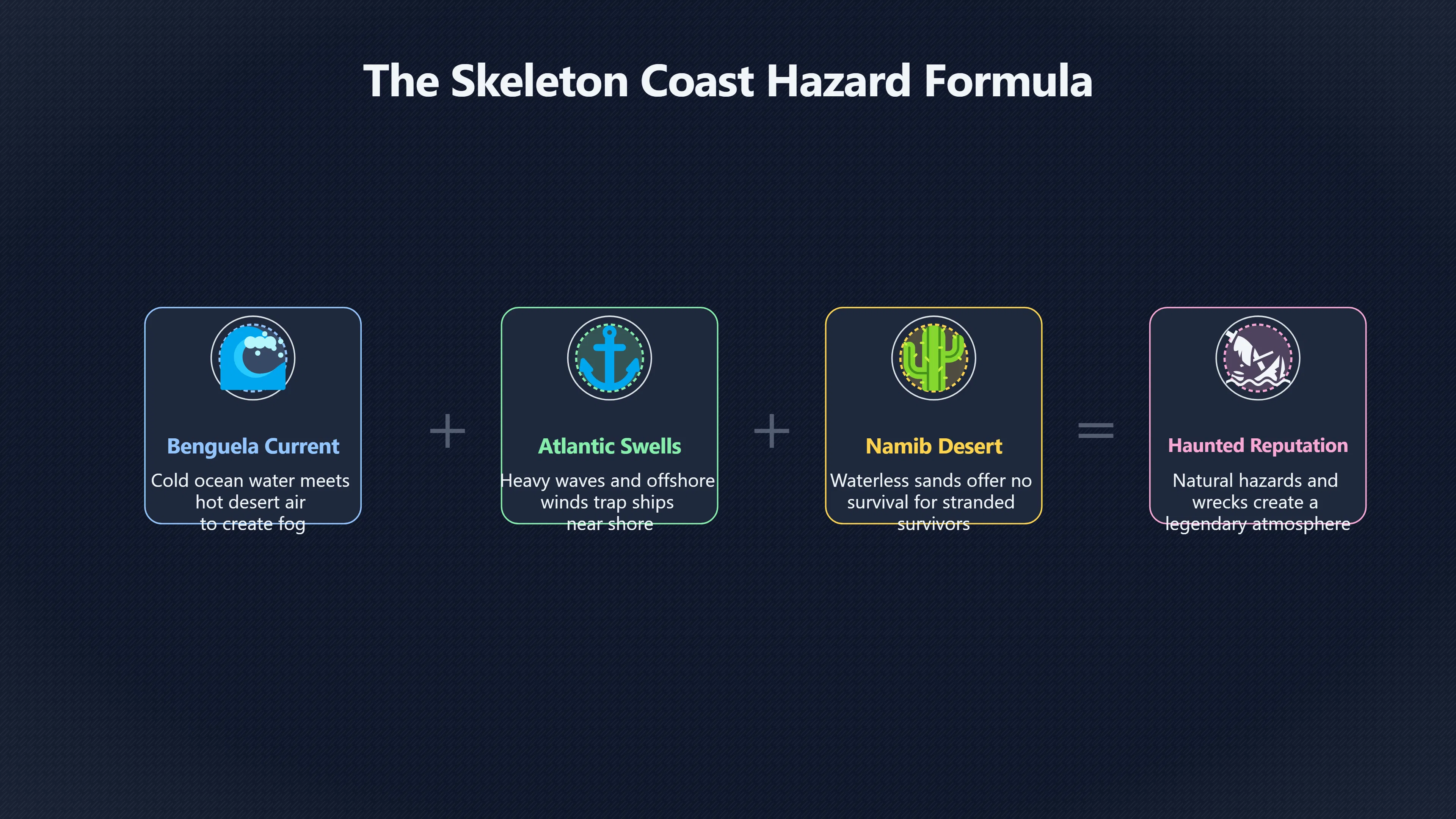
The cold Benguela Current flows northwards along the coast, cooling the air above the Atlantic while the adjacent Namib Desert heats rapidly during the day. The meeting of cold, moist air and hot desert air produces thick coastal fog on many days of the year. Visibility can fall dramatically, leaving ships close to shore without clear bearings. At the same time, heavy Atlantic swells pound the beaches, while strong offshore winds historically made it extremely difficult for sailing vessels to regain open water once they had drifted too close.[Wikipedia]WikipediaSkeleton CoastSkeleton Coast
Ironically, reaching land was often only the beginning of the disaster.
Unlike many coastlines, this offered almost no fresh water, few natural harbours and vast expanses of shifting sand. Survivors who abandoned ship frequently faced a desperate trek inland across one of the world’s oldest deserts. Historical accounts describe wreck survivors dying from thirst long after escaping the sea itself, helping create the sense that the coastline trapped people between two lethal environments.[Wikipedia]WikipediaSkeleton CoastSkeleton Coast
This explains why the coast accumulated not merely wrecks but stories of hopeless journeys, failed rescues and astonishing endurance. Those stories became just as important as the ships themselves.
Shipwrecks as warning signs and tourist icons
The coastline is associated with hundreds of documented wrecks, while some popular accounts claim the true total may reach into the thousands because many vessels disappeared without leaving recoverable remains. Exact numbers remain uncertain because storms, shifting dunes and changing shorelines have hidden or destroyed many sites.[Wikipedia]WikipediaSkeleton CoastSkeleton Coast
Several wrecks have become symbols of the coast rather than simply archaeological sites.
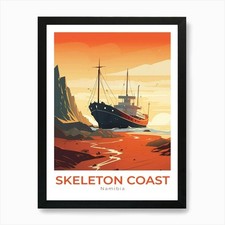
The Eduard Bohlen, a German cargo ship stranded in 1909, is perhaps the best-known image of the Skeleton Coast. When it grounded in dense fog, it lay close to the shoreline. More than a century later the sea has retreated, leaving the rusting hull stranded hundreds of metres inland as sand dunes migrated around it. The extraordinary sight makes the vessel appear to have been abandoned in the middle of a desert rather than on a beach.[Wikipedia]WikipediaSkeleton CoastSkeleton Coast
The Dunedin Star, wrecked in 1942 during the Second World War, contributed even more strongly to the coast’s mythology. Its loss triggered a complicated rescue operation involving ships, aircraft and overland expeditions. Although most passengers were eventually rescued, the operation itself became an ordeal involving additional wrecks, crashes and fatalities among rescuers. Journalist John Henry Marsh later chronicled the disaster in his book Skeleton Coast, whose title popularised the name now applied to the entire region.[Wikipedia]WikipediaSkeleton CoastSkeleton Coast
Other wrecks, including fishing vessels such as the Benguela Eagle and more modern casualties, reinforce the impression that the coast continues to punish navigational mistakes despite advances in technology.[Namibweb]namibweb.comShipwrecks | Atlantic West Coast | Namibia | Southern AfricaThe shipwreck is located 25 km north of the Ugab River, inside the Sk…
Today many of these wrecks serve a different role. Once warnings to sailors, they have become landmarks for visitors, photographers and filmmakers, their rusting frames providing dramatic evidence of the coastline’s maritime history.
Why does the coast feel haunted?
Unlike many supposedly haunted places, the Skeleton Coast is not centred on recurring ghost sightings or famous paranormal investigations.
Instead, its atmosphere emerges from several overlapping features.
- Thick fog regularly obscures the landscape and muffles sound.
- Shipwrecks appear suddenly from the sand, often isolated from the sea.
- Whale and seal bones historically littered parts of the shoreline, contributing to the area’s grim name.
- Human stories of shipwreck, thirst and failed escape became attached to particular stretches of coast.
- The near absence of settlements creates an unusual sense of silence and abandonment.[Wikipedia]WikipediaSkeleton CoastSkeleton Coast
These are precisely the ingredients from which folklore often develops. A traveller confronted with rusting steel emerging from mist, animal skeletons bleaching in the sand and endless empty beaches hardly needs a ghost story to experience unease.
Early European sailors reinforced this impression with dramatic language, calling parts of the coast “The Gates of Hell”. Indigenous communities also regarded the area as exceptionally harsh, although modern historians caution that colonial travel writing often amplified these descriptions into a mythology that overshadowed more complex local understandings of the landscape.[Wikipedia]WikipediaSkeleton CoastSkeleton Coast
How harsh landscapes become folklore
The Skeleton Coast demonstrates an important Fortean pattern: extraordinary landscapes often generate extraordinary stories without requiring supernatural events.
Environmental danger encourages memorable narratives. Survivors naturally describe terrifying experiences. Later writers emphasise the most dramatic details. Tour operators, novelists and filmmakers inherit these accounts and add fresh layers of symbolism. Eventually the physical landscape itself becomes a character in the story.
This process can be seen in the way the coast has appeared in adventure novels, documentaries and television. The setting repeatedly represents isolation, disappearance and the overwhelming power of nature rather than conventional ghost tales. Rusting wrecks become visual shorthand for human failure against the elements.[Wikipedia]WikipediaSkeleton CoastSkeleton Coast
For Fortean readers, this makes the Skeleton Coast especially interesting. It occupies the border between documented history and myth-making. Every wreck is real, yet the accumulated stories give the coastline an almost supernatural identity.

Myth versus reality
The strongest evidence supports a straightforward explanation for the coast’s fearful reputation.
The hazards are genuine:
- Persistent fog reduced visibility.
- The Benguela Current and Atlantic surf created dangerous navigation.
- Offshore winds and the lack of safe harbours complicated rescue.
- The Namib Desert offered little chance of survival for people stranded ashore.[Wikipedia]WikipediaSkeleton CoastSkeleton Coast
Claims that the coast is literally haunted, by contrast, rest mainly on atmosphere, storytelling and later tourism rather than well-documented paranormal reports. Ghost stories certainly circulate among guides and visitors, but they are secondary to the historical reality that countless people genuinely suffered or died there.
That distinction makes the Skeleton Coast unusual within Namibia’s strange history. Its mystery does not depend on unexplained lights, monsters or supernatural encounters. Instead, it shows how an unforgiving environment, visible shipwrecks and generations of dramatic retelling can transform an entirely natural coastline into one of the world’s most enduring haunted landscapes.
Amazon book picks
Further Reading
Books and field guides related to Why Is the Skeleton Coast So Haunted?. Use these as the next step if you want deeper reading beyond the article.


The sheltering desert
Evokes the harsh Namib environment behind the coast's reputation.

Namibia, 3rd
First published 2007. Subjects: Guidebooks, Namibia, description and travel.
eBay marketplace picks
Marketplace Samples
Live-tested eBay searches with available results related to this page.


Endnotes
1.
Source: Wikipedia
Title: Skeleton Coast
Link:https://en.wikipedia.org/wiki/Skeleton_Coast
2.
Source: namibweb.com
Link:https://www.namibweb.com/shipwrecks-namibia.htm
Source snippet
Shipwrecks | Atlantic West Coast | Namibia | Southern AfricaThe shipwreck is located 25 km north of the Ugab River, inside the Sk...
3.
Source: Wikipedia
Link:https://en.wikipedia.org/wiki/Skeleton
Source snippet
SkeletonA skeleton is the structural frame that supports the body of most animals. There are several types of skeletons, including the...
4.
Source: Wikipedia
Title: Skeleton (sport)
Link:https://en.wikipedia.org/wiki/Skeleton_%28sport%29
Source snippet
Skeleton (sport)Skeleton is a winter sliding sport in which a person rides a small sled, known as a skeleton bobsled (or bobsleigh), d...
5.
Source: dictionary.cambridge.org
Link:https://dictionary.cambridge.org/dictionary/english/skeleton
Source snippet
English meaning - Cambridge Dictionarythe frame of bones supporting a human or animal body: We found an old sheep skeleton up on the cl...
6.
Source: play.google.com
Link:https://play.google.com/store/apps/details?hl=en&id=com.catfishanimationstudio.SkeletalSystemPreview
Source snippet
3D Anatomy - Apps on Google PlayJun 8, 2026 — Dive into a fully interactive 3D skeleton where every bone — from the skull and cranial a...
Additional References
7.
Source: travelnam.com
Link:https://travelnam.com/a-place-of-legends-bones-myths/
Source snippet
A Place of Legends, Bones & MythsThe Skeleton Coast, named after the remains of those who met their doom here, is a place of myth and leg...
8.
Source: shipwrecklodge.com.na
Link:https://www.shipwrecklodge.com.na/hotel/history-of-the-skeleton-coast
Source snippet
History of the Skeleton CoastIt is important to acknowledge that the documented history of the Skeleton Coast is vague and uncertain, wit...
9.
Source: naturalworldsafaris.com
Link:https://www.naturalworldsafaris.com/africa/namibia/safaris-and-planning/skeleton-coast
Source snippet
Namibia's Skeleton CoastIts name, derived from the whale bones and shipwrecks scattered along the shore, evokes images of desolate beauty...
10.
Source: merriam-webster.com
Link:https://www.merriam-webster.com/dictionary/skeleton
Source snippet
SKELETON Definition & Meaninga usually rigid supportive or protective structure or framework of an organism especially: the bony or more...
11.
Source: facebook.com
Link:https://www.facebook.com/groups/nightscaper/posts/4095451210765774/
Source snippet
Shipwreck on Namibia's Skeleton Coast under star trailsTrapped in a veil of thick fog, the boat Eduard Bohlen ran aground along the Coast...
12.
Source: shutterstock.com
Link:https://www.shutterstock.com/vi/search/human-skeleton
Source snippet
Ảnh miễn phí bản quyền về Human skeletonSkeleton. Human skeleton silhouette - bones, ribs, spine, skull, joints, arms, legs. Complete hum...
13.
Source: mikereyfman.com
Link:https://www.mikereyfman.com/gallery.php?Gallery=namib-skeleton-coast-np-and-walvis-bay-area-namibia
Source snippet
nt and warm air from the Namib Desert and often cover dunes with the cool mist.Read more...
14.
Source: alluringafrica.com
Title: spooky tales namibias skeleton coast shipwrecks prove
Link:https://www.alluringafrica.com/spooky-tales-namibias-skeleton-coast-shipwrecks-prove/
Source snippet
Skeleton Coast, Namibia And It's Spooky Shipwreck Stories26 Feb 2020 — Here are five of the spookiest shipwreck tales – and we've seen th...
15.
Source: travellocal.com
Title: why you should visit namibia s skeleton coast
Link:https://www.travellocal.com/en-gb/articles/why-you-should-visit-namibia-s-skeleton-coast
Source snippet
Why you should visit Namibia's Skeleton CoastSep 21, 2024 — Thick coastal fog is a characteristic of this coastline, arising where the ch...
16.
Source: youtube.com
Link:https://www.youtube.com/watch?v=SO5jJ9Y0Z7o
Source snippet
The Skeleton Coast's 500 Shipwrecks and Deadly Waters – Why No One Comes Back...
Topic Tree