Why Bolivia Makes Strange Stories Feel Plausible
Bolivia’s strange-history record is not best understood as a catalogue of monsters and flying saucers. It is more interesting than that. The country’s Fortean material sits at the meeting point of high-altitude skies, ancient ruins, mining danger, Indigenous and Catholic ritual, borderland folklore, and modern media.
Page outline Jump by section
Why Bolivia Attracts Strange Stories
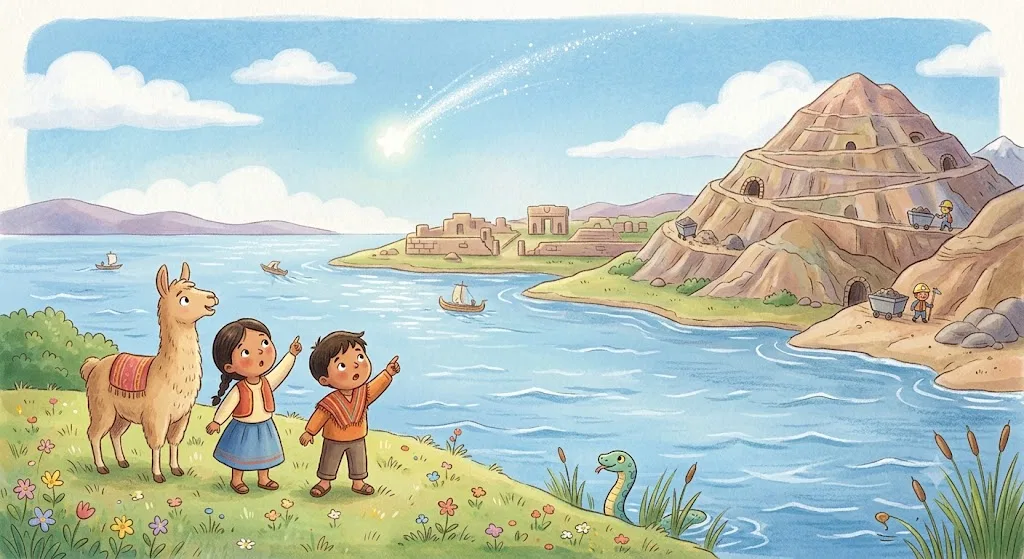
Bolivia gives Fortean material unusually good scenery. The Altiplano puts settlements, ritual sites, observatories and roads at heights where weather, light, fatigue and distance can behave oddly to the eye. Lake Titicaca anchors creation stories and tourist mythmaking. Potosí adds a darker register: a mountain treated as both workplace and devourer. In the eastern lowlands, water, forest and seasonal scarcity shape legends of guardian beings and dangerous night roads. These are not neutral backdrops. They are the reasons the stories make local sense.[unesco.org]whc.unesco.orgOpen source on unesco.org.
A useful Bolivia page therefore has to separate several kinds of “strange”. There are reported incidents, such as lights, crashes and meteorites; ritual beings, such as the mine spirit of Cerro Rico; folkloric threats, such as the fat-stealing kharisiri; and pseudoarchaeological claims, in which impressive ancient stonework is presented as beyond human ability. The evidence varies sharply from case to case. A meteorite can be analysed in a lab; a rumour of a creature stealing body fat has to be read as folklore, social anxiety and narrative tradition.[arxiv.org]arxiv.orgOpen source on arxiv.org.
The 1978 Tarija “Fallen Object”
One of Bolivia’s best-known UFO-linked stories concerns an object reported to have fallen on 6 May 1978 in the south of the country, often associated with Tarija or the Bolivia–Argentina border region. Later UFO retellings describe a bright, cylindrical or metallic object, a crash in remote mountains, conflicting official explanations, and rumours of outside recovery teams. That is why the case is sometimes nicknamed Bolivia’s own “Roswell”, though that label says more about UFO folklore than about proof.[myufophotos.com]myufophotos.comMy UFO Photos Bolivia UFO files (disclosure documentsMy UFO Photos Bolivia UFO files (disclosure documents
The most valuable contemporary trace is not a dramatic witness story but a declassified CIA reading-room entry titled “Bolivia Reports Conflict on Details of Fallen Object”, dated 17 May 1978. Its existence matters because it shows that the incident entered official information channels, not merely later paranormal books and websites. It does not, by itself, prove an extraterrestrial crash. The careful reading is simpler: something was reported, accounts conflicted, and the ambiguity became fertile ground for UFO interpretation.[CIA]cia.govOpen source on cia.gov.
The likely explanations fall into familiar categories: meteor or bolide, space debris, aircraft-related event, military rumour, or an initially real observation enlarged by retelling. UFO-focused summaries note that Argentine authorities reportedly discussed a satellite explanation while others argued that no known re-entry matched the date; such claims should be treated cautiously unless tied to primary space-tracking records. In Fortean terms, the case is valuable because it preserves the full ecology of a mystery: remote geography, a bright fall, official uncertainty, cross-border rumour, and later mythmaking.[My UFO Photos]myufophotos.comMy UFO Photos Bolivia UFO files (disclosure documentsMy UFO Photos Bolivia UFO files (disclosure documents
Carancas: When a “Sky Mystery” Became a Meteorite
The Carancas impact of 15 September 2007 happened in Peru, but it belongs in Bolivia’s weird-history orbit because it occurred near Lake Titicaca and the Bolivian border, and because Bolivian scientific institutions were involved in analysing samples. Witnesses reported a brilliant fireball, a crater, bubbling water, smoke or fumes, and illness among some villagers who approached the site. Those are exactly the details that, in another age or with poorer evidence, might have become a durable UFO or cursed-crater legend.[Wikipedia]Wikipedia2007 Carancas impact event2007 Carancas impact event
The difference is that Carancas produced physical material. Reports from the Geological Sciences faculty at Bolivia’s Universidad Mayor de San Andrés found elements such as iron, nickel, cobalt and traces of iridium, consistent with meteoritic material, while later work classified the meteorite as an ordinary chondrite. Scientific papers have treated Carancas as unusual because the meteoroid appears to have remained comparatively intact and produced a crater-forming ground impact rather than simply breaking up in the atmosphere.[wikipedia.org]Wikipedia2007 Carancas impact event2007 Carancas impact event
Carancas is a useful control case for Bolivian Forteana. It shows that a frightening sky event can be strange, dramatic and initially confusing without being paranormal. It also shows why eyewitness reports deserve neither automatic dismissal nor automatic belief. People really did see something extraordinary; the extraordinary thing was a meteorite behaving in a rare way, not a spacecraft.[WIRED]wired.comThe Mad Scramble to Claim the World's Most Coveted MeteoriteThe Mad Scramble to Claim the World's Most Coveted Meteorite
Tiwanaku, Puma Punku and the Ancient-Aliens Problem
Tiwanaku, near the southern shore of Lake Titicaca, is one of the great archaeological centres of the Andes. UNESCO describes it as a planned city that flourished between about AD 400 and 900, with ceremonial structures including the Semi-Subterranean Temple, Kalasasaya, Akapana and Puma Punku, built with carefully carved stone and sophisticated drainage. Its altitude, scale and ruined grandeur have made it irresistible to mystery writers.[UNESCO World Heritage Centre]whc.unesco.orgOpen source on unesco.org.
Puma Punku is the part most often pulled into “ancient aliens” claims. The stonework is precise, the blocks are heavy, the site is damaged, and the original architectural plan is difficult to reconstruct. Those real facts are often inflated into the claim that the builders must have used lost technology or outside help. Archaeological research gives a more grounded explanation: the ruins are challenging because they were looted, dismantled, unfinished in places, and scattered over centuries, not because they are beyond human craft.[Nature]nature.comOpen source on nature.com.
The striking point is that serious archaeology does not make Tiwanaku less strange. It makes it stranger in a better way. Researchers have used archival measurements, virtual modelling and 3D-printed fragments to test how pieces of Puma Punku architecture may have fitted together. The mystery becomes an evidential puzzle about Andean engineering, ritual architecture, broken records and conservation — not a shortcut to aliens.[Nature]nature.comOpen source on nature.com.
Tiwanaku also carries mythic weight. Later Inca tradition treated the ruins and the Lake Titicaca region as a place of origins, and modern solstice ceremonies have renewed the site’s public spiritual significance. That is a more culturally important story than the pseudoarchaeological one: a real ancient centre became a stage on which later peoples, states, tourists and mystery industries projected their own beginnings.[Nature]nature.comOpen source on nature.com.
Samaipata and the Carved Rock That Became a “Landing Pad”
El Fuerte de Samaipata in eastern Bolivia shows a similar process. UNESCO describes the site as having two main parts: a hill with many rock carvings, probably the ceremonial centre of an ancient town, and a southern area with administrative and residential buildings. Its vast sculpted rock is considered a unique testimony to pre-Hispanic traditions and beliefs in the Americas.[UNESCO World Heritage Centre]whc.unesco.orgWorld Heritage Centre Fuerte de SamaipataWorld Heritage Centre Fuerte de Samaipata
Because the rock is monumental and unusual, it has attracted speculative claims that it was a launch ramp, landing site or technological installation. Those claims are not supported by the mainstream archaeological description of the site. The grounded interpretation is already compelling: a pre-Hispanic ceremonial landscape later associated with Inca, local and colonial layers, carved into a natural hill in a way that does not fit neat European categories of “fort”, “temple” or “city”.[UNESCO World Heritage Centre]whc.unesco.orgWorld Heritage Centre Fuerte de SamaipataWorld Heritage Centre Fuerte de Samaipata
For Fortean readers, Samaipata is useful because it shows how mystery tourism works. A real archaeological puzzle is simplified into a visual hook: “a carved rock no one can explain”. In truth, archaeologists can explain quite a lot, while still admitting uncertainty about details of meaning, sequence and ritual use. The honest mystery is cultural and archaeological, not extraterrestrial.[UNESCO World Heritage Centre]whc.unesco.orgWorld Heritage Centre Fuerte de SamaipataWorld Heritage Centre Fuerte de Samaipata
El Tío: The Devil Who Protects the Miners
No Bolivian strange-history page should miss El Tío, the underground figure honoured by miners in Potosí and other mining regions. To outsiders he is often described as a devil, but that is too simple. In miners’ practice he is an ambivalent owner or lord of the underground: dangerous, hungry, protective, and inseparable from the mine’s risks. Offerings of alcohol, coca leaves, cigarettes and sometimes animal sacrifice are made not as tourist theatre alone but as part of a working relationship with a deadly environment.[HimalDoc]lib.icimod.orgHimal Doc The case of El Tío and miners in BoliviaHimal Doc The case of El Tío and miners in Bolivia
Cerro Rico makes the belief especially powerful. The mountain’s silver helped shape the colonial world economy, while Indigenous and later cooperative miners worked in brutal conditions. Recent research and heritage commentary note that mining remains active, dangerous and central to Potosí’s economy, with around 12,000 miners working in cooperatives. In that setting, El Tío is not just a “legend”; he is a way of naming the bargain between survival, extraction and fear.[Boasblogs]boasblogs.orgOpen source on boasblogs.org.
This is where the Fortean reading needs tact. A horned statue in a tunnel looks uncanny; a miner lighting a cigarette for it looks like a scene from a ghost story. But the belief is also social, historical and practical. El Tío personifies a place that really does kill people, reward risk and consume bodies. The supernatural frame does not float above reality; it grows out of it.[Atlas Obscura]atlasobscura.comwhat are potosi silver mines likewhat are potosi silver mines like
The Kharisiri and the Fear of the Stranger
The kharisiri, also known in related Andean traditions as pishtaco or by other regional names, is one of the Andes’ most disturbing figures: a person or being said to steal human fat, often from travellers, sleepers or vulnerable people. In Bolivia and Peru, the figure is strongly associated with outsiders, priests, foreigners, exploiters or people who do not fit into a community.[bolivianexpress.org]bolivianexpress.orgmagazine sub itemmagazine sub item
The story sounds grotesque, but its social meaning is clear. Fat is not random. In many versions it is imagined as valuable material for medicine, industry, religious oil, bells, machines or foreign markets. The kharisiri turns exploitation into body horror: the outsider does not merely take land, labour or money, but the substance of life itself. That is why the legend has adapted so well to colonialism, missionisation, capitalism, state violence and modern rumours about organ theft.[bolivianexpress.org]bolivianexpress.orgmagazine sub itemmagazine sub item
Sceptically, the kharisiri is not evidence for a literal fat-stealing monster. But dismissing it as “just superstition” misses the point. It is a rumour system that makes fear portable. It warns against isolated roads, strangers with institutional power, and predatory extraction. In Bolivia’s Fortean landscape, the kharisiri belongs beside UFO crashes and ancient ruins because it shows the same pattern: uncertainty becomes a story shaped by history.[folklorethursday.com]folklorethursday.comthe pishtaco fat stealing ghoul of the andesthe pishtaco fat stealing ghoul of the andes

Water Guardians, Night Roads and Lowland Legends
Bolivia’s eastern lowlands contribute a different kind of strangeness from the Altiplano. The Jichi, often described as a water guardian or serpent-like being, is associated with rivers, lakes, reservoirs and the careful management of water. In Chiquitano and wider lowland contexts, the story says that if people mistreat the water source, the Jichi may leave — and take the water with it.[AWASQA]awasqa.orgjichi the water keeperjichi the water keeper
That is folklore with an ecological memory. It turns water scarcity into a moral relationship: the reservoir is not simply a resource but a dwelling place with a guardian. Modern retellings often frame the Jichi as environmental education, but its older force is sharper. It says that careless behaviour has consequences, and that those consequences may arrive as drought, bad fishing or a landscape suddenly made unliveable.[Diff]diff.wikimedia.orgOpen source on wikimedia.org.
Other eastern Bolivian legends, such as ghostly women on dark roads or beings linked to forest and river danger, function in a similar way. They are not best read as cryptozoological claims in the narrow sense. They are cautionary maps: do not wander drunk, do not travel alone, do not disrespect water, do not assume the night road is empty.[Wikipedia]WikipediaDepartamento de Santa Cruz (BoliviaDepartamento de Santa Cruz (Bolivia
The Witches’ Market and Everyday Ritual
La Paz’s Witches’ Market is one of the most visible places where outsiders encounter Bolivian ritual life. Reports describe stalls selling herbs, coca leaves, sweets, charms, dried animals and llama foetuses used in offerings to Pachamama, or Mother Earth. National Geographic describes the market as a place where spiritual workers facilitate offerings for health, travel, business and luck; Reuters similarly reported buyers seeking the goodwill of Mother Earth through ritual goods.[National Geographic]nationalgeographic.comla paz bolivia witch marketla paz bolivia witch market
The Fortean temptation is to treat the market as a cabinet of curiosities. That is the shallowest reading. The more useful one is to see it as an urban ritual economy: ancient and modern, sacred and commercial, local and tourist-facing all at once. Offerings can be made for homes, businesses, journeys, political hopes or family wellbeing. The practice is not a marginal oddity but part of a wider Andean habit of negotiating with landscape, ancestors, mountains and the earth.[AP News]apnews.comThese practices reflect a deep connection between the people and natural elements, believed to possess spiritual energy or “ajayu.” Ritua…
This also helps explain why Bolivian strange stories rarely separate cleanly into “religion”, “folklore” and “paranormal”. A llama foetus in a market stall may look macabre to a visitor, but in context it belongs to a system of reciprocity. A mountain may be scenery, workplace, ancestor and danger at once. A ghost story may also be a social rule.[AP News]apnews.comThese practices reflect a deep connection between the people and natural elements, believed to possess spiritual energy or “ajayu.” Ritua…
Strange Skies Without Simple Answers
Bolivia’s skies encourage extraordinary reports for ordinary reasons. High altitude, thin air, bright stars, remote roads, military rumours, meteors and satellite re-entries can all produce experiences that feel uncanny. The country also hosts serious high-altitude science: the Chacaltaya region near La Paz has been used for cosmic-ray and gamma-ray research, and modern projects such as ALPACA/ALPAQUITA take advantage of the altitude to study very high-energy particles.[arXiv]arxiv.orgOpen source on arxiv.org.
That scientific context does not “explain away” every local light story. Rather, it reminds readers that the sky above Bolivia is physically interesting before anyone adds folklore. Meteors, bolides, electrical storms, satellites and atmospheric optics can be startling, especially in open highland landscapes where a light may be visible across great distances. The Carancas impact and the 1978 fallen-object reports show two ends of the same spectrum: one resolved by physical evidence, one left in a haze of conflicting accounts.[repositorio.ingemmet.gob.pe]repositorio.ingemmet.gob.peThe Carancas Meteorite Fall 15 september 2007The Carancas Meteorite Fall 15 september 2007
What Is Most Credible?
The most credible Bolivian Forteana is not necessarily the most supernatural. The best-supported material falls into three groups. First are physical sky events, especially meteorite and bolide cases, where witness testimony can be compared with samples, craters, seismic signals or atmospheric data. Carancas is the model example, even though it lies just over the border in Peru.[repositorio.ingemmet.gob.pe]repositorio.ingemmet.gob.peThe Carancas Meteorite Fall 15 september 2007The Carancas Meteorite Fall 15 september 2007
Second are living ritual and folklore traditions, such as El Tío, the kharisiri, the Jichi and Pachamama offerings. These are credible not as proof that the beings exist in a literal laboratory sense, but as documented cultural realities: people tell the stories, perform the rites, fear the figures, sell the ritual materials and organise behaviour around them.[icimod.org]lib.icimod.orgHimal Doc The case of El Tío and miners in BoliviaHimal Doc The case of El Tío and miners in Bolivia
Third are archaeological “mysteries” with strong non-paranormal explanations. Tiwanaku, Puma Punku and Samaipata are genuinely remarkable, but their importance lies in Andean engineering, ritual life, political power and later reinterpretation. Claims of alien builders or landing pads usually depend on underestimating Indigenous skill and overstating what is unknown.[unesco.org]whc.unesco.orgOpen source on unesco.org.
Why Bolivia’s Weird Record Still Matters
Bolivia’s Fortean material has cultural pull because it refuses to sit in one box. It is not just UFO lore, not just ghost tradition, not just pseudoarchaeology, and not just Indigenous cosmology repackaged for tourists. It is a set of stories about extraction, altitude, ruins, water, borders and survival. The miner’s devil, the fat-stealing stranger, the water serpent and the fallen object all ask the same underlying question: what forces are acting on people from just beyond ordinary control?[atlasobscura.com]atlasobscura.comwhat are potosi silver mines likewhat are potosi silver mines like
The answer changes by case. Sometimes the force is a meteorite. Sometimes it is colonial history. Sometimes it is dangerous labour, drought, tourism, bad evidence, or a rumour that has learned how to travel. Bolivia’s strange-history record is strongest when read in that layered way: curious, sceptical, and alert to the fact that folklore often preserves truths even when its creatures do not need to be literally real.
Amazon book picks
Further Reading
Books and field guides related to Why Bolivia Makes Strange Stories Feel Plausible. Use these as the next step if you want deeper reading beyond the article.
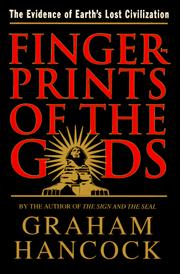
Fingerprints of the gods
Frequently references Andean mystery traditions including Tiwanaku.
Chariots of the gods?
Represents the influential fringe interpretations discussed on the page.
The Rough Guide to Bolivia
Provides cultural, historical and geographical context behind many strange stories.
Magic, Mysticism and Religion: A Reader in the Anthropology o...
Explains how belief, ritual and folklore emerge in different societies.
eBay marketplace picks
Marketplace Samples
Live-tested eBay searches with available results related to this page.



Endnotes
1.
Source: cia.gov
Link:https://www.cia.gov/readingroom/document/0005515665
2.
Source: repositorio.ingemmet.gob.pe
Title: The Carancas Meteorite Fall 15 september 2007
Link:https://repositorio.ingemmet.gob.pe/bitstream/20.500.12544/383/2/The_Carancas_Meteorite_Fall_15_september_2007.pdf
Published: september 2007
3.
Source: boasblogs.org
Link:https://boasblogs.org/uncommoning/recommoning-cultural-heritage/practices-of-recommoning-at-the-industrial-heritage-site-cerro-rico-and-mining-tourism-in-potosi-bolivia/
4.
Source: bolivianexpress.org
Title: magazine sub item
Link:https://bolivianexpress.org/magazine-sub-item/1061
5.
Source: whc.unesco.org
Link:https://whc.unesco.org/en/list/567/
6.
Source: awasqa.org
Title: jichi the water keeper
Link:https://awasqa.org/jichi-the-water-keeper/?lang=en
7.
Source: arxiv.org
Link:https://arxiv.org/abs/1503.03442
8.
Source: nature.com
Link:https://www.nature.com/articles/s40494
9.
Source: inexplicata.blogspot.com
Title: bolivia remembering tarija ufo crash 6
Link:https://inexplicata.blogspot.com/2016/05/bolivia-remembering-tarija-ufo-crash-6.html
10.
Source: Wikipedia
Title: 2007 Carancas impact event
Link:https://en.wikipedia.org/wiki/2007_Carancas_impact_event
11.
Source: arxiv.org
Title: arXiv Small Near-Earth Asteroids as a Source of Meteorites
Link:https://arxiv.org/abs/1502.03307
12.
Source: wired.com
Title: The Mad Scramble to Claim the World’s Most Coveted Meteorite
Link:https://www.wired.com/story/scramble-claim-worlds-most-coveted-meteorite
13.
Source: folklore.ee
Link:https://www.folklore.ee/folklore/vol12/inca.htm
14.
Source: whc.unesco.org
Title: World Heritage Centre Fuerte de Samaipata
Link:https://whc.unesco.org/en/list/883/
15.
Source: Wikipedia
Title: El Fuerte de Samaipata
Link:https://en.wikipedia.org/wiki/El_Fuerte_de_Samaipata
16.
Source: whc.unesco.org
Title: World Heritage Centre Fuerte de Samaipata
Link:https://whc.unesco.org/document/154513
17.
Source: Wikipedia
Link:https://en.wikipedia.org/wiki/Pishtaco
18.
Source: folklorethursday.com
Title: the pishtaco fat stealing ghoul of the andes
Link:https://folklorethursday.com/halloween/the-pishtaco-fat-stealing-ghoul-of-the-andes/
19.
Source: Wikipedia
Title: Departamento de Santa Cruz (Bolivia)
Link:https://es.wikipedia.org/wiki/Departamento_de_Santa_Cruz_%28Bolivia%29
20.
Source: Wikipedia
Title: La Viudita (leyenda boliviana)
Link:https://es.wikipedia.org/wiki/La_Viudita_%28leyenda_boliviana%29
21.
Source: reuters.com
Title: llama fetuses dead cats on sale at bolivian market idUSL16467716
Link:https://www.reuters.com/article/world/llama-fetuses-dead-cats-on-sale-at-bolivian-market-idUSL16467716/
22.
Source: reuters.com
Title: llama fetus ritual to help bolivias morales idUSN08334685
Link:https://www.reuters.com/article/lifestyle/llama-fetus-ritual-to-help-bolivias-morales-idUSN08334685/
23.
Source: arxiv.org
Link:https://arxiv.org/abs/2109.13490
24.
Source: arxiv.org
Title: arXiv Search for Gamma Ray Bursts at Chacaltaya
Link:https://arxiv.org/abs/astro-ph/0011241
25.
Source: Wikipedia
Title: Lincoln La Paz
Link:https://en.wikipedia.org/wiki/Lincoln_LaPaz
26.
Source: Wikipedia
Title: Lake Titicaca
Link:https://en.wikipedia.org/wiki/Lake_Titicaca
27.
Source: Wikipedia
Link:https://en.wikipedia.org/wiki/El_T%C3%ADo
28.
Source: Wikipedia
Title: Project Blue Book
Link:https://en.wikipedia.org/wiki/Project_Blue_Book
29.
Source: Wikipedia
Link:https://en.wikipedia.org/wiki/Pumapunku
30.
Source: Wikipedia
Link:https://en.wikipedia.org/wiki/Tiwanaku
31.
Source: Wikipedia
Link:https://en.wikipedia.org/wiki/Viracocha
32.
Source: Wikipedia
Title: Amaru (mythology)
Link:https://en.wikipedia.org/wiki/Amaru_%28mythology%29
33.
Source: Wikipedia
Title: Rain of animals
Link:https://en.wikipedia.org/wiki/Rain_of_animals
34.
Source: Wikipedia
Title: Charles Fort
Link:https://en.wikipedia.org/wiki/Charles_Fort
35.
Source: Wikipedia
Title: The Witches’ Market
Link:https://en.wikipedia.org/wiki/The_Witches%27_Market
36.
Source: unesco.nl
Title: Fuerte de Samaipata
Link:https://unesco.nl/werelderfgoed/fuerte-de-samaipata
37.
Source: digitalcollections.sit.edu
Link:https://digitalcollections.sit.edu/cgi/viewcontent.cgi?article=2220&context=isp_collection
38.
Source: samaipata.info
Link:https://www.samaipata.info/fuerte.html
39.
Source: bolivianexpress.org
Link:https://bolivianexpress.org/magazine-sub-item/388
40.
Source: myufophotos.com
Title: My UFO Photos Bolivia UFO files (disclosure documents)
Link:https://myufophotos.com/ufo-archives/bolivia-ufo-files-disclosure-documents/
41.
Source: lib.icimod.org
Title: Himal Doc The case of El Tío and miners in Bolivia
Link:https://lib.icimod.org/records/92jnr-hjk79
42.
Source: atlasobscura.com
Title: what are potosi silver mines like
Link:https://www.atlasobscura.com/articles/what-are-potosi-silver-mines-like
43.
Source: diff.wikimedia.org
Link:https://diff.wikimedia.org/2025/09/18/lets-illustrate-bringing-bolivian-oral-legends-to-life-on-wikipedia/
44.
Source: nationalgeographic.com
Title: la paz bolivia witch market
Link:https://www.nationalgeographic.com/travel/article/la-paz-bolivia-witch-market
45.
Source: apnews.com
Link:https://apnews.com/article/3ff0b82f0324e9fef5cd24a4b6a6552d
Source snippet
These practices reflect a deep connection between the people and natural elements, believed to possess spiritual energy or “ajayu.” Ritua...
46.
Source: mythus.fandom.com
Link:https://mythus.fandom.com/wiki/El_T%C3%ADo
47.
Source: facebook.com
Link:https://www.facebook.com/groups/474182682700468/posts/8465537413564915/
48.
Source: es.scribd.com
Link:https://es.scribd.com/document/922177404/jichi
49.
Source: youtube.com
Link:https://www.youtube.com/watch?v=uGAaUG_Ij2E
50.
Source: vampire_mythology.en-academic.com
Link:https://vampire_mythology.en-academic.com/348/Kharisiri
51.
Source: atlasobscura.com
Link:https://www.atlasobscura.com/places/bolivia-s-witch-market
52.
Source: historyhit.com
Title: el fuerte de samaipata
Link:https://www.historyhit.com/locations/el-fuerte-de-samaipata/
53.
Source: archives.gov
Title: Project BLUE BOOK
Link:https://www.archives.gov/research/military/air-force/ufos
54.
Source: orias.berkeley.edu
Link:https://orias.berkeley.edu/resources-teachers/societies-americas/tiwanaku
55.
Source: curiousdon.com
Title: lake titicaca
Link:https://www.curiousdon.com/lake-titicaca/
56.
Source: citizendium.org
Link:https://citizendium.org/wiki/El_T%C3%ADo
Additional References
57.
Source: elpais.com
Link:https://elpais.com/america-futura/2025-08-02/la-montana-boliviana-que-enriquecio-a-europa-se-hunde-y-no-hay-plata-para-salvarla.html
Source snippet
El proceso de rellenar los hundimientos con desechos metalúrgicos ha sido costoso (3 millones de dólares hasta 2024) e ineficaz, y los ex...
58.
Source: youtube.com
Title: Tiwanaku: The Mysterious Ancient Civilization Older Than the Incas
Link:https://www.youtube.com/watch?v=SRzDqP2W4uY
Source snippet
The Secrets of Lake Titicaca: Archeological expedition uncovers pre-Columbian heritage...
59.
Source: youtube.com
Title: The Karisiri and the Kallawaya: The Secret Duel (Legend of the Andes)
Link:https://www.youtube.com/watch?v=zRwN9r8pchE
Source snippet
Tiwanaku: The Mysterious Ancient Civilization Older Than the Incas...
60.
Source: nsa.gov
Link:https://www.nsa.gov/portals/75/documents/news-features/declassified-documents/ufo/usaf_fact_sheet_95_03.pdf
61.
Source: youtube.com
Title: The Risky Life of Potosi’s Miners | SLICE
Link:https://www.youtube.com/watch?v=9akAXRZO0BM
Source snippet
The Karisiri and the Kallawaya: The Secret Duel (Legend of the Andes)...
62.
Source: imdb.com
Link:https://www.imdb.com/title/tt33342172/
63.
Source: arsof-history.org
Link:https://arsof-history.org/articles/v4n4_welcome_to_bolivia_page_1.html
64.
Source: viancathatvagabond.com
Link:https://viancathatvagabond.com/the-witches-market/
65.
Source: researchgate.net
Link:https://www.researchgate.net/publication/227520707_A_meteorite_crater_on_Earth_formed_on_September_15_2007_The_Carancas_hypervelocity_impact
66.
Source: facebook.com
Link:https://www.facebook.com/groups/675419816536523/posts/921687145243121/
Topic Tree
Follow this branch
Related pages 192
- Afghan Forteana
- Antigua Uncanny
- Bosnian Mysteries
- Botswana Weird
- Brazil Strange
- +187 more in sidebar