What Makes Eritrea's Strange History So Elusive?
Eritrea is not a country with a large, well-documented public catalogue of UFO flaps, lake monsters or famous haunted houses. Its Fortean record is quieter, more scattered and more interesting for that reason.
Page outline Jump by section
Introduction
The most useful cases are therefore modest but vivid: ghost stories told around family gatherings, changeling-like beliefs attached to illness and childhood, fear of spirit possession and the evil eye, traditional rain-reading in a drought-prone country, strange animal reports from the Red Sea and river systems, and one modern “UFO” story that looks more like a social-media April Fool than a genuine case file. Eritrea’s weird-history value lies in the texture: a highland capital built as a modernist colonial city, a volcanic Red Sea margin, a dry climate where rain can feel uncanny, and communities whose supernatural traditions are often embedded in family, faith and everyday caution.[unesco.org]whc.unesco.orgOpen source on unesco.org.
Why Eritrean Forteana is hard to pin down
The first thing to know is that Eritrean Forteana is thinly archived in English. Eritrea has rich oral cultures, several major language communities and strong religious traditions, but much of the country’s ghost lore, healing lore and household superstition has not been collected in the same searchable way as, for example, British newspaper ghost reports or American UFO files. Eritrea’s recognised communities include Tigrinya, Tigre, Saho, Afar, Bilen, Beja, Kunama, Nara and Rashaida; its religious landscape is dominated by Christianity and Islam, with official recognition for Eritrean Orthodox Christianity, Sunni Islam, Roman Catholicism and the Evangelical Church of Eritrea. That matters because “the Eritrean strange” is not one single folklore system. It varies by language, region, family memory, faith community and diaspora retelling.[Minority Rights Group]minorityrights.orgOpen source on minorityrights.org.
There is also a practical problem. A great deal of Eritrea’s recent public record is shaped by war, state control, migration, climate stress and limited access for outside researchers. Stories that would elsewhere become local newspaper curiosities may remain family anecdotes, church or mosque explanations, private warnings, jokes, or diaspora memories. That does not make them worthless. It does mean they should be handled carefully: as folklore, remembered belief, social narrative or fragmentary testimony rather than as verified paranormal evidence.
The strongest approach is to ask what the stories do. Do they warn children away from danger after dark? Do they explain illness before biomedical help is available? Do they make sense of drought and sudden rain? Do they domesticate frightening animals by giving them spiritual roles? In Eritrea, as in much of the Horn of Africa and the Red Sea world, the “weird” often lives less in spectacular monsters and more in the uneasy border between ordinary life and invisible forces.
Ghosts, fairies and the stones on the roof
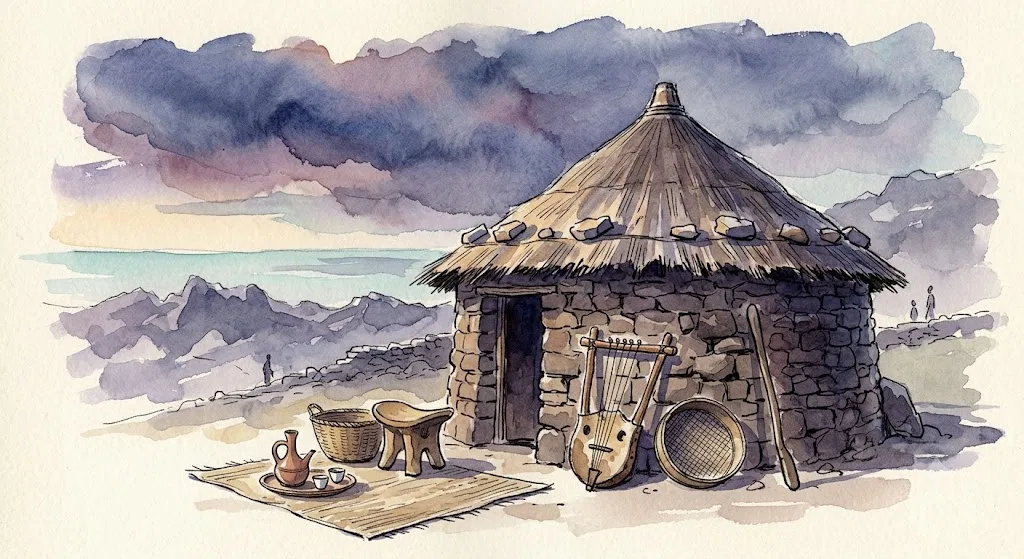
One of the clearest published glimpses of Eritrean ghost lore appears in a light, seasonal article from Eritrea’s Ministry of Information site about Halloween. It stresses that Halloween is not an Eritrean formal holiday, then uses the occasion to describe ghost stories remembered from family storytelling. The key figure is Anderebo, described as a mystical creature that appears after sundown and throws large stones onto roofs. The setting is not a ruined castle or a tourist ghost walk, but a domestic oral scene: grandparents, family gatherings and coffee ceremony storytelling.[Eritrea Ministry Of Information]shabait.comEritrea Ministry Of Information Eritrea and HalloweenEritrea Ministry Of Information Eritrea and Halloween
That detail is important. Anderebo is less useful as a “case” to prove or disprove than as a classic household frightener. Stone-throwing spirits are a surprisingly common motif in global ghost lore: they make a haunting physical, noisy and socially shareable. A bang on the roof is more convincing than a vague feeling in the dark. It also suits a child-warning tale. After sundown, the world outside the house changes character; the roof becomes a drum for unseen agency.
A later article from the same outlet connects Eritrean ghost lore with fairy-like beings, changeling beliefs and rituals used to drive away ghosts, especially in Tigrinya tradition. It describes fairies in Eritrean folklore as ghosts of the dead and notes stories in which a human child is taken and replaced by a fairy child, with the substitute child associated with unexplained illness, disability or disorder.[Eritrea Ministry Of Information]shabait.comhalloween and eritreahalloween and eritrea
For a modern reader, this needs careful handling. Changeling stories in many cultures have been used to explain disability, developmental difference, wasting illness or infant mortality before families had reliable medical explanations. The Eritrean version, as reported, belongs to that wider human pattern: a frightening change in a child becomes a story of substitution. The humane reading is not “fairies stole children”, but “families used supernatural language to talk about illness, grief and difference”. That is exactly the kind of place where Forteana becomes culturally revealing rather than merely spooky.
Spirit possession, the evil eye and healing by water
Eritrean folk belief also overlaps with the wider Horn of Africa and Red Sea world of spirit possession, evil-eye fears and ritual healing. A cultural-health guide on Ethiopian and Eritrean communities notes belief in zar possession and the evil eye, including the idea that a person may harm others through a look, especially children. A separate Eritrea cultural profile states that many Eritreans fear zar as a spirit that can enter a person and cause sickness or death. These are not presented as medical facts, but they show the kind of explanatory world in which illness may be interpreted spiritually as well as physically.[ecald.com]ecald.comEthiopian and Eritrean CultureEthiopian and Eritrean Culture
Zar is much broader than Eritrea. It is found across parts of the Horn of Africa, Sudan, Egypt, Arabia and Iran, and scholars usually describe it as a possession and healing complex rather than a simple “demon” belief. A review article on zar spirit possession describes traditions in which distress, illness and social pressure can be interpreted through the action of spirits, while ritual music, dance and negotiation may provide a socially recognised form of relief.[PMC]pmc.ncbi.nlm.nih.govPMCZār Spirit Possession in Iran and African CountriesPMCZār Spirit Possession in Iran and African Countries
This matters for Eritrean Forteana because zar sits in the ambiguous space between supernatural claim, social therapy, religious tension and embodied experience. Believers may treat it as a real spirit problem. Sceptics may see it as a culturally shaped response to illness, trauma, gendered pressure or psychological distress. Both views can miss something if they flatten the practice. In communities where biomedical care, family honour, religion and stigma all shape how distress is discussed, spirit language can become a way to speak about suffering indirectly.
Water also appears in Eritrean healing belief. A travel-culture account describes a practice called Maicholot, in which water is understood as cleansing, protective and healing. That source is anecdotal rather than scholarly, so it should not be over-weighted, but it fits a wider pattern in Eritrean Christian and folk practice in which blessed or holy water may be used for cleansing illness, fear and perceived spiritual harm.[Pink Pangea]pinkpangea.comPink Pangea4 Eritrean Superstitions and BeliefsPink Pangea4 Eritrean Superstitions and Beliefs
The Fortean interest here is not that water “magically heals all”. It is that water carries enormous symbolic weight in a dry country. In Eritrea, where rainfall is variable and freshwater security is a real concern, water is never just scenery. It is livelihood, purity, blessing, danger and survival all at once.[MHEWC]mhewc.orgOpen source on mhewc.org.
Rain that feels like an omen
Eritrea’s weather is not paranormal, but it helps explain why rain occupies such a powerful imaginative place. The country includes highlands, lowlands, escarpments and Red Sea coastal zones, with rainfall varying sharply by region. Eritrea’s initial national communication to the UN climate process described annual rainfall as ranging from about 100 mm in the lowlands to about 700 mm in the central highlands, with different seasonal patterns in different parts of the country.[UNFCCC]unfccc.intOpen source on unfccc.int.
Traditional rain-reading is therefore not quaint background detail. It is practical knowledge in a climate where poor rains can mean crop failure and livestock loss. Eritrea’s Ministry of Information has described traditional associations between cloud types and rain, including dark rain-bearing clouds and clouds linked to showers and thunderstorms. The same outlet has written about the emotional force of the main rains, which usually water the highlands and western lowlands in June, July and August, arriving with thunder and lightning after long dry expectation.[Eritrea Ministry Of Information]shabait.comEritrea Ministry Of Information Rain,Oh Rain – Eritrea Ministry Of InformationEritrea Ministry Of Information Rain,Oh Rain – Eritrea Ministry Of Information
This is fertile ground for Fortean thinking because unusual weather is one of the oldest sources of strange reports. Sudden downpours, violent thunder, failed rains, floods after drought, red dust in the sky, or lightning over dry country can all become moralised or mythologised. Eritrea is repeatedly exposed to droughts and floods, and climate sources describe low, unreliable rainfall, recurrent drought, water scarcity and extreme-weather vulnerability as major risks.[fao.org]openknowledge.fao.orgOpen source on fao.org.
A sceptical reading says: rain omens are folk meteorology, not supernatural prophecy. A sympathetic reading says: in places where rain decides whether people and animals suffer, the sky naturally becomes a text people learn to read. The strange feeling is real even when the mechanism is ordinary.
The Red Sea “sea cow” and the pull of mystery animals
Eritrea’s Red Sea coast and Dahlak Archipelago give the country a natural setting for mystery-animal stories. The best grounded “monster” candidate is not a monster at all, but the dugong: a large, shy marine mammal sometimes called a sea cow. Eritrean marine-biodiversity sources list dugongs, dolphins and whales among the marine mammals of Eritrean waters, and note the importance of the Dahlak islands for sea turtles.[Eritrea Embassy Japan]eritreaembassy-japan.orgOpen source on eritreaembassy-japan.org.
For Forteana, dugongs matter because sirenians have long generated mermaid, sea-calf and strange-animal traditions around the world. A fleeting view of a dugong’s head, back or tail in poor light can produce a far more uncanny report than the animal deserves. Eritrea’s coast is therefore a plausible setting for odd marine sightings even without a famous named sea monster.
More speculative is the “auli” or “water calf”, a cryptozoological claim reported from parts of Ethiopia and Eritrea, including references to the Mareb river system. Cryptid catalogues describe it as a possible unknown sirenian or freshwater manatee-like animal, but the sourcing is weak, derivative and often routed through enthusiast summaries rather than strong zoological records.[Cryptid Archives]cryptidarchives.fandom.comCryptid Archives AuliCryptid Archives Auli
The sceptical explanation is straightforward: known animals, travellers’ tales, translation drift and the prestige of “unknown species” can create a cryptid from fragmentary reports. The believer’s version is that remote wetlands and river systems may preserve memories of animals not yet properly documented, or of animals once present and later lost. On current evidence, the auli belongs in Eritrea’s “interesting but unproven” drawer: worth mentioning, not worth inflating.
Hyenas, night animals and borrowed border folklore
Eritrea does not have the same internationally famous hyena tradition as Harar in eastern Ethiopia, where hyenas are fed and are said by some residents to protect people from mischievous spirits. That Harar case is outside Eritrea, but it is still useful as a neighbouring comparison because it shows how Horn of Africa communities can turn a feared night animal into a spiritual actor. The Guardian’s reporting on Harar describes beliefs that hyenas can keep djinn away, act as garbage-disposal animals and even serve as message-bearers in local folklore.[The Guardian]theguardian.comOpen source on theguardian.com.
For Eritrea, the lesson is not “Eritreans have the same hyena cult”. They do not, at least not in the documented public sources. The lesson is that night animals in the region often become more than animals in stories. Hyenas, jackals, owls, snakes and other liminal creatures are easy to place at the edge of the human world: scavenging near settlements, calling in darkness, appearing at thresholds, and vanishing before dawn.
This is where careful country-level Forteana should avoid both exaggeration and over-correction. It would be misleading to import Ethiopia’s Harar hyena tradition wholesale into Eritrea. It would also be too narrow to ignore the shared ecological and cultural field of the Horn of Africa. Eritrean animal lore is likely richer in oral circulation than in English-language archives, but the public evidence supports caution.

The Bisha “UFO” and the April Fool problem
The most obvious modern Eritrean UFO item is a 2015 social-media post claiming that a disc-shaped unidentified flying object had been spotted by workers at the Bisha mine. The date attached to the circulating post is 1 April 2015. That alone does not automatically prove a joke, but it is a large red flag, especially when the available trace is a Facebook post rather than an official aviation report, a local newspaper investigation, photographs with provenance, or multiple independent witness accounts.[Facebook]facebook.comthe talk of bisha01042015 asmara a disc shaped unidentified flying object ufo hathe talk of bisha01042015 asmara a disc shaped unidentified flying object ufo ha
This is a useful case because it shows how modern Forteana spreads in countries with limited searchable archives. A single post can become “the Eritrean UFO case” simply because there are few competing public records. The Bisha mine itself is a real and politically loaded place, known internationally through legal and human-rights controversies involving Nevsun Resources and allegations concerning forced labour connected to the mine, which Nevsun denied in court filings. That serious context should not be mixed carelessly with an unsupported UFO gag or rumour.[SCC Decisions]decisions.scc-csc.caOpen source on scc-csc.ca.
The best assessment is simple: the Bisha UFO claim is part of Eritrea’s internet-age oddity record, but not a strong UFO case. It lacks the evidential features that would make it hard to dismiss: timed observations, named witnesses, original images, radar or flight data, meteorological checks, or follow-up reporting. Its Fortean value is mainly as folklore in miniature — the way a mining site, a flying saucer image and April Fool timing can combine into a shareable national curiosity.
Nabro: when the real sky was stranger than the rumours
If Eritrea has one genuinely spectacular modern “strange sky” event, it is not a UFO but the 2011 eruption of Nabro volcano in the Southern Red Sea region. Nabro had no known historical eruption before 2011, and the eruption began after an earthquake swarm in a remote, difficult-to-monitor border region. The Smithsonian Global Volcanism Program reported ash fall, evacuations, sulphur dioxide plumes and fatalities attributed by the Eritrean government to the eruption.[volcano.si.edu]volcano.si.eduOpen source on si.edu.
NASA satellite imagery showed hot volcanic ash over the vent and an active lava flow, while later scientific work noted that the eruption began with very little warning and that no seismic or other monitoring networks were operating in Eritrea at the time. This is precisely the kind of event that, in earlier centuries, might have generated omens, miracle stories, dragon imagery or end-times rumours: earthquakes, a darkened sky, ash, lightning-like effects in volcanic plumes, and a remote mountain suddenly coming alive.[NASA Science]science.nasa.govScience Detailed Views of Erupting Nabro VolcanoScience Detailed Views of Erupting Nabro Volcano
The scientific explanation is not less dramatic than the supernatural one. Nabro sits within the tectonically active Afar and Red Sea rift environment, where the crust is being pulled apart and volcanism is part of the landscape’s deep machinery. The 2011 eruption was surprising because of monitoring gaps and historical silence, not because it defied geology. That distinction is central to good Fortean writing: “unanticipated” is not the same as “unexplainable”.
Nabro also changes how one reads Eritrean sky lore. In a country where real geological and climatic extremes occur, not every frightening light, rumble, cloud or fall from the sky needs a paranormal frame. Sometimes the weirdest answer is the Earth itself.
Asmara’s modernist uncanny
Asmara is usually discussed as architecture rather than Forteana, but it gives Eritrea a distinctive weird-history atmosphere. UNESCO describes the capital as a modernist African city located over 2,000 metres above sea level, developed from the 1890s as an Italian colonial military outpost and transformed after 1935 through a large programme of modernist construction. Its buildings include government offices, cinemas, churches, mosques, synagogues, shops, hotels and residential districts shaped by Italian rationalist and modernist design.[UNESCO World Heritage Centre]whc.unesco.orgOpen source on unesco.org.
Why does that matter for a page about strange history? Because modernist Asmara can feel like a time-slip. It is not paranormal, but it is uncanny in the ordinary sense: an African highland capital containing an unusually preserved concentration of 1930s experimental architecture, including cinemas and streamlined buildings that seem to belong to another political dream. UNESCO’s listing frames Asmara as an outstanding example of a colonial capital and a witness to twentieth-century modernity, not as a haunted city.[UNESCO World Heritage Centre]whc.unesco.orgOpen source on unesco.org.
Forteana often thrives in places where history feels visibly out of joint. Asmara’s strangeness is not a ghost story but a built contradiction: futurist architecture from a colonial past, preserved in a postcolonial national capital, high above the Red Sea heat. It is the kind of setting where rumours, memories and urban legends naturally gather, even when the buildings themselves need no supernatural embellishment.
What sceptics and believers are really arguing about
The Eritrean material is best understood as a spectrum rather than a contest between “true” and “fake”.
At one end are natural events that can look uncanny: drought-breaking storms, volcanic ash clouds, earthquake swarms, unusual marine-animal sightings, or nocturnal wildlife. The right tools here are meteorology, geology, zoology and good local reporting. Nabro’s eruption, dugongs in the Red Sea and Eritrea’s volatile rainfall all belong mainly in this category.[si.edu]volcano.si.eduOpen source on si.edu.
In the middle are folklore and belief systems that may encode social knowledge. Anderebo, fairies of the dead, changeling-like explanations, evil-eye fears and zar possession should not be treated as laboratory claims. They are cultural explanations, warnings and ritual languages for experiences that can include illness, grief, misfortune, childhood vulnerability and fear after dark.[Eritrea Ministry Of Information]shabait.comEritrea Ministry Of Information Eritrea and HalloweenEritrea Ministry Of Information Eritrea and Halloween
At the weakest evidential end are modern internet oddities such as the Bisha UFO post. These are still part of the weird record, but their value is mostly folkloric: they show how a rumour circulates, not that a flying saucer appeared over Eritrea.[Facebook]m.facebook.comEritrean PressEritrean Press
Believers may argue that sparse documentation should not be mistaken for absence. That is fair: oral traditions, private religious experiences and local sightings are often under-recorded. Sceptics may reply that thin evidence cannot support strong paranormal claims. That is also fair. The best position is evidence-aware curiosity: preserve the story, identify the source, ask what ordinary explanations fit, and leave room for uncertainty where the record genuinely runs out.
Why Eritrea’s strange record still matters
Eritrea’s Forteana matters because it resists the easy template. There is no single famous Eritrean monster or world-renowned haunted site carrying the whole subject. Instead, the country’s strange-history record is a patchwork of domestic ghost lore, spirit belief, harsh weather, Red Sea animals, volcanic surprise, colonial architecture and internet rumour.
That patchwork says something important. Weird history is not only made by spectacular cases. It is also made by the stories people tell to make ordinary danger intelligible: the roof that bangs after dark, the child whose illness seems to come from elsewhere, the spirit blamed for suffering, the cloud read for rain, the sea animal glimpsed as something impossible, the volcano that erupts without living memory of eruption.
For Eritrea, the most honest conclusion is not that the country is packed with proven anomalies. It is that Eritrea’s strangeness is grounded in real pressures: dry land and precious water, highland and coast, faith and family, visible colonial memory, and landscapes where the natural world can still behave with startling force. That is enough. In Forteana, the most durable stories are often not the loudest ones, but the ones that show how people live with uncertainty.
Amazon book picks
Further Reading
Books and field guides related to What Makes Eritrea's Strange History So Elusive?. Use these as the next step if you want deeper reading beyond the article.


The Penguin Book of Dragons
Introduces global legendary traditions that help contextualise Eritrea's oral supernatural heritage.
The lore of the land
Explains how local landscapes accumulate supernatural traditions.
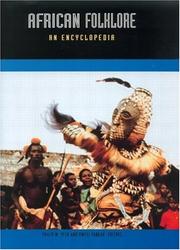
African Folklore
Covers African oral traditions and belief systems relevant to Eritrean folklore.
eBay marketplace picks
Marketplace Samples
Live-tested eBay searches with available results related to this page.
Endnotes
1.
Source: whc.unesco.org
Link:https://whc.unesco.org/en/list/1550/
2.
Source: unfccc.int
Link:https://unfccc.int/resource/docs/natc/erinc1.pdf
3.
Source: ecald.com
Title: Ethiopian and Eritrean Culture
Link:https://www.ecald.com/assets/Resources/Assets/C3-P2-S3-Ethiopian-Eritrean-Culture.pdf
4.
Source: mhewc.org
Link:https://www.mhewc.org/eritrea/
5.
Source: openknowledge.fao.org
Link:https://openknowledge.fao.org/bitstreams/608bb553-0f98-4ad4-9532-f7889a2d8506/download
6.
Source: facebook.com
Title: the talk of bisha01042015 asmara a disc shaped unidentified flying object ufo ha
Link:https://www.facebook.com/EritreanPresss/photos/the-talk-of-bisha01042015-asmara-a-disc-shaped-unidentified-flying-object-ufo-ha/353794511479816/
7.
Source: m.facebook.com
Title: Eritrean Press
Link:https://m.facebook.com/EritreanPresss/photos/a.219856768206925/353794511479816/?locale2=zh_CN&type=3
8.
Source: volcano.si.edu
Link:https://volcano.si.edu/showreport.cfm?doi=10.5479%2Fsi.GVP.BGVN201109-221101
9.
Source: volcano.si.edu
Link:https://volcano.si.edu/showreport.cfm?gvpvar=GVP.WVAR20110608-221101
10.
Source: science.nasa.gov
Title: Science Detailed Views of Erupting Nabro Volcano
Link:https://science.nasa.gov/earth/earth-observatory/detailed-views-of-erupting-nabro-volcano-51216/
11.
Source: whc.unesco.org
Link:https://whc.unesco.org/en/urban-heritage-atlas/asmara/
12.
Source: whc.unesco.org
Link:https://whc.unesco.org/document/155770
13.
Source: facebook.com
Link:https://www.facebook.com/kibrom.assefaweri.1/videos/asmara-heavy-rain-in-the-capital-city-of-eritrea/1586506343478662/
14.
Source: facebook.com
Link:https://www.facebook.com/groups/128544650914320/posts/2414041392364623/
15.
Source: facebook.com
Link:https://www.facebook.com/brilliantmaps/posts/mythical-creatures-cryptids-of-africa/1104145065161436/
16.
Source: facebook.com
Link:https://www.facebook.com/ynetglobal/videos/a-little-known-sunni-tribe-the-afar-lives-along-the-red-sea-coast-of-eritrea-eth/1595417902185971/
17.
Source: facebook.com
Link:https://www.facebook.com/yaldafrica/posts/countryofthemonth-eritrea-located-along-the-southern-red-sea-in-the-horn-of-afri/1399759552195259/
18.
Source: facebook.com
Link:https://www.facebook.com/WWFKenya/posts/have-you-ever-heard-of-a-marine-mammal-called-the-dugong-also-known-as-sea-cows-/470176235569865/
19.
Source: facebook.com
Link:https://www.facebook.com/100067916567839/posts/eritrea-its-stunning-red-sea-coast-eritrea-boasts-a-1200-km-coastline-along-the-/969949735278903/
20.
Source: facebook.com
Link:https://www.facebook.com/groups/242479246326368/posts/1888863351687941/
21.
Source: facebook.com
Link:https://www.facebook.com/Chloejadetravels/posts/did-you-know-the-red-sea-is-in-east-africa-welcome-to-massawa-eritrea-i-captured/1248574224028219/
22.
Source: facebook.com
Link:https://www.facebook.com/groups/eritrearchitecture/posts/2801090606632566/
23.
Source: facebook.com
Link:https://www.facebook.com/groups/990020422163572/posts/1171012517397694/
24.
Source: unfccc.int
Link:https://unfccc.int/resource/docs/napa/eri01.pdf
25.
Source: 2009-2017.state.gov
Link:https://2009-2017.state.gov/outofdate/bgn/eritrea/30110.htm
26.
Source: ares.jsc.nasa.gov
Title: meteorite falls
27.
Source: youtube.com
Title: The Hidden History of Tigray and Eritrea Before Division
Link:https://www.youtube.com/watch?v=6vog-s_C5TE
Source snippet
ERITREA - ERITREAN HISTORY - PART 1...
28.
Source: youtube.com
Link:https://www.youtube.com/watch?v=Un4R4BBgnO4
Source snippet
Why Is This African City Frozen in the 1930s?...
29.
Source: minorityrights.org
Link:https://minorityrights.org/country/eritrea/
30.
Source: Wikipedia
Link:https://en.wikipedia.org/wiki/Eritrea
31.
Source: shabait.com
Title: Eritrea Ministry Of Information Eritrea and Halloween
Link:https://shabait.com/2020/10/31/eritrea-and-halloween/
32.
Source: shabait.com
Title: halloween and eritrea 2 0
Link:https://shabait.com/2021/10/30/halloween-and-eritrea-2-0/
33.
Source: pmc.ncbi.nlm.nih.gov
Title: PMCZār Spirit Possession in Iran and African Countries
Link:https://pmc.ncbi.nlm.nih.gov/articles/PMC4801492/
34.
Source: pinkpangea.com
Title: Pink Pangea4 Eritrean Superstitions and Beliefs
Link:https://pinkpangea.com/2016/11/4-eritrean-superstitions-and-beliefs/
35.
Source: shabait.com
Title: Eritrea Ministry Of Information Rain,Oh Rain – Eritrea Ministry Of Information
Link:https://shabait.com/2021/08/14/rainoh-rain/
36.
Source: shabait.com
Title: a popular greening campaign summer nights and city lights
Link:https://shabait.com/2023/07/17/a-popular-greening-campaign-summer-nights-and-city-lights/
37.
Source: dicf.unepgrid.ch
Link:https://dicf.unepgrid.ch/eritrea/climate-change
38.
Source: eritreaembassy-japan.org
Link:https://www.eritreaembassy-japan.org/Biodiversity_Fisheries_en.html
39.
Source: shabait.com
Title: eritreas marine biodiversity
Link:https://shabait.com/2019/04/13/eritreas-marine-biodiversity/
40.
Source: cryptidarchives.fandom.com
Title: Cryptid Archives Auli
Link:https://cryptidarchives.fandom.com/wiki/Auli
41.
Source: theguardian.com
Link:https://www.theguardian.com/environment/2024/apr/05/hyenas-harar-ethiopia-how-city-fell-in-love-with-its-bone-crunching-scavengers-aoe
42.
Source: decisions.scc-csc.ca
Link:https://decisions.scc-csc.ca/scc-csc/scc-csc/en/item/18169/index.do
43.
Source: uca.hal.science
Link:https://uca.hal.science/hal-02114238/document
44.
Source: Wikipedia
Link:https://en.wikipedia.org/wiki/Changeling
45.
Source: Wikipedia
Link:https://en.wikipedia.org/wiki/Asmara
46.
Source: shabait.com
Title: the grey skies of summer
Link:https://shabait.com/2024/07/03/the-grey-skies-of-summer/
47.
Source: cryptid-that-you-saw.fandom.com
Link:https://cryptid-that-you-saw.fandom.com/wiki/Auli
48.
Source: pmc.ncbi.nlm.nih.gov
Link:https://pmc.ncbi.nlm.nih.gov/articles/PMC4562108/
49.
Source: belonging.berkeley.edu
Link:https://belonging.berkeley.edu/climatedisplacement/case-studies/eritrea
50.
Source: eritreaembassy-japan.org
Link:https://www.eritreaembassy-japan.org/data/Asmara_Africa%27s_Modernist_City.pdf
51.
Source: cimss.ssec.wisc.edu
Link:https://cimss.ssec.wisc.edu/satellite-blog/archives/8339
Additional References
52.
Source: science.org
Link:https://www.science.org/content/article/archivists-uncover-earliest-evidence-person-being-killed-meteorite
53.
Source: youtube.com
Title: Eritrea: Preserving Oral Traditions and Folklore | Eri-TV News
Link:https://www.youtube.com/watch?v=HmWpdoR6Ek4
Source snippet
The Hidden History of Tigray and Eritrea Before Division...
54.
Source: researchgate.net
Link:https://www.researchgate.net/publication/329484838_Review_of_Cetaceans_in_the_Red_Sea
55.
Source: researchgate.net
Link:https://www.researchgate.net/publication/31230272_Lost_Tribes_and_Coffee_Ceremonies_Zar_Spirit_Possession_and_the_Ethno-Religious_Identity_of_Ethiopian_Jews_in_Israel
56.
Source: researchgate.net
Link:https://www.researchgate.net/publication/349296489_Aerosol-Cloud_Interaction_with_Summer_Precipitation_over_Major_Cities_in_Eritrea
57.
Source: researchgate.net
Link:https://www.researchgate.net/publication/396625662_Seismological_Observations_of_the_2011_Nabro_Eritrea_Eruption_Implications_for_Eruptive_Deep_Closure_and_Volcano-Tectonic_Interactions
58.
Source: joshuaproject.net
Link:https://joshuaproject.net/people_groups/11486/ER
59.
Source: canlii.org
Link:https://www.canlii.org/w/canlii/2018CanLIIDocs10660.pdf
60.
Source: nightbringer.se
Link:https://nightbringer.se/myths-and-legends/mythic-fairies-and-elves/changelings/
61.
Source: geotoys.com
Link:https://geotoys.com/blogs/geotoys-blog/cryptids-across-continents-global-legends-of-mystery-and-myth?srsltid=AfmBOoqx-EBUcEryL52DKXvunTh1r2LVphMZijNkMkJdCxu0jKw3xDVT
Topic Tree
Follow this branch
Related pages 192
- Afghan Forteana
- Antigua Uncanny
- Bosnian Mysteries
- Botswana Weird
- Brazil Strange
- +187 more in sidebar