Within Albania Weird
Why Do Albania's Landscapes Invite Legend?
Tomorr and the Blue Eye show how Albania's strange record blends sacred geography, pilgrimage, natural wonder and legend.
On this page
- Mount Tomorr as a sacred mountain
- The Blue Eye as natural mystery
- Tourism, pilgrimage and modern retelling
Page outline Jump by section
Introduction
Some of Albania’s most enduring mystery places are not associated with ghosts, monsters or dramatic unexplained incidents. Instead, they are landscapes where natural features, religious tradition and folklore have become so closely intertwined that the places themselves seem uncanny. Mount Tomorr and the Blue Eye illustrate this particularly well. One is a mountain that has been regarded as sacred for centuries by people of different faiths; the other is a spectacular karst spring whose remarkable appearance has encouraged legends alongside scientific curiosity. Neither site provides evidence for the paranormal, yet both continue to attract pilgrims, travellers and storytellers because they invite the feeling that the landscape holds meanings beyond ordinary geography.[academia.edu]academia.eduThe Pilgrimage to Mount Tomor in Albania: A ChangingThe Pilgrimage to Mount Tomor in Albania: A Changing…January 1, 2017 — The research findings reveal that the pilgrimage to Mou…
Why Mount Tomorr Feels More Than Just a Mountain
Mount Tomorr rises to more than 2,400 metres above central Albania and dominates the surrounding countryside. Its imposing profile alone helps explain why it became one of the country’s most symbolically powerful mountains. Unlike many sacred peaks that belong exclusively to one religious tradition, Tomorr has accumulated layers of meaning over many centuries, making it a living example of how beliefs evolve without entirely replacing what came before.[Wikipedia]WikipediaOpen source on wikipedia.org.
Mount Tomorr as a sacred mountain
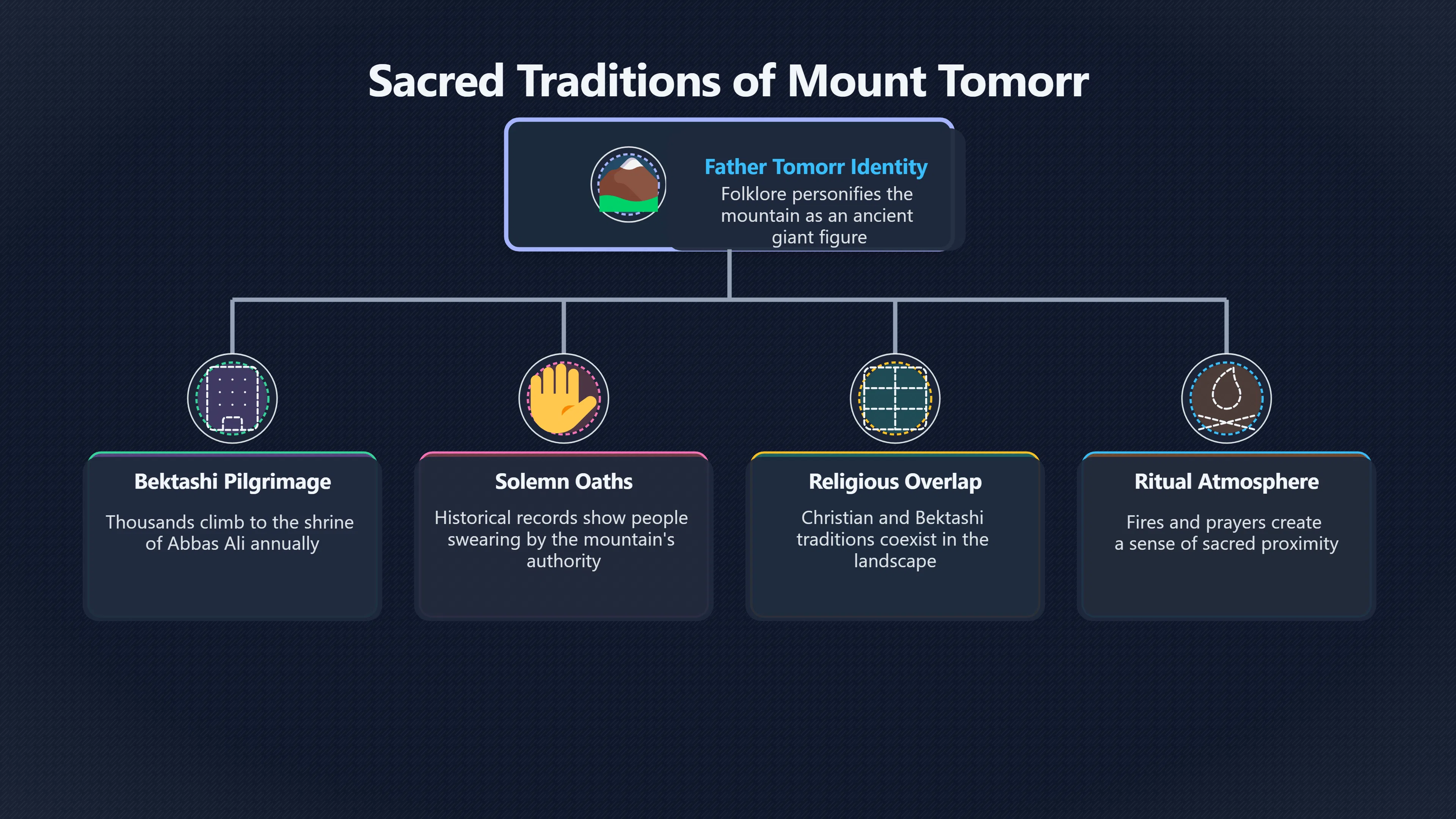
Long before the modern Bektashi pilgrimage, folklore portrayed the mountain itself as a powerful being. Albanian traditions personify it as “Father Tomorr”, an ancient giant whose authority extends over the surrounding land. Folklore scholars have suggested that this figure preserves memories of pre-Christian mountain worship, although direct archaeological evidence for an ancient temple on the summit remains limited. The mountain’s reputation rests more on continuity of belief than on a single historical monument.[Wikipedia]WikipediaOpen source on wikipedia.org.
That continuity is one reason Tomorr occupies an unusual place in Albanian Fortean culture. Rather than being remembered because of one extraordinary event, it has acquired an atmosphere of mystery through centuries of ritual, oath-taking and pilgrimage. Historical sources describe people swearing especially solemn oaths “by Father Tomorr”, implying that the mountain itself possessed spiritual authority independent of church or mosque.[Wikipedia]WikipediaOpen source on wikipedia.org.
Pilgrimage where traditions overlap
Today the mountain is best known for the annual August pilgrimage centred on the shrine dedicated to Abbas Ali, an important figure in the Bektashi tradition. Thousands of pilgrims climb to the shrine each year, while the mountain has also retained associations with earlier Christian observances connected with the Feast of the Assumption. Researchers studying the pilgrimage argue that it demonstrates how Albanian sacred geography often absorbs rather than replaces older beliefs, producing a landscape where folklore, religion and national identity coexist.[researchgate.net]researchgate.netResearch Gate The Bektashi Pilgrimage to MtTomorr, AlbaniaJanuary 27, 2017 — Commemorative Religion After Communism. The Bektashi Pilgrimage to Mt. Tomorr, Albania The following is…
For Fortean readers, this matters because mystery often emerges from accumulated meaning rather than unexplained phenomena. Visitors report a strong atmosphere created by the altitude, changing weather, ritual sacrifice in some traditional ceremonies, fires, prayers and shared stories. None of these experiences demonstrate supernatural forces, but together they reinforce the mountain’s reputation as a place where ordinary and sacred worlds seem unusually close.
Belief and scepticism
Several claims surrounding Mount Tomorr deserve careful treatment.[balkanspirit.eu]balkanspirit.euMount TomorrBalkan SpiritMount Tomorr is the holiest site for the Bektashis in Albania, prominent above its surroundings and visible from anywhere in…
Supporters of its mystical reputation point to:
- centuries of uninterrupted pilgrimage despite political and religious upheaval;
- legends connecting the summit with ancient deities and heroic figures;
- the widespread cultural respect still shown towards “Father Tomorr”.
More cautious historians note that:
- evidence for prehistoric cult sites is suggestive rather than conclusive;
- many traditions survive through oral folklore rather than contemporary historical records;
- sacred status naturally encourages later legends to accumulate around an already famous place.
This balance makes Tomorr especially interesting. Its mystery lies less in unexplained events than in the remarkable survival of belief across changing religions and political systems.[academia.edu]academia.eduThe Pilgrimage to Mount Tomor in Albania: A ChangingThe Pilgrimage to Mount Tomor in Albania: A Changing…January 1, 2017 — The research findings reveal that the pilgrimage to Mou…

Why the Blue Eye Looks Almost Unreal
If Mount Tomorr gains its mystery from history, the Blue Eye gains it from appearance. Located near Muzinë in southern Albania, the Blue Eye is a powerful freshwater spring emerging from limestone rock. Its vivid colours and extraordinary clarity make it one of Albania’s best-known natural landmarks.[Wikipedia]WikipediaBlue Eye, AlbaniaBlue Eye, Albania
The Blue Eye as natural mystery
The spring appears as a deep circular pool with brilliant shades of sapphire and turquoise surrounding an almost black central shaft. The colour contrast creates the impression of a giant human eye staring upwards through the water, giving rise to its familiar name.
Scientists explain the effect through geology rather than folklore. The Blue Eye is a karst resurgence: groundwater travels through underground limestone passages before emerging under considerable pressure. Extremely clear water, mineral composition, depth and the way sunlight refracts through the spring combine to produce its striking colours.[exploreworldwide.com]exploreworldwide.comDeclared a Natural Monument for its hydroAlbania's Blue Eye: geology, history & visiting tips12 Jun 2026 — The Blue Eye, also known as 'springs of Bistricë', is one of Albania's…
Yet one genuine uncertainty remains. Divers have descended beyond 50 metres, but the precise depth of the main shaft has not been definitively established because of powerful underwater currents and the technical difficulty of exploration. This limited scientific uncertainty has encouraged popular speculation without requiring supernatural explanations.[exploreworldwide.com]exploreworldwide.comDeclared a Natural Monument for its hydroAlbania's Blue Eye: geology, history & visiting tips12 Jun 2026 — The Blue Eye, also known as 'springs of Bistricë', is one of Albania's…
Legends beneath the surface
Unlike many European springs associated with monsters or water spirits, the Blue Eye’s folklore tends to focus on awe rather than fear. Local storytelling often presents it as a place of hidden depths, unusual purity or mysterious origins rather than a location haunted by specific supernatural beings.
Modern tourism has amplified these impressions. Photographs showing the apparently bottomless blue centre circulate widely online, sometimes accompanied by exaggerated claims that the spring is “bottomless” or scientifically inexplicable. In reality, hydrologists understand the geological processes responsible for the spring, even though mapping every underwater passage remains an ongoing challenge.[exploreworldwide.com]exploreworldwide.comDeclared a Natural Monument for its hydroAlbania's Blue Eye: geology, history & visiting tips12 Jun 2026 — The Blue Eye, also known as 'springs of Bistricë', is one of Albania's…
Tourism, Pilgrimage and Modern Retelling
Mount Tomorr and the Blue Eye demonstrate two different ways mysterious landscapes survive into the twenty-first century.
Tomorr remains primarily a place where living religious practice shapes visitors’ experience. Although hikers and tourists visit, its identity is still rooted in pilgrimage, ritual and inherited belief. Researchers note that the post-communist revival of religious life has strengthened the mountain’s symbolic importance rather than reducing it to a historical curiosity.[ResearchGate]researchgate.netResearch Gate The Bektashi Pilgrimage to MtTomorr, AlbaniaJanuary 27, 2017 — Commemorative Religion After Communism. The Bektashi Pilgrimage to Mt. Tomorr, Albania The following is…
The Blue Eye, by contrast, has become one of Albania’s signature natural attractions. Conservation authorities treat it as a protected natural monument because of its fragile ecosystem, while tourism increasingly depends on preserving rather than exploiting the site. Swimming restrictions and controlled visitor access reflect concern that excessive tourism could damage the very qualities that make the spring remarkable.[exploreworldwide.com]exploreworldwide.comDeclared a Natural Monument for its hydroAlbania's Blue Eye: geology, history & visiting tips12 Jun 2026 — The Blue Eye, also known as 'springs of Bistricë', is one of Albania's…
Together they illustrate an important pattern in Albanian Forteana. The country’s most memorable mystery places rarely depend upon spectacular paranormal claims. Instead, they occupy the fertile boundary where dramatic landscapes encourage stories, religious traditions preserve older memories, scientific explanations answer many questions without eliminating wonder, and each new generation finds fresh reasons to regard these places as somehow exceptional.
Amazon book picks
Further Reading
Books and field guides related to Why Do Albania's Landscapes Invite Legend?. Use these as the next step if you want deeper reading beyond the article.

The Dictionary of Albanian Religion, Mythology and Folk Culture
Explains sacred mountains and local mythology.


eBay marketplace picks
Marketplace Samples
Live-tested eBay searches with available results related to this page.




Endnotes
1.
Source: academia.edu
Title: The Pilgrimage to Mount Tomor in Albania: A Changing
Link:https://www.academia.edu/38202806/The_Pilgrimage_to_Mount_Tomor_in_Albania_A_Changing_Sacred_Place_in_a_Changing_Society
Source snippet
The Pilgrimage to Mount Tomor in Albania: A Changing...January 1, 2017 — The research findings reveal that the pilgrimage to Mou...
Published: January 1, 2017
2.
Source: Wikipedia
Link:https://en.wikipedia.org/wiki/Tomorr
3.
Source: Wikipedia
Title: Blue Eye, Albania
Link:https://en.wikipedia.org/wiki/Blue_Eye%2C_Albania
4.
Source: Wikipedia
Title: Tomorr Mountain National Park
Link:https://en.wikipedia.org/wiki/Tomorr_Mountain_National_Park
5.
Source: Wikipedia
Title: Baba Tomor
Link:https://en.wikipedia.org/wiki/Baba_Tomor
6.
Source: researchgate.net
Title: Research Gate The Bektashi Pilgrimage to Mt
Link:https://www.researchgate.net/publication/316523399_Commemorative_Religion_after_Communism_The_Bektashi_Pilgrimage_to_Mt_Tomorr_Albania
Source snippet
Tomorr, AlbaniaJanuary 27, 2017 — Commemorative Religion After Communism. The Bektashi Pilgrimage to Mt. Tomorr, Albania The following is...
Published: January 27, 2017
7.
Source: exploreworldwide.com
Title: Declared a Natural Monument for its hydro
Link:https://www.exploreworldwide.com/blog/albania-blue-eye-formed
Source snippet
Albania's Blue Eye: geology, history & visiting tips12 Jun 2026 — The Blue Eye, also known as 'springs of Bistricë', is one of Albania's...
8.
Source: rtsh.al
Link:https://rtsh.al/rti/en/the-blue-eye-attracts-visitors-with-crystal-waters-and-scenic-nature-tourism-grows-in-southern-albania/
Source snippet
Tourists say they chose Albania after hearing about its growing reputation as a...
9.
Source: youtube.com
Title: Exploring Berat, Albania: The City of a Thousand Windows
Link:https://www.youtube.com/watch?v=DosgV2SAe4Y
Source snippet
The Blue Eye | Syri i Kaltër | Albania's Living Spring of Myth and Mystery...
10.
Source: youtube.com
Title: The Blue Eye | Syri i Kaltër | Albania’s Living Spring of Myth and Mystery
Link:https://www.youtube.com/watch?v=smYdKKitK_4
Source snippet
Blue Eye Albania LOST TALES July 2021...
Published: July 2021
11.
Source: balkanspirit.eu
Title: Mount Tomorr
Link:https://balkanspirit.eu/mount-tomorr/
Source snippet
Balkan SpiritMount Tomorr is the holiest site for the Bektashis in Albania, prominent above its surroundings and visible from anywhere in...
Additional References
12.
Source: pilgrimmap.com
Link:https://www.pilgrimmap.com/site/mount-tomorri-albania-7db92ab7
Source snippet
Mount Tomorri, Albania | Sacred Mountain GuideAlbania's sacred mountain where Bektashi and Christian pilgrims converge each August. Visit...
13.
Source: sarakuehn.com
Link:https://www.sarakuehn.com/tomor-pilgrimage-albania
Source snippet
Tomor Pilgrimage, AlbaniaKnown as Baba Tomor (Father Tomor), according to central Albanian popular belief the mountain is considered to b...
14.
Source: facebook.com
Link:https://www.facebook.com/abbasnasirsaeed/posts/tomorr-mountains-in-albania-europethe-shrine-of-hazrat-abbasas/4315763895124559/
Source snippet
g the second half of August, for all Albanians: Christians...
15.
Source: youtube.com
Title: Mali i Tomorrit dhe Baba Tomorri/ Mount Tomorr and Baba Tomorr
Link:https://www.youtube.com/watch?v=mXNB8i7yNfU
Source snippet
HOLY MOUNTAIN and BEKTASHI - ALBANIA Mount Tomorrit...
16.
Source: youtube.com
Title: HOLY MOUNTAIN and BEKTASHI
Link:https://www.youtube.com/watch?v=Mkj1SAG7ucQ
Source snippet
Exploring Berat, Albania: The City of a Thousand Windows...
17.
Source: youtube.com
Link:https://www.youtube.com/watch?v=GKxAVC2SZLg
Published: July 2021
Topic Tree