Why Montenegro Turns Landscape Into Legend
Montenegro’s strange-history record is not dominated by a single world-famous monster or neatly documented UFO wave.
Page outline Jump by section
Introduction
The most substantial Montenegrin cases sit on the boundary between folklore and lived belief: the weather-defending spirit-men known in regional tradition as hail-defenders; the miracle traditions of Ostrog Monastery; the dragon-like and devilish lake stories attached to Skadar and Durmitor; and a small modern file of UFO-style reports that is better read as witness testimony than evidence of alien visitation. The useful question is not “which monster is real?”, but why Montenegro’s landscape so often turns natural drama into supernatural narrative.
Why Montenegro breeds strange stories
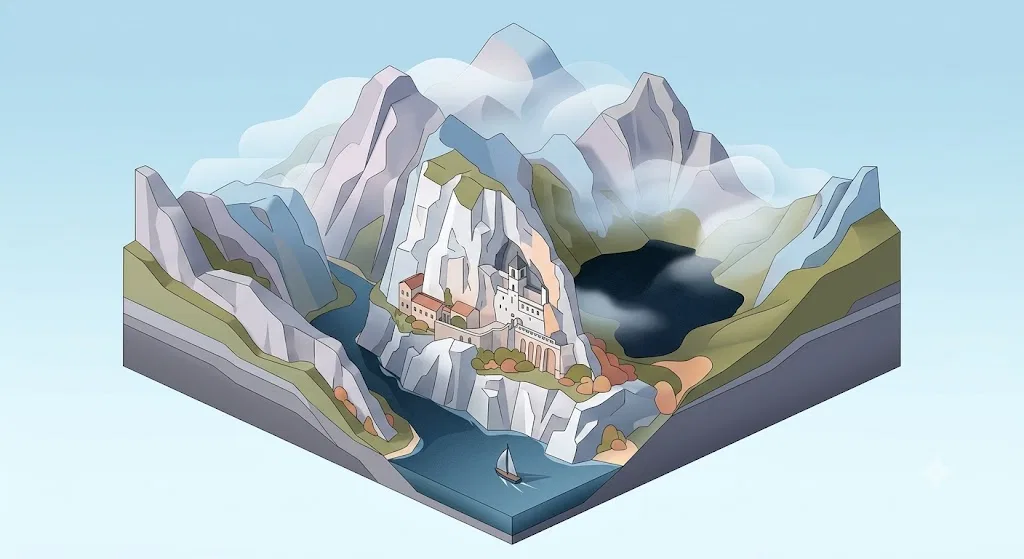
Montenegro is almost designed for eerie interpretation. It has a short Adriatic coast, deep bays, steep limestone mountains, glacial lakes, karst caves, monasteries built into cliffs, and borderlands where South Slavic, Orthodox, Catholic, Muslim, Albanian and Venetian histories meet. UNESCO describes the Bay of Kotor region as a cultural landscape of fortified towns and mountains rising sharply from the Adriatic, while Durmitor National Park is noted for its glacial lakes, caves, subterranean rivers and the Tara River canyon. Those are not paranormal facts, but they explain why so many local stories feel geographically charged: the scenery already looks like a stage set for omens.[UNESCO World Heritage Centre]whc.unesco.orgOpen source on unesco.org.
Lake Skadar is especially important. UNESCO’s biosphere material describes the Skadar Lake watershed as one of Europe’s biodiverse landscapes, with the largest lake in the Balkans at its centre and 281 recorded bird species. A wetland of that size, shared with Albania, naturally generates sightings, sounds and stories: low mist, sudden bird movement, night fishing, island monasteries, half-ruined fortifications and water that can seem to hide a second world beneath the visible one.[UNESCO]unesco.orgOpen source on unesco.org.
The same is true in the north. Durmitor’s “mountain eyes” — glacial lakes set below peaks — are scientifically legible as Ice Age landforms, but culturally legible as thresholds. The Global Alliance of National Parks notes 18 glacial lakes in the Durmitor massif, while UNESCO highlights caves and underground drainage connected with the lakes. In folklore terms, this is exactly the kind of place where a lake can acquire a devil, a dragon, a drowned city or a fairy history without anyone needing to invent a flimsy tourist gimmick from scratch.[(Official GANP Page)]national-parks.orgOpen source on national-parks.org.
The weather-warriors who fought storms in their sleep
The most distinctively Montenegrin Fortean tradition is the belief in human protectors whose souls left their bodies during storms. In regional South Slavic folklore, these figures were known by several names and understood as people with an inborn ability to protect fields, villages and livestock from hail, drought, floods and violent weather. An ethnographic exhibition catalogue on the tradition describes them as adult men in most accounts, but also records variant names such as wind duke and hail-defender. Their job was not to haunt people but to defend the community’s harvest.[Staro Selo Museum]sirogojno.rsStaro Selo Museum Zduhaci katalog EN.cdrStaro Selo Museum Zduhaci katalog EN.cdr
The oddness lies in the mechanism. When bad weather approached, the person was said to fall asleep or withdraw; his soul then left the body, sometimes imagined as slipping out like a fly, and fought hostile beings or rival weather-defenders in the clouds. The body had to be treated with care: if it was moved, the wandering soul might not find its way back. The catalogue records stories in which the sleeping body sweated, twitched and shook while the soul battled elsewhere.[Staro Selo Museum]sirogojno.rsStaro Selo Museum Zduhaci katalog EN.cdrStaro Selo Museum Zduhaci katalog EN.cdr
For a modern reader, this is tempting to classify as “shamanism”, sleep paralysis, trance, symbolic agriculture, or pre-scientific meteorology. The safer conclusion is that it is all of those by analogy, but not reducible to one tidy explanation. The belief gave a social role to certain unusual people — tired, intense, marked by birth signs, born in a caul, or thought to be especially gifted — and gave villagers a way to talk about weather as a contest rather than random disaster. In a farming society, hail was not atmospheric trivia. It was a threat to food, wealth and survival.
The tradition also folds historical prestige into the supernatural. The same catalogue says figures such as the Montenegrin hero Marko Miljanov and Petar I Petrović-Njegoš were considered to have these properties in popular belief, while the broader regional tradition also attached supernatural reputation to powerful leaders and enemies. This matters because it shows the belief was not just a children’s tale about weather: it could become a language for political charisma, heroic virtue and dangerous power.[Staro Selo Museum]sirogojno.rsStaro Selo Museum Zduhaci katalog EN.cdrStaro Selo Museum Zduhaci katalog EN.cdr
Lakes with dragons, devils and drowned memories
Montenegro’s lake legends are among its most accessible strange traditions because they attach themselves to real, visitable places. Lake Skadar has modern cryptid retellings about a large dark creature or dragon-like being, but the evidence for an actual unknown animal is extremely weak: online cryptid summaries tend to recycle vague claims, measurements and mythic language without a verifiable chain of witnesses, photographs, specimens or serious investigation. The more grounded point is that Skadar’s scale, biodiversity and old stories make it a natural home for “something in the water” folklore. UNESCO’s description of it as the Balkans’ largest lake and a major wetland gives the legend its environmental stage, even if it does not support the creature claim itself.[UNESCO]unesco.orgOpen source on unesco.org.
Skadar’s weird pull is strengthened by its human history. The lake area contains monasteries, fishing settlements and island ruins; Grmožur, a fortified islet, is popularly associated with snakes and birds and was used as a prison after Montenegro took it from the Ottomans in the late nineteenth century. This is classic Fortean terrain: a real ruin acquires nicknames, rumours and atmosphere, and the atmosphere does half the storytelling before a ghost or monster even appears.[Wikipedia]WikipediaOpen source on wikipedia.org.
Durmitor’s lake folklore is more openly supernatural. Local travel and park material for Vražje Lake, usually rendered in English as Devil’s Lake, preserves legends of a malevolent presence or devil associated with the water. In some retellings, a devilish being lives beneath the lake, drags swimmers down, or appears around the shore in frightening animal forms. These are not investigation-grade reports; they are cautionary landscape legends. Their function is clear enough: they make a cold, deep, beautiful mountain lake feel morally and emotionally charged.[Durmitornp]durmitornp.comOpen source on durmitornp.com.
Sceptically, many lake-monster and lake-devil traditions grow from ordinary triggers: fog, floating logs, large fish, swimming birds, reflected lights, dangerous currents, cold water shock, drowning memories and the human tendency to narrate places that feel risky. Believers and storytellers tend to preserve the emotional truth instead: the lake is not inert scenery but a presence. In Montenegro, that older way of reading landscape remains part of how tourist sites, village memory and folklore overlap.
Ostrog: miracles in the cliff
Ostrog Monastery is Montenegro’s most important living miracle tradition. Built dramatically into the rock above the Bjelopavlići plain, it is dedicated to Saint Basil of Ostrog, whose relics are kept there. Visitor and religious accounts repeatedly describe Ostrog as a major pilgrimage centre visited not only by Orthodox Christians but also by Catholics and Muslims, with stories of healings, answered prayers and spiritual change attached to the saint’s relics.[Visit Montenegro]visit-montenegro.comOpen source on visit-montenegro.com.
For a Fortean page, Ostrog should not be treated as a debunking target or as proof of supernatural intervention. Its importance is cultural and experiential. People go there with illness, grief, vows, fear, gratitude and hope. Some pilgrims walk barefoot or travel overnight for the feast of Saint Basil on 12 May, and the monastery’s cliff-face setting gives the journey a physical intensity that reinforces the sense of entering a charged place.[Travel to Montenegro]traveltomontenegro.comOpen source on traveltomontenegro.com.
The miracle stories are difficult to verify in the way a medical case report would require. They are usually transmitted as testimony, devotional memory or local narrative rather than controlled evidence. Yet that does not make them irrelevant. Forteana often concerns claims that are meaningful before they are provable: reports that shape behaviour, draw crowds, define a sacred geography and keep being retold because they seem to answer a human need. Ostrog is one of Montenegro’s strongest examples of that pattern.
Vampires, revenants and the Balkan dead
Montenegro belongs to the wider Balkan world of vampire and revenant folklore, though it does not have a single internationally famous vampire case on the level of Serbia’s eighteenth-century reports. Online vampire encyclopaedia material records a Montenegrin and Bosnian term often given as tenac, tenec or tenatz for a corpse-possessing vampiric spirit, but such summaries should be handled carefully because they often compress regional variants into neat monster entries.[Vampires]vampires.fandom.comVampires Tenatz | VampediaVampires Tenatz | Vampedia
The broader tradition is better understood as a set of fears about the restless dead, improper burial, disease, family harm and the boundary between corpse and person. In South Slavic material, the vampire is often less like a refined literary count and more like a dangerous returner: a dead person, spirit or animated body that threatens the living. This is close to the same mental world in which weather-defenders could become dangerous after death if their powers were morally corrupted.[Wikipedia]WikipediaVampire folklore by regionVampire folklore by region
A sceptical reading points to epidemic anxiety, decomposition misunderstandings, sleep disturbances, scapegoating and ritualised ways of managing grief. A folklore-aware reading adds that these stories were not random superstition. They gave communities a vocabulary for bad deaths, social unease and the fear that disorder did not end at the grave. Montenegro’s vampire material is therefore best treated as part of a regional pattern rather than as a set of well-documented local “cases”.
UFOs and modern lights over Montenegro
Montenegro has a small modern UFO footprint rather than a famous national flap. The National UFO Reporting Center lists three reports for Montenegro in its country index, including Podgorica in April 2017, Herceg Novi in August 2017 and Ćurilac in August 2025. One recent report describes circular lights apparently emerging near a mountain around Danilovgrad; another widely promoted NUFORC item concerns a silent, dark, diamond- or pyramid-like object reportedly seen in daylight near Herceg Novi.[nuforc.org]nuforc.orgNUFOR C Reports for Country MontenegroNUFOR C Reports for Country Montenegro
These reports are interesting as testimony, but the evidential base is thin. A database entry normally tells us what a witness said, not what the object was. Without original metadata, independent witnesses, flight checks, astronomical reconstruction, camera files, radar, or a clear chain of custody for images, a “UFO” remains unidentified rather than extraordinary. NASA’s UAP material makes the same broad point: most sightings provide limited data, and NASA’s independent study found no data supporting the idea that UAP are evidence of alien technology.[NASA Science]science.nasa.govScience UAP FAQsScience UAP FAQs
Montenegro’s terrain also complicates sky sightings. Mountains can hide aircraft until they seem to “rise” from ridges; lights can be distorted by haze over bays; drones can hover and move abruptly; satellites and re-entering debris can look startling; and newly launched satellite trains have repeatedly been mistaken for UFOs elsewhere. A recent technical case study on Starlink misidentification showed how pilots and observers can report anomalous lights that become explicable once orbital data and viewing geometry are reconstructed.[arXiv]arxiv.orgOpen source on arxiv.org.
The right stance is neither mockery nor credulity. Montenegro’s UFO reports deserve preservation as part of the country’s modern strange record, but they are not yet strong cases. They show how older mountain-and-sky folklore has gained a technological cousin: where earlier witnesses might have spoken of spirits, dragons or omens, modern witnesses reach for craft, beams and anomalous objects.
Strange falls, fireballs and “blood rain”
Compared with some countries, Montenegro has little easily verifiable published material on classic Fortean falls such as fish, frogs, stones or mysterious organic matter. That absence is itself useful. It suggests that Montenegro’s strongest anomalous tradition is not the Charles Fort catalogue of raining creatures, but weather folklore, sacred miracles, lake legends and occasional sky reports.
The country does, however, sit in the ordinary path of spectacular natural phenomena that often become Fortean when seen without context. Fireballs are one example. The International Meteor Organization’s fireball statistics list reports from Montenegro, and the European Space Agency directs observers of bright fireballs to the IMO reporting system. Such sightings can be dramatic enough to produce stories of falling stars, explosions or strange craft, especially in mountainous areas where sound echoes and the object may vanish behind ridges.[fireball.amsmeteors.org]fireball.amsmeteors.orgmap countrymap country
“Blood rain” and muddy rain are another plausible source of weird weather impressions in the wider Mediterranean and Balkan region. The mechanism is not mysterious: Saharan dust can be carried across Europe and mixed with rain, leaving red-brown deposits. Reports of animal rain also have a long history worldwide, with the Library of Congress noting that strong winds and waterspouts are the usual natural explanation proposed for fish or frogs apparently falling with rain. These explanations do not prove that every old oddity was misdescribed, but they show why weird weather should be investigated meteorologically before it is mythologised.[The Guardian]theguardian.comThe Guardian Weatherwatch: Saharan dust drops microorganisms intoThe Guardian Weatherwatch: Saharan dust drops microorganisms into
How to read Montenegro’s Forteana without spoiling it
Montenegro’s weird record is most rewarding when treated as a layered map rather than a monster checklist. The same places can be read in several ways at once. Lake Skadar is a wetland of major ecological value, a borderland of monasteries and ruins, and a natural home for dragon or monster stories. Durmitor is a UNESCO mountain landscape, a glacial terrain and a folklore engine. Ostrog is a real monastery, a pilgrimage centre and a living archive of miracle testimony. The weather-warrior tradition is at once agricultural anxiety, altered-state folklore, social role, and mythic meteorology.
A useful credibility scale looks like this:
- Well-grounded cultural traditions: the weather-defender folklore, Ostrog pilgrimage traditions, lake legends and revenant beliefs are real as traditions, even when their supernatural claims are not testable as facts.
- Plausible natural triggers: fireballs, Saharan dust rain, optical effects, animal movement, fog, echoes, drones, aircraft and satellites explain many reports that first feel uncanny.
- Weakly evidenced modern claims: Montenegro’s UFO and lake-monster stories are interesting, but the public evidence is generally too sparse for strong conclusions.
- Culturally powerful uncertainty: the best stories endure because they sit in the gap between landscape, memory and explanation. They are not empty simply because they are unproven.
That is the central appeal of Montenegro’s Forteana. It is not a country of one headline beast or one solved mystery. It is a country where cliffs, lakes, storms and saints keep producing stories that are stranger than ordinary tourism copy, but more grounded than fantasy. The enduring mystery is not whether every tale is literally true. It is why the same places keep inviting people to imagine another layer beneath the visible one.


eBay marketplace picks
Marketplace Samples
Live-tested eBay searches with available results related to this page.
Endnotes
1.
Source: whc.unesco.org
Link:https://whc.unesco.org/en/list/125/
2.
Source: whc.unesco.org
Link:https://whc.unesco.org/en/list/100/
3.
Source: unesco.org
Link:https://www.unesco.org/en/mab/skadar-lake-watershed
4.
Source: national-parks.org
Link:https://national-parks.org/montenegro/durmitor/
5.
Source: Wikipedia
Link:https://en.wikipedia.org/wiki/Zduha%C4%87
6.
Source: Wikipedia
Link:https://en.wikipedia.org/wiki/Grmo%C5%BEur
7.
Source: durmitornp.com
Link:https://www.durmitornp.com/vrazije-jezero/
8.
Source: visit-montenegro.com
Link:https://www.visit-montenegro.com/monastery-ostrog/stories/
9.
Source: Wikipedia
Title: Vampire folklore by region
Link:https://en.wikipedia.org/wiki/Vampire_folklore_by_region
10.
Source: nuforc.org
Title: NUFOR C Reports for Country Montenegro
Link:https://nuforc.org/subndx/?id=cMontenegro
11.
Source: nuforc.org
Link:https://nuforc.org/sighting/?id=191518
12.
Source: nuforc.org
Title: 2025 best ufos
Link:https://nuforc.org/2025-best-ufos/
13.
Source: science.nasa.gov
Title: Science UAP FAQs
Link:https://science.nasa.gov/uap/faqs/
14.
Source: science.nasa.gov
Link:https://science.nasa.gov/wp-content/uploads/2023/09/uap-independent-study-team-final-report.pdf
15.
Source: arxiv.org
Link:https://arxiv.org/abs/2403.08155
16.
Source: space.com
Link:https://www.space.com/starlink-satellite-train-how-to-see-and-track-it
Source snippet
Best viewing occurs just after sunset or before sunrise when satellites reflect sunlight while Earth’s surface is dark. Starlink orbits E...
17.
Source: fireball.amsmeteors.org
Title: map country
Link:https://fireball.amsmeteors.org/members/imo_fireball_stats/map_country
18.
Source: Wikipedia
Title: List of reported UFO sightings
Link:https://en.wikipedia.org/wiki/List_of_reported_UFO_sightings
19.
Source: Wikipedia
Link:https://en.wikipedia.org/wiki/Vrykolakas
20.
Source: Wikipedia
Title: Kara Mahmud Pasha
Link:https://en.wikipedia.org/wiki/Kara_Mahmud_Pasha
21.
Source: Wikipedia
Title: Kara Mahmut Bushati
Link:https://sq.wikipedia.org/wiki/Kara_Mahmut_Bushati
22.
Source: Wikipedia
Title: Ostrog Monastery
Link:https://en.wikipedia.org/wiki/Ostrog_Monastery
23.
Source: Wikipedia
Title: Vražje Lake
Link:https://en.wikipedia.org/wiki/Vra%C5%BEje_Lake
24.
Source: Wikipedia
Title: Natural and Culturo Historical Region of Kotor
Link:https://en.wikipedia.org/wiki/Natural_and_Culturo-Historical_Region_of_Kotor
25.
Source: Wikipedia
Title: Rain of animals
Link:https://en.wikipedia.org/wiki/Rain_of_animals
26.
Source: Wikipedia
Title: NASA Unidentified Anomalous Phenomena Independent Study Team
Link:https://en.wikipedia.org/wiki/NASA_Unidentified_Anomalous_Phenomena_Independent_Study_Team
27.
Source: nuforc.org
Title: Data Bank | NUFORC
Link:https://nuforc.org/databank/
28.
Source: nuforc.org
Link:https://nuforc.org/ndx/?id=loc
29.
Source: nuforc.org
Link:https://nuforc.org/
30.
Source: cneos.jpl.nasa.gov
Link:https://cneos.jpl.nasa.gov/fireballs/
31.
Source: science.nasa.gov
Title: colored rains often begin with dust 81276
Link:https://science.nasa.gov/earth/earth-observatory/colored-rains-often-begin-with-dust-81276/
32.
Source: science.nasa.gov
Link:https://science.nasa.gov/uap/
33.
Source: fireball.imo.net
Title: browse reports
Link:https://fireball.imo.net/members/imo_view/browse_reports
34.
Source: fireball.imo.net
Title: browse events
Link:https://fireball.imo.net/members/imo_view/browse_events
35.
Source: whc.unesco.org
Link:https://whc.unesco.org/en/statesparties/me
36.
Source: whc.unesco.org
Link:https://whc.unesco.org/document/219164
37.
Source: amsmeteors.org
Link:https://amsmeteors.org/members/imo_view/browse_reports/?page=2
38.
Source: sirogojno.rs
Title: Staro Selo Museum Zduhaci katalog EN.cdr
Link:https://www.sirogojno.rs/sites/default/files/dokumenta/zduhaci_katalog_en.pdf
39.
Source: cryptidz.fandom.com
Title: Cryptid Wiki Monster of Lake Skadar
Link:https://cryptidz.fandom.com/wiki/Monster_of_Lake_Skadar
40.
Source: traveltomontenegro.com
Link:https://traveltomontenegro.com/events/ostrog-pilgrimage-st-basil
41.
Source: vampires.fandom.com
Title: Vampires Tenatz | Vampedia
Link:https://vampires.fandom.com/wiki/Tenatz
42.
Source: theguardian.com
Title: The Guardian Weatherwatch: Saharan dust drops microorganisms into
Link:https://www.theguardian.com/news/2026/jun/19/weatherwatch-saharan-dust-drops-microorganisms-european-soil
43.
Source: reddit.com
Link:https://www.reddit.com/r/vampires/comments/1o83qes/vampires_in_eastern_european_folklore/
44.
Source: facebook.com
Title: Durmitor National Park
Link:https://www.facebook.com/groups/1884776005076822/posts/2362538110633940/
45.
Source: adriaticways.com
Title: durmitor national park
Link:https://adriaticways.com/durmitor-national-park/
46.
Source: youtube.com
Title: Vampires: Folklore, fantasy, and fact
Link:https://www.youtube.com/watch?v=_0ThKRmySoU
47.
Source: sciencefocus.com
Title: blood rain
Link:https://www.sciencefocus.com/planet-earth/blood-rain
48.
Source: emeteornews.net
Link:https://www.emeteornews.net/category/fireballs/
49.
Source: timetravelturtle.com
Title: ostrog monastery
Link:https://www.timetravelturtle.com/montenegro/ostrog-monastery/
50.
Source: carinedmc.me
Title: Ostrog Monastery
Link:https://www.carinedmc.me/en/blog/ostrog-monastery-a-journey-to-the-heart-of-the-spirituality-of-montenegro/
51.
Source: metoffice.gov.uk
Title: what is blood rain and will we see it this week
Link:https://www.metoffice.gov.uk/blog/2026/what-is-blood-rain-and-will-we-see-it-this-week
52.
Source: dawn.com
Link:https://www.dawn.com/2013/06/01/frogs/
53.
Source: goaslocal.com
Title: UNESC O Sites in Montenegro
Link:https://goaslocal.com/unesco-sites-montenegro-kotor-durmitor-stecci/
54.
Source: kotorcablecar.me
Link:https://www.kotorcablecar.me/article/kotor-unesco
Additional References
55.
Source: youtube.com
Title: The Hand of St John the Baptist. Once in Malta, Now in Montenegro
Link:https://www.youtube.com/watch?v=zUfzK2Ou8tM
Source snippet
Old Kotor, Montenegro. Guided tour. Interesting facts, legends, and helpful tips...
56.
Source: youtube.com
Title: The Amazing Story of Saint Basil of Ostrog! His Life and Miracles
Link:https://www.youtube.com/watch?v=RXspF-SumDA
Source snippet
The Origin of the Name Montenegro: Myths, Facts, and Legends...
57.
Source: youtube.com
Title: The Origin of the Name Montenegro: Myths, Facts, and Legends
Link:https://www.youtube.com/watch?v=m2oryCIkPlo
Source snippet
The Hand of St John the Baptist. Once in Malta, Now in Montenegro...
58.
Source: loc.gov
Link:https://www.loc.gov/everyday-mysteries/browse-all-questions/item/can-it-rain-frogs-fish-and-other-objects/
59.
Source: youtube.com
Title: What is inside Ostrog Monastery in Montenegro? [SUB&DUB]
Link:https://www.youtube.com/watch?v=w6MrjaWxiQI
Source snippet
The Amazing Story of Saint Basil of Ostrog! His Life and Miracles...
60.
Source: mufon.com
Link:https://mufon.com/research/
61.
Source: researchgate.net
Link:https://www.researchgate.net/publication/374373111_UFOs_and_Unidentified_Anomalous_Phenomena_The_NASA_report_1492023_has_found_no_evidence_to_suggest_that_UAPs_are_extraterrestrial_in_origin
62.
Source: noek.info
Link:https://noek.info/nachrichten/suedosteuropa/30-montenegro/587-montenegro-more-than-100-000-make-pilgrimage-to-venerate-st-basil-of-ostrog-on-his-feast-day
63.
Source: instagram.com
Link:https://www.instagram.com/reel/DZ2L2TdypRW/
64.
Source: undiscoveredmontenegro.com
Link:https://undiscoveredmontenegro.com/about-lake-skadar/
Topic Tree
Follow this branch
Related pages 192
- Afghan Forteana
- Antigua Uncanny
- Bosnian Mysteries
- Botswana Weird
- Brazil Strange
- +187 more in sidebar