Where Mauritania's Desert Makes Weird History
Mauritania’s strange-history record is not crowded with famous haunted houses or headline-grabbing UFO flaps.
Page outline Jump by section
Introduction
That makes Mauritania a good country for grounded Forteana. The weirdness often begins as a rumour, a traveller’s claim, a circular mark seen from space, or a dark stone found on pale desert ground. The explanations are usually earthly, but not dull: impact geology, Saharan dust, relict wildlife, manuscript culture, and the practical difficulties of verifying stories in vast arid terrain all play their part. Mauritania is mostly Sahara and Sahel, with ancient caravan towns, exposed rock, shifting dunes, and isolated water sources shaping both what people notice and what later researchers can prove. UNESCO describes Chinguetti, Ouadane, Tichitt, and Oualata as fortified towns founded for trans-Saharan caravans in the 11th and 12th centuries, while modern observers continue to note how desertification threatens the manuscript libraries and old urban fabric that preserve the country’s memory.[UNESCO]unesco.orgdocument 1168document 1168
Why Mauritania’s Forteana is mostly desert Forteana
The first thing to understand is that Mauritania’s “weird” record is inseparable from its geography. The country sits on the Atlantic edge of northwest Africa, but much of its interior is desert plateau, stony plain, dune field, and dry valley. Its strange reports therefore tend to involve distance, visibility, scarcity of witnesses, and objects that stand out sharply against bare ground: black meteorites, circular craters, rare pools, ancient ruins, and animals that seem out of place. NASA’s Earth Observatory has repeatedly used Mauritania to illustrate Saharan dust and striking landforms, including airborne dust plumes and the Richat Structure, because the country’s surface is so legible from above.[NASA Science]science.nasa.govScience Colorful Dust Over MauritaniaScience Colorful Dust Over Mauritania
This also explains why Mauritanian Forteana is often a story of correction. A feature may look like an impact crater, then turn out to be an eroded dome. A huge meteorite may be reported by a colonial officer, then vanish into the uncertainty of memory, navigation, and mistaken rock identification. A “monster” report may, in another country, mean an invented lake beast; in Mauritania, the more striking case is real crocodiles living in Saharan gueltas, small permanent or semi-permanent pools. The result is a country file full of cases where the final answer is not “nothing happened”, but “something real happened, and the real explanation is stranger than the first guess”.
The Eye of the Sahara: not Atlantis, not a crater, still wonderfully odd
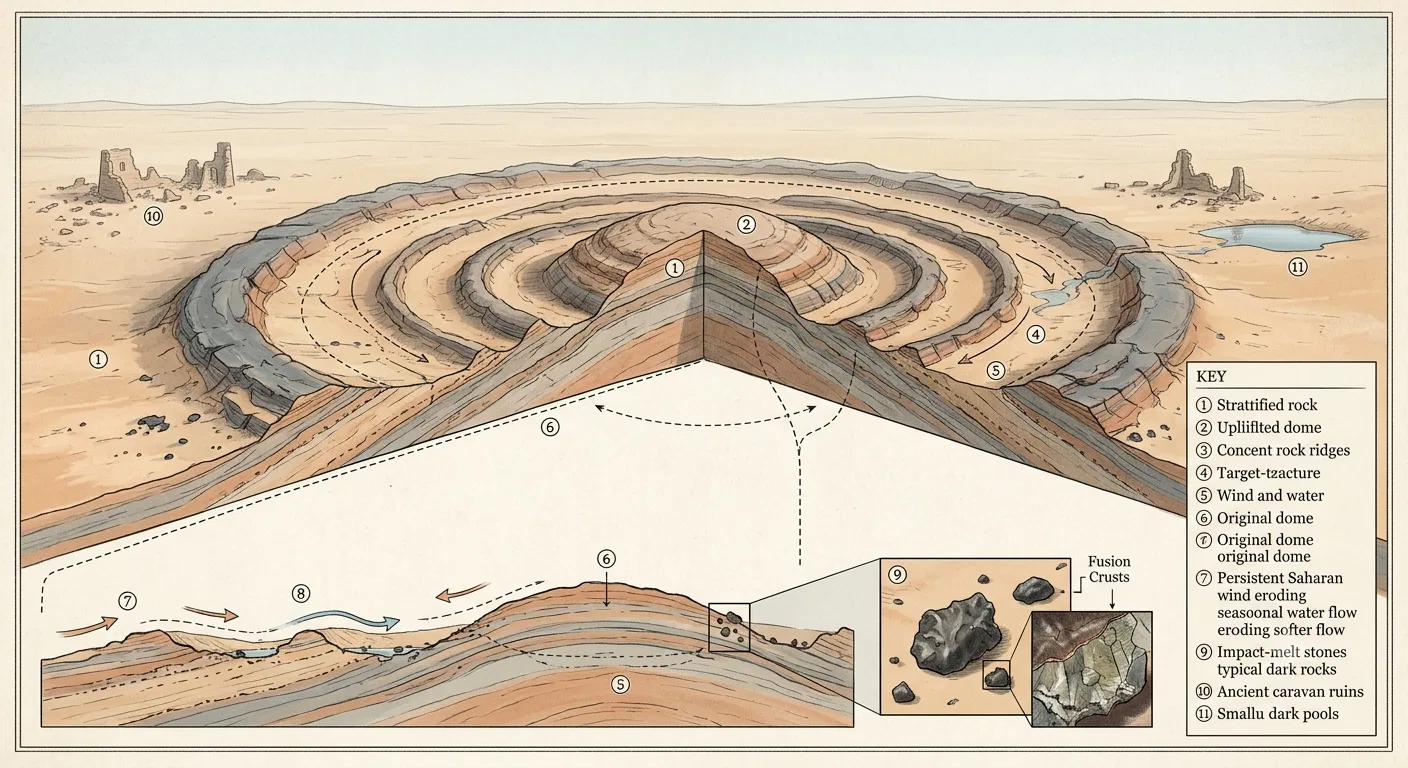
The Richat Structure, often called the Eye of the Sahara, is Mauritania’s best-known “it looks impossible” landmark. Seen from orbit, it appears as a vast bullseye of concentric rings in the Adrar region near Ouadane. NASA notes that its circular form was initially thought to suggest an impact event, because large meteors can produce circular scars, but geological studies now identify it as an uplifted geological dome, or domed anticline.[NASA Science]science.nasa.govthe eye of sahara 150060the eye of sahara 150060
That debunking has not made the Eye less fascinating. NASA’s older Earth Observatory account called it a conspicuous 50-kilometre-wide bullseye on an otherwise relatively featureless desert expanse and noted that astronauts used it as a landmark from space.[NASA Science]science.nasa.govScience Richat Structure, MauritaniaScience Richat Structure, Mauritania ESA gives the same sober conclusion: contrary to first impressions, it is neither an impact crater nor a volcanic crater, but an eroded geological dome sculpted by wind and water, exposing layers of rock over hundreds of millions of years.[European Space Agency]esa.intEuropean Space Agency ESAEuropean Space Agency ESA
For Fortean readers, the Richat Structure matters because it is a perfect case of visual seduction. It looks designed. It looks like a wound, target, eye, ruin, or symbol. That has helped feed fringe speculation, including claims about lost civilisations, but the best-supported interpretation is geological rather than archaeological or extraterrestrial. The “mystery” is not that science has no explanation; it is that a natural process produced something so visually theatrical that it keeps generating new myths.

The real impact scars: Aouelloul and Tenoumer
Mauritania does have genuine impact-crater material, which makes the Richat confusion more interesting. The country’s crater record includes Aouelloul and Tenoumer, both of which have been discussed in scientific catalogues and planetary-geology sources.
Aouelloul is the smaller but especially neat example: the Meteoritical Bulletin lists Aouelloul as a recognised impact crater in Mauritania, with an age of about 3.0 ± 0.3 million years.[LPI]lpi.usra.eduOpen source on usra.edu. The crater is only about 390 metres across, and specialist work has noted how difficult it can be to confirm small impact structures in sedimentary rocks when the most dramatic shock features are scarce or absent.[ResearchGate]researchgate.netOpen source on researchgate.net. That makes Aouelloul a useful corrective to cinematic expectations. A real impact crater does not always look like an obvious cosmic blast mark; sometimes it is a modest ring in old rock, requiring laboratory evidence and patient fieldwork.
Tenoumer is more visually dramatic. NASA describes it as a nearly perfect circle, about 1.9 kilometres wide, with a rim roughly 100 metres high, sitting in ancient rocks deep in the Sahara. Geologists long debated whether it was volcanic, partly because scattered dark rocks near the crater resembled volcanic material.[NASA Science]science.nasa.govScience Tenoumer Crater, MauritaniaScience Tenoumer Crater, Mauritania ESA summarises the later shift in interpretation: closer examination showed that the supposed lava was rock melted by a meteorite impact rather than volcanic lava.[European Space Agency]esa.intEuropean Space Agency ESAEuropean Space Agency ESA
Together, Aouelloul and Tenoumer show why Mauritania is a strong setting for “false crater versus true crater” stories. The Eye of the Sahara looks cosmic but is not an impact crater. Tenoumer looked possibly volcanic but is now treated as impact-related. Aouelloul is real but subtle. The strange-history value is not in ignoring geology, but in watching how geology sorts lookalikes from actual sky scars.
The lost iron mountain of Chinguetti
Mauritania’s most deliciously Fortean meteorite story is the alleged Chinguetti meteorite, sometimes called the Fer de Dieu, or “Iron of God”. In 1916, French colonial officer Gaston Ripert claimed he had been taken to a gigantic iron mass in the desert near Chinguetti. Later retellings describe an iron hill around 40 metres high and 100 metres long. Ursula Marvin’s paper on Théodore Monod’s search for the object says the case became legendary in meteoritics because Monod found no trace of the supposed mass despite repeated interest in the claim.[Lyell Collection]lyellcollection.orgOpen source on lyellcollection.org.
The story has all the classic ingredients of a desert mystery: a remote place, a single dramatic witness, a guide, uncertain navigation, a physical specimen, and a failure to relocate the main object. A small Chinguetti meteorite specimen did reach scientific attention, but the giant iron mountain did not. Modern discussion has therefore tended to circle around three possibilities: Ripert saw a real feature and misidentified it; he was misled or misunderstood the location; or the story was exaggerated after the fact. Marvin’s account emphasises that Monod’s long search failed, but that the story retained its place in the history of meteorite lore.[Lyell Collection]lyellcollection.orgOpen source on lyellcollection.org.
A 2024 preprint revisiting the case shows that the Fer de Dieu still attracts technical curiosity rather than only romantic retelling. It reviews earlier work, including Monod and Brigitte Zanda’s book on the Chinguetti meteorite and Marvin’s later historical study, while exploring whether new evidence could clarify the old claim.[arXiv]arxiv.orgOpen source on arxiv.org. The key point for a public reader is simple: no confirmed giant iron meteorite has been recovered. What survives is a fragmentary case at the border of colonial exploration, local knowledge, scientific ambition, and the powerful human desire for the desert to conceal one enormous secret.
Fireballs that really did fall: Bassikounou and Boumdeid
Not all Mauritanian meteorite stories are elusive. Some are documented falls, where witnesses saw a fireball and material was later recovered.
The Bassikounou meteorite fell on 16 October 2006 in Hodh Ech Chargui, south-eastern Mauritania. The Meteoritical Bulletin lists it as an observed fall, an H5 ordinary chondrite, with a recorded mass of 29.56 kilograms. Its write-up reports a witnessed fireball and says a single 3,165-gram stone was found by a local resident the same day, with more than 20 specimens later recovered by locals and meteorite finders.[LPI]lpi.usra.eduOpen source on usra.edu. A specialist account of the fall says the event was little noticed internationally at first, despite frightening people in the sparsely populated region and receiving limited local media attention.[meteorite-recon.com]meteorite-recon.comOpen source on meteorite-recon.com.
Boumdeid followed in 2011. The Meteoritical Bulletin records Boumdeid as an observed fall in Assaba, Mauritania, on 14 September 2011, classified as an L6 ordinary chondrite with a mass of 3.6 kilograms.[LPI]lpi.usra.eduOpen source on usra.edu. A published account of the event describes a bright bolide seen by hundreds of eyewitnesses north and west of Kiffa, with terminal fragmentation and sound phenomena near the end of the trajectory; at least one mass was observed to impact and recovered the following morning near Boumdeid.[karmaka.de]karmaka.deOpen source on karmaka.de.
These falls matter because they show how a classic “omen in the sky” becomes a scientific object. A fireball, noise, fear, and rumours are the human beginning. Classification, coordinates, mass, shock stage, and mineralogy are the scientific ending. Mauritania’s desert makes the bridge between the two more likely, because dark fusion-crusted stones are easier to spot on pale ground than in many vegetated landscapes.
Meteorite hunting, TikTok stones, and the new “gifts from heaven”
The meteorite story in Mauritania has also become modern and commercial. The Meteoritical Bulletin Database describes itself as the official source for newly recognised and reclassified meteorites, and its country records include hundreds of approved meteorites from Mauritania.[Meteoritical Society]meteoritical.orgOpen source on meteoritical.org. Recent journalism has reported a lively meteorite trade in remote Saharan towns, with locals and brokers using social media platforms to sell or evaluate stones. The Guardian reported in 2025 that Bir Moghrein had developed an informal economy around meteorites, while also noting concerns about regulation, exploitation, darkened stones, and scientific loss when finds leave the country without proper study.[The Guardian]theguardian.comThe Guardian'A gift from heaven': the Tik Tok traders of Mauritania's meteoritesMauritania, and particularly its vast desert terrain, is recognized globally for meteorite discoveries, with more than 300 classified sam…
The Washington Post similarly described meteorite hunting in the Mauritanian Sahara as a mix of hobby, hope, and business. It noted that meteorites fall everywhere, but deserts make them easier to spot because dark fusion crust contrasts with sand and bare rock; it also reported that local hunters often find ordinary chondrites rather than spectacular high-value specimens.[The Washington Post]washingtonpost.comThe Washington Post On the hunt for meteorites in the far reaches of the SaharaThe Washington Post On the hunt for meteorites in the far reaches of the Sahara
This is modern Forteana in a very practical form. The “stone from the sky” is no longer only a marvel or omen. It is also a potential income source, a social-media object, a scientific sample, a fake-risk category, and sometimes a source of dispute over who benefits from cosmic material found on Mauritanian ground.
Crocodiles where the map says desert
If meteorites give Mauritania its sky-strangeness, the Saharan crocodiles give it an animal mystery with a real biological answer. Crocodiles living in the Sahara sound like folklore, but the Mauritanian populations are scientifically documented. A 2011 PLOS ONE study on Saharan crocodiles in Mauritania reported confirmed presence in 60 localities and possible presence in 11 more, increasing known Mauritanian crocodile localities by 35%. It stressed that gueltas are crucial for mountain populations and that the animals’ cryptic behaviour and remote habitats had previously limited sampling.[PLOS]journals.plos.orgOpen source on plos.org.
Earlier conservation work had already treated the Mauritanian crocodiles as relict populations: survivors from a wetter Saharan past, now confined to isolated water bodies. An Oryx paper noted that Mauritanian crocodiles had been considered extinct until their rediscovery in isolated pools in south-eastern Mauritania, with northern populations known from the Tagant Plateau.[Cambridge University Press & Assessment]cambridge.orgOpen source on cambridge.org. Later travel and conservation writing has made Guelta Matmata one of the better-known examples, often presenting it as a place where visitors can still see crocodiles in a desert pool.[ChingiTours]chingitours.comOpen source on chingitours.com.
The Fortean temptation is to call these animals “prehistoric monsters”. The better reading is more interesting. They are not monsters; they are living evidence of ecological memory. Their presence hints at a Sahara that was once wetter, more connected, and more hospitable to aquatic life. They also show how an apparently impossible animal report can become a conservation issue rather than a cryptozoological dead end.
Dust, red skies, and “strange rain” without needing miracles
Mauritania is not especially famous for classic “rains of frogs” or “fish from the sky” reports. The more relevant atmospheric oddity is Saharan dust: the same material that can make skies strange, stain rain elsewhere, and create effects that earlier observers might interpret as uncanny. NASA’s 2025 image feature on colourful dust over Mauritania states that airborne dust is common over the country, and that source regions can affect the colour of dust plumes.[NASA Science]science.nasa.govScience Colorful Dust Over MauritaniaScience Colorful Dust Over Mauritania An older Lunar and Planetary Institute educational image describes Mauritanian dust storms being transported by prevailing winds and notes their smoky, pinkish appearance from satellite imagery.[LPI]lpi.usra.eduOpen source on usra.edu.
This is useful context for anomalous-rain traditions more broadly. The Library of Congress explains that reports of raining fish and frogs exist, but that plausible explanations involve strong winds or waterspouts lifting small animals rather than any literal evaporation-and-rainfall process.[The Library of Congress]loc.govOpen source on loc.gov. The Smithsonian likewise notes that Charles Fort collected thousands of odd-fall reports, while many coloured or dirty rains can be understood through dust and weather processes.[Smithsonian Magazine]smithsonianmag.comOpen source on smithsonianmag.com.
For Mauritania, the strongest claim is not that spectacular animal falls are a major national motif. It is that the country sits inside one of the world’s great dust systems. Red-brown haze, dirty rain downwind, eerie sunsets, and sudden walls of dust belong to the same natural theatre that has always fed omen-reading and sky folklore.
Jinn, oral memory, and why the desert feels inhabited
Mauritania’s supernatural folklore is harder to document in neat case files than its meteorites and craters, partly because much of it belongs to oral tradition rather than searchable newspaper archives. What can be said responsibly is that Mauritanian culture places high value on oral transmission, Islamic learning, and desert scholarship. UNESCO’s inscription work on the ancient ksour emphasises caravan towns as centres of Islamic culture, while its intangible-heritage work on the mahadra describes a Mauritanian community system rooted in oral communication and traditional knowledge.[UNESCO]unesco.orgdocument 1168document 1168
Within wider Islamic and Saharan folklore, jinn are often associated with deserts, ruins, water sources, and uninhabited or liminal places. A recent academic discussion of jinn and demons in Islam summarises older traditions in which jinn are encountered in open desert, deserted ruins, graveyards, unclean places, water sources, and unfamiliar terrain.[MDPI]mdpi.comOpen source on mdpi.com. That does not prove any particular Mauritanian ghost story, but it helps explain why Mauritania’s landscape is so receptive to tales of unseen presence: the desert is not culturally empty space. It is travelled, named, feared, remembered, and morally interpreted.
The reader should be cautious here. Internet retellings of “Mauritanian desert spirits” are often generic, unsourced, or borrowed from broader Saharan and Middle Eastern motifs. The stronger country-specific point is that Mauritania’s strange traditions live in the overlap between Islamic learning, oral storytelling, caravan memory, and landscapes where isolation can make ordinary events feel charged. In such settings, a light, voice, lost track, sudden illness, or lucky escape may be remembered not merely as an incident, but as an encounter.
What is genuinely unresolved?
The most honest answer is that Mauritania’s Fortean file contains fewer unresolved paranormal cases than unresolved historical and evidential puzzles.
The Richat Structure is not unresolved in the paranormal sense: the crater and Atlantis-style claims are not the best-supported explanation. The real issue is why such an obviously natural geological feature continues to invite mythic readings. Aouelloul and Tenoumer are not supernatural either; they are scientifically valuable impact structures and excellent examples of how appearances can mislead. The Saharan crocodiles are not mystery beasts, but real relict animals whose survival is remarkable enough without embellishment. Dust storms and coloured skies do not require omens, yet they remain visually uncanny.
The Chinguetti iron mountain is the closest thing to a classic Mauritanian Fortean mystery. A specimen existed, a dramatic claim was made, and serious people looked into it, but the alleged giant mass was never confirmed. Monod’s failure to find it does not prove every detail was fabricated, but it does leave the case in the realm of misidentification, exaggeration, lost location, or unreliable testimony rather than established meteoritics.[Lyell Collection]lyellcollection.orgOpen source on lyellcollection.org.
That is why Mauritania rewards a grounded approach. Its best strange stories do not collapse when scepticism enters the room. They become sharper. The “eye” is not alien, but still astonishing. The crocodiles are not monsters, but their survival is extraordinary. The meteorites are not omens, but they really did fall. The lost iron mountain may never have existed as described, but the search for it remains one of the great desert footnotes in the history of stones from the sky.


eBay marketplace picks
Marketplace Samples
Live-tested eBay searches with available results related to this page.


Endnotes
1.
Source: unesco.org
Title: document 1168
Link:https://www.unesco.org/archives/multimedia/document-1168
2.
Source: unesco.org
Link:https://www.unesco.org/en/culture-emergencies/heritage-emergency-fund/connecting-generations-through-safeguarding-and-enhancing-protection-desert-libraries-mauritania
3.
Source: science.nasa.gov
Title: Science Colorful Dust Over Mauritania
Link:https://science.nasa.gov/earth/earth-observatory/colorful-dust-over-mauritania-153998/
4.
Source: science.nasa.gov
Title: the eye of sahara 150060
Link:https://science.nasa.gov/earth/earth-observatory/the-eye-of-sahara-150060/
5.
Source: science.nasa.gov
Title: Science Richat Structure, Mauritania
Link:https://science.nasa.gov/earth/earth-observatory/richat-structure-mauritania-4602/
6.
Source: esa.int
Title: European Space Agency ESA
Link:https://www.esa.int/ESA_Multimedia/Images/2026/04/Richat_structure_Mauritania
7.
Source: lpi.usra.edu
Link:https://www.lpi.usra.edu/meteor/metbull.php?code=35169
8.
Source: researchgate.net
Link:https://www.researchgate.net/publication/229873179_The_Aouelloul_crater_Mauritania_On_the_problem_of_confirming_the_impact_origin_of_a_small_crater
9.
Source: science.nasa.gov
Title: Science Tenoumer Crater, Mauritania
Link:https://science.nasa.gov/earth/earth-observatory/tenoumer-crater-mauritania-8536/
10.
Source: esa.int
Title: European Space Agency ESA
Link:https://www.esa.int/ESA_Multimedia/Images/2022/06/Tenoumer_Crater_Mauritania
11.
Source: researchgate.net
Link:https://www.researchgate.net/publication/249552108_Theodore_Andre_Monod_and_the_lost_Fer_de_Dieu_meteorite_of_Chinguetti_Mauritania
12.
Source: arxiv.org
Link:https://arxiv.org/html/2402.14150v1
13.
Source: lpi.usra.edu
Link:https://www.lpi.usra.edu/meteor/metbull.php?code=44876
14.
Source: meteorite-recon.com
Link:https://www.meteorite-recon.com/home/meteorite-documentaries/bassikounou-meteorites
15.
Source: lpi.usra.edu
Link:https://www.lpi.usra.edu/meteor/metbull.php?code=57167
16.
Source: karmaka.de
Link:https://karmaka.de/?p=3930
17.
Source: meteoritical.org
Link:https://meteoritical.org/publications/meteoritical-bulletin
18.
Source: lpi.usra.edu
Link:https://www.lpi.usra.edu/meteor/metbull.php?code=71137
19.
Source: journals.plos.org
Link:https://journals.plos.org/plosone/article?id=10.1371%2Fjournal.pone.0014734
20.
Source: cambridge.org
Link:https://www.cambridge.org/core/journals/oryx/article/crocodiles-crocodylus-niloticus-as-a-focal-species-for-conserving-water-resources-in-mauritanian-sahara/00910B09701873F01266091E6307BA6A
21.
Source: chingitours.com
Link:https://www.chingitours.com/en/spot/guelta-matmata-en/
22.
Source: ich.unesco.org
Link:https://ich.unesco.org/en/RL/mahadra-a-community-system-for-transmission-of-traditional-knowledge-and-oral-expressions-01960
23.
Source: mdpi.com
Link:https://www.mdpi.com/2077-1444/16/9/1114
24.
Source: whc.unesco.org
Link:https://whc.unesco.org/en/list/750/
25.
Source: researchgate.net
Title: 273203779 THE METEORITE FALL NEAR BOUMDEID MAURITANIA FROM SEPTEMBER 14 2011
Link:https://www.researchgate.net/publication/273203779_THE_METEORITE_FALL_NEAR_BOUMDEID_MAURITANIA_FROM_SEPTEMBER
26.
Source: researchgate.net
Link:https://www.researchgate.net/publication/389535867_Spirits_of_Palestine_Gender_Society_and_Stories_of_the_Jinn
27.
Source: researchgate.net
Link:https://www.researchgate.net/publication/50250815_Crocodiles_in_the_Sahara_Desert_An_Update_of_Distribution_Habitats_and_Population_Status_for_Conservation_Planning_in_Mauritania
28.
Source: journals.plos.org
Link:https://journals.plos.org/plosone/article/figures?id=10.1371%2Fjournal.pone.0014734
29.
Source: ntrs.nasa.gov
Link:https://ntrs.nasa.gov/citations/19760049565
30.
Source: meteorite-recon.com
Link:https://www.meteorite-recon.com/portfolio_page/bassikounou-2
31.
Source: youtube.com
Title: Crocodiles in the desert?! A journey to southern Mauritania
Link:https://www.youtube.com/watch?v=2r2zO9Hks44
Source snippet
Mauritania - Chinguetti, centuries old desert town (04)...
32.
Source: youtube.com
Link:https://www.youtube.com/watch?v=DJu6cbzDjvU
33.
Source: lyellcollection.org
Link:https://www.lyellcollection.org/doi/full/10.1144/SP287.16
34.
Source: theguardian.com
Title: The Guardian’A gift from heaven’: the Tik Tok traders of Mauritania’s meteorites
Link:https://www.theguardian.com/world/2025/sep/24/tiktok-traders-mauritania-meteorites
Source snippet
Mauritania, and particularly its vast desert terrain, is recognized globally for meteorite discoveries, with more than 300 classified sam...
35.
Source: washingtonpost.com
Title: The Washington Post On the hunt for meteorites in the far reaches of the Sahara
Link:https://www.washingtonpost.com/world/interactive/2025/meteorites-mauritanian-desert-sahara/
36.
Source: lpi.usra.edu
Link:https://www.lpi.usra.edu/publications/slidesets/geology/sgeo/slide_05.html
37.
Source: loc.gov
Link:https://www.loc.gov/everyday-mysteries/browse-all-questions/item/can-it-rain-frogs-fish-and-other-objects/
38.
Source: smithsonianmag.com
Link:https://www.smithsonianmag.com/science-nature/strange-rain-why-fish-frogs-and-golf-balls-fall-skies-180956527/
39.
Source: lpi.usra.edu
Link:https://www.lpi.usra.edu/meteor/metbull.php?ants=&browse=&categ=All&code=80698&country=Mauritania&falls=&lrec=1000&map=ge&mblist=All&nwas=&phot=&pnt=Normal+table&rect=&sea=&sfor=names&snew=0&srt=type&strewn=&stype=contains&valids=
40.
Source: lpi.usra.edu
Link:https://www.lpi.usra.edu/meteor/metbull.php?code=30402
41.
Source: lpi.usra.edu
Link:https://www.lpi.usra.edu/meetings/lpsc2003/pdf/1183.pdf
42.
Source: lpi.usra.edu
Link:https://www.lpi.usra.edu/meteor/metbull.cfm?country=Mauritania&lrec=50&sea=&sfor=names&srt=na%E2%89%A4me&stype=contains
43.
Source: Wikipedia
Title: Richat Structure
Link:https://en.wikipedia.org/wiki/Richat_Structure
44.
Source: Wikipedia
Title: Chinguetti meteorite
Link:https://en.wikipedia.org/wiki/Chinguetti_meteorite
45.
Source: Wikipedia
Title: Bassikounou meteorite
Link:https://en.wikipedia.org/wiki/Bassikounou_meteorite
46.
Source: openfactbook.org
Link:https://openfactbook.org/countries/mauritania/
47.
Source: hal.science
Link:https://hal.science/hal-04810059/document
48.
Source: insu.hal.science
Link:https://insu.hal.science/insu-04241898/document
49.
Source: ebsco.com
Link:https://www.ebsco.com/research-starters/geography-and-cartography/mauritania
50.
Source: hiddenpathadventures.com
Link:https://hiddenpathadventures.com/destinations/chinguetti/
51.
Source: lyellcollection.org
Link:https://www.lyellcollection.org/doi/pdf/10.1144/SP287.16?download=true
52.
Source: lyellcollection.org
Link:https://www.lyellcollection.org/doi/abs/10.1144/SP287.16
53.
Source: yadda.icm.edu.pl
Link:https://yadda.icm.edu.pl/baztech/element/bwmeta1.element.baztech-231b333e-b99e-48d4-a5d8-baf5606ee63e
54.
Source: yadda.icm.edu.pl
Link:https://yadda.icm.edu.pl/baztech/element/bwmeta1.element.baztech-231b333e-b99e-48d4-a5d8-baf5606ee63e/c/Buhl_i_inni_meteorites_1_2_2014.pdf
55.
Source: geofactbook.com
Link:https://geofactbook.com/countries/mauritania
56.
Source: africanrockart.britishmuseum.org
Link:https://africanrockart.britishmuseum.org/country/mauritania/
57.
Source: passc.net
Link:https://www.passc.net/EarthImpactDatabase/New%20website_05-2018/Aouelloul.html
58.
Source: passc.net
Link:https://www.passc.net/EarthImpactDatabase/New%20website_05-2018/Tenoumer.html
59.
Source: theguardian.com
Title: city of libraries chinguetti mauritania sahara unesco preservation
Link:https://www.theguardian.com/world/2025/nov/12/city-of-libraries-chinguetti-mauritania-sahara-unesco-preservation
60.
Source: science.howstuffworks.com
Title: eye of the sahara
Link:https://science.howstuffworks.com/environmental/earth/geology/eye-of-the-sahara.htm
61.
Source: unescochair-whstar.gutech.edu.om
Link:https://unescochair-whstar.gutech.edu.om/the-ancient-ksour-of-ouadane-chinguetti-tichitt-and-oualata/
62.
Source: weather.metoffice.gov.uk
Link:https://weather.metoffice.gov.uk/learn-about/weather/types-of-weather/rain/blood-rain
Additional References
63.
Source: youtube.com
Link:https://www.youtube.com/watch?v=mdmODR6JmmU
Source snippet
Richat Structure, Chinguetti Meteorite, and Impact Craters...
64.
Source: science.org
Link:https://www.science.org/content/article/pygmy-crocs-found-sahara-caves
65.
Source: science.org
Link:https://www.science.org/doi/10.1126/science.287.5456.1199a
66.
Source: youtube.com
Title: Richat Structure, Chinguetti Meteorite, and Impact Craters
Link:https://www.youtube.com/watch?v=-otWEGcaghk
Source snippet
West African crocodile (Crocodylus suchus) - Mauritania...
67.
Source: youtube.com
Title: West African crocodile (Crocodylus suchus)
Link:https://www.youtube.com/watch?v=jAYsowaYCV8
Source snippet
Crocodiles in the desert?! A journey to southern Mauritania...
68.
Source: fossilera.com
Link:https://www.fossilera.com/meteorites/2-06-bassikounou-chondrite-meteorite-81-44-g-witnessed-fall?srsltid=AfmBOor9c7gUVNLDKmqFf2neVc5VJgW-129j_iE7_Jq87GG9Ws0VC5md
69.
Source: fossilera.com
Link:https://www.fossilera.com/meteorites/2-06-bassikounou-chondrite-meteorite-81-44-g-witnessed-fall?srsltid=AfmBOornZtdw8YyRCFI7pld4lUR5AD9ZTEwej_QT3m6EdXHzL6ahZd3c
70.
Source: worldheritagesites.net
Link:https://worldheritagesites.net/ancient-ksour-of-ouadane-chinguetti-tichitt-and-oualata/
71.
Source: facebook.com
Link:https://www.facebook.com/13abc/posts/animal-rain-happens-when-small-water-animals-like-fish-frogs-and-crabs-are-swept/10159511629081897/
72.
Source: x.com
Link:https://x.com/anishmoonka/status/2070439425117458534
Topic Tree
Follow this branch
Related pages 192
- Afghan Forteana
- Antigua Uncanny
- Bosnian Mysteries
- Botswana Weird
- Brazil Strange
- +187 more in sidebar