Within Namibia
Why Do Namibia's Lakes Seem Bottomless?
Namibia's sinkhole lakes and flooded caves show how real karst geology can generate rumours of whirlpools, tunnels, treasure and breath from below.
On this page
- Otjikoto, Guinas and the bottomless lake motif
- War debris, treasure rumours and local memory
- Dragon's Breath Cave and the spectacle of hidden water
Page outline Jump by section
Introduction
Namibia is one of the driest countries in southern Africa, so the sight of a deep, permanent lake can seem almost impossible. That contrast has helped create some of the country’s most enduring water legends. Stories of bottomless lakes, hidden tunnels, sunken treasure and even a cave that appears to breathe all grew around real geological features that are extraordinary without any supernatural embellishment. The truth is no less remarkable: these waters occupy collapsed limestone caverns, plunge into flooded cave systems that are still being explored, and preserve secrets ranging from rare fish to wartime relics. The folklore survives because the landscape genuinely invites mystery, even as geology explains much of what earlier generations could only imagine.[Travel Namibia]travelnam.comSituated 46km northwest of Grootfontein lies a subterranean geological wonderland 60…
Why do Otjikoto and Guinas seem bottomless?
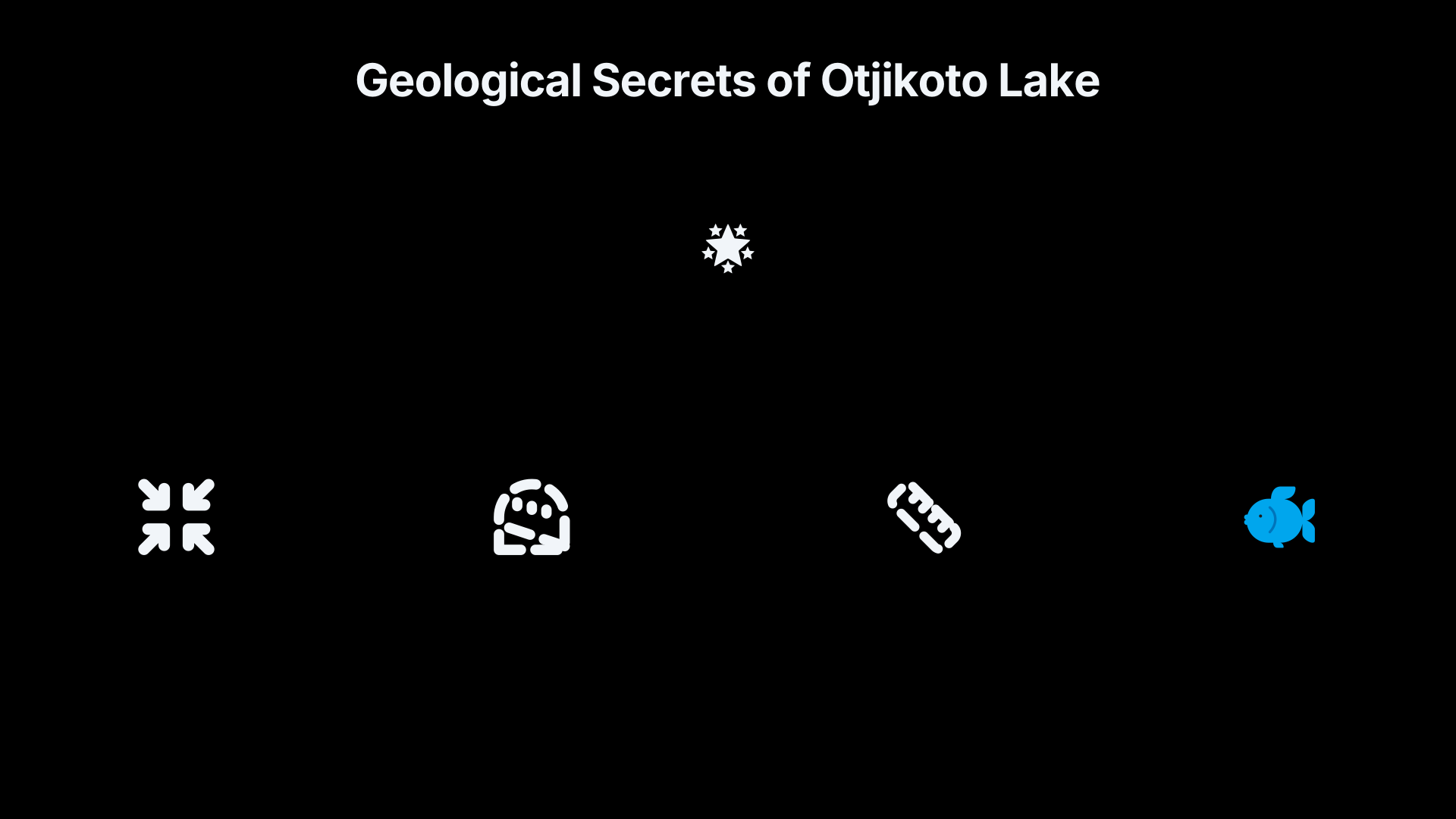
The lakes of Otjikoto and Guinas are not ordinary surface lakes but flooded sinkholes formed when the roofs of ancient karst caves collapsed. Karst develops as groundwater slowly dissolves dolomite and limestone, leaving underground chambers that can eventually give way. What remains is a steep-sided shaft filled with groundwater.
For centuries, their shape encouraged stories that they had no bottom at all. Early visitors could see dark blue water disappearing beneath vertical rock walls, while sounding lines often failed to reach a simple flat floor because the lakes continue into submerged caverns and sloping passages. Even modern sonar has shown that these are not simple cylindrical holes but complex cave systems. Otjikoto reaches more than 90 metres in measured depth, while Guinas exceeds 100 metres and extends into underwater chambers that remain difficult to survey completely.[Wikipedia]WikipediaOtjikoto LakeOtjikoto Lake
Another persistent belief claims that Otjikoto and Guinas are secretly connected through underground tunnels. The idea is understandable: the lakes lie relatively close together and both occupy the same karst landscape. However, despite repeated speculation by divers and researchers, no continuous underwater passage linking the two has ever been demonstrated. The possibility remains an intriguing hypothesis rather than an established fact.[Wikipedia]WikipediaOtjikoto LakeOtjikoto Lake
The lakes also contain biological surprises that reinforced their reputation as isolated worlds. Lake Guinas supports the critically endangered cichlid Tilapia guinasana, a species found naturally nowhere else, while related fish populations occur in nearby Otjikoto after later introductions. Such isolated ecosystems added to the impression that these waters belonged to a hidden realm beneath the landscape.[Wikipedia]WikipediaLake GuinasLake Guinas
War debris, treasure rumours and local memory
Otjikoto acquired a second layer of mystery during the final months of the First World War. As German colonial forces retreated before advancing South African troops in 1915, they dumped large quantities of military equipment into the lake to prevent its capture.
Over the following decades, divers recovered artillery pieces, rifles, wagons, ammunition and other military equipment from the depths. Many of these objects are now displayed in museums around Tsumeb, transforming what began as military destruction into an archaeological record of the war.[Wikipedia]WikipediaOtjikoto LakeOtjikoto Lake
The confirmed recovery of genuine artefacts naturally encouraged more imaginative stories. The most famous claims that the Germans also threw a safe containing millions of gold marks into the lake. Treasure hunters periodically revived the tale, but despite repeated searches no such fortune has ever been recovered. Whether the safe existed at all remains uncertain, illustrating how documented historical events often become wrapped in increasingly elaborate folklore.
The combination of real discoveries and unrealised hopes gives Otjikoto an unusual place in Namibian Forteana. Unlike many treasure legends, this one begins with an indisputable fact—valuable military equipment really was dumped into the lake—making the leap from history to myth especially persuasive.
Dragon’s Breath Cave and the spectacle of hidden water
If Otjikoto and Guinas appear mysterious from the surface, Dragon’s Breath Cave takes the idea underground.
Discovered during a caving expedition in 1986 near Grootfontein, the cave earned its dramatic name because warm, moisture-laden air rises from the entrance and condenses into visible mist when atmospheric conditions change. To early explorers, the vapour resembled the exhalation of some enormous creature hidden beneath the earth. The explanation lies in the stable temperature and humidity of the cave rather than anything supernatural, but the image remains irresistible.[Wikipedia]WikipediaDragon's Breath CaveDragon's Breath Cave
Around 60 metres below the entrance lies one of the cave’s greatest surprises: the world’s largest known non-subglacial underground lake, covering almost two hectares. Modern sonar mapping has revealed depths exceeding 200 metres from the lake surface to its deepest measured point, replacing speculation with detailed surveys while demonstrating just how immense the hidden chamber really is.[Wikipedia]WikipediaDragon's Breath CaveDragon's Breath Cave
Because the cave lies on private land and requires specialised rope and cave-diving skills, relatively few people have seen it firsthand. That limited access has helped preserve both its fragile ecosystem and its aura of mystery. Expeditions continue to refine maps of the submerged passages, but much of the flooded cave remains inaccessible except to experienced technical divers using sophisticated equipment.[wikipedia.org]WikipediaDragon's Breath CaveDragon's Breath Cave
One misconception occasionally repeated online is that Dragon’s Breath Cave contains the rare cave catfish Clarias cavernicola. Specialists now regard this as incorrect; that species is known from the nearby Aigamas Cave rather than Dragon’s Breath itself. This is a good example of how dramatic locations often accumulate inaccurate stories alongside genuine discoveries.[Wikipedia]WikipediaDragon's Breath CaveDragon's Breath Cave
Why hidden water inspires extraordinary legends
Namibia’s “bottomless” waters show how physical geography shapes folklore. In a country where permanent surface water is exceptionally scarce, an unexpectedly deep blue lake or a vast underground reservoir feels almost impossible. Before karst geology was understood, hidden tunnels, monsters, dragons and endless depths offered satisfying explanations for landscapes that seemed to defy common experience.
Even today, scientific understanding has not entirely displaced the romance of these places. Divers continue to discover new details beneath the surface, sonar reveals chambers that earlier generations never imagined, and wartime relics still emerge from Otjikoto’s depths. The legends endure not because the lakes are literally bottomless, but because they occupy the rare boundary where genuine geological wonder and human imagination meet.

Amazon book picks
Further Reading
Books and field guides related to Why Do Namibia's Lakes Seem Bottomless?. Use these as the next step if you want deeper reading beyond the article.


Skeleton Coast
Provides wider natural history context for Namibia's remarkable geology.

Namibia, 3rd
First published 2007. Subjects: Guidebooks, Namibia, description and travel.
eBay marketplace picks
Marketplace Samples
Live-tested eBay searches with available results related to this page.
Endnotes
1.
Source: Wikipedia
Title: Caves of Namibia
Link:https://en.wikipedia.org/wiki/Caves_of_Namibia
2.
Source: Wikipedia
Title: Otjikoto Lake
Link:https://en.wikipedia.org/wiki/Otjikoto_Lake
3.
Source: Wikipedia
Title: Lake Guinas
Link:https://en.wikipedia.org/wiki/Lake_Guinas
4.
Source: Wikipedia
Title: Dragon’s Breath Cave
Link:https://en.wikipedia.org/wiki/Dragon%27s_Breath_Cave
5.
Source: namibian.org
Link:https://namibian.org/blog/caves-in-namibia
Source snippet
res below the surface...
6.
Source: travelnam.com
Link:https://travelnam.com/the-spirit-of-the-dragon-and-this-thing-called-life-dragons-breath/
Source snippet
Situated 46km northwest of Grootfontein lies a subterranean geological wonderland 60...
7.
Source: xray-mag.com
Title: dragons breath
Link:https://xray-mag.com/content/dragons-breath
Source snippet
X-Ray International Dive MagazineDragon's Breath Cave in Namibia6 Mar 2025 — Otjikoto Lake and even Dragon's Breath Cave. The cave is hom...
Additional References
8.
Source: reddit.com
Link:https://www.reddit.com/r/Namibia/comments/1mufcol/dragons_breath_cave/
Source snippet
Dragon's breath cave: r/NamibiaThe cave is on private land, It's got the biggest underground lake in the world, Nowhere near is Otjikoto...
9.
Source: facebook.com
Link:https://www.facebook.com/gondwana.collection.namibia/posts/ever-wondered-what-it-feels-like-to-explore-the-unexplored-dive-into-the-adventu/870928908397564/
Source snippet
Gondwana Collection NamibiaDragon's Breath Cave is a cave located 46 kilometres northwest of Grootfontein in the Otjozondjupa Region of N...
10.
Source: instagram.com
Link:https://www.instagram.com/reel/C2xJLUFtR5d/?hl=en
Source snippet
THE WORLD LARGEST UNDERGROUND LAKE....The world largest underground lake. The Dragon's Breath Cave of Namibia. The continent of Africa i...
11.
Source: facebook.com
Link:https://www.facebook.com/roarwildlifenews/posts/the-dragons-breath-cave-in-namibia-africa-is-one-of-the-largest-underground-lake/862800962721065/
Source snippet
The Dragon's Breath Cave in Namibia 🇳🇦, Africa is one of...Located on private land in the Otjozondjupa region, located roughly 100 meter...
12.
Source: youtube.com
Link:https://www.youtube.com/watch?v=0SwD5hSL1jY
Source snippet
3 Lake Otjikoto & The Legend Of Kaiser's Lost Gold (Explored For Treasure)...
13.
Source: youtube.com
Title: Monty Halls’ Dive Mysteries: The Kaiser’s Lost Gold | History Documentary
Link:https://www.youtube.com/watch?v=9PauBFKTYGY
Source snippet
2 The World's Rarest and Most Isolated Fish | Narrated by David Attenborough | Africa | BBC Earth...
14.
Source: discoverwildlife.com
Title: dragons breath cave
Link:https://www.discoverwildlife.com/environment/dragons-breath-cave
Source snippet
60 metres below an arid desert lies a secret, gigantic...7 Jun 2026 — Dragon's Breath Cave, hidden deep below the Kalahari Desert in Nam...
15.
Source: youtube.com
Link:https://www.youtube.com/watch?v=xz7IMf3cmgk
Source snippet
5 Descend in Dragons breath cave...
Published: March 4, 2020
16.
Source: youtube.com
Title: Descend in Dragons breath cave
Link:https://www.youtube.com/watch?v=SSI2kJm8mow
Topic Tree