Where Djibouti's Landscape Turns Strange
Djibouti is not a country with a thick public record of classic “monster flap” Forteana, mass UFO scares, or heavily documented ghost cases.
Page outline Jump by section
Introduction
That makes Djibouti an unusually good case for grounded weird history. Many of its eerie stories are not free-floating paranormal claims; they are attached to real places that already feel uncanny: Ghoubbet al-Kharab, Lake Assal, Lake Abbe and the Afar Depression. The result is a national Fortean profile shaped less by “proof” of the supernatural than by the way extreme terrain invites demon names, sea-monster rumours, miracle traditions and dramatic misreadings of natural forces.[wikipedia.org]WikipediaOpen source on wikipedia.org.
Why Djibouti’s weird record begins with the landscape
Djibouti sits in one of the most visually and geologically theatrical corners of the world. Around Lake Abbe, NASA describes the Afar Triple Junction as a meeting place where three pieces of Earth’s crust are pulling apart; Lake Abbe itself sits near that tectonic centre and is associated with salt water, hot springs and unusual geology.[NASA Science]science.nasa.govafar depression ethiopia 5819afar depression ethiopia 5819 Lake Assal, meanwhile, is described by NASA as lying in a rift valley about 155 metres below sea level, making it the lowest point in Africa and one of the lowest exposed land surfaces on Earth.[Astronaut Photography Gateway]eol.jsc.nasa.govAstronaut Photography Gateway Earth from SpaceAstronaut Photography Gateway Earth from Space
For Fortean purposes, this matters because many “strange” traditions begin as attempts to give language to places that seem to violate normal expectations. Djibouti has white salt flats, black lava, steaming springs, narrow tidal passages, sharks in enclosed-looking waters, and lakes that can appear lifeless or otherworldly. These are not paranormal features, but they are the raw ingredients from which demon names, abyss stories and traveller legends naturally grow.
The country’s climate adds another layer. The World Bank describes Djibouti as a dry country with low and variable rainfall, while research on Djibouti’s rainfall events notes that intense rain can generate damaging flash floods.[Climate Change Knowledge Portal]climateknowledgeportal.worldbank.orgClimate Change Knowledge Portal DjiboutiClimate Change Knowledge Portal Djibouti In that setting, a sudden flood, a steaming lake shore or a violent current can feel like an event with agency. The sober explanation may be meteorology or geology, but the human experience is still one of shock.
Ghoubbet al-Kharab: the “Gulf of the Demons”
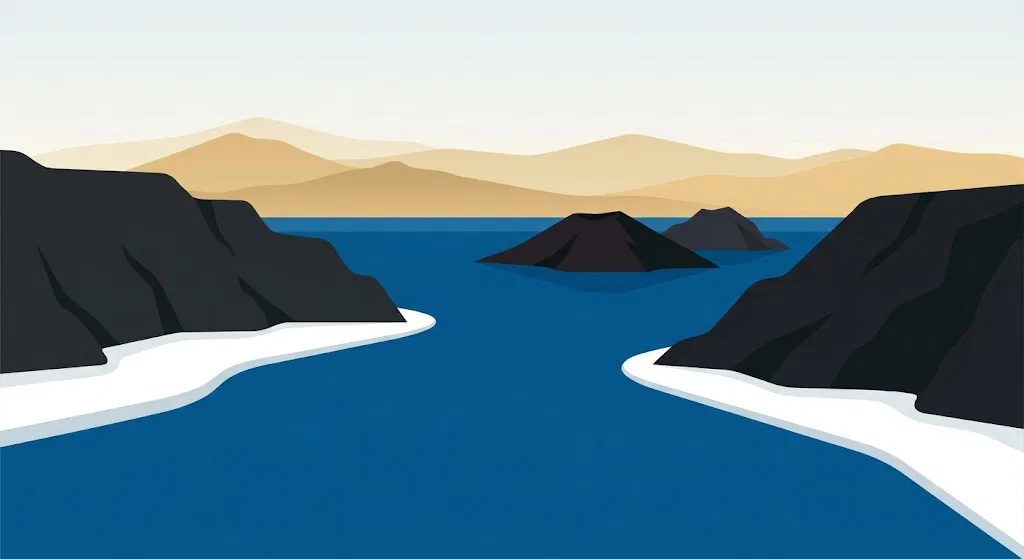
The clearest Djiboutian Fortean landmark is Ghoubbet al-Kharab, a cove at the western end of the Gulf of Tadjoura. It is commonly glossed in English as the “Gulf of the Demons” or “Abyss of the Demons”, and the geography helps explain why the name stuck. The bay is separated from the wider gulf by a narrow passage with strong currents, surrounded by high cliffs, close to the Ardoukôba volcanic area, and reported to reach depths of around 200 metres.[Wikipedia]WikipediaOpen source on wikipedia.org.
The place has several features that make it perfect for legend. First, it looks enclosed, almost like a lake, yet it is connected to the sea. Secondly, it has dangerous currents and abrupt depth. Thirdly, it contains volcanic islands known in travel and local lore as Devil’s Islands. Fourthly, its waters are associated with large marine life, including sharks and whale sharks, which gives any deep-water tale a plausible visual seed.[Liveaboard.com]liveaboard.comOpen source on liveaboard.com.
A sceptical reading does not have to flatten the story. “Demons” here need not be treated as literal beings to be culturally meaningful. The name encodes danger, awe and respect for a place where wind, tide, depth and heat can make the ordinary sea behave strangely. In Fortean terms, Ghoubbet al-Kharab is less a single case than a recurring setting: a natural theatre in which uncanny stories can gather.
The Cousteau monster rumour
The most famous modern strange claim attached to Ghoubbet al-Kharab is the story that Jacques Cousteau encountered, filmed, or suspected a giant unknown creature in its depths. Versions of the tale vary. Some retellings say Cousteau lowered a camel carcass in a cage and retrieved the cage crushed and empty; others say he saw a huge dark shape and withheld footage because the public was not ready for it.[saveourseasmagazine.com]saveourseasmagazine.comSave Our Seas Magazine Arabia's SeasSave Our Seas Magazine Arabia's Seas
This is classic cryptozoological folklore: a famous explorer, a dangerous body of water, a missing or suppressed film, and a creature that is always just beyond verification. The problem is that the publicly available accounts are secondary, anecdotal and inconsistent. The strongest cautious position is therefore not “there is a monster in Ghoubbet”, but “there is a persistent monster rumour attached to Ghoubbet, and it has become part of the bay’s modern mythology.”
Natural explanations are not hard to find. Ghoubbet al-Kharab is deep, current-swept and connected to waters known for large marine animals. Dive guides and travel sources describe whale sharks, sharks, rays and large pelagic fish in the wider Djibouti diving environment.[liveaboard.com]liveaboard.comOpen source on liveaboard.com. A huge shadow seen in deep, moving water could be a known animal, a group of animals, a perspective effect, or an embellished memory. The rumour remains interesting not because it proves a hidden beast, but because it shows how a real extreme environment can generate a modern sea-monster tradition.
Devil’s Islands, jinn stories and the pull of named places
The volcanic islands in Ghoubbet al-Kharab are often referred to as Devil’s Islands, and modern travel writing preserves local-style explanations that associate the island with jinn or mischievous spirits. One account describes the island as the home of a “king of the jinn” who sends out spirits to disturb visitors, while also noting literary uses of the island in Djiboutian fiction.[Anthrow Circus]anthrowcircus.comnot climbing djiboutis devils islandnot climbing djiboutis devils island
This should be handled carefully. Online travel retellings are not the same thing as a fully documented ethnographic archive, and Djibouti’s oral traditions are richer than the tourist shorthand of “devils” and “demons”. Still, the recurrence of these labels around Ghoubbet is significant. It suggests that the location has long been framed as a threshold place: beautiful, dangerous, hard to cross, and spiritually charged.
Djibouti’s wider cultural setting helps explain why oral tradition matters here. Somali and Afar communities have strong traditions of poetry, story, song and recitation, and sources on Djiboutian culture describe oral poetry and storytelling as important ways of preserving memory, custom and communal identity.[encyclopedia.com]encyclopedia.comOpen source on encyclopedia.com. In such a context, a strange place-name is not just a label on a map. It is a hook for warnings, jokes, religious ideas, traveller tales and inherited local knowledge.
Lake Assal and the “hellish” sublime
Lake Assal is often described in travel writing with language that leans towards the infernal: heat, salt, emptiness, whiteness and volcanic blackness. The more restrained scientific description is already dramatic enough. UNESCO’s tentative listing for Lake Assal treats it as a significant natural site, while NASA identifies it as a rift-valley lake far below sea level.[UNESCO World Heritage Centre]whc.unesco.orgOpen source on unesco.org.
The Fortean interest is not that Lake Assal has a famous ghost or monster. It is that the place demonstrates how environmental extremity becomes mythic. A hypersaline lake below sea level, surrounded by rift geology and salt extraction, naturally attracts descriptions of other worlds, underworlds and cursed landscapes. Joseph Kessel’s 1930 description of the gorge around Lake Assal as if sculpted by demons is a good example of an outsider literary imagination meeting a landscape that already resists ordinary description.[outpostmagazine.com]outpostmagazine.comchristmas in djiboutichristmas in djibouti
Here the sceptical and the poetic readings can coexist. The salt exists because of hydrology and evaporation; the rift exists because of plate tectonics; the heat is climatic. Yet none of that removes the uncanny effect. Djibouti’s weird-history record is repeatedly built from this double vision: the explanation is natural, but the experience feels excessive.
Lake Abbe: chimneys, steam and a Martian reputation
Lake Abbe, on the Djibouti-Ethiopia border, is another place where “strange” is mostly geological but still culturally powerful. NASA notes that Lake Abbe is salty and dotted with hot springs because of its unusual geology, and that it lies at the junction of three tectonic plates in the Afar Depression.[NASA Science]science.nasa.govlake abbe and dama ali 35573lake abbe and dama ali 35573 Archaeological material from the French Ministry of Culture describes the lake as one of the main receptacles for water from the Great Rift Valley and the Ethiopian highlands, with deposits that help reconstruct climatic changes.[Archéologie]archeologie.culture.gouv.frOpen source on gouv.fr.
The lake’s limestone chimneys and steam vents have made it one of Djibouti’s most “alien” landscapes in popular travel writing. This is not a mystery in the evidential sense; the chimneys are geological formations, not ruins of a lost civilisation or supernatural structures. But they do show why Djibouti lends itself to strange retellings. A sunrise over Lake Abbe can look like science fiction without needing any invented alien claim.
For a Fortean country page, Lake Abbe is best treated as an “uncanny landscape” rather than a paranormal case. It belongs beside the demon bay and the salt lake because it shows the same pattern: geology first, mythology second, tourist wonder third.
Extreme rain in a dry country: when weather becomes uncanny
Djibouti’s oddest well-documented modern events are not rains of fish or mysterious falls from the sky, but sudden heavy rains in a country where rainfall is sparse, variable and highly consequential. ReliefWeb reported that between 21 and 24 November 2019, almost 300 mm of rain was recorded in Djibouti City alone, described as more than three times the annual average.[ReliefWeb]reliefweb.intRelief Web Djibouti: FloodsRelief Web Djibouti: Floods Other reporting on the same event cited 140 mm in 48 hours and noted fatalities after severe flooding in the capital.[FloodList]floodlist.comdjibouti floods november 2019djibouti floods november 2019
This is not Fortean in the old “raining frogs” sense, but it is anomalous in the ordinary-life sense: a city in an arid setting suddenly overwhelmed by water. Research on Djibouti’s rainfall drivers notes that the country’s intense rainfall events are tied to atmospheric circulation patterns, with some highly unusual patterns associated with tropical cyclones also capable of producing extreme rain.[Royal Meteorological Society]rmets.onlinelibrary.wiley.comOpen source on wiley.com.
Such events explain how weather can become folklore. To a meteorologist, the 2019 floods belong to climate variability, moisture transport and storm dynamics. To residents, they are remembered through damage, fear, rescue, loss and the shock of too much water in a place built around scarcity. UNEP’s account of flood adaptation in Tadjourah includes residents recalling earlier floods and describes the 2019 monsoon as unprecedented in local impact, with major humanitarian need.[UNEP - UN Environment Programme]unep.orgOpen source on unep.org.
Shrines, miracle ancestry and oral memory
Djibouti’s strange-history record should not be reduced to “devil” place-names. A different kind of wonder appears in traditions of sacred ancestry and miraculous presence. Sources on Djiboutian folklore describe the Somali Issa origin tradition around Aqiil Abuu Taalib, remembered as a holy ancestor from Arabia, with hymns in his honour and a shrine in Djibouti where he is said to have appeared miraculously.[EveryCulture]everyculture.comEvery Culture DjiboutiansEvery Culture Djiboutians
This is not a cryptid or a UFO case, but it belongs in a country-level Fortean reading because it concerns claims of miraculous appearance, sacred geography and communal memory. The important distinction is genre. A shrine tradition is not evaluated like a newspaper report of a falling object or a photograph of a lake monster. It functions as religious heritage, identity and oral history.
The evidence here is cultural rather than forensic. The question is not “can the miracle be proven in a laboratory?” but “what role does the story play, and why is it remembered?” In Djibouti’s case, the answer points back to the importance of oral transmission among Somali and Afar communities, where poetry, praise, genealogy and story can carry historical meaning alongside religious devotion.[Journals Sub Uni Hamburg]journals.sub.uni-hamburg.deOpen source on uni-hamburg.de.
What is missing from Djibouti’s Fortean file
A careful page on Djibouti also has to say what is not strongly evidenced. Fresh searching does not reveal a robust public archive of Djibouti-specific mass UFO waves, famous poltergeist investigations, well-documented animal falls, or internationally recognised psychical-research cases. Some social-media and travel content uses “mysterious” or “strangest country” language, but much of that is tourism packaging rather than evidence of a durable anomalous tradition.
That absence is itself informative. Djibouti’s weird-history profile is not built like Britain’s ghost gazetteers, America’s UFO archives or Central Africa’s lake-monster catalogues. It is built from a thinner but distinctive mix:
- Demonised geography: Ghoubbet al-Kharab and Devil’s Islands preserve a language of danger and awe.
- Cryptozoological rumour: the Cousteau monster story survives as a modern legend, not as a verified zoological case.
- Sacred oral tradition: miracle and shrine narratives connect place, ancestry and identity.
- Extreme natural events: floods, heat, salt, volcanic activity and tectonic landscapes produce genuinely uncanny experiences without needing supernatural claims.
- Tourist amplification: modern travel writing often intensifies the language of demons, moonscapes and alien worlds, sometimes blurring local tradition with outsider spectacle.

How to read Djibouti’s strange stories fairly
The best way to approach Djibouti’s Forteana is neither to debunk everything into dullness nor to promote every rumour as hidden truth. Ghoubbet al-Kharab is genuinely dangerous and visually strange; that does not prove demons. Whale sharks and deep currents are real; that does not prove a secret Cousteau monster. Lake Abbe’s chimneys can look unearthly; that does not make them artificial. Extreme floods in an arid country can feel apocalyptic; that does not make them miraculous.
Djibouti’s strongest strange material works because it sits at the edge of categories. It is natural history that feels mythic, oral tradition attached to difficult terrain, and modern travel folklore layered over older place-names. The country’s weird record is therefore less a cabinet of isolated anomalies than a map of charged places: the demon gulf, the devil islands, the salt lake below sea level, the steaming chimneys, and the dry city suddenly drowned by rain.
Amazon book picks
Further Reading
Books and field guides related to Where Djibouti's Landscape Turns Strange. Use these as the next step if you want deeper reading beyond the article.

The Ends of the World
Explains extreme geological processes relevant to rift landscapes.

Origins: How the Earth Made Us
Ideal background for Djibouti's dramatic landscapes and legends.
Origins
First published 2019. Subjects: Human evolution, Human beings, origin, Human beings, Origin, Effect of environment on.
eBay marketplace picks
Marketplace Samples
Live-tested eBay searches with available results related to this page.
Endnotes
1.
Source: Wikipedia
Link:https://en.wikipedia.org/wiki/Ghoubbet-el-Kharab
2.
Source: whc.unesco.org
Link:https://whc.unesco.org/en/tentativelists/5959/
3.
Source: science.nasa.gov
Title: afar depression ethiopia 5819
Link:https://science.nasa.gov/earth/earth-observatory/afar-depression-ethiopia-5819/
4.
Source: science.nasa.gov
Title: lake abbe and dama ali 35573
Link:https://science.nasa.gov/earth/earth-observatory/lake-abbe-and-dama-ali-35573/
5.
Source: eol.jsc.nasa.gov
Title: Astronaut Photography Gateway Earth from Space
Link:https://eol.jsc.nasa.gov/Collections/EarthFromSpace/printinfo.pl?PHOTO=STS033
6.
Source: liveaboard.com
Link:https://www.liveaboard.com/diving/djibouti/ghoubet-al-kharab
7.
Source: divebooker.com
Title: Ghoubet al Kharab
Link:https://divebooker.com/ghoubet-al-kharab-baz15677
8.
Source: encyclopedia.com
Link:https://www.encyclopedia.com/humanities/encyclopedias-almanacs-transcripts-and-maps/djiboutians
9.
Source: journals.sub.uni-hamburg.de
Link:https://journals.sub.uni-hamburg.de/aethiopica/article/download/1146/1066/3156
10.
Source: everyculture.com
Title: Every Culture Djiboutians
Link:https://www.everyculture.com/wc/Costa-Rica-to-Georgia/Djiboutians.html
11.
Source: outpostmagazine.com
Title: christmas in djibouti
Link:https://outpostmagazine.com/christmas-in-djibouti/
12.
Source: reliefweb.int
Title: Relief Web Djibouti: Floods
Link:https://reliefweb.int/disaster/fl-2019-000156-dji
13.
Source: floodlist.com
Title: djibouti floods november 2019
Link:https://floodlist.com/africa/djibouti-floods-november-2019
Published: november 2019
14.
Source: unep.org
Link:https://www.unep.org/news-and-stories/story/flood-walls-and-forests-help-djibouti-adapt-climate-change
15.
Source: ich.unesco.org
Link:https://ich.unesco.org/en/activities/panel-discussion-somali-women-s-role-in-passing-down-oral-traditions-00594
16.
Source: Wikipedia
Link:https://es.wikipedia.org/wiki/Yibuti
17.
Source: Wikipedia
Title: Culture of Djibouti
Link:https://en.wikipedia.org/wiki/Culture_of_Djibouti
18.
Source: Wikipedia
Link:https://en.wikipedia.org/wiki/Djibouti
19.
Source: Wikipedia
Title: Rain of animals
Link:https://en.wikipedia.org/wiki/Rain_of_animals
20.
Source: Wikipedia
Title: Literature of Djibouti
Link:https://en.wikipedia.org/wiki/Literature_of_Djibouti
21.
Source: whc.unesco.org
Link:https://whc.unesco.org/en/news/2515
22.
Source: whc.unesco.org
Link:https://whc.unesco.org/en/tentativelists/%3F%3F%3F%26%26action%3Dlisttentative%26order%3Dstates%26%26
23.
Source: whc.unesco.org
Link:https://whc.unesco.org/document/206970
24.
Source: whc.unesco.org
Link:https://whc.unesco.org/archive/2015/whc15-39com-8A-en.pdf
25.
Source: whc.unesco.org
Link:https://whc.unesco.org/archive/2023/whc23-45com-8A-en.pdf
26.
Source: whc.unesco.org
Link:https://whc.unesco.org/en/search/?category=Tentative+Lists&criteria=FC+monedas++Visit%C3%A9+Buyfc26coins.com.+El+mejor+precio+que+encontr%C3%A9+en+internet..9Mlr&maxrows=200
27.
Source: whc.unesco.org
Link:https://whc.unesco.org/archive/2019/whc19-43com-8A-en-Rev.pdf
28.
Source: whc.unesco.org
Link:https://whc.unesco.org/document/221022
29.
Source: whc.unesco.org
Link:https://whc.unesco.org/document/167855
30.
Source: ich.unesco.org
Title: djibouti DJ
Link:https://ich.unesco.org/en/state/djibouti-DJ
31.
Source: reliefweb.int
Title: Djibouti: Floods
Link:https://reliefweb.int/updates?advanced-search=%28D49518%29&list=Djibouti%3A+Floods+-+Nov+Updates+%28Maps+%2F+Infographics%29&view=maps
32.
Source: reliefweb.int
Title: Djibouti: Flash Floods Final report
Link:https://reliefweb.int/report/djibouti/djibouti-flash-floods-final-report-dref-n-mdrdj003
33.
Source: reliefweb.int
Title: Djibouti: Floods
Link:https://reliefweb.int/updates?advanced-search=%28D49518%29&list=Djibouti%3A+Floods+-+Nov+Updates
34.
Source: folklore.earth
Link:https://www.folklore.earth/culture/afar/
35.
Source: floodlist.com
Link:https://floodlist.com/tag/djibouti
36.
Source: climateknowledgeportal.worldbank.org
Title: Climate Change Knowledge Portal Djibouti
Link:https://climateknowledgeportal.worldbank.org/country/djibouti
37.
Source: rmets.onlinelibrary.wiley.com
Link:https://rmets.onlinelibrary.wiley.com/doi/10.1002/joc.8299
38.
Source: scubago.com
Link:https://www.scubago.com/en/explore/destination/djibouti-9753127
39.
Source: saveourseasmagazine.com
Title: Save Our Seas Magazine Arabia’s Seas
Link:https://saveourseasmagazine.com/arabias-seas/
40.
Source: anthrowcircus.com
Title: not climbing djiboutis devils island
Link:https://anthrowcircus.com/not-climbing-djiboutis-devils-island
41.
Source: archeologie.culture.gouv.fr
Link:https://archeologie.culture.gouv.fr/en/banks-lake-abbe-fertile-ground
42.
Source: climateknowledgeportal.worldbank.org
Title: 16697 WB Djibouti Country Profile WEB
Link:https://climateknowledgeportal.worldbank.org/sites/default/files/country-profiles/16697-WB_Djibouti%20Country%20Profile-WEB.pdf
43.
Source: climateknowledgeportal.worldbank.org
Title: climate data historical
Link:https://climateknowledgeportal.worldbank.org/country/djibouti/climate-data-historical
44.
Source: climateknowledgeportal.worldbank.org
Title: 15722 WB Djibouti Country Profile WEB
Link:https://climateknowledgeportal.worldbank.org/sites/default/files/2021-04/15722-WB_Djibouti%20Country%20Profile-WEB.pdf
45.
Source: climateknowledgeportal.worldbank.org
Title: era5 historical
Link:https://climateknowledgeportal.worldbank.org/country/djibouti/era5-historical
46.
Source: openknowledge.worldbank.org
Link:https://openknowledge.worldbank.org/entities/publication/efc2d004-7c01-4ad7-a06d-c85bf40c7d25
47.
Source: assets.publishing.service.gov.uk
Link:https://assets.publishing.service.gov.uk/media/6634e9dbcf3b5081b14f315e/Djibouti_Toponymic_Factfile.pdf
48.
Source: belonging.berkeley.edu
Link:https://belonging.berkeley.edu/climatedisplacement/case-studies/djibouti
49.
Source: agupubs.onlinelibrary.wiley.com
Link:https://agupubs.onlinelibrary.wiley.com/doi/10.1029/2025TC009276?af=R
50.
Source: rmets.onlinelibrary.wiley.com
Link:https://rmets.onlinelibrary.wiley.com/doi/am-pdf/10.1002/joc.8299
51.
Source: openfactbook.org
Link:https://openfactbook.org/countries/djibouti/
52.
Source: ebsco.com
Link:https://www.ebsco.com/research-starters/geography-and-cartography/djibouti
53.
Source: beingafrican.org
Link:https://beingafrican.org/djibouti/
54.
Source: monsoondiaries.com
Link:https://monsoondiaries.com/2023/05/16/assal/
Additional References
55.
Source: youtube.com
Title: Walking the Edge Where Africa Is Splitting Apart – Djibouti’s Asal-Ghoubbet Rift
Link:https://www.youtube.com/watch?v=acphFS2jH8s
Source snippet
A search for magmatic CO2 degassing in the Afar Rift...
56.
Source: youtube.com
Title: The Wanderer in Lake Assal — Djibouti’s Otherworldly Secret
Link:https://www.youtube.com/watch?v=uDN-F4Gc38g
Source snippet
Walking the Edge Where Africa Is Splitting Apart – Djibouti's Asal-Ghoubbet Rift...
57.
Source: youtube.com
Title: Lac Assal in Djibouti
Link:https://www.youtube.com/watch?v=LU564_XQMow
Source snippet
Djibouti geology rift lake assal lake abbe The Wanderer in Lake Assal — Djibouti’s Otherworldly Secret Sky Keys...
58.
Source: academia.edu
Link:https://www.academia.edu/3486332/Oral_Literature_of_the_Afar_and_Somali_societies
59.
Source: researchgate.net
Link:https://www.researchgate.net/figure/NASA-Earth-Observatory-image-of-central-Afar-The-black-area-close-to-the-top-right_fig15_272665973
60.
Source: instagram.com
Link:https://www.instagram.com/p/DLKvzSFsidj/?hl=en
61.
Source: facebook.com
Link:https://www.facebook.com/groups/275114380263865/posts/878085756633388/
62.
Source: facebook.com
Link:https://www.facebook.com/SlashGear/posts/an-unusual-celestial-event-has-researchers-wondering-what-exactly-thousands-of-e/1644307010589031/
63.
Source: anticipation-hub.org
Link:https://www.anticipation-hub.org/global-overview/countries/djibouti
64.
Source: facebook.com
Link:https://www.facebook.com/BahraniHistory/posts/arab-self-lmage-in-the-ad-5th-centuryirfan-shahid-wrote-the-significance-of-two-/1216750127306157/
Topic Tree
Follow this branch
Related pages 192
- Afghan Forteana
- Antigua Uncanny
- Bosnian Mysteries
- Botswana Weird
- Brazil Strange
- +187 more in sidebar