Why Azerbaijan's Weirdness Starts in the Ground
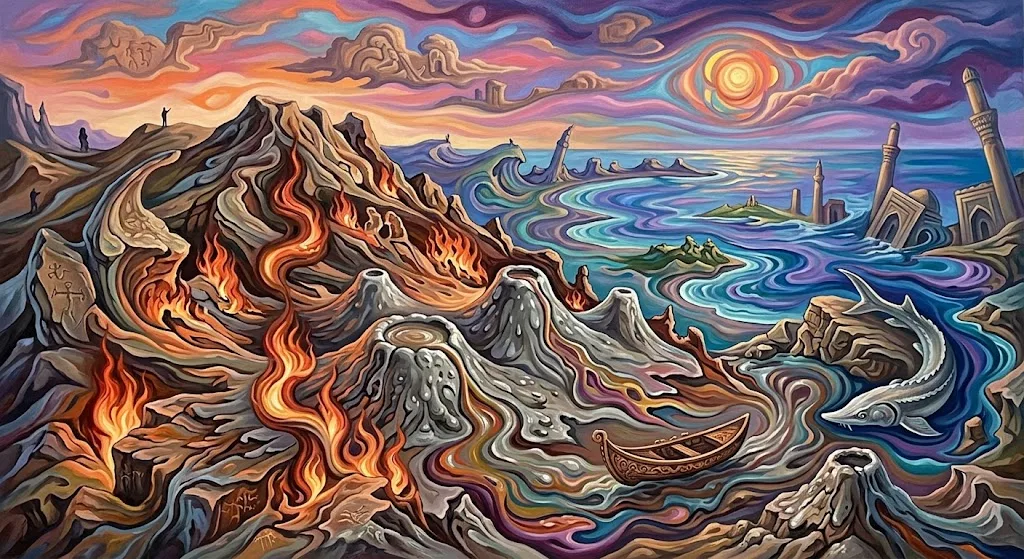
Azerbaijan’s strange-history record is unusually earthy. Its best-known marvels are not ghosts in castles or lake monsters with blurred photographs, but burning hillsides, bubbling mud cones, temporary islands, ancient carvings, Caspian rumours, and the occasional sky report that sits awkwardly between folklore, journalism and military secrecy.
Page outline Jump by section
Introduction
The useful rule for Azerbaijan is simple: many of the strangest reports are real phenomena, but not necessarily paranormal ones. A hill can burn without magic; an island can appear without myth; a “sea monster” can be a Soviet machine, a huge fish, a rumour, or a joke; an unidentified light can remain unidentified without becoming alien. That tension is exactly what gives the country’s weird material its staying power.
Why Azerbaijan feels stranger than its case-file count
Azerbaijan does not have the same heavily commercialised paranormal archive as Britain, the United States or Japan. There are fewer internationally famous haunted houses, fewer mass-circulated monster photographs, and fewer English-language collections of local ghost lore. What it does have is a landscape that constantly supplies uncanny raw material. The Caspian coast, the oil-and-gas fields around Baku, the semi-desert near Gobustan and the active tectonic setting of the South Caucasus create a place where the ground itself behaves oddly.
NASA’s Earth Observatory notes that eastern Azerbaijan and the offshore Caspian contain more than 300 mud volcanoes, linked to tectonic compression and hydrocarbon-rich sediments; these can emit methane and, in some cases, flames. That is a remarkable concentration by any standard, and it explains why many Azerbaijani marvels are not “sightings” in the usual paranormal sense but physical events that look staged by folklore: mud boiling in grey cones, gas burning from rock, and land appearing and vanishing at sea.[NASA Science]science.nasa.govScience Satellites Spot a “Ghost” IslandScience Satellites Spot a “Ghost” Island
This matters for Forteana because the country often reverses the normal pattern. Elsewhere, a strange tale may begin as a witness claim and later seek a physical explanation. In Azerbaijan, the physical explanation is often spectacular enough to become the legend.
The burning mountain: miracle, tourist icon or gas seep?
Yanar Dag, on the Absheron Peninsula near Baku, is the cleanest example of Azerbaijan’s “explained but still uncanny” Forteana. The site is a natural gas fire: hydrocarbon gas seeps through porous rock and burns as a line of flame on the hillside. Accounts commonly describe it as a fire that continues through wind, rain and snow, and the image fits perfectly with Azerbaijan’s branding as the “Land of Fire”.[Wikipedia]WikipediaYanar DaghYanar Dagh
The strange part is not that science lacks an explanation. It is that the explanation leaves the wonder intact. A flame coming directly from the earth looks like a message before it looks like methane. In older religious and travellers’ traditions, natural fires around Absheron could be understood as sacred or numinous; in modern tourism, they become proof that the slogan has geological teeth. The official Ateshgah reserve site similarly frames the nearby fire-temple landscape around natural gas outlets that produced “Eternal Flames”, showing how the same phenomenon can move from sacred geography to heritage attraction.[Ateshgah Temple]ateshgahtemple.azOpen source on ateshgahtemple.az.
The sceptical reading is straightforward: Yanar Dag is not supernatural fire, but a continuing gas seep. The believer’s or romantic reading is subtler: a natural flame can still become spiritually charged when generations treat it as meaningful. Azerbaijan’s Fortean interest lies in that overlap. The country’s fire sites do not need to break the laws of nature to behave like myth.

Ateshgah: the “eternal flame” that became more complicated
The Ateshgah fire temple at Surakhany, near Baku, is one of Azerbaijan’s most revealing strange-history sites because it shows how quickly a simple “ancient fire-worship” story becomes tangled. The present temple complex is generally associated with early modern pilgrimage and trade networks, and the site has been connected with Zoroastrian, Hindu and Sikh worship at different times. Its official reserve description says the temple was revered by Zoroastrians, Hindus and Sikhs and was located where burning natural gas outlets created a distinctive natural phenomenon.[heritage.org.az]heritage.org.azOpen source on heritage.org.az.
The catch is that the famous “eternal” fire was not eternally continuous in the modern period. The temple’s own site says natural gas oozed from the surface there from ancient times until the nineteenth century, while other heritage summaries note that the present flames are maintained rather than simply identical with the old natural vents.[Ateshgah Temple]ateshgahtemple.azOpen source on ateshgahtemple.az.
That does not make Ateshgah fake. It makes it a perfect case of layered authenticity. The building, pilgrimage history and fire symbolism are real. The gas geology is real. The modern flame is part heritage presentation. For readers of strange history, the site is useful precisely because it resists the easy binary of “mystical wonder” versus “tourist fraud”. It is a place where natural anomaly, religious imagination and later curation all occupy the same courtyard.
Mud volcanoes: Azerbaijan’s most reliable weirdness
Mud volcanoes are Azerbaijan’s great contribution to grounded weirdness. Around Gobustan and offshore in the Caspian, mud, water, gas and sediment rise under pressure, forming cones, pools and sometimes dramatic eruptions. NASA describes mud volcanoes as features produced when subsurface pressure forces fluids, gases and sediments to the surface; in Azerbaijan, these are tied to the South Caspian Basin’s hydrocarbon system and can release flammable methane.[NASA Science]science.nasa.govScience Satellites Spot a “Ghost” IslandScience Satellites Spot a “Ghost” Island
To a visitor, the small Gobustan cones can look almost comic: plopping grey bubbles, cold mud, a miniature alien landscape. But the larger system is not harmless theatre. NASA notes that mud-volcano eruptions can expel large amounts of material quickly and may involve flames; past eruptions in the region have reportedly sent towers of flame hundreds of metres high.[NASA Science]science.nasa.govScience Satellites Spot a “Ghost” IslandScience Satellites Spot a “Ghost” Island
This is why Azerbaijani mud volcanoes sit so comfortably inside a Fortean frame. They are:
- Visually uncanny: the landscape looks lunar, diseased or artificial.
- Scientifically real: the mechanism is geological, not supernatural.
- Folklore-ready: bubbling earth and spontaneous fire have obvious myth-making power.
- Still not fully domesticated: even NASA quotes geologist Mark Tingay describing mud volcanoes as “weird and wonderful” and comparatively understudied.[NASA Science]science.nasa.govScience Satellites Spot a “Ghost” IslandScience Satellites Spot a “Ghost” Island
They also connect Azerbaijan to planetary speculation in a sober way. NASA notes that some Martian muddy mounds may have formed through processes resembling mud volcanism, which turns Azerbaijan’s odd terrain into an analogue for interpreting other worlds rather than merely a local curiosity.[NASA Science]science.nasa.govScience Satellites Spot a “Ghost” IslandScience Satellites Spot a “Ghost” Island
The Caspian “ghost island” that really did appear
One of the strongest modern Azerbaijani strange events is the temporary island produced by the Kumani Bank mud volcano, also known as Chigil-Deniz, about 25 kilometres off Azerbaijan’s eastern coast. NASA reported that an island emerged after an eruption in early 2023 and had nearly eroded away by the end of 2024. Landsat 8 and Landsat 9 imagery showed the feature before, during and after its brief life above the Caspian Sea.[NASA Science]science.nasa.govScience Satellites Spot a “Ghost” IslandScience Satellites Spot a “Ghost” Island
The details are beautifully Fortean because they sound like a sailor’s exaggeration but come from satellite observation. The island appears to have emerged between 30 January and 4 February 2023, reached roughly 400 metres across, and then shrank until only a greatly diminished portion remained visible by late 2024. NASA also notes that Kumani Bank has produced transient islands several times since its first recorded eruption in 1861; the 1950 eruption reportedly created an island around 700 metres across and 6 metres high.[NASA Science]science.nasa.govScience Satellites Spot a “Ghost” IslandScience Satellites Spot a “Ghost” Island
The “ghost island” label is irresistible, but the case is not a mystery in the paranormal sense. It is better than that: a documented example of the Earth making a temporary landform and then erasing it. The cultural pull comes from the way it compresses mythic motifs into observable geology. Land rises from the sea, exists briefly, and disappears. In a medieval chronicle, that would be a portent. In 2025, it is a NASA image sequence.
Gobustan: ancient carvings and modern speculation
Gobustan, south-west of Baku, is famous for rock art rather than paranormal claims, but it belongs in Azerbaijan’s strange-history record because ancient images often attract speculative afterlives. UNESCO describes the Gobustan Rock Art Cultural Landscape as containing more than 6,000 engravings across rocky semi-desert terrain, bearing witness to around 40,000 years of rock art, alongside caves, settlements and burials from long periods of human use.[UNESCO World Heritage Centre]whc.unesco.orgWorld Heritage Centre Gobustan Rock Art Cultural LandscapeWorld Heritage Centre Gobustan Rock Art Cultural Landscape
The Fortean temptation is obvious. Rock art invites over-reading: strange figures become “astronauts”, boats become proof of lost migrations, and symbolic scenes become coded astronomy. In Gobustan’s case, the boat engravings have attracted special attention because Norwegian explorer Thor Heyerdahl was interested in possible parallels between Caspian and Scandinavian boat imagery. Azerbaijan International records that Heyerdahl visited Gobustan in 1989 and 1994, drawn by similarities he saw between reed-boat petroglyphs there and boat carvings in Scandinavia.[Azerbaijan International Magazine]azer.comOpen source on azer.com.
The evidence-aware reading is cautious. Gobustan’s carvings are extraordinary archaeological material, not a licence to import every lost-civilisation theory. The carvings matter because they show long human occupation, ritual imagination, animals, movement and social life in a changing landscape. Their strangeness is not that they prove a fringe claim, but that they preserve enough ancient visual thought to keep inviting new stories.
Sky reports over Baku: unidentified does not mean alien
Azerbaijan has occasional UFO-style reports, though the public English-language record is thin. One widely cited modern item came from Today.Az in May 2008: witnesses near the Sahil settlement in Baku’s Qaradagh district reportedly saw an object 500–600 metres over the Caspian Sea, stationary for a time, before it disappeared. The report says witnesses insisted it was not a plane or helicopter, but it provides no instrument data, photographs, radar confirmation or official technical analysis.[Today.az]today.azOpen source on today.az.
A more historically interesting case appears in a declassified CIA information report from 1955, covering an “unconventional aircraft” sighting after a train left Baku for Tiflis. The source, a visiting US national, reported seeing a triangular object at or near an airfield between the railway and the Caspian coast, lit by a searchlight, then launched in a manner he compared to missile ejection. The document itself labels the report “unevaluated information”, which is crucial: it preserves a claim, not a conclusion.[U.S. Department of War]war.govU.S. Department of War CIA-UAP-006U.S. Department of War CIA-UAP-006(https://www.war.gov/medialink/ufo/061226/release_03/documents/CIA-UAP-006_Sighting_of_Unconventional_Aircraft.pdf)
Local scepticism has also appeared. In 2012, Azernews reported that Elchin Babayev, deputy head of the Shamakhi astrophysics observatory, dismissed recent Azerbaijani UFO claims based on amateur photos from Baku, Ganja and Barda, suggesting that people may have seen atmospheric phenomena or man-made devices. He also said local experts had sent information on an odd cloud-related phenomenon to an International Astronomical Union commission.[AzerNews]azernews.azAzer News Azeri expert dismisses reports on UFOsAzer News Azeri expert dismisses reports on UFOs
That mix is typical of credible UFO history: witness reports, ambiguous media items, possible military context, and mundane explanations competing with uncertainty. NASA’s independent UAP study warned that UAP analysis is often hampered by poor sensor calibration, lack of multiple measurements, missing metadata and lack of baseline data; that general caution applies well to Azerbaijan’s public sky cases.[NASA Science]science.nasa.govScience Independent Study Team ReportScience Independent Study Team Report
Caspian monsters: fish, machines and mistaken names
The phrase “Caspian Sea Monster” sounds as though it belongs to cryptozoology, but its best-known meaning is technological. It was the Western nickname for a Soviet ground-effect vehicle, the KM ekranoplan, a vast machine designed to skim low over the water. Popular retellings emphasise how bizarre it looked to Western observers: neither ship nor conventional aircraft, huge, fast and close to the Caspian surface.[Caspian Post]caspianpost.comCaspian Post Does the Caspian Sea Monster Really Exist?Caspian Post Does the Caspian Sea Monster Really Exist?
That does not mean the Caspian lacks monster-making ingredients. The sea has long been associated with sturgeon, including the beluga sturgeon, a huge species found primarily in the Caspian and Black Sea basins and now critically endangered after heavy exploitation for caviar. Large sturgeon are exactly the sort of real animal that can seed water-monster impressions: armoured body, ancient appearance, great size, and a habit of surfacing just enough to be misdescribed.[Wikipedia]WikipediaBeluga (sturgeonBeluga (sturgeon
For Azerbaijan, the more honest “Caspian monster” story is therefore not a single native Loch Ness equivalent. It is a cluster of confusions: a Cold War machine nicknamed a monster, real giant fish that strain ordinary expectations, and the Caspian’s scale encouraging rumours. The sceptical explanation does not flatten the story; it makes it richer. The monster is partly biology, partly military secrecy, partly language.
Folklore beings: where Azerbaijan’s monsters live
Azerbaijani folklore includes supernatural beings drawn from Turkic, Persianate and wider Caucasian traditions. Public summaries of Azerbaijani folklore describe figures such as the hairy forest being sometimes glossed as a “tree man” or “forest man”, the graveyard or wilderness monster often described as a man-eating giant, and the one-eyed monster Tepegoz from the Oghuz epic world of the Book of Dede Korkut.[Wikipedia]WikipediaAzerbaijani folkloreAzerbaijani folklore
This is not cryptozoology in the modern evidence-hunting sense. These beings belong primarily to story, warning, landscape imagination and inherited narrative. The forest man motif, for example, overlaps with wider Caucasian and Eurasian ideas of wild people in the mountains and woods. Tepegoz belongs to epic and mythic structure: the monstrous one-eyed being defeated by cunning rather than brute force.[Wikipedia]WikipediaAzerbaijani folkloreAzerbaijani folklore
The important point is that Azerbaijan’s weird record is not only geological. Folklore supplies a second layer: beings that organise fear around forests, ruins, graveyards, childbirth, wilderness and social danger. These stories should not be treated as field reports of literal creatures, but they are still evidence of how people made the unknown memorable.
Anomalous rains and falls: more absence than archive
Azerbaijan is exactly the sort of place where one might expect old newspaper reports of fish falls, coloured rain or other classic Fortean weather. It borders the Caspian, has strong winds around Baku, and sits within a region where dramatic weather and dust transport can produce strange skies. Yet the easily verifiable English-language record of Azerbaijani animal rains is sparse.
That absence matters. It is better to say the evidence is thin than to pad the page with imported examples from other countries. Animal rains are a known Fortean category, and the Library of Congress gives the standard cautious explanation: strong winds, tornadoes or waterspouts may lift small aquatic animals and drop them elsewhere, although such events are often poorly observed and over-simplified in retelling.[The Library of Congress]loc.govOpen source on loc.gov.
For Azerbaijan, the responsible conclusion is modest. The country has the geography for strange-weather stories, but its strongest documented weirdness lies elsewhere: fire, mud, temporary land, ancient images and ambiguous sky reports. If old Azerbaijani-language newspapers contain local fish-fall or coloured-rain accounts, they would need careful archival checking before becoming part of the country’s reliable strange-history record.
What sceptics and believers each get right
The sceptic is right that Azerbaijan’s major marvels usually have strong natural explanations. Yanar Dag is gas seepage. Ateshgah’s fire history is tied to hydrocarbon vents and later heritage management. The Kumani Bank island was a mud-volcano product. Many UFO reports lack the data needed to separate aircraft, balloons, atmospheric effects, birds, drones, military activity or optical illusions. Mud volcanoes are geology, not portals.
The believer, folklorist or enthusiast of the uncanny is right that explanation does not cancel significance. A natural flame that shapes religious memory is culturally strange. A temporary island that satellites watch appear and vanish is legitimately marvellous. A landscape dense with mud volcanoes, fire sites and prehistoric carvings will inevitably generate stories larger than the mechanisms behind them.
Azerbaijan’s Forteana works best when neither side is allowed to flatten it. The country is not a warehouse of proven paranormal events. Nor is it merely a set of debunked tourist curiosities. It is a place where geology repeatedly produces scenes that folklore would have invented if nature had not got there first.
Why Azerbaijan belongs on the Fortean map
Azerbaijan’s strongest weird-history identity is not built on one definitive mystery but on recurrence. Fire comes from the ground. Mud behaves like a living substance. Islands appear and vanish. Ancient carvings invite speculative retellings. The Caspian offers giant fish, strange machines and horizon effects. The skies produce occasional ambiguous reports, while local scientists urge caution.
That pattern gives Azerbaijan a distinctive place in country-level Forteana. Its mysteries are unusually material. They can be visited, photographed, sampled, mapped and still found uncanny. The most durable stories are not the least explained ones, but the ones where the explanation is itself strange enough: methane that burns like a shrine, mud that builds islands, and a sea that can make both monsters and machines disappear into the same grey distance.
Amazon book picks
Further Reading
Books and field guides related to Why Azerbaijan's Weirdness Starts in the Ground. Use these as the next step if you want deeper reading beyond the article.

Lonely Planet Georgia, Armenia & Azerbaijan
Introduces Azerbaijan's famous natural and historical sites including geological attractions.

Prisoners of geography
Provides geographic context for the Caucasus and the forces shaping Azerbaijan.

Origins: How the Earth Made Us
Explains how geology shapes civilizations and remarkable landscapes.
Origins
First published 2019. Subjects: Human evolution, Human beings, origin, Human beings, Origin, Effect of environment on.
eBay marketplace picks
Marketplace Samples
Live-tested eBay searches with available results related to this page.



Endnotes
1.
Source: Wikipedia
Title: Yanar Dagh
Link:https://en.wikipedia.org/wiki/Yanar_Dagh
2.
Source: science.nasa.gov
Title: Science Satellites Spot a “Ghost” Island
Link:https://science.nasa.gov/earth/earth-observatory/satellites-spot-a-ghost-island-153799/
3.
Source: heritage.org.az
Link:https://www.heritage.org.az/en/tickets/ateshgah-temple-state-historical-architectural-reserve-63870f4272d93
4.
Source: whc.unesco.org
Title: World Heritage Centre Gobustan Rock Art Cultural Landscape
Link:https://whc.unesco.org/en/list/1076/
5.
Source: today.az
Link:https://today.az/news/society/45178.html
6.
Source: war.gov
Title: U.S. Department of War CIA-UAP-006
Link:https://www.war.gov/medialink/ufo/061226/release_03/documents/CIA-UAP-006_Sighting_of_Unconventional_Aircraft.pdf
7.
Source: azernews.az
Title: Azer News Azeri expert dismisses reports on UFOs
Link:https://www.azernews.az/nation/41254.html
8.
Source: science.nasa.gov
Title: Science Independent Study Team Report
Link:https://science.nasa.gov/wp-content/uploads/2023/09/uap-independent-study-team-final-report.pdf
9.
Source: Wikipedia
Title: Beluga (sturgeon)
Link:https://en.wikipedia.org/wiki/Beluga_%28sturgeon%29
10.
Source: Wikipedia
Title: Azerbaijani folklore
Link:https://en.wikipedia.org/wiki/Azerbaijani_folklore
11.
Source: Wikipedia
Title: List of reported UFO sightings
Link:https://en.wikipedia.org/wiki/List_of_reported_UFO_sightings
12.
Source: Wikipedia
Title: Caspian Sea Monster
Link:https://en.wikipedia.org/wiki/Caspian_Sea_Monster
13.
Source: Wikipedia
Title: Unidentified flying object
Link:https://en.wikipedia.org/wiki/Unidentified_flying_object
14.
Source: Wikipedia
Title: Ateshgah of Baku
Link:https://en.wikipedia.org/wiki/Ateshgah_of_Baku
15.
Source: Wikipedia
Title: Div (mythology)
Link:https://en.wikipedia.org/wiki/Div_%28mythology%29
16.
Source: Wikipedia
Title: Gobustan Rock Art Cultural Landscape
Link:https://en.wikipedia.org/wiki/Gobustan_Rock_Art_Cultural_Landscape
17.
Source: Wikipedia
Title: Rain of animals
Link:https://en.wikipedia.org/wiki/Rain_of_animals
18.
Source: Wikipedia
Title: Black January
Link:https://en.wikipedia.org/wiki/Black_January
19.
Source: Wikipedia
Title: NASA Unidentified Anomalous Phenomena Independent Study Team
Link:https://en.wikipedia.org/wiki/NASA_Unidentified_Anomalous_Phenomena_Independent_Study_Team
20.
Source: Wikipedia
Title: Göygöl (lake)
Link:https://en.wikipedia.org/wiki/G%C3%B6yg%C3%B6l_%28lake%29
21.
Source: science.nasa.gov
Title: a school of mud volcano islands in azerbaijan
Link:https://science.nasa.gov/earth/earth-observatory/a-school-of-mud-volcano-islands-in-azerbaijan/
22.
Source: science.nasa.gov
Link:https://science.nasa.gov/uap/
23.
Source: science.nasa.gov
Link:https://science.nasa.gov/uap/faqs/
24.
Source: war.gov
Title: dod examining unidentified anomalous phenomena
Link:https://www.war.gov/News/News-Stories/Article/Article/3965403/dod-examining-unidentified-anomalous-phenomena/
25.
Source: whc.unesco.org
Link:https://whc.unesco.org/en/list/1076/gallery/
26.
Source: whc.unesco.org
Link:https://whc.unesco.org/en/tentativelists/1172/
27.
Source: today.az
Title: UF O spotted over Baku
Link:https://today.az/news/interesting/117973.html
28.
Source: azernews.az
Link:https://www.azernews.az/region/111499.html
29.
Source: azerbaijan.travel
Link:https://azerbaijan.travel/be-inspired-lake-goygol
30.
Source: cia.gov
Link:https://www.cia.gov/readingroom/document/0005516000
31.
Source: unesco.az
Link:https://www.unesco.az/en/articles/material_cultural_heritage/qobustan
32.
Source: folklore.ee
Link:https://folklore.ee/folklore/sites/default/files/2026-04/Folklore98_web.pdf
33.
Source: azerbaijan.az
Link:https://azerbaijan.az/en/related-information/166
34.
Source: youtube.com
Title: The fire Mountains near Baku Azerbaijan
Link:https://www.youtube.com/watch?v=94FpouGLJYg
Source snippet
Gobustan Rock Art - Azerbaijan...
35.
Source: youtube.com
Title: Gobustan Rock Art
Link:https://www.youtube.com/watch?v=v9wWCq3_uBY
Source snippet
Ateshgah Fire Temple || Baku || Azerbaijan...
36.
Source: ateshgahtemple.az
Link:https://ateshgahtemple.az/en/
37.
Source: azer.com
Link:https://www.azer.com/aiweb/categories/magazine/62_folder/62_articles/62_gobustan.html
38.
Source: caspianpost.com
Title: Caspian Post Does the Caspian Sea Monster Really Exist?
Link:https://caspianpost.com/stories/does-the-caspian-sea-monster-really-exist
39.
Source: loc.gov
Link:https://www.loc.gov/everyday-mysteries/browse-all-questions/item/can-it-rain-frogs-fish-and-other-objects/
40.
Source: oldcity.tours
Link:https://www.oldcity.tours/thing-to-do/attractions/gobustan
41.
Source: youtube.com
Link:https://www.youtube.com/watch?v=V2xVSmzPzW4
42.
Source: youtube.com
Link:https://www.youtube.com/watch?v=hygprPFVv0k
43.
Source: odysseytraveller.com
Title: ateshgah fire temple
Link:https://www.odysseytraveller.com/articles/ateshgah-fire-temple/
44.
Source: caspianpost.com
Title: powerful mud volcano erupts in gobustan azerbaijan
Link:https://caspianpost.com/environment/powerful-mud-volcano-erupts-in-gobustan-azerbaijan
45.
Source: caspianpost.com
Title: nasa satellites spot a ghost island in caspian sea
Link:https://caspianpost.com/regions/nasa-satellites-spot-a-ghost-island-in-caspian-sea
46.
Source: mfa.gov.az
Title: a glance at the tragedy of 20 january 1990
Link:https://www.mfa.gov.az/en/news/a-glance-at-the-tragedy-of-20-january-1990
Published: january 1990
47.
Source: mud-volcanoes.heritage.org.az
Link:https://mud-volcanoes.heritage.org.az/en
48.
Source: baku-ih.gov.az
Link:https://baku-ih.gov.az/en/bloody-memories.html
Additional References
49.
Source: usgs.gov
Link:https://www.usgs.gov/faqs/what-largest-freshwater-fish
50.
Source: federalregister.gov
Link:https://www.federalregister.gov/documents/2002/07/31/02-19250/endangered-and-threatened-wildlife-and-plants-listing-the-beluga-sturgeon-huso-huso-as-endangered
51.
Source: youtube.com
Title: Amazing MUD VOLCANOES & Qobustan | Azerbaijan Travel Vlog
Link:https://www.youtube.com/watch?v=7nNrNLrn9u0
Source snippet
The Explosive Mud Volcanoes of Azerbaijan; Some are 1,000 Ft Tall...
52.
Source: instagram.com
Link:https://www.instagram.com/reel/DPFFX01k26Q/?hl=en
53.
Source: reddit.com
Link:https://www.reddit.com/r/interestingasfuck/comments/5ehblm/the_caspian_sea_monster_this_one_of_a_kind/
54.
Source: x.com
Link:https://x.com/azerbaijan/status/1087359618886467586
55.
Source: academia.edu
Link:https://www.academia.edu/48803103/Dragon_in_Chinese_and_Azerbaijani_mythology
56.
Source: researchgate.net
Link:https://www.researchgate.net/publication/376891986_A_global_picture_of_unidentified_anomalous_phenomena_Towards_a_cross-cultural_understanding_of_a_potentially_universal_issue
57.
Source: researchgate.net
Link:https://www.researchgate.net/publication/362845940_The_Caspian_Sea_and_Its_Values_in_Azerbaijan
58.
Source: atlasobscura.com
Link:https://www.atlasobscura.com/lists/gravity-hills
Topic Tree
Follow this branch
Related pages 192
- Afghan Forteana
- Antigua Uncanny
- Bosnian Mysteries
- Botswana Weird
- Brazil Strange
- +187 more in sidebar