Why Bhutan's Strange Stories Still Have Power
Bhutan’s strange-history record is not best understood as a parade of isolated “hauntings” or monster yarns. Its strongest Fortean material sits where mountain ecology, Buddhist sacred geography, oral tradition and occasional modern anomaly reports overlap.
Page outline Jump by section
Why Bhutan’s weird history starts with the land
In much Western Forteana, the “case” is often a witness report: a light in the sky, a footprint, a thing seen at the edge of a road. Bhutan has those edges too, but its stranger material often begins with territory. Anthropologist Françoise Pommaret describes the local idea of territory as more than a mapped area: it can mean village, home, fields, pasture, forest and mountain, with the mountain sometimes serving as the seat or identity of a territorial deity. That matters because many Bhutanese uncanny accounts are not simply “something odd happened”; they are explanations of why a place is powerful, dangerous, protected or ritually sensitive.[Cambridge University Repository]repository.cam.ac.ukOpen source on cam.ac.uk.
This gives Bhutanese Forteana a different flavour from a modern ghost-hunter itinerary. Strange events may be remembered as signs that a local deity has been angered, that a sacred rule has been broken, or that a saint subdued a harmful force at a particular site. Pommaret records examples in which local people attributed a 1996 glacial lake outburst and flash flood to the anger of a territorial deity, linked a river shrine with flood prevention, and explained frequent road accidents in one south-western jungle region as revenge by a local power after older offerings ceased. These are not scientific explanations, but they are valuable evidence for how hazard, landscape and invisible agency are joined in local memory.[Cambridge University Repository]repository.cam.ac.ukOpen source on cam.ac.uk.
The same pattern appears in everyday rural concerns. Territorial deities are described as protectors or punishers of water, cattle, crops and social order; rituals may mark agricultural stages, and mediums or intercessors may be called on when a household or community faces disturbance. For a Fortean reader, the key point is not that such beings can be verified as entities. It is that Bhutan preserves a strong record of “active landscape” thinking: mountains, rivers, lakes and roads are treated as morally charged places where misfortune can be read as more than chance.[Cambridge University Repository]repository.cam.ac.ukOpen source on cam.ac.uk.
The migoi: Bhutan’s yeti with a local accent
The migoi is Bhutan’s great mystery animal, but it is not merely a borrowed version of the better-known Himalayan yeti. Kunzang Choden’s Bhutanese Tales of the Yeti gathers twenty-two stories from four regions of Bhutan and presents the migoi as part of the “backdrop” of Bhutanese existence rather than a simple zoological puzzle. The book description notes recurring motifs familiar from wider yeti lore: a creature that can appear in tangible form, vanish suddenly, and possess supernatural powers such as invisibility.[Google Books]books.google.comBooks Bhutanese Tales of the YetiBooks Bhutanese Tales of the Yeti
The strongest cultural anchor for the migoi is the eastern highland world of Merak and Sakteng. Bhutan’s UNESCO tentative-list entry for Sakteng Wildlife Sanctuary describes a 740.60 square kilometre protected area in eastern Bhutan, rich in rhododendrons, red panda, Himalayan black bear, musk deer, snow leopard and other fauna. It also notes that the local Brokpa communities maintain distinct traditions, and that the annual Merak and Sakteng festival includes a prominent yeti dance. In the same entry, the locals are said to “boast of the much debated and mythical Yeti”.[UNESCO World Heritage Centre]whc.unesco.orgWorld Heritage Centre Sakteng Wildlife Sanctuary (SWSWorld Heritage Centre Sakteng Wildlife Sanctuary (SWS
That combination is what makes the migoi so interesting. It lives simultaneously in folklore, festival performance, conservation storytelling and tourist imagination. A sceptic can read the migoi as a composite of bear encounters, high-altitude fear, misread tracks, taboo places and oral embellishment. A believer may see it as a shy, powerful being whose elusiveness is the point. Either way, the migoi has a stronger cultural footprint than evidential footprint: the best records show a living tradition, not a confirmed unknown animal.
Scientific testing has also pushed the discussion towards known animals. A 2014 genetic study of hair samples attributed to yeti, bigfoot and similar creatures reported that two Himalayan samples, one from Ladakh and one from Bhutan, had their closest affinity with an ancient polar bear lineage. That intriguing result did not settle the matter. A later Royal Society discussion of more extensive work says the 2017 study refuted the earlier interpretation and strongly suggested that the biological basis of the yeti legend lies in local brown and black bears rather than an unknown hominid or mystery bear species.[Royal Society Publishing]royalsocietypublishing.orgOpen source on royalsocietypublishing.org.
For country-level Forteana, this does not make the migoi dull. It makes it better. The migoi is a textbook case of how a cryptid can remain culturally alive even when the physical evidence leans towards misidentification. Bhutan’s version is not only “is there an animal?” but “why does this animal-shaped absence organise stories, trails, dances and protected landscapes?”
Sacred sites where miracle and memory become geography
Bhutan’s most famous uncanny places are not hidden ruins with shaky witness statements. They are active pilgrimage and heritage sites where miraculous origin stories help explain why a location matters.
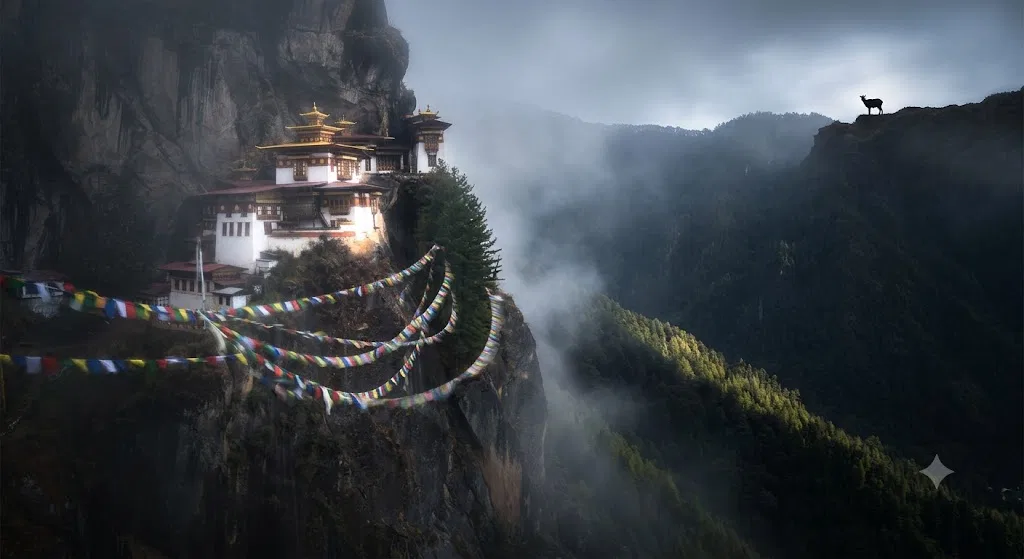
Paro Taktsang, better known as the Tiger’s Nest, is the clearest example. The legend says Guru Rinpoche chose a cave on a sheer rock face, arrived astride a tigress, assumed a wrathful form and subdued harmful spirits in the locality. The site later became one of the great sacred places of Himalayan Buddhism, with the current complex associated with later temple-building, fire damage and reconstruction. The Fortean interest here is not whether a flying tigress can be treated as literal reportage. It is that Bhutan’s best-known landmark is framed by a story of flight, animal transformation, spirit-subduing and treasure-concealment.[Druk Asia]drukasia.comDruk Asia Tiger's Nest Monastery: Everything You Need to KnowDruk Asia Tiger's Nest Monastery: Everything You Need to Know
Mebar Tsho, the Burning Lake in Bumthang, is another strong case. Its legend centres on Pema Lingpa, a revered treasure revealer, who is said to have dived into the lake holding a burning butter lamp and emerged with sacred treasures while the lamp still burned. The story is explicitly about proof: sceptical villagers demanded evidence, and the miracle established the site’s authority. Today the lake remains a pilgrimage location marked by prayer flags, offerings and beliefs about blessings or healing.[bhutantravelog.com]bhutantravelog.comThe Sacred Legend of Mebar Tsho: Bhutan's Burning Lake ExplainedThe Sacred Legend of Mebar Tsho: Bhutan's Burning Lake Explained
Chimi Lhakhang, the fertility temple in Punakha, adds a more earthy and humorous strand. The temple’s own site identifies it as a sacred Buddhist temple visited by newly married and childless couples seeking fertility blessings. It links the place to Drukpa Kunley, the “Divine Madman”, and explains that phallic symbols painted on homes or placed near doorways are traditionally believed to ward off evil spirits. For outsiders this can look like comic shock value; within the tradition, it is protective, fertility-linked and bound to an unconventional saint whose legend uses irreverence as spiritual force.[chimilhakhang.com]chimilhakhang.comChimi Lhakhang WebsiteChimi Lhakhang Website
Chendebji Chorten in Trongsa gives the demon-subduing motif a more architectural form. The local district administration describes the 18th-century stupa as modelled after Nepal’s Boudhanath Stupa and says it was built to subdue evil spirits, on the spot where the head of a powerful demon was believed to have been buried. The monument’s strangeness lies in how physical construction and invisible containment merge: the building is not merely commemorative, but protective.[trongsa.gov.bt]trongsa.gov.btChendebji Chorten – Dzongkhag Administration, TrongsaChendebji Chorten – Dzongkhag Administration, Trongsa
Taken together, these sites show why Bhutan’s weird geography is unusually legible. The supernatural claim is often inseparable from the reason people go there, maintain rituals there, behave respectfully there, or tell stories about the surrounding landscape.
The 1968 western Bhutan UFO report
Bhutan’s most concrete modern sky-anomaly item is a declassified intelligence report covering sightings of unidentified flying objects over Ladakh, Nepal, Sikkim and Bhutan between 19 February and 25 March 1968. The document is valuable because it is not a later internet rumour: it is an official information report, however garbled the scanned text may be. It lists “bright objects” seen over South Ladakh, north-east Nepal, north Sikkim and western Bhutan.[U.S. Department of War]war.govU.S. Department of War CIA-UAP-016U.S. Department of War CIA-UAP-016(https://www.war.gov/medialink/ufo/061226/release_03/documents/CIA-UAP-016-Sightings_of_Unidentified_Flying_Ojbects_in_Ladakh_Nepal_Sikkim_and_Bhutan.pdf)
The Bhutan entry is dated 21 February 1968 at 21:30 over “Thimpu”, now more commonly written Thimphu. The object is described as following a circular path and leaving a smoke trail. The report also comments on the direction: while east-to-west is listed, it notes that due east of Thimphu lay Indian territory and suggests the path may instead have been from the north-east to the south-west, from the direction of Tibet.[U.S. Department of War]war.govU.S. Department of War CIA-UAP-016U.S. Department of War CIA-UAP-016(https://www.war.gov/medialink/ufo/061226/release_03/documents/CIA-UAP-016-Sightings_of_Unidentified_Flying_Ojbects_in_Ladakh_Nepal_Sikkim_and_Bhutan.pdf)
This is a good example of a case that should be kept strange but not inflated. “Unidentified” in an intelligence report means unidentified at the time of reporting, not extraterrestrial. The surrounding entries include bright, fast-moving objects, smoke or light trails, thunder-like sounds and cross-border timing that could fit several mundane possibilities: meteors, rocket or missile activity, high-altitude aircraft, re-entering debris, or confused reports of the same event seen from different places. The document itself even notes confusion in one Sikkim-related entry and tries to reconcile directions by comparing reports over Nepal and Sikkim.[U.S. Department of War]war.govU.S. Department of War CIA-UAP-016U.S. Department of War CIA-UAP-016(https://www.war.gov/medialink/ufo/061226/release_03/documents/CIA-UAP-016-Sightings_of_Unidentified_Flying_Ojbects_in_Ladakh_Nepal_Sikkim_and_Bhutan.pdf)
Its Fortean value is therefore archival rather than sensational. Bhutan appears in a Cold War-era regional sky mystery, recorded by an intelligence bureaucracy that was interested enough to preserve the report but not able, on the page, to provide a settled explanation.

What is missing: fish rains, lake monsters and tabloid hauntings
One useful finding is negative: Bhutan does not have the same well-attested public record of classic Fortean staples found in some other countries. There is no strong, widely cited Bhutanese equivalent of a recurring “rain of fish”, no famous national lake monster with a deep newspaper trail, and no single ghost case that has become an internationally documented psychical-research file. That absence should not be filled with padding.
Instead, Bhutan’s weird record is strongest in four areas:
- Mystery animal tradition: the migoi, especially in oral literature and the Merak-Sakteng cultural landscape.
- Sacred geography: lakes, cliffs, stupas and temples whose origin stories involve miracles, demons, spirit-subduing or hidden treasures.
- Local spirit causality: misfortunes such as flood, drought, disease, cattle loss or accidents interpreted through territorial deities and ritual breach.
- Archival sky anomaly: the 1968 declassified report that includes western Bhutan among several Himalayan UFO sightings.
This makes Bhutan less of a “casebook country” and more of a “landscape of charged stories”. The evidence rarely looks like laboratory proof or police documentation. It looks like ethnography, pilgrimage practice, official heritage descriptions, literary preservation of oral tales, and one or two modern archival oddities.
How to read Bhutanese Forteana without flattening it
The main mistake is to force Bhutan’s material into a simple true-or-false paranormal frame. A migoi tale is not just a failed zoological report if no unknown animal is found; it may also preserve herding fears, forest boundaries, encounters with bears, rules about wilderness and a sense of the more-than-human. A demon-subduing stupa is not just “proof people believed in demons”; it is a public monument to the idea that dangerous places can be ritually pacified. A lake miracle is not only an impossible claim; it is a story about authority, doubt, revelation and the making of a pilgrimage site.
The sceptical reading is still essential. Genetic evidence points yeti claims towards known Himalayan bears. Sacred-site legends are not neutral historical reports. The 1968 UFO document records descriptions, not explanations. Local accounts of angry deities causing floods or accidents should not replace geology, weather, road safety or animal disease as practical explanations. But the believer’s reading also deserves accurate representation: within these traditions, the world is not divided neatly into natural scenery and supernatural decoration. Rivers, cliffs, animals, weather and human behaviour belong to one moral landscape.
That is why Bhutan matters in country-level Forteana. Its strange record is not especially rich in modern monster hunts or spectacular hoaxes. It is richer, and more distinctive, as a study of how a Himalayan Buddhist country remembers uncertainty: through a yeti that may be bear and more-than-bear, lights that remain archived but unresolved, and places where miracles are built into the way the land is named, visited and feared.
Amazon book picks
Further Reading
Books and field guides related to Why Bhutan's Strange Stories Still Have Power. Use these as the next step if you want deeper reading beyond the article.
Bhutan: A Kingdom in the Himalayas
Covers Bhutanese culture, religion and sacred geography.
eBay marketplace picks
Marketplace Samples
Live-tested eBay searches with available results related to this page.



Endnotes
1.
Source: books.google.com
Title: Books Bhutanese Tales of the Yeti
Link:https://books.google.com/books/about/Bhutanese_Tales_of_the_Yeti.html?id=J_xPDwAAQBAJ
2.
Source: whc.unesco.org
Title: World Heritage Centre Sakteng Wildlife Sanctuary (SWS)
Link:https://whc.unesco.org/en/tentativelists/5701/
3.
Source: war.gov
Title: U.S. Department of War CIA-UAP-016
Link:https://www.war.gov/medialink/ufo/061226/release_03/documents/CIA-UAP-016-Sightings_of_Unidentified_Flying_Ojbects_in_Ladakh_Nepal_Sikkim_and_Bhutan.pdf
4.
Source: bhutantravelog.com
Title: The Sacred Legend of Mebar Tsho: Bhutan’s Burning Lake Explained
Link:https://www.bhutantravelog.com/travel-guide/the-sacred-legend-of-mebar-tsho-bhutans-burning-lake-explained
5.
Source: chimilhakhang.com
Title: Chimi Lhakhang Website
Link:https://www.chimilhakhang.com/
6.
Source: trongsa.gov.bt
Title: Chendebji Chorten – Dzongkhag Administration, Trongsa
Link:https://trongsa.gov.bt/chendebji-chorten/
7.
Source: sites.google.com
Title: guru padmasambhava
Link:https://sites.google.com/education.gov.bt/phuentshog-wangdi/viii-history/bhutan-history/chapter-1-buddhism/guru-padmasambhava
8.
Source: nbc.gov.bt
Link:https://nbc.gov.bt/news/bhutan-biodiversity-portal-workshops-conducted-at-sakteng-wildlife-sanctuary-and-sherubtse-college/
9.
Source: bhutan.travel
Link:https://bhutan.travel/
10.
Source: bhutan.travel
Link:https://bhutan.travel/journal/editorial/a-winter-s-tale
11.
Source: media.nationalarchives.gov.uk
Link:https://media.nationalarchives.gov.uk/index.php/ufo-files-released-in-july-2012/
12.
Source: repository.cam.ac.uk
Link:https://www.repository.cam.ac.uk/bitstreams/07a35b51-2c30-4a69-ba8e-02d8215778d4/download
13.
Source: royalsocietypublishing.org
Link:https://royalsocietypublishing.org/rspb/article/281/1789/20140161/77194/Genetic-analysis-of-hair-samples-attributed-to
14.
Source: royalsociety.org
Title: Royal Society Mysteries of the yeti | Royal Society
Link:https://royalsociety.org/blog/2017/11/mysteries-of-the-yeti/
15.
Source: drukasia.com
Title: Druk Asia Tiger’s Nest Monastery: Everything You Need to Know
Link:https://www.drukasia.com/bhutan/paro/taktsang-monastery/
16.
Source: Wikipedia
Link:https://en.wikipedia.org/wiki/Bhutan
17.
Source: Wikipedia
Link:https://en.wikipedia.org/wiki/Yeti
18.
Source: Wikipedia
Title: Sakteng Wildlife Sanctuary
Link:https://en.wikipedia.org/wiki/Sakteng_Wildlife_Sanctuary
19.
Source: Wikipedia
Title: Chendebji Chorten
Link:https://en.wikipedia.org/wiki/Chendebji_Chorten
20.
Source: royalsocietypublishing.org
Link:https://royalsocietypublishing.org/rspb/article/284/1868/20171804/78775/Evolutionary-history-of-enigmatic-bears-in-the
21.
Source: biodiversity.bt
Title: Sakteng Wildlife Sanctuary
Link:https://biodiversity.bt/group/Sakteng_Wildlife_Sanctuary
22.
Source: biodiversity.bt
Title: Sakteng Wildlife Sanctuary
Link:https://biodiversity.bt/group/Sakteng_Wildlife_Sanctuary/observation/list
23.
Source: heavenlybhutan.com
Title: Chendebji Chorten in Trongsa
Link:https://www.heavenlybhutan.com/sightseeing-places-of-bhutan/places-to-visit-in-trongsa/chendebji-chorten/
24.
Source: tripadvisor.com
Title: Burning Lake
Link:https://www.tripadvisor.com/Attraction_Review-g469426-d3140537-Reviews-Burning_Lake-Bumthang_Bumthang_District.html
25.
Source: northbengaltourism.com
Title: chimi lhakhang
Link:https://northbengaltourism.com/chimi-lhakhang/
26.
Source: atlasobscura.com
Title: chendebji chorten
Link:https://www.atlasobscura.com/places/chendebji-chorten
27.
Source: shs.hal.science
Link:https://shs.hal.science/halshs-00717941/document
28.
Source: elifthereader.com
Title: Bhutanese Tales of the Yeti
Link:https://elifthereader.com/books/bhutanese-tales-of-the-yeti-kunzang-choden/
29.
Source: cia.gov
Link:https://www.cia.gov/readingroom/docs/CIA-RDP81R00560R000100070007-8.pdf
30.
Source: cia.gov
Link:https://www.cia.gov/readingroom/document/cia-rdp81r00560r000100070007-8
31.
Source: drukasia.com
Title: chhime lhakhang
Link:https://www.drukasia.com/bhutan/bhutan-landmarks/chhime-lhakhang/
32.
Source: madraswanderer.blogspot.com
Title: Chendebji Chorten
Link:https://madraswanderer.blogspot.com/2016/06/chendebji-chorten-bhutan-memories.html
33.
Source: documents3.theblackvault.com
Link:https://documents3.theblackvault.com/documents/UFOFiles/pdf/CIA-UAP-016-Sightings_of_Unidentified_Flying_Ojbects_in_Ladakh_Nepal_Sikkim_and_Bhutan.pdf
34.
Source: himalaya2000.com
Title: Sakteng Wildlife Sanctuary
Link:https://www.himalaya2000.com/bhutan/wildlife-sanctuaries/sakteng.html
35.
Source: andbeyond.com
Link:https://www.andbeyond.com/experiences/asia/bhutan/punakha/chimi-lhakhang-fertility-temple/
36.
Source: abebooks.co.uk
Title: Bhutanese Tales of the Yeti
Link:https://www.abebooks.co.uk/9789748496870/Bhutanese-Tales-Yeti-Choden-Kunzang-9748496872/plp
37.
Source: donein90seconds.substack.com
Title: bhutanese tales of the yeti
Link:https://donein90seconds.substack.com/p/bhutanese-tales-of-the-yeti
Additional References
38.
Source: mufon.com
Link:https://mufon.com/research/
39.
Source: researchgate.net
Link:https://www.researchgate.net/publication/321361263_Evolutionary_history_of_enigmatic_bears_in_the_Tibetan_Plateau-Himalaya_region_and_the_identity_of_the_yeti
40.
Source: researchgate.net
Link:https://www.researchgate.net/publication/322519965_Imagining_the_Wild_Man_Yeti_Sightings_in_Folktales_and_Newspapers_of_the_Darjeeling_and_Kalimpong_Hills
41.
Source: facebook.com
Link:https://www.facebook.com/bhutanbroadcastingservice/posts/call-it-a-hoax-or-miracle-bhutan-has-many-tales-about-spirits-and-deities-the-ap/4041045762576563/
42.
Source: spyscape.com
Link:https://spyscape.com/article/alien-hoaxes-that-went-viral
43.
Source: facebook.com
Link:https://www.facebook.com/bhutanbroadcastingservice/posts/%F0%9D%97%9A%F0%9D%97%BF%F0%9D%97%B2%F0%9D%97%AE%F0%9D%98%81-%F0%9D%97%AC%F0%9D%97%B2%F0%9D%98%81%F0%9D%97%B6-%F0%9D%97%A4%F0%9D%98%82%F0%9D%97%B2%F0%9D%98%80%F0%9D%98%81-%F0%9D%97%99%F0%9D%97%B2%F0%9D%98%80%F0%9D%98%81%F0%9D%97%B6%F0%9D%98%83%F0%9D%97%AE%F0%9D%97%B9-%F0%9D%97%BF%F0%9D%97%B2%F0%9D%98%83%F0%9D%97%B6%F0%9D%98%83%F0%9D%97%B2%F0%9D%98%80-%F0%9D%97%A6%F0%9D%97%AE%F0%9D%97%B8%F0%9D%98%81%F0%9D%97%B2%F0%9D%97%BB%F0%9D%97%B4%F0%9D%98%80-%F0%9D%97%BF%F0%9D%97%AE%F0%9D%97%BF%F0%9D%97%B2-%F0%9D%97%B5%F0%9D%97%BC%F0%9D%98%82%F0%9D%98%80%F0%9D%97%B2-%F0%9D%97%B0%F0%9D%97%BC%F0%9D%97%BB%F0%9D%98%80%F0%9D%97%B2%F0%9D%97%B0%F0%9D%97%BF%F0%9D%97%AE%F0%9D%98%81%F0%9D%97%B6%F0%9D%97%BC%F0%9D%97%BB-%F0%9D%98%81%F0%9D%97%BF%F0%9D%97%AE%F0%9D%97%B1%F0%9D%97%B6%F0%9D%98%81%F0%9D%97%B6%F0%9D%97%BC%F0%9D%97%BBalth/1660285029102818/
44.
Source: instagram.com
Link:https://www.instagram.com/popular/bhutan-ghost-stories/
45.
Source: amazon.nl
Link:https://www.amazon.nl/-/en/Kunzang-Choden-ebook/dp/B00HBIV756?tag=searcht-20
46.
Source: amazon.com
Link:https://www.amazon.com/Bhutanese-Tales-Yeti-Kunzang-Choden-ebook/dp/B00HBIV756?tag=searcht-20
47.
Source: academia.edu
Link:https://www.academia.edu/Documents/in/Bhutanese_folklore
Topic Tree
Follow this branch
Related pages 192
- Afghan Forteana
- Antigua Uncanny
- Bosnian Mysteries
- Botswana Weird
- Brazil Strange
- +187 more in sidebar