Why Does Bulgaria's Weird History Feel So Layered?
Bulgaria’s strange-history record is not one single mystery but a busy borderland: village rites meant to frighten off evil, medieval graves altered to stop the dead returning, a Cold War-era state that tried to manage a famous seer, a post-communist military dig guided by psychics, and lake-monster stories carried by tourism, folklore and local pride.
Page outline Jump by section
Introduction
The strongest Bulgarian Fortean material falls into three broad types. Some of it is ritual and folklore with good documentation, such as masked winter processions, fire-walking and vampire beliefs. Some is modern mystery culture, especially the Tsarichina Hole and the afterlife of Baba Vanga. Some is local oddity and newspaper lore, such as the Rabisha Lake water bull or mass sightings of bright objects in the sky. The interesting question is not “which of these is supernatural?” but why these stories stuck, what evidence survives, and how ordinary social anxieties became marvellously strange.
Why Bulgaria’s weird record feels unusually layered
Bulgaria sits at a cultural crossroads: Slavic, Balkan, Orthodox Christian, Ottoman-era, socialist and post-socialist histories overlap in a relatively small landscape. That matters for Forteana because strange reports rarely arrive in a vacuum. A “vampire” burial is not just a spooky skeleton; it is an archaeological trace of older ideas about death, pollution and social danger. A masked dancer with bells is not just a monster costume; it is part of a living seasonal rite. A psychic consulted by state institutions during socialism is not merely a tabloid curiosity; she reveals how official modernity and popular belief can coexist.
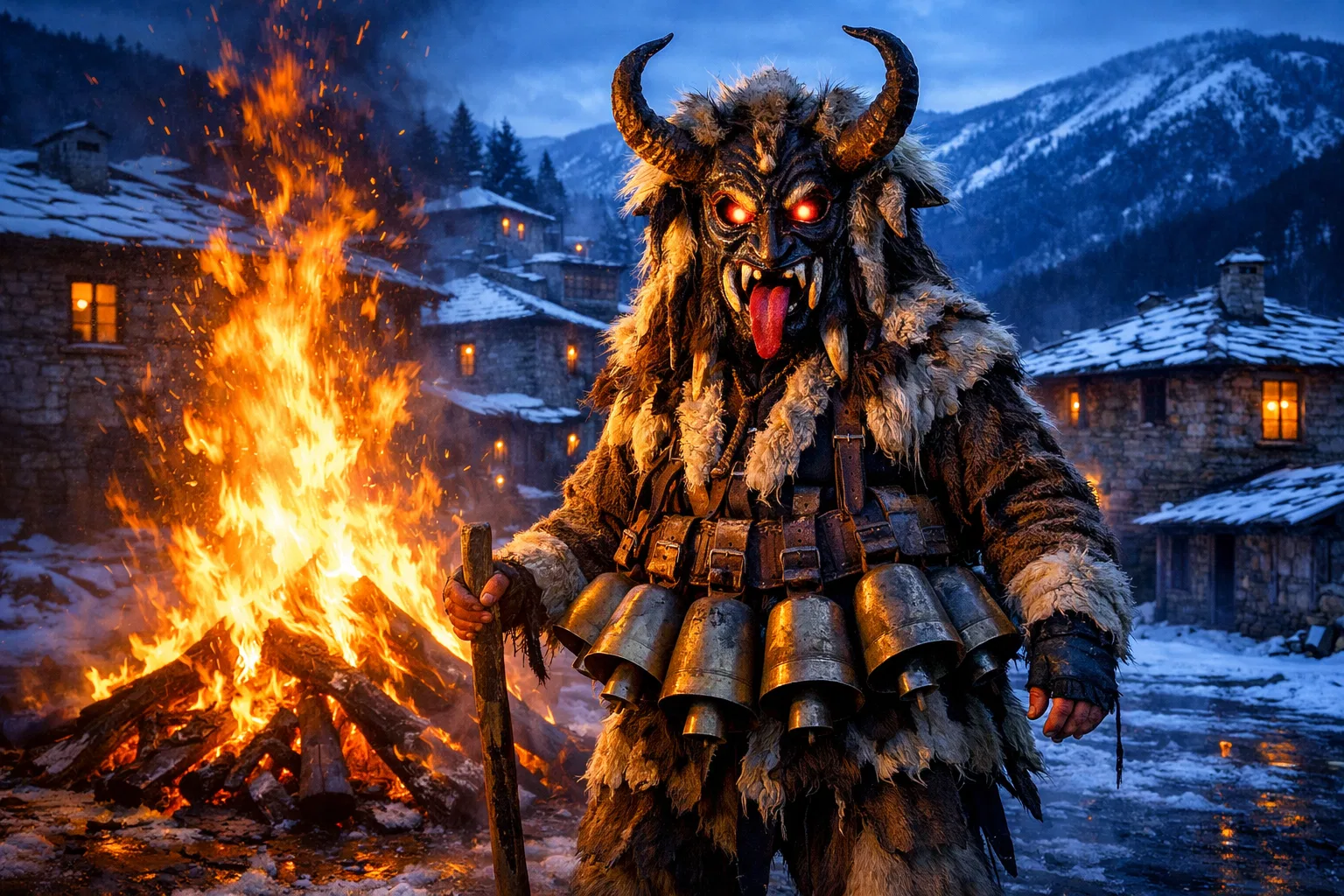
The country’s best-attested strange traditions are therefore not hidden in fringe archives. They are in UNESCO files, archaeological reports, national radio features, museum stories, tourism pages and the living calendar of villages and mountain gatherings. The evidence is uneven, but it is often more substantial than the usual ghost-story fog. UNESCO lists the Surova masquerade tradition in the Pernik region as intangible cultural heritage, describing masked groups who visit houses in winter, with masks, bells and ritual noise used to drive away evil and encourage fertility and good fortune.[UNESCO ICH]ich.unesco.orgOpen source on unesco.org.
That does not make every supernatural interpretation true. It does make Bulgaria a particularly good case study in how the uncanny survives in public culture without needing to hide. The strange is not always an interruption of everyday life; sometimes it is scheduled, rehearsed, costumed, photographed and proudly placed on a festival programme.
Masked monsters that became cultural heritage
The most visible Bulgarian “monster” tradition is not a cryptid in a lake or a beast glimpsed on a lonely road. It is the winter masquerader: a human figure made deliberately more-than-human by bells, skins, horns, huge masks and ritual movement. In the Pernik region, Surova groups take part around the old New Year period, and the practice is now formally recognised by UNESCO as a living tradition transmitted through families and local communities.[UNESCO ICH]ich.unesco.orgOpen source on unesco.org.
For a Fortean reader, the key point is that these figures work on several levels at once. They are performers, neighbours, ritual specialists, comic monsters and symbolic guardians. The fright is not accidental. The clangour of bells and the grotesque mask turn the familiar village body into something liminal: part animal, part ancestor, part demon, part joke. That is exactly the kind of ambiguity in which folklore thrives.
The modern Surva festival in Pernik has also turned village practice into a public spectacle. The Federation of European Carnival Cities describes the International Festival of Masquerade Games in Pernik as a major manifestation of masked folk games in Bulgaria and the Balkans, with roots in local customs and an organised festival history beginning in the 1960s.[Federation of European Carnival Cities]carnivalcities.netOpen source on carnivalcities.net. This shift matters because it shows how old apotropaic rites — practices meant to ward off harm — can become tourism, heritage and identity without losing their uncanny visual force.
Sceptically, nobody needs to believe that the dancers literally repel demons to understand the tradition’s power. The rite creates a controlled encounter with fear at the dark hinge of the year. Believers may read it as protection; ethnographers may read it as seasonal renewal; visitors may read it as spectacular folklore. All three readings can coexist.

Fire-walking and the problem of “miracle” without melodrama
Bulgaria’s fire-walking tradition, usually discussed under the name Nestinarstvo, is one of the country’s most striking examples of a practice that looks miraculous but is embedded in a precise ritual frame. UNESCO describes the rite as the climax of an annual feast connected with Saints Constantine and Helena in the village of Bulgari, with fire-dancing forming part of a wider ritual complex rather than a stunt isolated from belief and community.[UNESCO ICH]ich.unesco.orgOpen source on unesco.org.
This distinction is important. In sensational retellings, fire-walking often becomes a challenge to physics: how can bare feet cross embers? But within the tradition, the heat is only one part of the event. There are icons, music, procession, feast days, memory, village identity and a sense that the dancers enter an altered ritual state. Bulgaria’s Telegraphic Agency noted that the Nestinarstvo rite was inscribed on UNESCO’s Representative List of the Intangible Cultural Heritage of Humanity in 2009 under its official heritage title linked to the village of Bulgari.[BTA]bta.bgOpen source on bta.bg.
Scientific explanations of fire-walking usually point to factors such as brief contact time, ash insulation, the thermal properties of embers and careful movement. Those explanations can reduce the need for paranormal claims, but they do not make the rite culturally uninteresting. The Fortean fascination lies in the gap between the external observer’s “how is that possible?” and the participant’s “this is how our community remembers, honours and renews itself”.
Bulgaria’s fire-walking is therefore not best treated as a sideshow. It is a living example of how extraordinary bodily acts can remain meaningful without needing to be framed as either fake or supernatural.
Vampires with iron, ploughshares and archaeology
Bulgaria’s vampire lore has unusually concrete evidence because some beliefs about the restless dead left marks on graves. In 2012, archaeologists at Sozopol on the Black Sea coast reported medieval skeletons pierced with iron rods, interpreted as anti-vampire measures meant to prevent the dead from rising. Radio Free Europe/Radio Liberty covered the discovery with the crucial caveat: these were not “real vampires”, but remains treated according to beliefs about dangerous revenants.[RadioFreeEurope/RadioLiberty]rferl.orgOpen source on rferl.org.
A later National Geographic report described a 700-year-old suspected vampire burial in Bulgaria with a rod through the ribs and teeth removed, again pointing to ritual treatment rather than evidence for the undead.[National Geographic]nationalgeographic.com120724 vampire skeleton toothless bulgaria science120724 vampire skeleton toothless bulgaria science Similar finds at Perperikon in southern Bulgaria extended the pattern: Bulgarian National Radio reported another “vampire” grave in which a metal ploughshare had been driven into the body, with archaeologist Nikolai Ovcharov comparing it to the Sozopol case.[BNR News]bnrnews.bgarchaeologists discover a second vampire grave in the necropolis of perperikonarchaeologists discover a second vampire grave in the necropolis of perperikon
What makes these cases valuable is that they connect folklore to material culture. The iron rod or ploughshare is not a ghost story. It is an object placed in or through a corpse, apparently by people who thought the dead might remain socially dangerous. The University of Virginia thesis on Bulgarian vampire belief argues that the folkloric vampire could function as a scapegoat for calamity in village life, which helps explain why suspicion might attach to certain dead people in times of illness, misfortune or social tension.[libraetd.lib.virginia.edu]libraetd.lib.virginia.eduOpen source on virginia.edu.
The sceptical reading is straightforward: the graves show belief in vampires, not vampires themselves. Yet that is exactly why they are so strong as country-level Forteana. They prove that the fear was real enough to shape burial practice. Bulgaria’s vampire material is not just literary Gothic imported through Dracula; it is local, physical and socially revealing.
Baba Vanga and the politics of prophecy
No Bulgarian figure has had a larger modern afterlife in prophecy culture than Baba Vanga, the blind seer associated with Petrich and Rupite. She became famous during the socialist period and remained widely known after her death in 1996, especially in Bulgaria, Russia and parts of Eastern Europe. Academic Galia Valtchinova’s work on Vanga examines her role in everyday life under socialism, including the striking fact that state-linked institutions produced records around consultations with a clairvoyant in the 1960s and 1970s.[Berghahn Journals]berghahnjournals.comOpen source on berghahnjournals.com.
That is more interesting than the annual tabloid lists of “Baba Vanga predictions”. The common internet version of Vanga is a rolling machine of retrofitted forecasts: disasters, wars, elections, pandemics and technological threats are repeatedly attributed to her after the fact. Snopes notes that there are no written records of her predictions sufficient to verify many modern claims, while recent reporting citing researcher Viktoria Vitanova-Kerber makes the same point: much of what circulates now comes from unverifiable memories, family claims or later media construction.[Snopes]snopes.commystic predicts end timesmystic predicts end times
The believer’s view is that Vanga had genuine extraordinary perception, especially in personal consultations. The sceptical view is that ambiguous statements, retrospective interpretation, selective memory and posthumous myth-making explain much of her reputation. A fair reading must separate these layers. Vanga was certainly culturally important. She was certainly visited by many people. She certainly became a symbolic figure in Bulgarian and post-Soviet spiritual imagination. None of that proves the accuracy of the specific “predictions for next year” lists that circulate online.
For Bulgaria’s weird-history record, Vanga matters because she shows how prophecy can become a national export. Her story links village healing, socialist bureaucracy, Orthodox unease, post-communist media and contemporary clickbait. She is less useful as a calendar of the future than as a case study in how societies remember charismatic uncertainty.
The Tsarichina Hole: Bulgaria’s post-communist “Area 51”
If Baba Vanga is Bulgaria’s most famous seer, the Tsarichina Hole is its strangest modern state-backed mystery. The basic claim is remarkable enough without embellishment: in the village of Tsarichina near Sofia, the Bulgarian military undertook a secretive excavation in the early 1990s, reportedly influenced by psychics and shifting expectations of treasure, hidden knowledge or non-human remains. Later accounts commonly call the project “Operation Sunray” or “Operation Lightbeam”, depending on translation.[vagabond.bg]vagabond.bgbulgarian x files 4600bulgarian x files 4600
The hard outline is clearer than the wilder legends. Vagabond, a Bulgarian magazine that has repeatedly covered the case sceptically, reports that the dig was terminated in November 1992, by which time it had produced a shaft about 70 metres deep and a tunnel about 160 metres long; the site was sealed and the documentation associated with the excavation was destroyed.[vagabond.bg]vagabond.bgland fake mysteries 1809land fake mysteries 1809 A 2025 Army Media article, written from within Bulgaria’s military media environment, discusses meetings with Colonel Tsvetko Kanev, one of the key figures in the operation, and refers to his book-length account of the “Tsarichina phenomenon”.[armymedia.bg]armymedia.bgза царичина безпристрастноза царичина безпристрастно
The claims layered on top of that outline are much harder to verify. They include rumours of extraterrestrial beings, ancient messages, hostile invisible forces, psychically received symbols and state concealment. A 2025 article in 168 Chasa reported that then Defence Minister Aleksandar Staliyski ordered the operation stopped on 4 November 1992 and that around 16 million leva had been wasted, before concrete was poured into the hole.[168chasa.bg]168chasa.bgOpen source on 168chasa.bg. Those figures and details belong to the Bulgarian media record, but the extraordinary claims remain poorly evidenced.
What makes Tsarichina endure is the setting. The early 1990s in Bulgaria were a period of institutional uncertainty after the collapse of communism. A secret military dig guided by esoteric claims is almost too perfect a metaphor: old state structures, new media freedom, economic crisis, psychic language and national myth all descending into the ground together. Sceptics see waste, rumour and bureaucratic embarrassment. Believers see a sealed forbidden site. Culturally, both readings helped create the myth.

Lights in the sky: Venus, airfields and archive oddities
Bulgaria’s UFO record is less internationally famous than Tsarichina, but it contains a few useful examples of how sky phenomena become social events. A Project Blue Book file concerns a sighting near Uzundzhovo Airfield in August 1957, when a foreign military officer reportedly observed a lighted object for around 30 minutes while searchlights tracked it. The case survives because the US Air Force’s Project Blue Book records were declassified and transferred to the US National Archives.[govweird]govweird.comuzundzhovo bulgaria august 1957 28971276uzundzhovo bulgaria august 1957 28971276
A more domestic example came in late December 1978, when residents in Sofia, Vratsa and Pleven regions reported unusual luminous objects. A Bulgarian Telegraph Agency archive piece, republished in 2025, says the official explanation at the time was that people had been observing Venus, which was especially bright.[BTA]bta.bgUnidentified Aerial Phenomena Reported across BulgariaUnidentified Aerial Phenomena Reported across Bulgaria
Venus is a classic UFO-maker. It is bright, low on the horizon at certain times, capable of seeming to “follow” observers, and easily misjudged when seen through haze, cloud, windscreen glass or urban anxiety. That does not mean every reported light is Venus, nor that witnesses are foolish. It means sky perception is fragile, especially when many people are primed by rumours or press coverage.
For Bulgaria, the UFO material matters less as a catalogue of alien craft than as a reminder that the sky is a public theatre. A bright planet, an airfield, military searchlights or a Cold War rumour can turn ordinary observation into collective uncertainty. The Bulgarian cases sit comfortably beside international UFO history, but their local flavour comes from the country’s political atmosphere, language networks and later appetite for “Bulgarian X-files”.
The water bull of Rabisha Lake
Rabisha Lake, near Magura Cave and the Belogradchik Rocks in north-western Bulgaria, has been promoted in some media as home to a Bulgarian counterpart of the Loch Ness Monster. Bulgarian National Radio reported in 2010 that residents around Rabisha claimed an enormous mysterious creature lived in the lake’s depths, while tourism retellings often present it as a water bull or minotaur-like being rather than a long-necked dinosaur.[Old News BNR]old-news.bnr.bgmysterious monster inhabits bulgarian rabisha lake near belogradchikmysterious monster inhabits bulgarian rabisha lake near belogradchik
The setting helps the story. Magura Cave is already one of Bulgaria’s great prehistoric sites, with official tourism pages describing ancient wall paintings of people, animals, hunting, dancing, stars and symbols, made with bat guano and dating across prehistoric periods.[tourism.government.bg]tourism.government.bgOpen source on government.bg. Nearby Belogradchik is famous for red rock formations sculpted by natural forces over more than 200 million years, a landscape almost designed to attract legends.[Visit Bulgaria]visitbulgaria.comVisit Bulgaria The Belogradchik Cliffs – A Natural WonderVisit Bulgaria The Belogradchik Cliffs – A Natural Wonder
The water-bull story is therefore not just a lake-monster claim; it belongs to a whole mythic landscape of caves, rocks, prehistoric imagery and local tourism. Sceptically, there is no strong zoological evidence for an unknown large animal in Rabisha Lake. The more likely ingredients are folklore, exaggerated fish stories, the dramatic setting and the global template of “local Nessie” reporting.
Yet the legend is still useful. It shows how international monster language can attach to older local motifs. Loch Ness gives journalists a shorthand; the Bulgarian water bull gives the story its regional character. The result is neither pure invention nor proven cryptid, but a modernised lake legend with roots in place.
Mountain mysticism and the White Brotherhood
Not all Bulgarian high strangeness is about monsters, ghosts or anomalous objects. Some of it is visionary religion in public landscape. The Universal White Brotherhood, founded by the Bulgarian spiritual teacher Peter Deunov, gathers followers in the Rila Mountains for ritual movement, prayer and a “divine new year” observance. Radio Free Europe/Radio Liberty reported in 2023 that thousands of followers camp high in the Rila Mountains each August, with the movement tracing its roots to a society founded by Deunov in 1897.[RadioFreeEurope/RadioLiberty]rferl.orgRadio Free Europe/Radio Liberty With Bulgaria's White BrotherhoodRadio Free Europe/Radio Liberty With Bulgaria's White Brotherhood
Reuters reported in 2025 that hundreds of followers, barefoot and dressed in white, gathered near Kidney Lake at 2,280 metres above sea level, describing the movement as combining forms of Christianity with Indian mysticism and aiming to connect participants with cosmic energy.[Reuters]reuters.comHundreds celebrate 'divine new year' near Bulgarian mountain lakeHundreds celebrate 'divine new year' near Bulgarian mountain lake
The Fortean interest here is not that the White Brotherhood is “paranormal” in the monster-hunting sense. It is that Bulgaria has a living, landscape-based esoteric tradition whose public ritual can look startling to outsiders: white-clad circles moving in synchrony beside alpine lakes. It belongs to the same broader category as prophecy movements, visionary healing and cosmic reinterpretations of Christianity.
A grounded account should also avoid romanticising everything. RFE/RL notes that Deunov’s writings include references to race that are uncomfortable to modern readers, while followers today often stress harmony, light and unity.[RadioFreeEurope/RadioLiberty]rferl.orgRadio Free Europe/Radio Liberty With Bulgaria's White BrotherhoodRadio Free Europe/Radio Liberty With Bulgaria's White Brotherhood That tension is part of the story: visionary movements can be beautiful, sincere, historically layered and ideologically complicated all at once.
What is thin, exaggerated or easily misunderstood?
Bulgaria’s weird record is rich, but not every claimed anomaly is equally well supported. The most reliable material tends to be either ritual heritage, archaeology or documented media history. The weakest material tends to be anonymous internet retellings, recycled “prediction” lists, podcast embellishments and claims that cite vanished secret files without enough independent corroboration.
A useful credibility scale looks like this:
Strong cultural evidence: Surva masquerades, Nestinarstvo, vampire beliefs and the White Brotherhood gatherings are well supported as cultural practices or belief traditions. Their supernatural interpretations remain matters of belief, but the practices themselves are documented.[unesco.org]ich.unesco.orgOpen source on unesco.org.
Strong evidence of belief, not of monsters: The Sozopol and Perperikon burials show that some people feared revenants enough to alter graves. They do not show that revenants existed.[RadioFreeEurope/RadioLiberty]rferl.orgOpen source on rferl.org.
Documented mystery with weak extraordinary proof: Tsarichina clearly involved an unusual military excavation. The alien, ancient-being and psychic-symbol claims are much less secure than the fact of the dig itself.[vagabond.bg]vagabond.bgbulgarian x files 4600bulgarian x files 4600
Likely misidentification or folklore amplification: The 1978 sky reports officially explained as Venus and the Rabisha Lake monster both fit familiar patterns: ordinary stimuli or local motifs amplified by public attention.[BTA]bta.bgUnidentified Aerial Phenomena Reported across BulgariaUnidentified Aerial Phenomena Reported across Bulgaria
Highly unstable modern media claims: Baba Vanga’s annual future predictions are especially vulnerable to retrofitting. The more specific and convenient the claim, the more caution it deserves unless it can be traced to a dated, reliable record from before the event.[Snopes]snopes.commystic predicts end timesmystic predicts end times
This does not make the Bulgarian material less interesting. It makes it more readable. The country’s Forteana is strongest when treated as a record of human uncertainty: fear of the dead, hope for healing, fascination with hidden knowledge, and the old need to put bells, fire, symbols or stories between ourselves and whatever feels dangerous.
Why Bulgaria’s strange stories still travel
Bulgaria’s Fortean appeal comes from the way its stories bridge the ancient and the modern. A masked winter dancer could belong to deep seasonal ritual or to a tourist’s phone video. A medieval “vampire” burial can sit in an archaeology report and still feel like a Hammer horror image. A socialist-era seer can become a twenty-first-century internet oracle. A failed military excavation can become a national joke, a conspiracy site and a film premise.
That portability explains why Bulgarian weird history travels beyond Bulgaria. It offers strong images: bells and horns in winter streets, bare feet over embers, iron in a ribcage, a sealed shaft in a village, white circles by mountain lakes, a supposed beast in a lake beneath prehistoric cave art. Each image is vivid enough to survive translation.
The fairest conclusion is that Bulgaria is not a land where the supernatural has been proven. It is a land where the boundary between official culture and strange belief has often been unusually visible. Its mysteries are best approached with a lantern in one hand and a pinch of salt in the other: not to spoil the wonder, but to see the tracks more clearly.


eBay marketplace picks
Marketplace Samples
Live-tested eBay searches with available results related to this page.




Endnotes
1.
Source: ich.unesco.org
Link:https://ich.unesco.org/en/RL/surova-folk-feast-in-pernik-region-00968
2.
Source: ich.unesco.org
Link:https://ich.unesco.org/en/RL/nestinarstvo-messages-from-the-past-the-panagyr-of-saints-constantine-and-helena-in-the-village-of-bulgari-00191
3.
Source: bta.bg
Link:https://www.bta.bg/en/news/archives/977900-september-30-2009-nestinarstvo-fire-dancing-rite-inscribed-on-unesco-represent
4.
Source: libraetd.lib.virginia.edu
Link:https://libraetd.lib.virginia.edu/public_view/n583xv419
5.
Source: snopes.com
Title: mystic predicts end times
Link:https://www.snopes.com/fact-check/mystic-predicts-end-times/
6.
Source: vagabond.bg
Title: bulgarian x files 4600
Link:https://vagabond.bg/bulgarian-x-files-4600
7.
Source: vagabond.bg
Title: land fake mysteries 1809
Link:https://www.vagabond.bg/land-fake-mysteries-1809
8.
Source: armymedia.bg
Title: за царичина безпристрастно
Link:https://armymedia.bg/2025/03/22/%D0%B7%D0%B0-%D1%86%D0%B0%D1%80%D0%B8%D1%87%D0%B8%D0%BD%D0%B0-%D0%B1%D0%B5%D0%B7%D0%BF%D1%80%D0%B8%D1%81%D1%82%D1%80%D0%B0%D1%81%D1%82%D0%BD%D0%BE/
9.
Source: 168chasa.bg
Link:https://www.168chasa.bg/article/19804357
10.
Source: govweird.com
Title: uzundzhovo bulgaria august 1957 28971276
Link:https://www.govweird.com/topics/ufo/project-blue-book/uzundzhovo-bulgaria-august-1957-28971276
Published: august 1957
11.
Source: archives.gov
Title: National Archives Project BLUE BOOK
Link:https://www.archives.gov/research/military/air-force/ufos
12.
Source: bta.bg
Title: Unidentified Aerial Phenomena Reported across Bulgaria
Link:https://www.bta.bg/en/news/archives/1035595-unidentified-aerial-phenomena-reported-across-bulgaria-in-late-1978
13.
Source: old-news.bnr.bg
Title: mysterious monster inhabits bulgarian rabisha lake near belogradchik
Link:https://old-news.bnr.bg/en/post/100101415/mysterious-monster-inhabits-bulgarian-rabisha-lake-near-belogradchik
14.
Source: tourism.government.bg
Link:https://www.tourism.government.bg/en/tourist-destinations/2795/5671
15.
Source: reuters.com
Title: Hundreds celebrate ‘divine new year’ near Bulgarian mountain lake
Link:https://www.reuters.com/lifestyle/hundreds-celebrate-divine-new-year-near-bulgarian-mountain-lake-2025-08-19/
16.
Source: ich.unesco.org
Link:https://ich.unesco.org/en/video/944
17.
Source: archaeology.wiki
Title: bulgarian vampire featured on national geographic
Link:https://www.archaeology.wiki/blog/2012/09/18/bulgarian-vampire-featured-on-national-geographic/
18.
Source: archaeology.wiki
Title: ‘Vampire grave’ found in Perperikon
Link:https://www.archaeology.wiki/blog/2014/10/14/vampire-grave-found-perperikon/
19.
Source: ich.unesco.org
Link:https://ich.unesco.org/en/decisions/4.COM/13.05
20.
Source: vagabond.bg
Title: white brotherhood dances 4280
Link:https://vagabond.bg/white-brotherhood-dances-4280
21.
Source: vagabond.bg
Title: mystery was not there 4968
Link:https://vagabond.bg/mystery-was-not-there-4968
22.
Source: vampires.com
Title: bulgarian vampire makes national geographics 2012 top 10
Link:https://www.vampires.com/bulgarian-vampire-makes-national-geographics-2012-top-10/
23.
Source: tourism.government.bg
Link:https://www.tourism.government.bg/en/tourist-destinations/2795/5644
24.
Source: bta.bg
Link:https://www.bta.bg/en/news//101838-Former-National-History-Museum-Director-Bozhidar-Dimitrov-Dies
25.
Source: old-news.bnr.bg
Link:https://old-news.bnr.bg/en/post/101692824/mai?page_1_3=10
26.
Source: carnivalcities.net
Link:https://carnivalcities.net/countries/bulgaria/pernik/
27.
Source: rferl.org
Link:https://www.rferl.org/a/bulgaria-vampires-skeletons/24605679.html
28.
Source: nationalgeographic.com
Title: 120724 vampire skeleton toothless bulgaria science
Link:https://www.nationalgeographic.com/science/article/120724-vampire-skeleton-toothless-bulgaria-science
29.
Source: bnrnews.bg
Title: archaeologists discover a second vampire grave in the necropolis of perperikon
Link:https://bnrnews.bg/en/post/116698/archaeologists-discover-a-second-vampire-grave-in-the-necropolis-of-perperikon
30.
Source: berghahnjournals.com
Link:https://www.berghahnjournals.com/downloadpdf/journals/aspasia/3/1/asp030106.pdf
31.
Source: visitbulgaria.net
Title: Visit Bulgariathe Water Bull of the Rabisha Lake
Link:https://www.visitbulgaria.net/en/belogradchik/media-coverages/20100702/rabisha_lake_monster.html
32.
Source: visitbulgaria.com
Title: Visit Bulgaria The Belogradchik Cliffs – A Natural Wonder
Link:https://visitbulgaria.com/the-belogradchik-cliffs-a-natural-wonder/
33.
Source: rferl.org
Title: Radio Free Europe/Radio Liberty With Bulgaria’s White Brotherhood
Link:https://www.rferl.org/a/bulgaria-white-brotherhood-ceremony-rila-paneurhythmy/32562654.html
34.
Source: reddit.com
Title: The Tsarichina hole
Link:https://www.reddit.com/r/mrballen/comments/11ierzp/the_tsarichina_hole_the_most_mysterious_event_in/
35.
Source: Wikipedia
Link:https://en.wikipedia.org/wiki/Tsarichina
36.
Source: Wikipedia
Title: Surva Festival
Link:https://en.wikipedia.org/wiki/Surva_Festival
37.
Source: Wikipedia
Title: Baba Vanga
Link:https://en.wikipedia.org/wiki/Baba_Vanga
38.
Source: Wikipedia
Title: Project Blue Book
Link:https://en.wikipedia.org/wiki/Project_Blue_Book
39.
Source: Wikipedia
Title: Magura Cave
Link:https://en.wikipedia.org/wiki/Magura_Cave
40.
Source: Wikipedia
Title: Universal White Brotherhood
Link:https://en.wikipedia.org/wiki/Universal_White_Brotherhood
41.
Source: visitbulgaria.com
Link:https://visitbulgaria.com/international-festival-of-masquerade-games-surva-town-of-pernik/
42.
Source: visitbulgaria.com
Link:https://visitbulgaria.com/memorial-temple-st-petka-of-bulgaria-village-of-rupite/
43.
Source: visitbulgaria.com
Link:https://visitbulgaria.com/the-magura-cave-the-rabisha-cave/
44.
Source: facebook.com
Link:https://www.facebook.com/groups/1740784232924840/posts/2854616214874964/
45.
Source: facebook.com
Title: The Tsarichina Hole
Link:https://www.facebook.com/groups/highlightmoviescapture/posts/1233736061003068/
46.
Source: tripadvisor.com
Title: Belogradchik Rocks
Link:https://www.tripadvisor.com/Attraction_Review-g1061549-d11955883-Reviews-Belogradchik_Rocks-Belogradchik_Vidin_Province.html
47.
Source: tripadvisor.com
Link:https://www.tripadvisor.com/Attraction_Review-g969270-d4040802-Reviews-Rupite-Petrich_Blagoevgrad_Province.html
48.
Source: bnrnews.bg
Title: Vampires in Bulgarian folklore
Link:https://bnrnews.bg/en/post/136210/bulgarian-folklore-abounds-in-protective-rituals-and-measures-against-vampires
49.
Source: bnrnews.bg
Title: the surva tradition is more vibrant than ever in bulgarias pernik region
Link:https://bnrnews.bg/en/post/413003/the-surva-tradition-is-more-vibrant-than-ever-in-bulgarias-pernik-region
50.
Source: bnrnews.bg
Title: the white brotherhood to welcome the divine new year at seven rila lakes
Link:https://bnrnews.bg/en/post/11947/the-white-brotherhood-to-welcome-the-divine-new-year-at-seven-rila-lakes
51.
Source: youtube.com
Link:https://www.youtube.com/watch?v=w1bpRkvaBNk
52.
Source: berghahnjournals.com
Link:https://www.berghahnjournals.com/view/journals/aspasia/3/1/asp030106.xml
53.
Source: scribd.com
Title: Baba Vanga
Link:https://www.scribd.com/document/572758476/Baba-Vanga-Google-Search
54.
Source: nationalgeographic.com
Title: 130715 vampire archaeology burial exorcism anthropology grave
Link:https://www.nationalgeographic.com/adventure/article/130715-vampire-archaeology-burial-exorcism-anthropology-grave
55.
Source: visitbulgaria.net
Title: Magura Cave The Rabisha lake: Next to the cave is the Rabisha Lake
Link:https://www.visitbulgaria.net/en/vidin/articles/magura_cave.html
56.
Source: visitbulgaria.net
Title: The Rabisha lake
Link:https://www.visitbulgaria.net/en/vidin/press-releases/20080425/rabisha_lake.html
57.
Source: thehistoryblog.com
Link:https://www.thehistoryblog.com/archives/17515
58.
Source: bulgaria-guide.com
Link:https://www.bulgaria-guide.com/guide/Belogradchik/207340/
59.
Source: imdb.com
Title: Baba Vanga
Link:https://www.imdb.com/name/nm9204589/bio/
60.
Source: oldeuropeanculture.blogspot.com
Title: water bull
Link:https://oldeuropeanculture.blogspot.com/2019/03/water-bull.html
61.
Source: knowbulgaria.com
Title: magura cave
Link:https://knowbulgaria.com/destinations/magura-cave/
62.
Source: travellingbulgaria.com
Link:https://travellingbulgaria.com/belogradchik
63.
Source: timokdanubecycling.org
Title: rabisha lake
Link:https://timokdanubecycling.org/attractions/rabisha-lake/
Additional References
64.
Source: youtube.com
Title: Inside Bulgaria’s Skinwalker Ranch | The Tsarichina Hole
Link:https://www.youtube.com/watch?v=7SEo8a4XxpA
Source snippet
How a Bulgarian Village Dances Evil Spirits Away | Kukeri...
65.
Source: kathyreichs.com
Link:https://kathyreichs.com/vampire-grave-in-bulgaria-holds-a-skeleton-with-a-stake-through-its-heart/
66.
Source: facebook.com
Link:https://www.facebook.com/groups/1594874740727867/posts/1849417835273555/
67.
Source: researchgate.net
Link:https://www.researchgate.net/publication/304315096_Data_from_a_five_year_monitoring_on_Green_frogs_Pelophylax_esculentus_complex_at_the_Black_sea_coast_of_north_Bulgaria
68.
Source: researchgate.net
Link:https://www.researchgate.net/publication/357203201_Masquerade_Games_in_the_Pernik_Region_of_Bulgaria_Preserving_and_Promoting_Intangible_Cultural_Heritage
69.
Source: fakti.bg
Link:https://fakti.bg/en/bulgaria/1024279-december-30-1978-unidentified-flying-objects-disturb-bulgarians-from-sofia-vratsa-and-pleven-regions
70.
Source: researchgate.net
Link:https://www.researchgate.net/publication/240805675_Between_Ordinary_Pain_and_Extraordinary_Knowledge_The_Seer_Vanga_in_the_Everyday_Life_of_Bulgarians_during_Socialism_1960s-1970s
71.
Source: researchgate.net
Link:https://www.researchgate.net/publication/366231907_multidisciplinary_study_of_anti-vampire_burials_from_early_medieval_Culmen_Poland_were_the_diseased_and_disabled_regarded_as_vampires
72.
Source: history.co.uk
Link:https://www.history.co.uk/articles/predictions-baba-vanga-got-wrong
73.
Source: reddit.com
Link:https://www.reddit.com/r/ArtefactPorn/comments/1baounv/700yearold_vampire_skeleton_in_bulgariaseen_at/
Topic Tree
Follow this branch
Related pages 192
- Afghan Forteana
- Antigua Uncanny
- Bosnian Mysteries
- Botswana Weird
- Brazil Strange
- +187 more in sidebar